The 2015 Yao Family Wines investor deck presents a compelling case for a celebrity-backed luxury brand that has already achieved significant market validation. With $8 million in wine sold within its first 39 months, the company demonstrates that it is more than a vanity project; it is a functional business with established distribution through Pernod Ricard China. The deck focuses heavily on the macro-opportunity of the Chinese middle class, which was projected to reach 625 million by 2025. By positioning imported wine as a status symbol, the brand seeks to transition into direct-to-consumer…
Key takeaways
- The company achieved $8 million in wine sales within its first 39 months of operation (Slide 3).
- Product pricing is tiered for luxury, ranging from $50/bottle for 'Napa Crest' to $625/bottle for the 'Family Reserve' (Slide 2).
- Target production for the flagship 'Napa Crest' red blend is set at 10,000 cases per year (Slide 2).
- The Chinese middle class was projected to grow from 310 million in 2010 to 625 million by 2025 (Slide 4).
- Imported wine in China grew from 6 million cases in 2008 to 31 million cases in 2013 (Slide 4).
- Distribution in China is anchored by Pernod Ricard, which holds a 44% market share in imported spirits (Slide 6).
- Direct-to-consumer (DTC) sales are identified as generating 2x the revenue of sales to distributors (Slide 7).
- Future plans include physical tasting rooms in both Napa and Shanghai to build a loyal mailing list (Slide 7).
Executive Summary
The Yao Family Wines investor deck from March 2015 is a study in celebrity brand extension. Unlike many celebrity-backed ventures that rely solely on a name, this deck provides evidence of significant commercial traction, citing $8 million in sales over a 39-month period. The strategy is built on a 'bridge' model: sourcing high-quality Napa Valley grapes and selling them to a Chinese market that views imported luxury goods as essential status symbols. The deck emphasizes the transition from wholesale to high-margin direct-to-consumer (DTC) channels, a standard move for luxury brands seeking to own their customer data and increase profitability.
Slide 1: Title Slide
The title slide is minimalist, featuring the company logo—a red seal-style icon—and the brand name in a classic serif font. It clearly states 'Investor Deck - March 2015.' The imagery of autumn vineyard leaves reinforces the agricultural and 'terroir' aspects of the business, immediately distancing the brand from a purely commercial or 'fast-moving consumer goods' feel. It sets a tone of heritage and luxury.
Slide 2: The Wines
This slide establishes the product hierarchy and pricing strategy. It showcases three distinct labels: Yao Ming Family Reserve Cabernet Sauvignon ($625/btl, 250 cases/year), Yao Ming Napa Valley Cabernet Sauvignon ($150/btl, 2,000 cases/year), and Napa Crest Napa Valley Red Blend ($50/btl, 10,000 cases/year). By presenting these side-by-side, the company demonstrates a 'halo' effect strategy: the ultra-exclusive $625 bottle builds the brand's prestige, while the $50 'Napa Crest' provides the volume necessary for scale. The target production numbers suggest a controlled, scarcity-based growth model.
Slide 3: The Mission
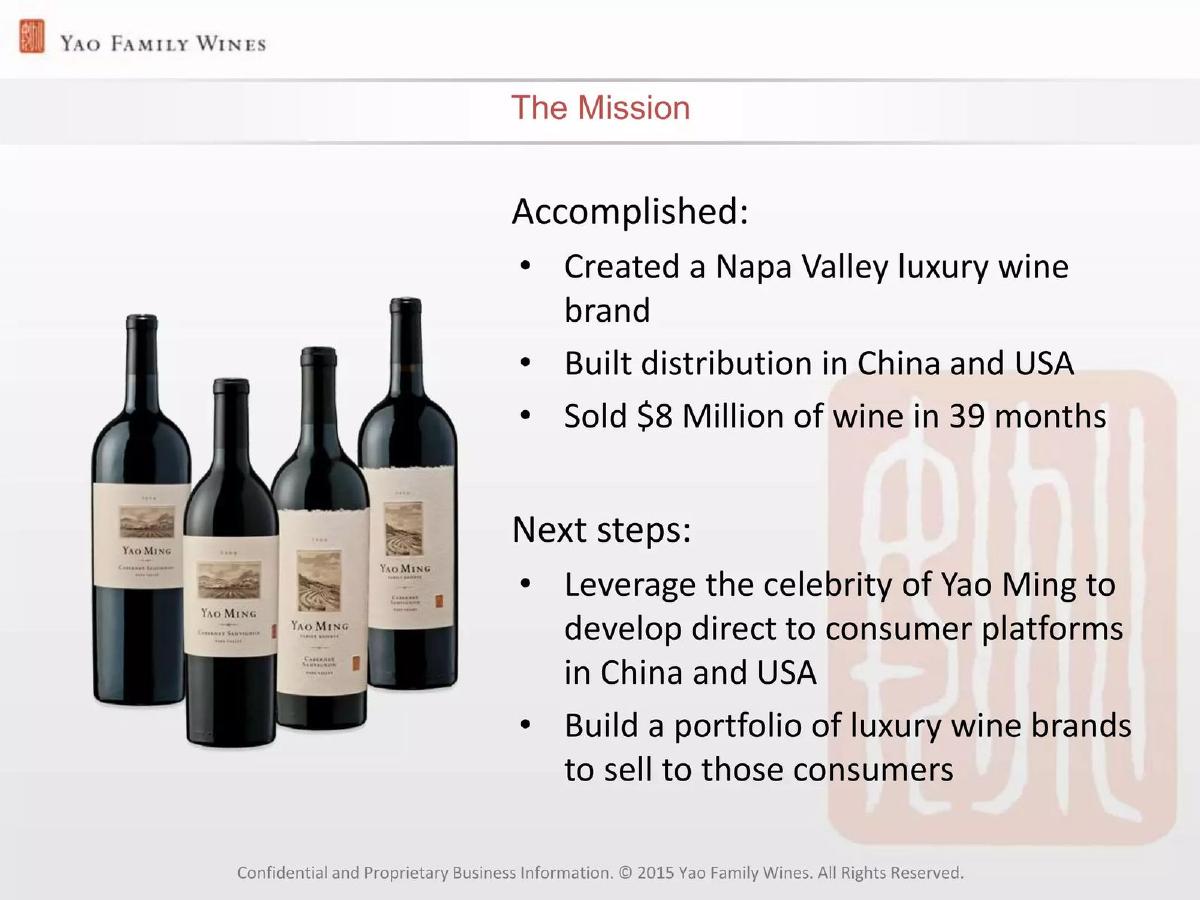
The 'Mission' slide serves as a progress report. It lists three major accomplishments: the creation of the brand, the establishment of distribution in both China and the USA, and the achievement of $8 million in sales within 39 months. This is a critical slide for investors because it proves the 'celebrity' aspect has already converted into 'currency.' The 'Next Steps' section outlines the pivot to DTC platforms and the expansion into a broader portfolio of luxury wine brands, indicating that the company intends to be a house of brands rather than a single-product entity.
Slide 4: The Opportunity (China)
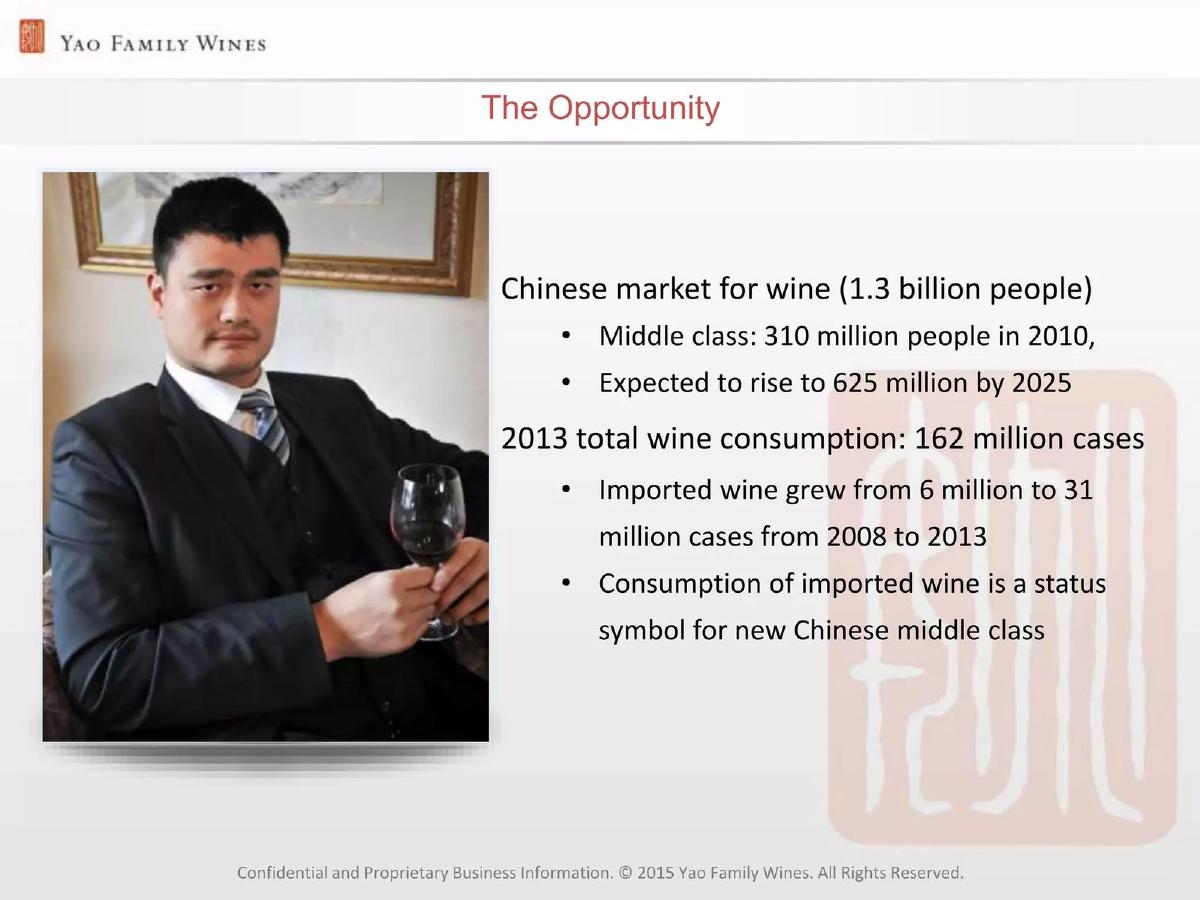
This slide focuses on the macro-economic tailwinds in China. It features a photo of Yao Ming, reinforcing his role as the face of the brand. The data points are aggressive: a middle class expected to grow to 625 million people by 2025 and a total wine consumption of 162 million cases in 2013. The most important metric here is the growth of imported wine, which rose from 6 million to 31 million cases in five years. The slide explicitly states that imported wine is a 'status symbol,' which justifies the premium pricing seen on Slide 2.
Slide 5: USA Wine Market
While China is the growth engine, the US is presented as the foundation. The slide notes that the US is the largest retail wine market in the world. It highlights that California wineries focus on the domestic market rather than exports, creating a gap that Yao Family Wines is uniquely positioned to fill. The mention of $77 million in exports from California to China in 2013 provides a benchmark for the specific niche the company occupies.
Slide 6: Distribution China
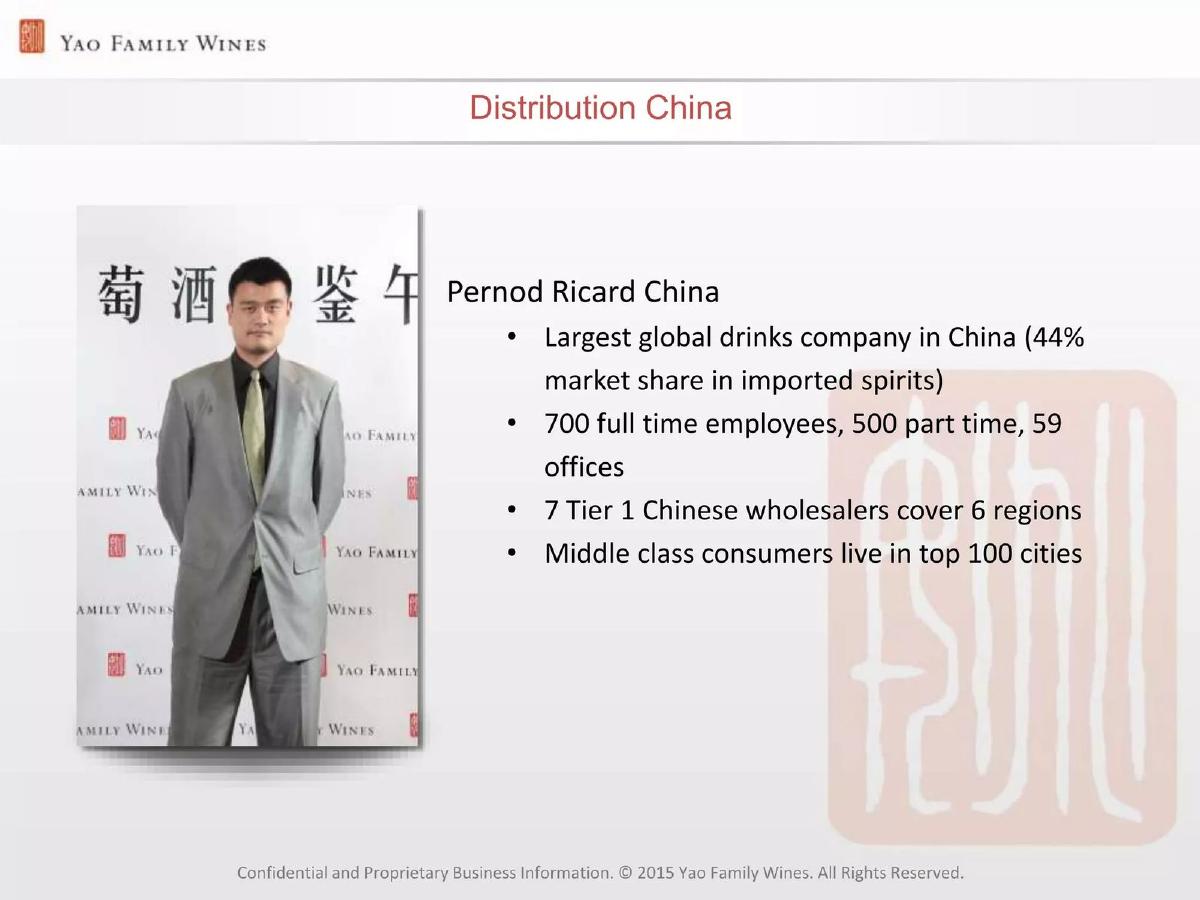
This slide addresses the 'how' of their Chinese operations. By partnering with Pernod Ricard China , the company gains access to a massive infrastructure: 700 full-time employees and 59 offices. The slide notes Pernod Ricard's 44% market share in imported spirits. This partnership mitigates the risk of a US-based company trying to navigate the complex Chinese regulatory and logistics landscape independently. It shows the company has 'Tier 1' institutional support.
Slide 7: Direct to Consumer Initiatives
The final slide in this set outlines the future margin-expansion strategy. It claims that DTC sales generate 2x the revenue of distributor sales. The plan to build tasting rooms in both Napa and Shanghai is a classic luxury wine play to build a 'loyal mailing list.' The most interesting point is the plan for a social media platform to position Yao Ming as a 'lifestyle role model' covering art, architecture, and food. This suggests the company views itself as a lifestyle media entity as much as a winery.
What Yao Family Wines Does Well
The deck is exceptionally strong at validating the brand's existence. Many celebrity decks fail because they focus on the celebrity's fame rather than the business's performance. By leading with $8 million in sales and specific bottle pricing, Yao Family Wines proves there is a market for their product. The partnership with Pernod Ricard is another significant 'trust signal' that suggests the business is operationally sound and capable of reaching the top 100 Chinese cities mentioned on Slide 6. The tiered product strategy is also well-executed, providing a clear path for different segments of the 'new Chinese middle class.'
What is Missing from the Deck
The provided slides are missing several key components typically required for a full investment round. First, there is no Team Slide beyond Yao Ming himself; investors would want to see the winemakers, the operations team, and the executives managing the Pernod Ricard relationship. Second, there is no Financial Projections slide; while they mention $8M in past sales, they do not project future EBITDA or burn rate. Third, the Ask is missing from these slides. We do not know how much capital they are raising or what the specific valuation is. Finally, there is no mention of Unit Economics beyond the '2x revenue' claim for DTC; a breakdown of COGS (Cost of Goods Sold) for a $150 bottle of wine would be highly relevant for a luxury goods investor.
Founder's Guide: What to Copy
Founders should emulate the way this deck uses macro-economic data to support a specific niche. Slide 4 doesn't just say 'China is big'; it connects the growth of the middle class specifically to the growth of imported wine and labels it a 'status symbol.' This creates a logical bridge to the $625 price point. Additionally, the use of 'Accomplished' vs. 'Next Steps' on Slide 3 is a great way to show momentum. It tells the investor: 'We have already built the machine; now we are just asking you to help us turn the dial to a higher margin (DTC) setting.'
Frequently asked questions
- What is the primary value proposition of Yao Family Wines?
- The value proposition is the intersection of Napa Valley luxury winemaking and the massive cultural influence of Yao Ming in China. The deck argues that imported wine is a status symbol for the Chinese middle class, and Yao Ming serves as a 'lifestyle role model' to facilitate this connection. By combining high-end production with a pre-built celebrity audience, the brand bypasses traditional brand-building timelines.
- How does the company handle distribution in its primary markets?
- In China, the company leverages Pernod Ricard China, the largest global drinks company in the region. This partnership provides access to 59 offices and 7 Tier 1 wholesalers covering 6 regions. In the US, the deck mentions established distribution but focuses more on the transition toward direct-to-consumer platforms like tasting rooms to capture higher margins.
- What are the specific price points for the wine portfolio?
- The portfolio is strictly premium. The 'Napa Crest' Red Blend is the entry-level luxury offering at $50 per bottle. The 'Yao Ming' Napa Valley Cabernet Sauvignon is priced at $150 per bottle, and the ultra-premium 'Yao Ming Family Reserve' Cabernet Sauvignon retails for $625 per bottle.
- Why is the company shifting toward Direct-to-Consumer (DTC) sales?
- According to Slide 7, DTC sales generate twice the revenue of distributor sales. The company views a loyal mailing list as the foundation for long-term luxury brand success. To achieve this, they plan to build physical infrastructure, including tasting rooms in Napa and Shanghai, and a social media platform focused on art, architecture, and food.
- What market trends are supporting this business model?
- The deck highlights two major trends: the rapid growth of the Chinese middle class and the increasing volume of imported wine as a status symbol. Specifically, imported wine volume in China quintupled between 2008 and 2013. Additionally, the US is noted as the largest retail wine market by dollar value, providing a stable secondary market.