Guest House presents a compelling case for disrupting the traditional $5 billion home staging market by layering a tech-enabled retail marketplace on top of a service business. The deck highlights a significant market opportunity—6.5 million homes sold annually in the US, with 31% currently staged—and positions Guest House as the solution to the industry's lack of technology and consistency. By partnering with premium brands like Crate & Barrel and Burrow, the company creates a 'shoppable home' experience where buyers can purchase furnishings via QR codes. The 2021 results, including a 270% r…
Key takeaways
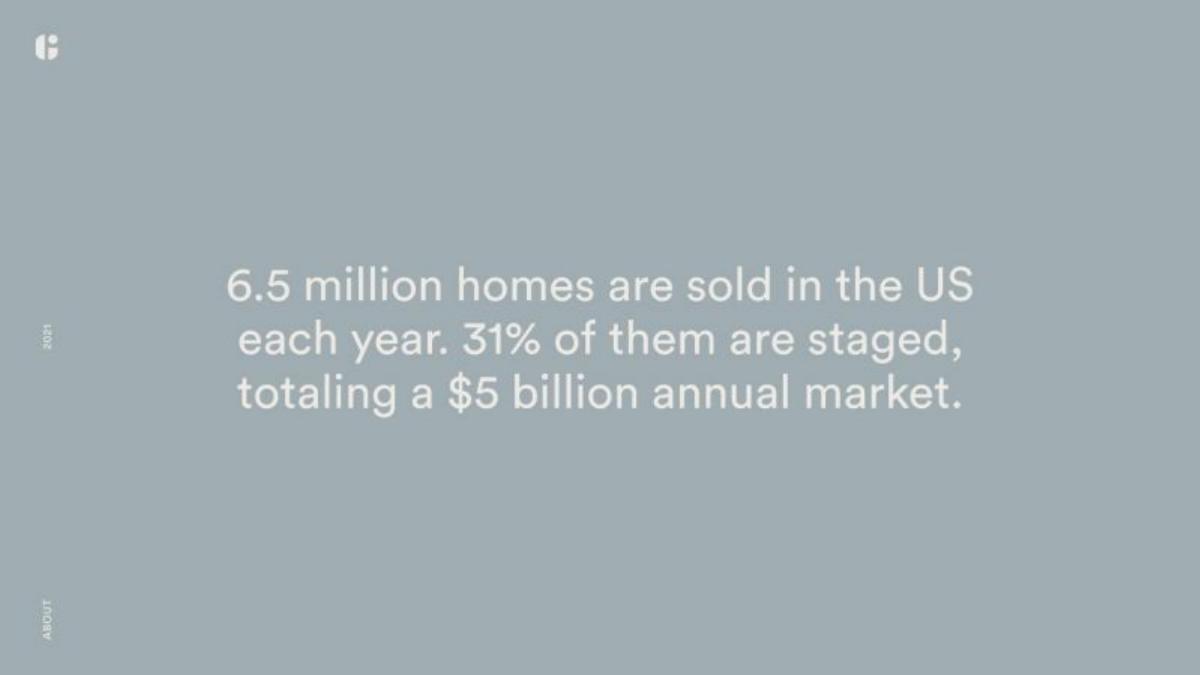
- The US home staging market is valued at $5 billion annually, with 31% of the 6.5 million homes sold each year being staged (Slide 3).
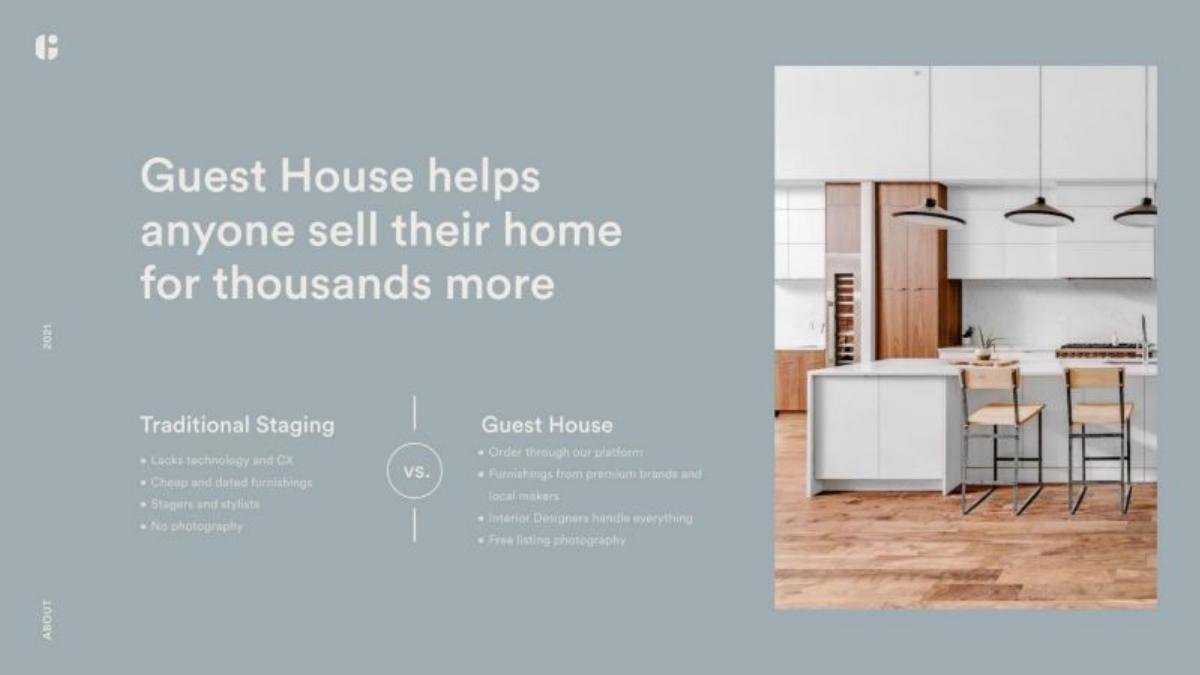
- Guest House differentiates itself from traditional staging by offering premium brands, interior designer management, and free listing photography (Slide 5).
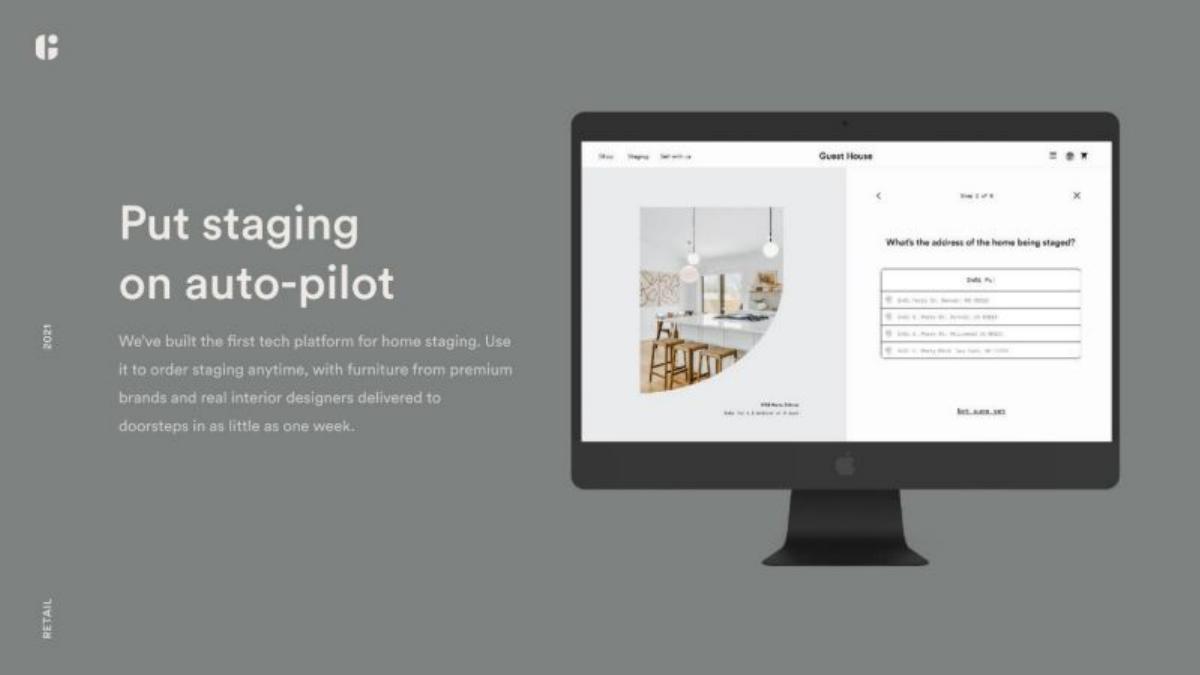
- The platform enables staging delivery in as little as one week, significantly faster than traditional lead times (Slide 6).
- Strategic retail partnerships include known brands such as Crate & Barrel, Joybird, Burrow, and Poly & Bark (Slide 7).
- A partnership with Affirm allows realtors or homeowners to 'stage today, pay later' for a few hundred dollars a month (Slide 10).
- The business model is dual-sided: staging fees starting at $1,050 per month from realtors and commissions on furniture sales from the marketplace (Slide 15).
- Traction is evidenced by a 270% YTD revenue increase and an average customer NPS of 73 (Slide 17).
- The company operates in four initial markets: Denver, Boulder, Colorado Springs, and San Diego (Slide 17).
Executive Summary: The Shoppable Home
Guest House entered the PropTech space in 2021 with a pitch that bridged the gap between real estate services and retail marketplaces. By the time this deck was circulated, they had already established a foothold in the Colorado and San Diego markets, leveraging a high-growth model that turned empty listings into curated showrooms. The deck's primary strength lies in its visual clarity and the clear articulation of a 'better way' to handle a legacy real estate process. With a $30M raise reported in the catalogue facts, this deck serves as a prime example of how to pitch a service-heavy business by emphasizing its technological and marketplace scalability.
Slides 1-5: The Problem and The Pivot
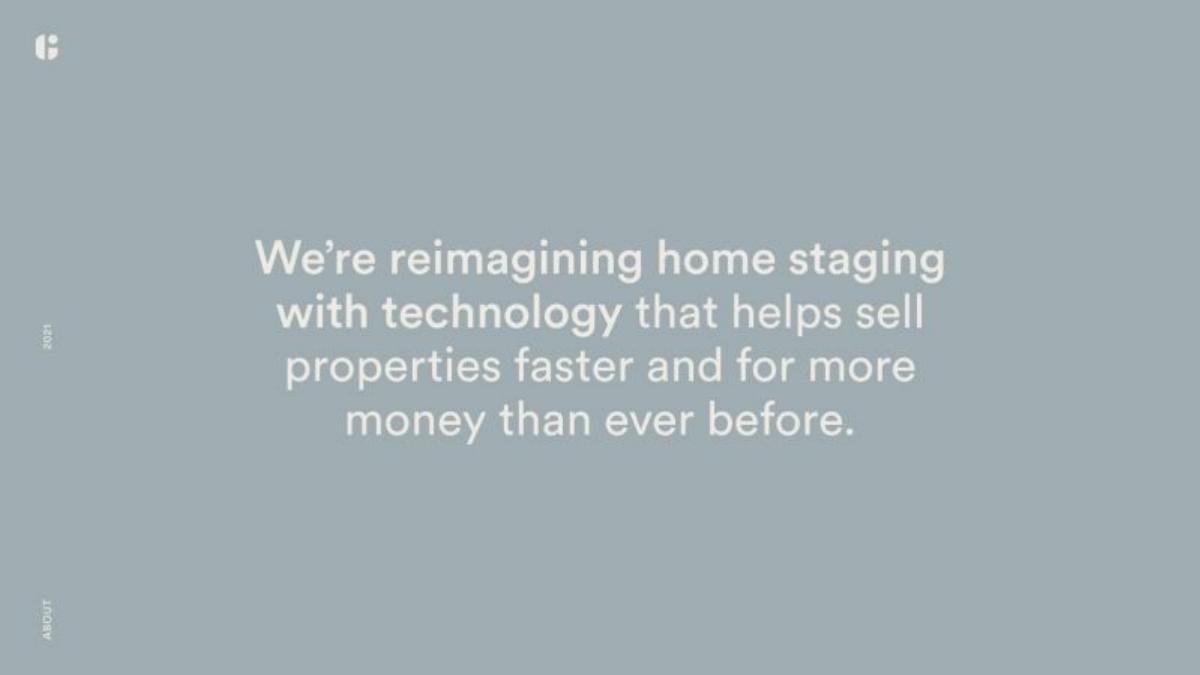
The deck opens with a minimalist aesthetic, immediately signaling the brand's focus on design. Slide 2 sets the mission: "reimagining home staging with technology that helps sell properties faster and for more money." This is a classic value proposition for the real estate industry, focusing on the bottom line of the primary user—the realtor.
Slide 3 provides the market validation. It notes that 6.5 million homes are sold in the US annually, and 31% of them are staged, creating a $5 billion annual market. This is a crucial slide because it defines the Total Addressable Market (TAM) for the service side of the business. Slide 4 identifies the pain points: a lack of technology, inconsistency, and poor consumer experience. By Slide 5, Guest House presents a direct comparison between "Traditional Staging" and their model. They highlight that traditional methods use "cheap and dated furnishings" and lack photography, whereas Guest House offers a platform-based ordering system, premium brands, and free listing photography.
Slides 6-10: The Tech-Enabled Service
Slides 6 through 10 focus on the product experience. Slide 6 introduces the concept of putting staging on "auto-pilot," claiming to be the first tech platform for the industry. A key metric here is the speed of delivery: "in as little as one week." In the fast-moving real estate market, speed is a major competitive advantage.
Slide 7 is a "trust" slide, showcasing partnerships with premium brands like Crate & Barrel, Joybird, and Burrow. This is a strategic move; it tells investors that Guest House isn't just buying furniture—they are a distribution channel for major retailers. Slide 8 and 9 emphasize the 'hands-off' nature for the realtor, noting that interior designers handle the project and photographers capture high-quality images with full usage rights. Slide 10 introduces a fintech element through a partnership with Affirm, allowing customers to pay for staging over time, which lowers the barrier to entry for lower-commission listings.
Slides 11-13: The Marketplace Evolution
This section represents the 'hook' for venture scale. Slide 11 explicitly states that Guest House is "turning real estate into a retail experience." This shifts the narrative from a local service business to a national marketplace. Slide 12 explains the mechanism: buyers scan QR codes in the home to purchase furnishings. This solves the "furniture lead time" problem for new homeowners while creating a secondary revenue stream for the company.
Slide 13 introduces the "furniture resale marketplace" concept. It explains that as products cycle through homes, they are discounted up to 60%. This creates a circular economy model that appeals to both budget-conscious consumers and investors interested in sustainable business practices. It also suggests a high utilization rate for their inventory.
Slides 14-15: The Business Model
Slide 15 is the most important slide for understanding the company's economics. It breaks revenue into two buckets: From Realtors (Staging fees starting at $1,050/month) and From Marketplace (Commission on sale of goods). This dual-revenue stream is what justifies a higher valuation than a standard staging company. It also notes that while staging is regional (Denver, Boulder, etc.), the marketplace is "Available nationally," indicating the path to geographic expansion.
Slides 16-17: Traction and Results
The "Traction" section is brief but dense. Slide 17, titled "2021 Results," lists six key metrics. The standout figure is the "270% Revenue Increase YTD." Coupled with an NPS of 73, this suggests that the company is growing rapidly without sacrificing quality. The mention of "500+ Guest House Makers" and "30+ Guest House Designers" provides a sense of the operational scale required to support their four active markets.
Slides 18-21: Team and Conclusion
The deck concludes with the team. Slide 19 shows a balanced leadership group, including Founder & CEO Alex Ryden and CTO Jon Sakas. The presence of a "Head of Creative" and "Director of Design" reinforces the brand-first approach seen throughout the deck. Notably, the deck ends on Slide 20 with a "Thank You" and contact information, omitting a final "Ask" or "Use of Funds" slide. This suggests the deck may have been used in a context where the terms were already known or were being discussed in a separate document.
What Guest House Does Well
The Guest House deck is a masterclass in visual storytelling . Because the business is about aesthetics, the deck itself is beautiful, using high-quality interior photography that proves the product's value without needing much text. The comparison slide (Slide 5) is particularly effective because it doesn't just say they are better; it lists specific, tangible benefits like "free listing photography" and "premium brands" that a realtor would immediately value. Furthermore, the dual-revenue model is presented simply, making a complex operation seem easy to understand and scale.
What is Missing from the Deck
Despite its success, the deck has several omissions that a typical Series A investor might flag. Unit Economics are entirely absent; there is no mention of the cost to acquire a customer (CAC), the lifetime value (LTV), or the margins on the furniture sales versus the staging fees. Competitive Landscape is also thin; while they compare themselves to "Traditional Staging," they do not mention other tech-enabled competitors or virtual staging startups which are a significant threat to physical staging. Finally, the lack of an 'Ask' slide is a missed opportunity to define the milestones the $30M would help them achieve.
Founder's Playbook: Lessons to Copy
Lead with the Market Gap: Slide 4 clearly identifies why the current industry is failing. If you can prove the status quo is broken, your solution becomes a necessity rather than a luxury. · Leverage Partnerships: By including logos like Crate & Barrel and Affirm, Guest House borrows the credibility of established giants. This is a great way for early-stage startups to look bigger than they are. · Show, Don't Just Tell: Instead of describing a "shoppable home," Slide 12 shows a mockup of the interface. This makes the concept feel real and ready for market. · Quantify Quality: Using NPS (Net Promoter Score) alongside revenue growth (Slide 17) is a powerful way to show that your growth is sustainable and that customers actually like the product.
Frequently asked questions
- What is the primary problem Guest House is solving?
- According to Slide 4, the traditional staging industry lacks technology, consistency, and a consumer-friendly experience. Traditional staging often uses cheap, dated furnishings and lacks professional photography. Guest House solves this by providing a tech platform to order staging with premium brands and professional designers, while including high-quality photography and 3D tours to help homes sell faster and for more money.
- How does Guest House generate revenue?
- The company employs a two-pronged revenue model as shown on Slide 15. First, they charge realtors staging fees starting at $1,050 per month. This service is currently available in specific Colorado and California markets. Second, they earn a commission on the sale of goods through their marketplace, which is available nationally. This allows them to monetize both the service and the physical products used in the service.
- What is the 'retail experience' mentioned in the deck?
- Guest House turns staged homes into showrooms. As described on Slides 11 and 12, buyers of a staged home can scan QR codes to purchase individual items, entire rooms, or the full interior. This eliminates furniture lead times for the buyer and creates a resale marketplace for Guest House where items are discounted up to 60% as they cycle through different homes (Slide 13).
- What kind of traction did the company show in 2021?
- Slide 17 outlines significant growth, including a 270% year-to-date revenue increase. The company achieved an average Net Promoter Score (NPS) of 73, indicating high customer satisfaction. Operationally, they grew to 12 full-time employees, 30+ designers, and a network of over 500 'Makers' across four primary markets in Colorado and San Diego.
- What is missing from the Guest House pitch deck?
- The deck is missing a specific 'Ask' slide detailing how much capital they are seeking and how it will be allocated. It also lacks a detailed competition slide beyond the 'Traditional Staging' comparison on Slide 5. Furthermore, there are no slides dedicated to unit economics (CAC/LTV) or a long-term financial forecast, which are standard for a $30M Seed/Series A round.