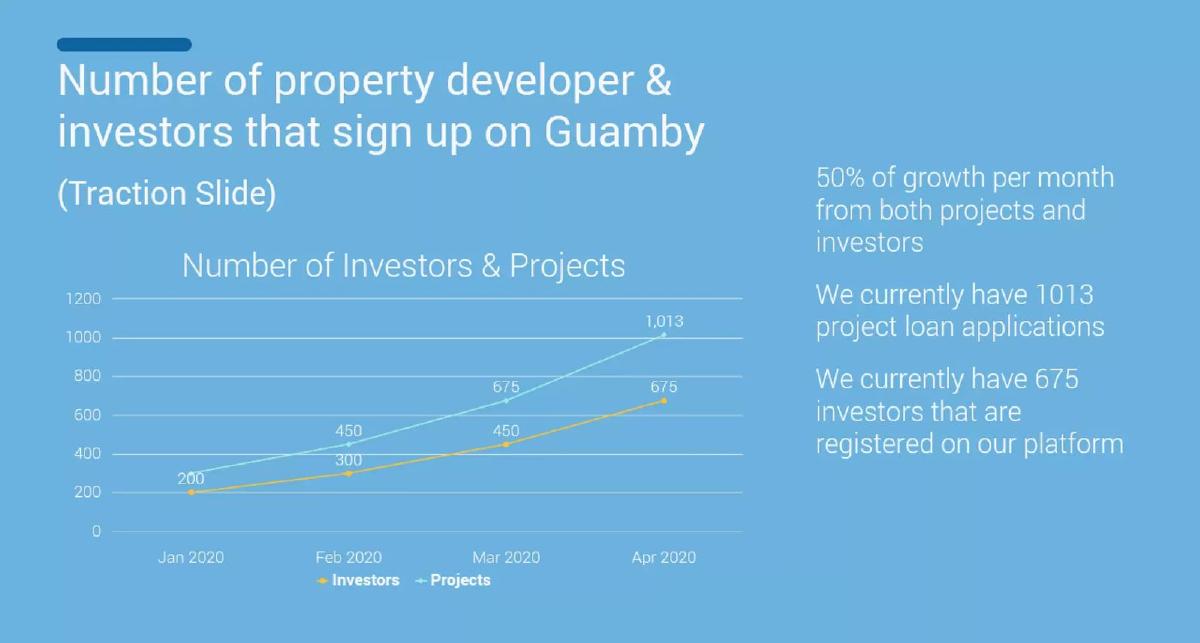
Guamby presents a real estate crowdfunding platform aimed at the South African market, specifically focusing on 'fix & flip' projects. The deck, published in 2020, highlights a dual-sided marketplace connecting accredited investors with property developers. The company reports early traction, growing from 200 investors in January 2020 to 675 by April 2020, alongside 1,013 project loan applications. Their revenue model relies on origination fees, interest rate spreads, and pre-funding loans via their own balance sheet. Seeking $500,000 in total across various expansion categories, the deck pro…
Key takeaways
- The company claims a 50% monthly growth rate for both projects and investors as of April 2020 (Slide 6).
- Guamby operates on a three-pronged revenue model: 1.5-3.5% origination fees, 1-3% interest rate spreads, and balance sheet pre-funding (Slide 7).
- The platform targets a specific niche of 'fix & flip' projects exclusively across South Africa (Slide 5).
- The total funding ask is $500,000, with the largest single allocation ($200,000) dedicated to external vetting of projects (Slide 10).
- Investor access is restricted to accredited investors globally, rather than retail investors (Slide 5).
- The team includes a COO with a claim of $100 million USD in property sold (Slide 9).
- Technical development is supported by Faster Capital, acting as a technical co-founder (Slide 9).
- Market analysis cites a total of $35.2B raised on real estate crowdfunding platforms globally (Slide 8).
Executive Summary: The African Real Estate Crowdfunding Vision
Guamby’s pitch deck, published in 2020, positions the company as a bridge between global accredited investors and the South African real estate market. By focusing specifically on the "fix & flip" niche, Guamby attempts to solve the traditional barriers to real estate entry: high capital requirements, lack of transparency, and the complexity of project management. The deck is structured as a standard 11-slide seed-stage presentation, moving from problem identification to a specific $500,000 capital request.
Slide 1: Title and Contact
The cover slide is functional, featuring the Guamby logo and the tagline "We are the future of real estate investing in Africa." It includes immediate contact information, including a phone number with a +264 (Namibia) area code, despite the listing describing the company as South African-based. This slide sets a professional, if minimalist, tone for the rest of the presentation.
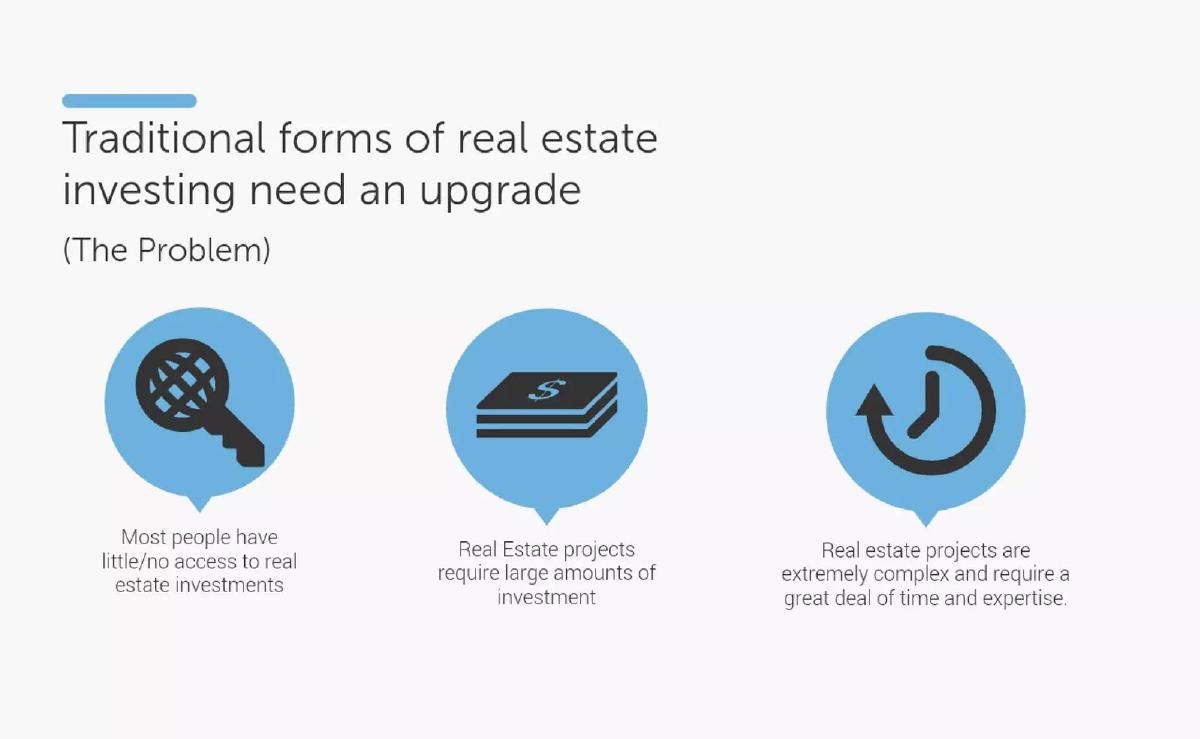
Slide 2: The Problem
Guamby identifies three core pain points in traditional real estate investing: lack of access for most people, the requirement for large amounts of capital, and the high level of expertise and time needed to manage projects. The slide uses simple iconography to represent these barriers, framing the industry as one in need of an "upgrade."
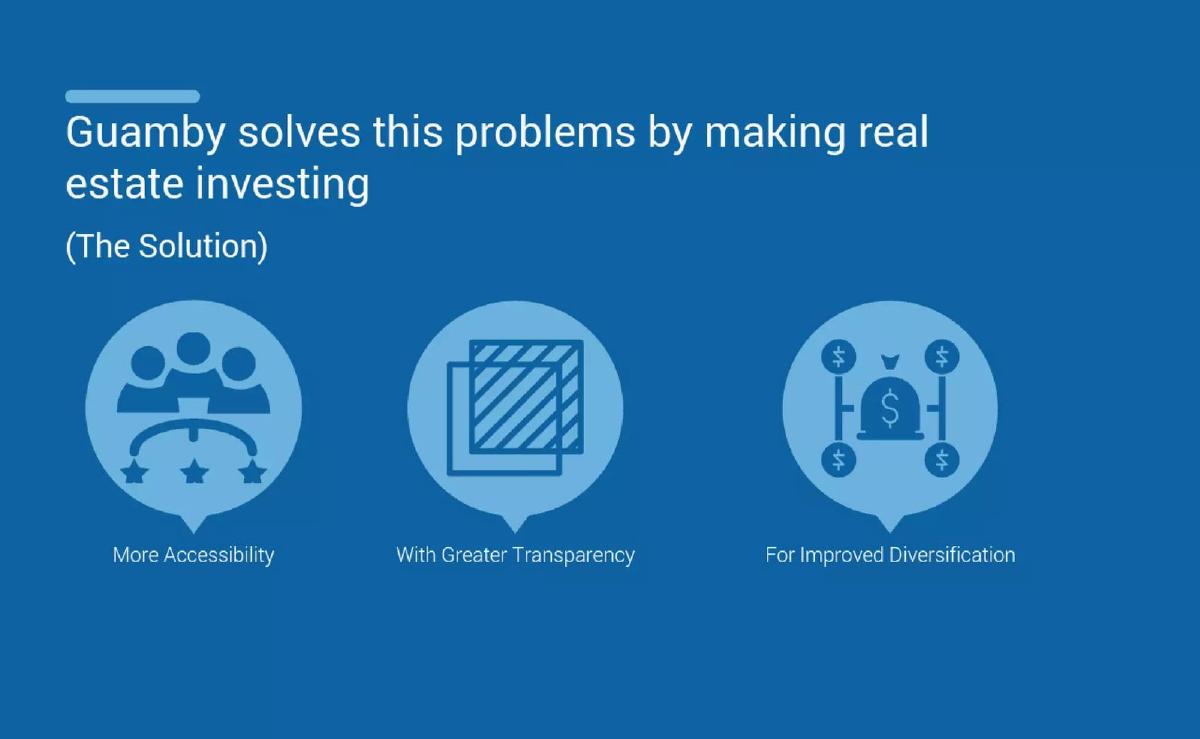
Slide 3: The Solution
The solution slide mirrors the problem slide, promising "More Accessibility," "Greater Transparency," and "Improved Diversification." While these are standard value propositions for crowdfunding platforms, the slide remains at a high level without explaining the specific mechanism of the platform yet.
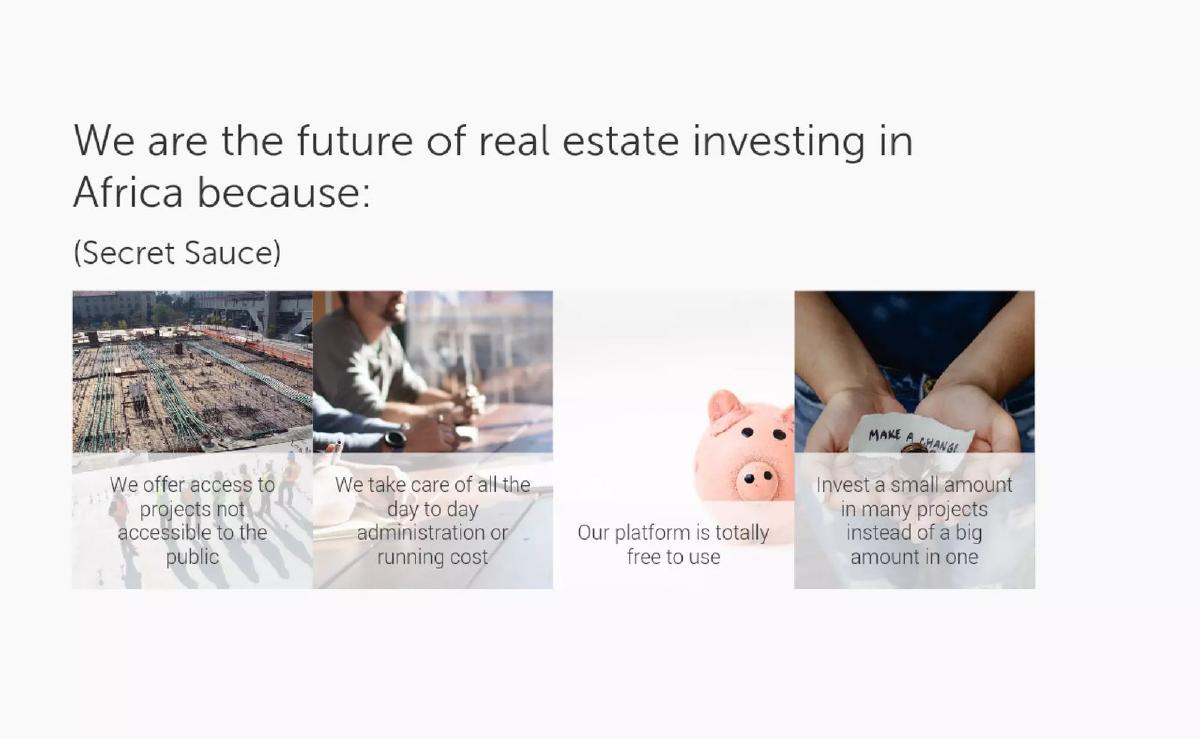
Slide 4: The Secret Sauce
This slide attempts to differentiate Guamby. The company lists four key drivers: access to non-public projects, handling all day-to-day administration and running costs, a platform that is "totally free to use" for investors, and the ability to invest small amounts across multiple projects. The claim of being "totally free to use" is later clarified in the business model slide, suggesting the platform generates revenue from the developers and interest spreads rather than direct user fees.
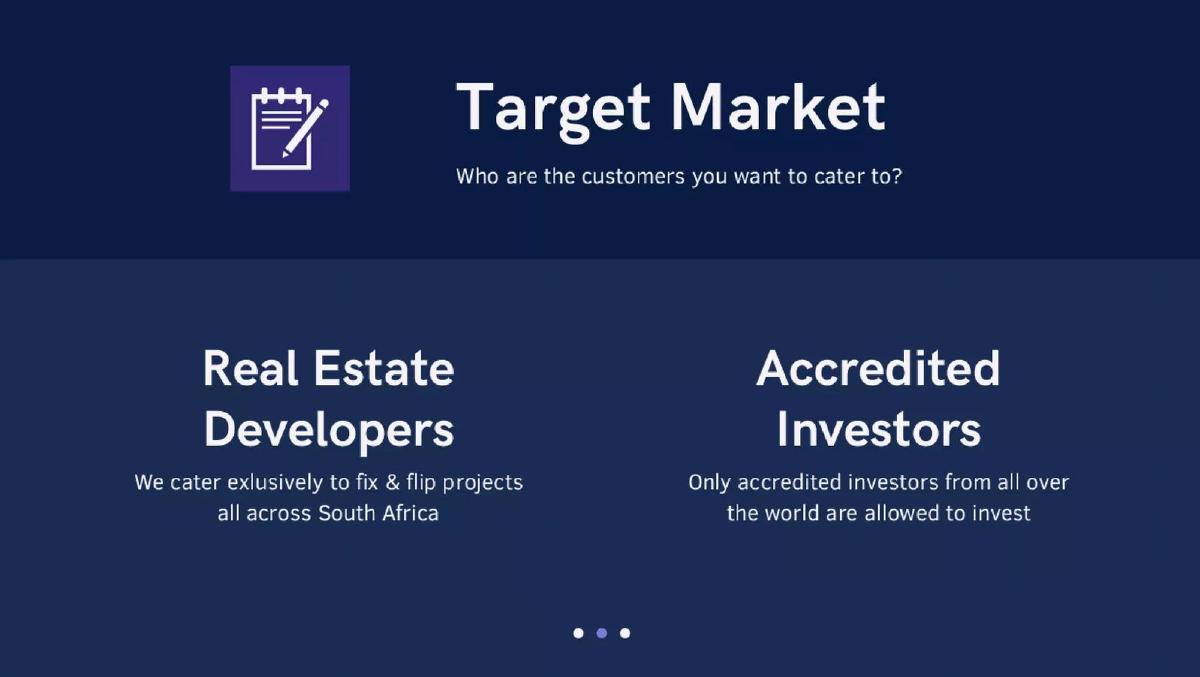
Slide 5: Target Market
Guamby defines its two-sided marketplace clearly here. They cater "exclusively to fix & flip projects all across South Africa" for developers. On the investor side, they specify that "Only accredited investors from all over the world are allowed to invest." This is a critical distinction, as it avoids the regulatory complexities of retail crowdfunding but limits the total addressable user base.
Slide 6: Traction Slide
This is the most data-dense slide in the deck. It features a line graph showing growth from January 2020 to April 2020. According to the chart, registered investors grew from 200 to 675, and project loan applications grew from 200 to 1,013. The slide explicitly states a "50% of growth per month" for both metrics. This suggests strong early demand, particularly on the supply (developer) side of the marketplace.
Slide 7: Business Model
Guamby outlines three revenue streams: 1.5-3.5% Origination fee charged to the redeveloper at loan closing; 1-3% Interest Rate Spread , representing the margin between the borrower's rate and the investor's return; and Balance Sheet Pre-funding . The third point indicates that Guamby intends to use its own capital to start loans before passing them to investors, which requires significant liquidity but allows for faster deal execution.
Slide 8: Market Analysis
The market analysis slide provides global context rather than local South African data. It cites 150% growth in the real estate crowdfunding market in 2019, $120M in VC raised by similar platforms, and a total of $35.2B raised on these platforms globally. While these figures validate the sector, the deck lacks specific TAM/SAM/SOM figures for the South African or broader African market.
Slide 9: The Team
The team slide introduces three principals. CEO Mbangoje Jatamunua is noted as a Chartered Financial Analyst. CTO David Mulder is credited with 10+ years of experience as a full-stack developer. COO Madite Moalusi is the most experienced in the sector, with a claim of "100 Million USD in property sold." The slide also notes that "Faster Capital is our technical co-founder," indicating an outsourced or partnership-based approach to building the core technology.
Slide 10: Funds Needed for Expansion
The deck concludes with a specific ask of $500,000, broken down into six categories:
$70,000 for app development. · $38,000 for website development. · $22,000 for security and safety. · $50,000 for marketing. · $120,000 for office expenses and salaries. · $200,000 for external vetting of projects.
The allocation of 40% of the raise ($200k) to external vetting highlights the company's focus on risk management and due diligence as a core operational cost.
Slide 11: Final Contact
The deck ends with a repeat of the contact information, including the website (guamby.net) and email address.
What Works in This Deck
The traction slide (Slide 6) is the strongest element of the presentation. Showing a 5x increase in project applications over four months provides tangible evidence of market demand in the South African developer community. Furthermore, the business model (Slide 7) is transparent and standard for the industry, which helps investors quickly understand how the company intends to reach profitability. The specific breakdown of the $500,000 ask (Slide 10) shows a level of operational planning that is often missing in early-stage decks.
What Is Missing
The most glaring omission is a competitive analysis. The deck does not mention other African real estate platforms or traditional REITs, leaving the investor to wonder how Guamby defends its niche. Additionally, while the team slide mentions a technical co-founder (Faster Capital), there is no demonstration of the actual platform interface or user experience. For a company seeking $70,000 specifically for app development, showing a prototype or wireframes would have been beneficial. Finally, the deck lacks a "Why Now?" slide that addresses specific economic conditions in South Africa that make 2020 the right time for this venture.
Founder Takeaways
Founders should note the effectiveness of the "Secret Sauce" slide (Slide 4) in translating abstract benefits (transparency, accessibility) into concrete operational promises (handling administration, small-check sizes). However, the reliance on a "technical co-founder" entity rather than an in-house team can be a red flag for some VCs; founders in this position should be prepared to explain the long-term plan for bringing tech in-house. The use of a balance sheet to pre-fund loans is a high-risk, high-reward strategy that requires a much deeper dive into risk mitigation than this deck provides.
Frequently asked questions
- What is Guamby's primary business model?
- Guamby functions as a real estate investment platform that monetizes through three channels: an origination fee of 1.5% to 3.5% charged to redevelopers, an interest rate spread of 1% to 3% between what borrowers pay and what investors receive, and the use of their own balance sheet to pre-fund loans to originate deals quickly.
- Who is the target audience for the platform?
- The platform serves two distinct groups. On the supply side, they cater exclusively to real estate developers focused on fix-and-flip projects in South Africa. On the demand side, they only allow accredited investors from around the world to participate in the investment opportunities.
- How much capital is Guamby seeking and for what purpose?
- The deck outlines a need for $500,000. This is broken down into $70,000 for app development, $38,000 for the website, $22,000 for security, $50,000 for marketing, $120,000 for office expenses and salaries, and $200,000 for external project vetting.
- What traction did the company show in early 2020?
- Between January and April 2020, Guamby reported significant growth. Registered investors grew from 200 to 675, while project loan applications increased from 200 to 1,013. The company stated they were achieving a 50% month-over-month growth rate during this period.
- Who are the key members of the leadership team?
- The team consists of CEO Mbangoje Jatamunua (a CFA), CTO David Mulder (a full-stack developer with 10+ years of experience), and COO Madite Moalusi (who claims $100M in property sales). They also list Faster Capital as their technical co-founder.