Gutsy’s 14-slide pitch deck is a lean, highly visual argument for a new category in cybersecurity: process mining for security governance. The company, which reportedly raised $51 million in a 2024 Seed round, avoids dense text in favor of architectural diagrams and clear value propositions. By highlighting the gap between security tools and actual execution, Gutsy positions itself as a layer of truth that normalizes and correlates data across fragmented stacks. The deck is notable for its lack of traditional financial metrics or market size slides, relying instead on the pedigree of its lead…
Key takeaways
- The deck identifies a core problem on Slide 3: security processes are currently 'hard to see' despite the abundance of tools.
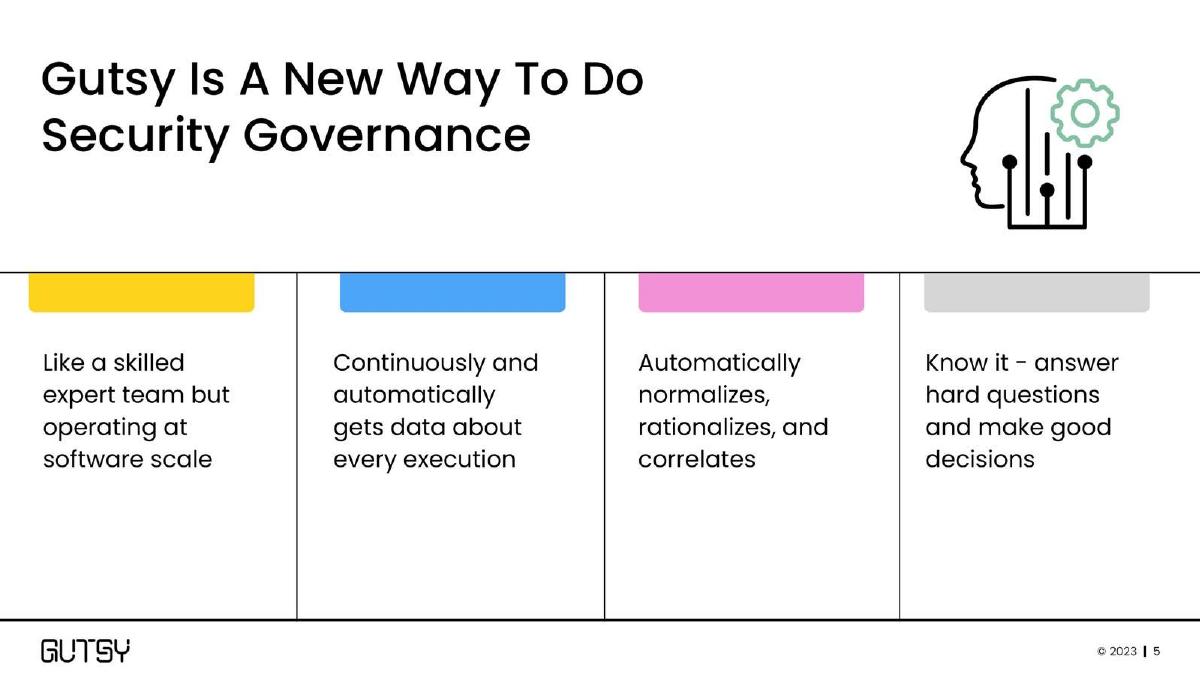
- Gutsy defines its value proposition on Slide 5 as security governance that operates at 'software scale' through continuous automation.
- The product functions by automatically normalizing, rationalizing, and correlating data from every execution (Slide 5).
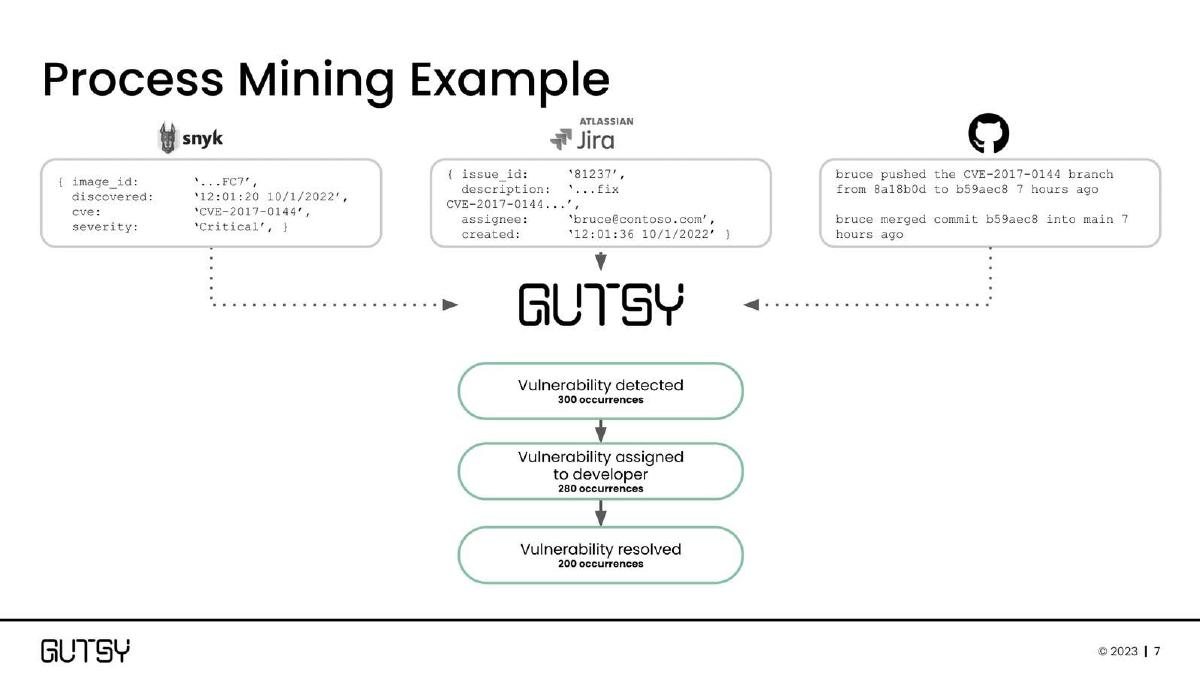
- A concrete technical example on Slide 7 shows integration with Snyk, Jira, and GitHub to track vulnerability resolution rates.
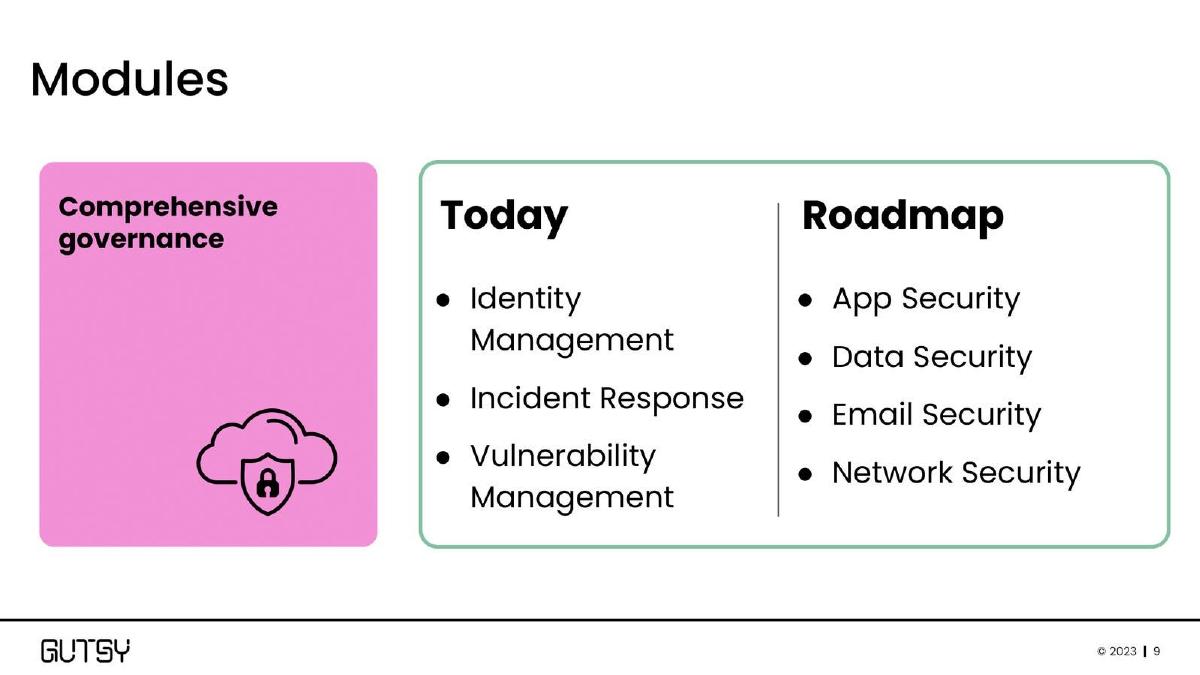
- The current product focus is limited to Identity Management, Incident Response, and Vulnerability Management (Slide 9).
- The future roadmap includes expansion into App, Data, Email, and Network security (Slide 9).
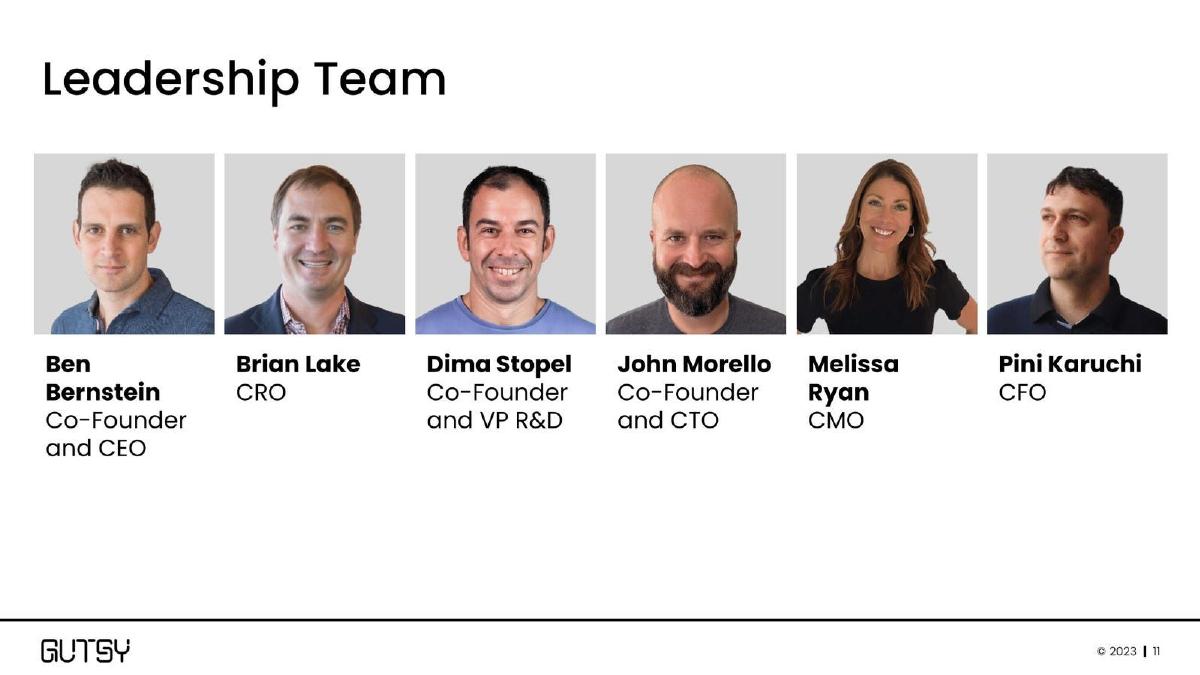
- The leadership team includes three co-founders and a C-suite of six, including a CEO, CRO, CTO, and CFO (Slide 11).
- The company maintains a global footprint with offices in Portland, New York, Baton Rouge, and Tel Aviv (Slide 13).
The $51M Seed Anomaly
Gutsy’s 2024 Seed round is a significant outlier in the venture capital landscape. Raising $51 million at the Seed stage is typically reserved for 'second-time' founders with proven exits or deep technical moats in high-value sectors like cybersecurity. The deck reflects this maturity; it is not a pitch for a prototype, but a pitch for a new architectural standard in security governance. The narrative focuses on the transition from manual, fragmented security checks to automated, process-oriented visibility.
Slide 1-2: Brand Identity
The deck opens with a minimalist title slide featuring the Gutsy logo. The branding is clean and modern, utilizing a custom typeface that suggests connectivity and flow—fitting for a company focused on process mining. There is no subtitle or mission statement on these initial slides, forcing the viewer to focus entirely on the brand name.
Slide 3: The Problem Statement
Slide 3, titled "But Processes Are Hard To See," uses a blurred architectural diagram to illustrate the current state of enterprise security. The visual represents a complex web of tools and handoffs that are currently opaque to leadership. This slide establishes the 'pain point' without using bullet points; it relies on the visual frustration of a blurry workflow to communicate that security teams are flying blind when it comes to how their tools actually interact.
Slide 4: The Gap in Governance
While the text provided for Slide 4 is simply the company name, the visual narrative of the deck suggests a transition from the 'blurry' problem to the clear solution. In a 14-slide deck, this is often where a founder would place a 'Status Quo' slide, explaining why current Governance, Risk, and Compliance (GRC) tools are failing to keep up with the speed of modern software development.
Slide 5: The Value Proposition
Slide 5, "Gutsy Is A New Way To Do Security Governance," breaks down the core offering into four pillars. First, it claims to act "Like a skilled expert team but operating at software scale." Second, it "Continuously and automatically gets data about every execution." Third, it "Automatically normalizes, rationalizes, and correlates" that data. Finally, it promises to help users "Know it - answer hard questions and make good decisions." This slide is the heart of the pitch, moving from the 'what' to the 'how' by emphasizing automation and data normalization.
Slide 6: The Technical Bridge
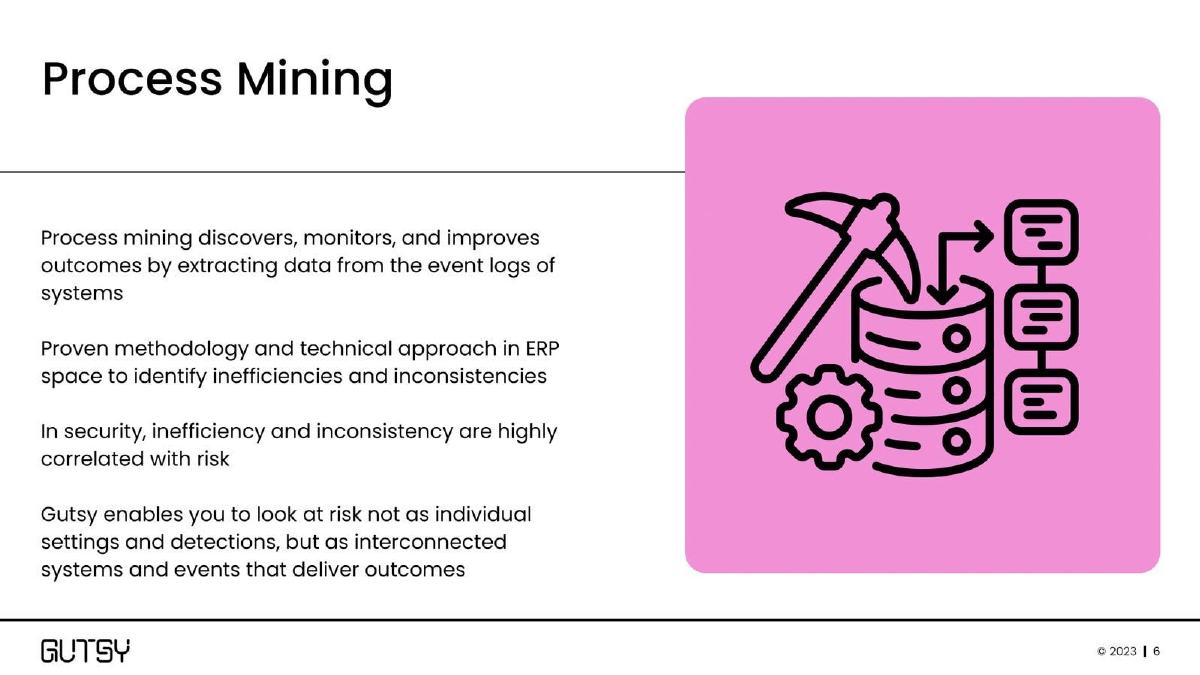
Slide 6 continues the branding consistency. In the context of the surrounding slides, this likely serves as a transition into the technical demonstration of the process mining engine. By this point, the deck has established the problem (invisibility) and the solution (automated governance).
Slide 7: Process Mining in Action
Slide 7, "Process Mining Example," provides the most concrete evidence of the product's utility. It shows data flowing from three sources: Snyk (vulnerability discovery), Jira (task assignment), and GitHub (code resolution). Gutsy sits in the middle, aggregating this data to show a funnel: 300 vulnerabilities detected, 280 assigned to developers, and 200 resolved. This slide proves that Gutsy isn't just another dashboard; it is a tool for measuring the actual throughput and efficacy of a security organization.
Slide 8: The Platform View
Slide 8 serves as a visual placeholder for the broader platform architecture. It reinforces the Gutsy logo, ensuring that the brand remains central as the deck moves from technical examples to business strategy.
Slide 9: Product Roadmap and Modules
Slide 9, "Modules," outlines the current and future state of the product. Under "Today," the deck lists Identity Management, Incident Response, and Vulnerability Management. Under "Roadmap," it lists App Security, Data Security, Email Security, and Network Security. This slide is crucial for investors because it shows that while Gutsy is starting with specific use cases, the underlying technology is horizontal and can eventually cover the entire security stack.
Slide 10: Strategic Positioning
Slide 10 maintains the minimalist aesthetic. At this stage of the deck, the focus typically shifts from the product to the 'Why Now' and the team that will execute the vision.
Slide 11: The Leadership Team
Slide 11, "Leadership Team," is likely the primary reason for the $51M Seed round. It lists Ben Bernstein (Co-Founder and CEO), Brian Lake (CRO), Dima Stopel (Co-Founder and VP R&D), John Morello (Co-Founder and CTO), Melissa Ryan (CMO), and Pini Karuchi (CFO). The inclusion of a full C-suite (CRO, CMO, CFO) at the Seed stage is highly unusual and indicates a 'day one' readiness to scale. The founders have significant pedigree in the space, which provides the credibility needed to pitch a new category like process mining.
Slide 12: Operational Readiness
Slide 12 acts as a transition to the company's physical and operational footprint. It reinforces the professional, high-capital nature of the startup.
Slide 13: Global Footprint
Slide 13, "Locations," features a world map with pins in Portland, OR; Baton Rouge, LA; New York, NY; and Tel Aviv, Israel. This tells a story of a company that is already global, tapping into the deep cybersecurity talent pool in Israel while maintaining a strong presence in major US markets. For a Seed round, this level of geographic distribution is ambitious and suggests the capital raised is being used to fuel a multi-national engineering and sales effort.
Slide 14: Closing
The deck concludes with a final branded slide. Notably, there is no 'Ask' slide detailing the specific use of funds or the valuation, which is common in highly competitive rounds where the terms are often dictated by the strength of the founders' previous track records rather than a standard pitch deck template.
What Works in the Gutsy Deck
Visual Metaphors: The use of the blurred diagram on Slide 3 is an excellent way to communicate a complex problem (lack of visibility) without overwhelming the reader with text. It creates an immediate emotional connection with anyone who has tried to manage a fragmented security stack.
Concrete Integration Examples: Slide 7 is the strongest slide in the deck. By naming specific, recognizable tools like Snyk, Jira, and GitHub, Gutsy grounds its abstract concept of 'process mining' in a workflow that every technical investor understands. It moves the conversation from 'what is this?' to 'how fast can you build more of these integrations?'
Roadmap Clarity: Slide 9 does a great job of balancing current reality with future ambition. By clearly separating what is available 'Today' from the 'Roadmap,' the founders build trust while still painting a picture of a massive, multi-module platform.
What is Missing from the Gutsy Deck
The Competitive Landscape: The deck makes no mention of existing GRC (Governance, Risk, and Compliance) players or other process mining companies like Celonis. While Gutsy is positioning itself as a 'new way,' investors usually want to see how a startup plans to displace or integrate with the incumbents.
Market Size (TAM): There is no slide dedicated to the Total Addressable Market. While the $51M round size implies a massive market, a standard deck usually includes data on the billions of dollars spent on security governance and the inefficiency of current manual processes.
Financials and Metrics: As a Seed round, revenue might be negligible, but the deck also omits any mention of pilot programs, design partners, or user growth. It relies entirely on the 'Product + Team' formula rather than 'Traction + Metrics.'
The Ask: The deck does not state how much they are raising or what the milestones for the next 18-24 months are. This suggests the deck was used as a supporting document for a round that was already heavily oversubscribed or led by insiders who were already familiar with the deal terms.
What Other Founders Should Copy
The 'Software Scale' Narrative: Founders in the infrastructure or security space should emulate how Gutsy frames its value. Instead of just saying 'we automate things,' they say they operate 'at software scale.' This framing justifies a higher valuation because it implies the product can grow without a linear increase in headcount.
Clean, Professional Design: The deck looks like it belongs to a Series C company. The consistent use of the logo, the high-quality headshots of the leadership team, and the uncluttered slides all signal that this is a professional organization. For founders, investing in high-end design can be a signal of the quality of the underlying engineering.
Focus on Data Normalization: In an era of 'tool sprawl,' any startup that can credibly claim to 'normalize, rationalize, and correlate' data (Slide 5) will have an easier time getting a meeting. Gutsy leans into the role of being the 'connective tissue' between other tools, which is a highly defensible position in the enterprise stack.
Frequently asked questions
- How much did Gutsy raise with this deck?
- According to reports from Business Insider, Gutsy raised $51 million in a Seed round in 2024. This is an exceptionally large amount for a Seed stage, suggesting high investor confidence in the founding team and the technical complexity of the process mining solution they are building for the cybersecurity industry.
- What is process mining in the context of Gutsy?
- As shown on Slide 7, Gutsy uses process mining to ingest data from various tools like Snyk and GitHub to map the actual lifecycle of a security event. It tracks how many vulnerabilities are detected versus how many are assigned and eventually resolved, providing a clear view of process efficiency and gaps that traditional static security tools might miss.
- Who are the founders of Gutsy?
- Slide 11 identifies the co-founding team as Ben Bernstein (CEO), Dima Stopel (VP R&D), and John Morello (CTO). The leadership team is further bolstered by Brian Lake (CRO), Melissa Ryan (CMO), and Pini Karuchi (CFO), indicating a heavy emphasis on experienced executive leadership early in the company's lifecycle.
- What specific security areas does Gutsy cover?
- According to Slide 9, Gutsy currently offers modules for Identity Management, Incident Response, and Vulnerability Management. Their roadmap indicates plans to expand into broader categories including Application Security, Data Security, Email Security, and Network Security, aiming for a comprehensive governance platform.
- Where is Gutsy located?
- Slide 13 features a map titled 'Locations,' showing that the company operates out of four primary hubs: Portland, OR; Baton Rouge, LA; New York, NY; and Tel Aviv, Israel. This distributed model suggests a strong engineering presence in Israel combined with a US-based go-to-market and executive team.