Hackmania’s 12-slide deck positions the company as a bridge between India's massive student population and a corporate sector struggling with expensive, unvalidated tech hiring. Operating under the product name HackerBay, the startup offers a 'one-stop shop' for hiring developers through online challenges and branded hackathons. The deck claims a market volume of INR 4000 Crores for tech hiring in India and showcases a revenue model built on platform licensing for universities and service fees for corporate events. While the deck provides clear competitive benchmarking and a structured go-to-…
Key takeaways
- The platform targets two distinct segments: companies seeking validated tech talent and universities needing better infrastructure for coding practice (Slide 2).
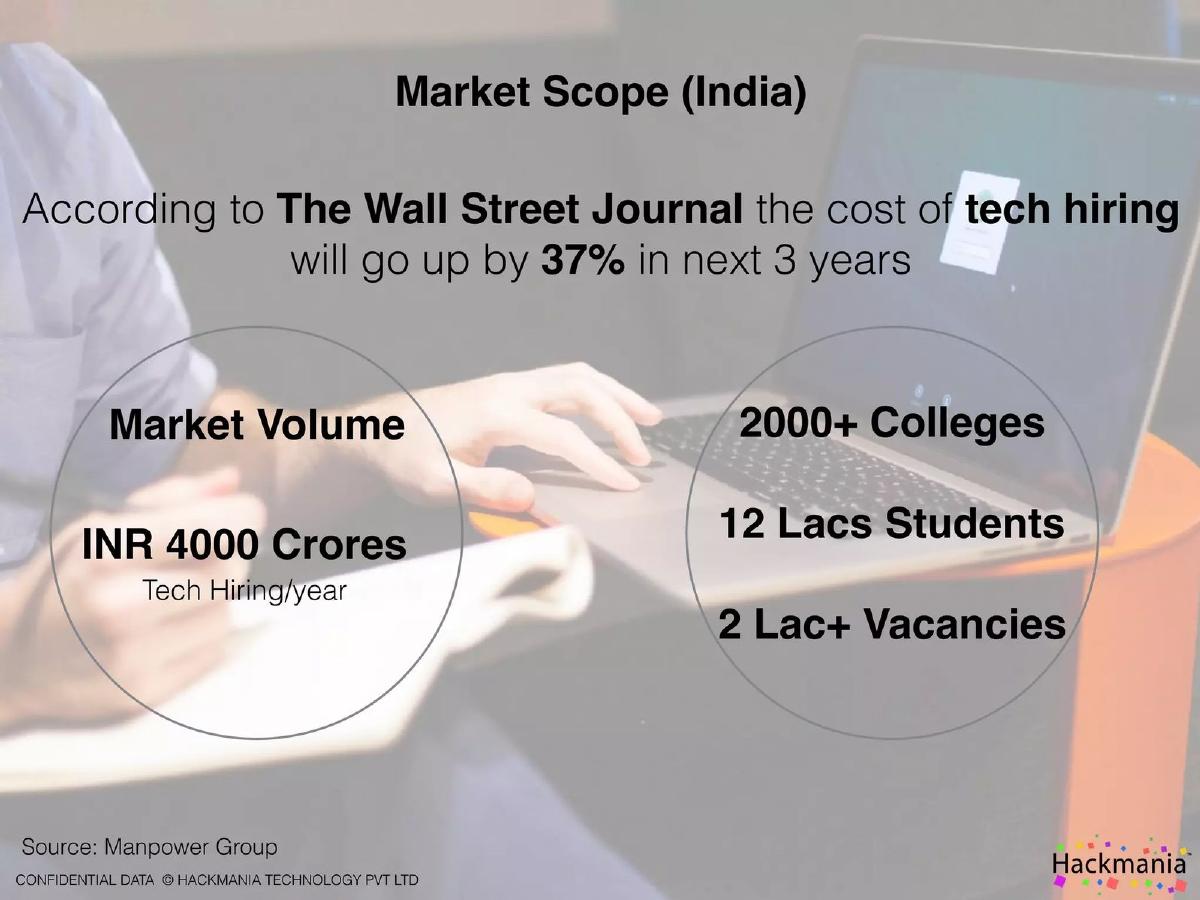
- Hackmania identifies a market volume of INR 4000 Crores for tech hiring in India, with over 12 Lacs students and 2 Lacs+ vacancies (Slide 4).
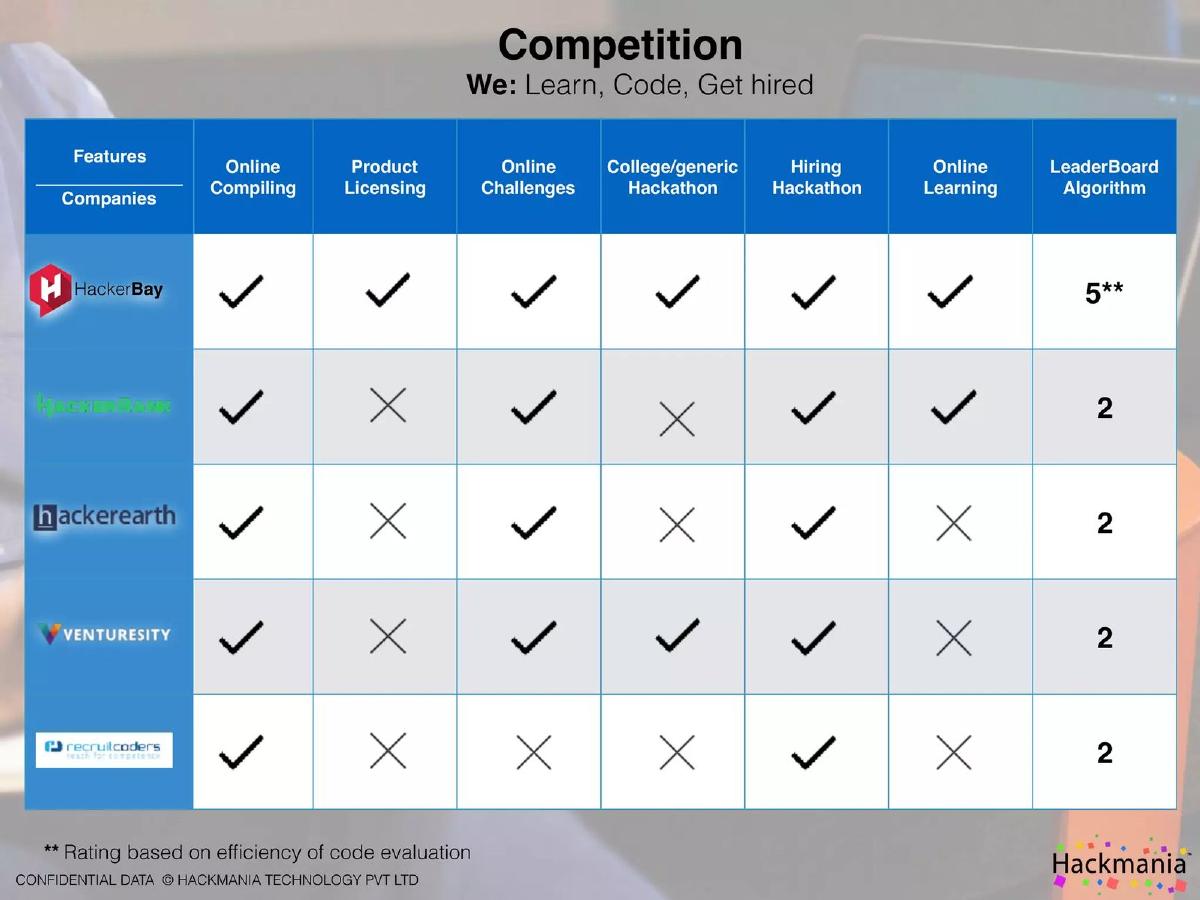
- The product, HackerBay, differentiates itself from competitors like HackerRank and HackerEarth by offering product licensing and a proprietary 'LeaderBoard Algorithm' rated at 5 stars (Slide 5).
- Revenue is generated through three streams: licensing fees for universities/corporates, sponsorship for generic hackathons, and service fees for organizing events (Slide 8).
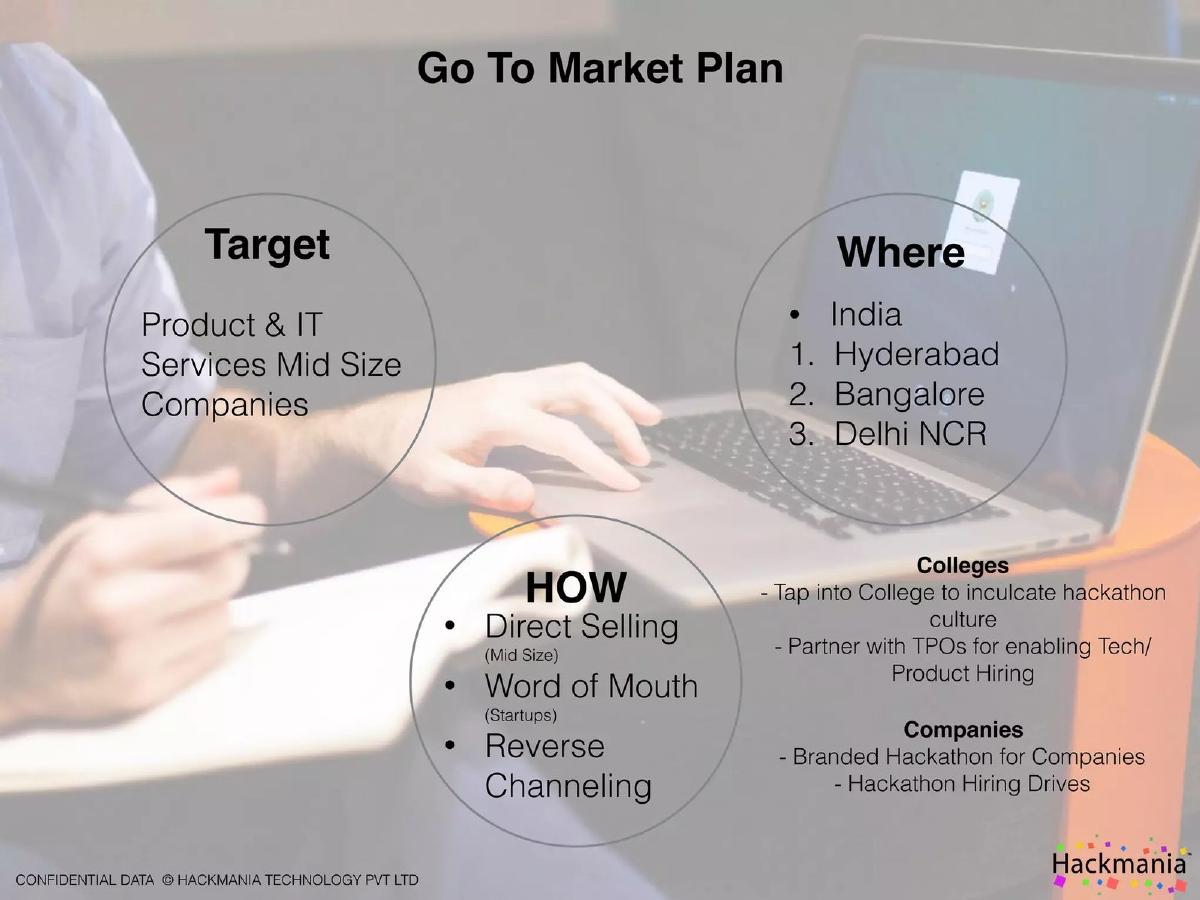
- The startup utilizes 'Reverse Channeling' as a core part of its go-to-market strategy to connect students to hiring companies (Slide 6).
- User growth projections show a sharp spike reaching 300,000 hackers by March 2017 (Slide 9).
- The team is led by Founder & CEO Rajat Shahi and includes a retired military officer, Major Sunil Shetty, as Co-Founder & CSO (Slide 10).
- The deck omits a specific funding request, valuation, or breakdown of how capital will be deployed (Slide 1-12).
Hackmania Pitch Deck: Slide-by-Slide Analysis
Slide 1: Title and Branding
The cover slide introduces the company as Hackmania, with the product branding 'HackerBay' prominently displayed. The subtitle defines the business model: 'Corporate & Hiring Hackathons | Online Challenges.' It also notes that the company is 'Incubated By Progress' and provides the URL hackerbay.co. A legal footer identifies the entity as Hackmania Technology Pvt Ltd.
Slide 2: Problem Statement
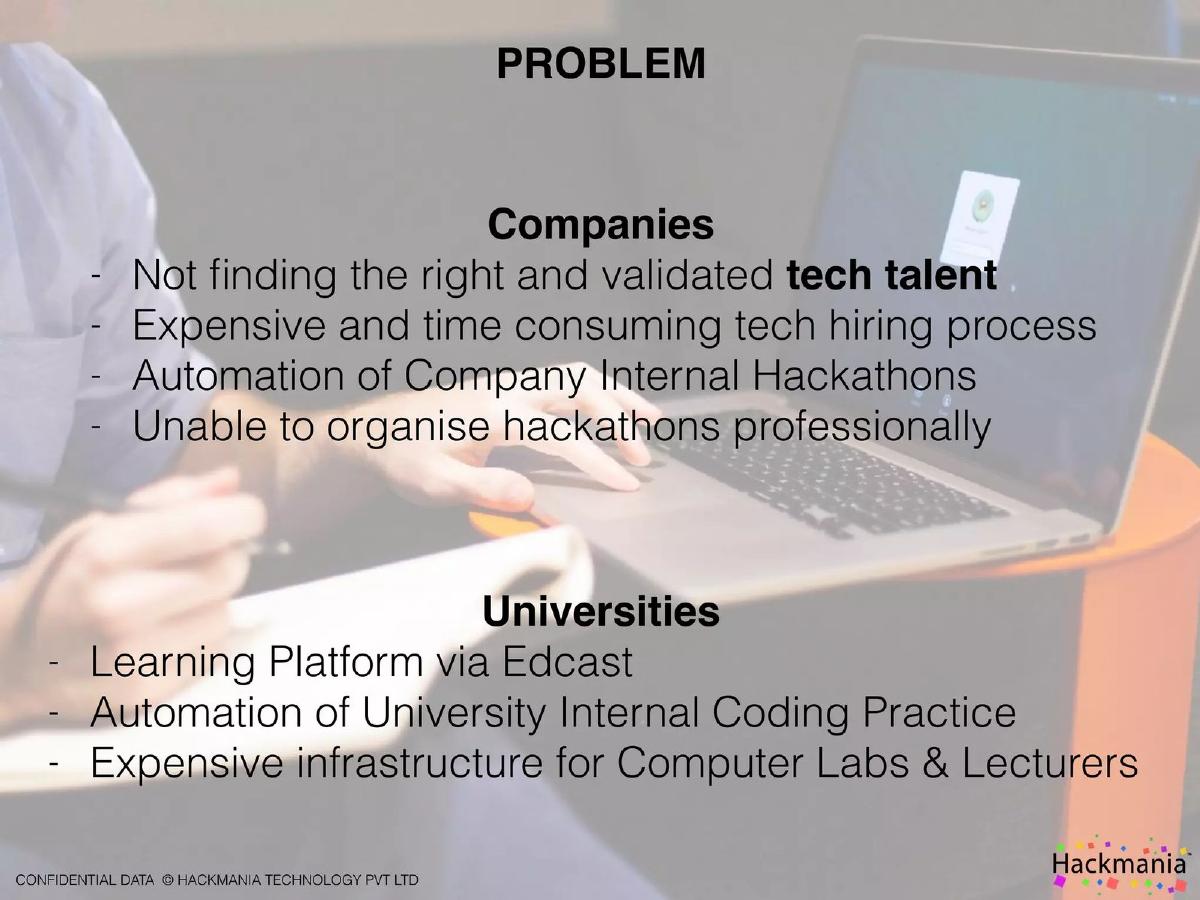
The deck splits the problem into two categories: Companies and Universities. For companies, the focus is on the inability to find 'validated tech talent' and the 'expensive and time consuming' nature of hiring. It also mentions a lack of professional hackathon organization. For universities, the slide cites a lack of automated coding practice and the high cost of labs and lecturers. It mentions 'Edcast' as a learning platform component.
Slide 3: The Solution
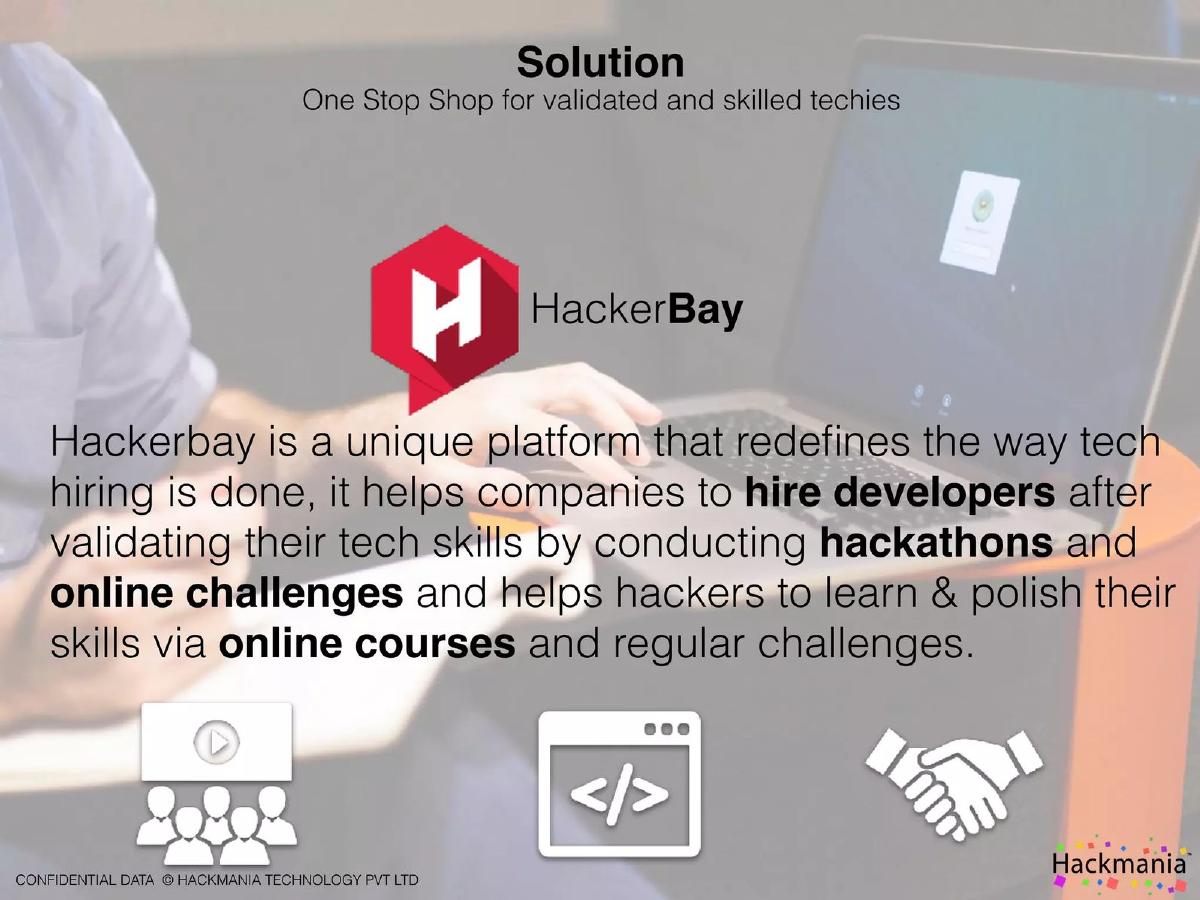
Hackmania positions HackerBay as a 'One Stop Shop for validated and skilled techies.' The slide describes the platform as a tool that helps companies hire developers after validating their skills via hackathons and online challenges. Simultaneously, it serves hackers by providing online courses and regular challenges to 'polish their skills.' Three icons represent learning, coding, and the final hiring handshake.
Slide 4: Market Scope (India)
This slide focuses exclusively on the Indian market. It cites The Wall Street Journal, stating tech hiring costs will rise by 37% in the next three years. Key metrics include a market volume of 'INR 4000 Crores' for tech hiring per year. The talent pool is quantified as 2000+ colleges, 12 Lacs (1.2 million) students, and 2 Lacs+ (200,000+) vacancies. The data is attributed to Manpower Group.
Slide 5: Competitive Landscape
A feature matrix compares HackerBay against HackerRank, HackerEarth, Venturesity, and Recruitcoders. HackerBay claims to be the only provider offering all seven listed features, including 'Product Licensing' and 'College/generic Hackathons.' A specific note at the bottom claims their 'LeaderBoard Algorithm' is rated 5 stars based on 'efficiency of code evaluation,' while all competitors are rated 2 stars.
Slide 6: Go To Market Plan
The strategy is divided into 'Target,' 'Where,' and 'How.' The target is mid-size Product & IT Services companies. The geographic focus is Hyderabad, Bangalore, and Delhi NCR. The 'How' involves direct selling, word of mouth, and 'Reverse Channeling.' For colleges, the plan is to partner with Training and Placement Officers (TPOs) to 'inculcate hackathon culture.'
Slide 7: User Acquisition
Titled 'Getting Hackers On The Platform,' this slide lists acquisition channels: college hackathons, online challenges, generic hackathons, and meetups. It also mentions outreach partners such as '10k' (likely 10,000 Startups), 'TIA' (Tech in Asia), and 'UPTEC.' The Unique Selling Proposition (USP) is stated as a 'large number of quality & validated hackers.'
Slide 8: Revenue Model
The model is tripartite: Licensing (fees from universities and corporates for platform use), Sponsorship (for generic events), and Service Fees (for organizing branded corporate hackathons). It specifies a 'Subscription based PAAS' for corporate hiring processes and a 'weekly practice' fee for colleges to identify top coders.
Slide 9: Status & Market Plans
This slide uses three line graphs to show growth projections. 'Users' (hackers) are projected to jump from near-zero in June 2016 to 300,000 by March 2017. 'College/Companies' shows a target of 300 colleges and approximately 60-70 companies by January 2017. The 'Revenue' graph shows 'Cashflow' reaching a projected 4,000,000 (presumably INR) by early 2017.
Slide 10: Team
The team consists of six members: Rajat Shahi (Founder & CEO), Prashanth Vishwanatha (Co-Founder & CTO), Major(Retd.) Sunil Shetty (Co-Founder & CSO), Tarun Shetty (Director of Finance), Suchith Reddy (Corporate Relations), and Amit Singh (Senior Developer). No prior company experience or educational backgrounds are listed for the members.
Slide 11: Advisors
Two advisors are featured: Miten Mehta (Entrepreneur & Investor) and Ramesh Loganathan (MD, Progress Software). This reinforces the 'Incubated by Progress' claim from the cover slide.
Slide 12: Conclusion and Call to Action
The final slide displays partner logos (Progress, 10,000 Startups, Tech in Asia, UPTEC Idealabs, and Exotel). The call to action is for developers to 'Make your developer profile now' at the HackerBay website. It ends with the hashtag #HappyHacking.
What Hackmania Does Well
The deck identifies a very specific, high-pain-point market: the gap between the volume of engineering graduates in India and the ability of companies to verify their actual coding skills. By targeting both the supply side (universities) and the demand side (corporates), they create a clear ecosystem play. The competitive matrix is aggressive, specifically identifying 'Product Licensing' as a differentiator, which suggests a move toward a scalable SaaS model rather than just a services-based event business. The inclusion of a retired military officer as a Co-Founder and CSO is a unique team element that might suggest a focus on operational discipline or high-level corporate relations.
What is Missing from the Hackmania Deck
The most significant omission is the Fundraising Ask . There is no mention of how much capital the company is seeking, the valuation, or the specific milestones that the investment will fund. Furthermore, while there are revenue and user growth projections on Slide 9, there is no Historical Traction data clearly distinguished from projections. The deck also lacks Unit Economics ; it mentions revenue streams but does not explain the cost of acquisition (CAC) for hackers or the lifetime value (LTV) of a corporate client. Finally, the Team Slide lacks professional pedigree; listing 'Founder & CEO' is standard, but investors typically want to see 'Ex-Google' or 'Sold previous startup for $X' to gauge founder-market fit.
Founder Takeaways: What to Copy and What to Avoid
Copy the Market Segmentation: Slide 2 is a strong example of how to present a multi-sided problem. By clearly delineating the pain points for companies versus universities, the founders show they understand the incentives of everyone in their ecosystem. Copy the Revenue Diversification: Slide 8 shows a healthy mix of recurring revenue (licensing/SaaS) and transactional revenue (service fees/sponsorships), which provides both stability and immediate cash flow.
Avoid the 'Perfect' Feature Matrix: Slide 5 falls into a common trap where the startup gives itself a checkmark for everything and gives competitors 'X' marks. While this looks good on a slide, savvy investors know that companies like HackerRank have deep feature sets. Claiming a '5-star' algorithm while giving industry leaders '2 stars' without providing a technical white paper or third-party validation can come across as unsubstantiated. Avoid Vague Growth Charts: The graphs on Slide 9 lack clear labeling of historical vs. projected data. Using a single line that suddenly spikes vertically (as seen in the 'Users' graph) often signals 'hockey stick' projections that aren't backed by a clear acquisition engine description.
Frequently asked questions
- What is the primary problem Hackmania aims to solve?
- According to Slide 2, the company addresses two main issues. For companies, it solves the problem of not finding 'validated' tech talent and the high costs associated with hiring. For universities, it addresses the lack of automated coding practice platforms and the high expense of computer lab infrastructure and lecturers.
- How does Hackmania differentiate itself from established competitors like HackerRank?
- Slide 5 provides a feature comparison matrix. Hackmania (HackerBay) claims to offer 'Product Licensing' and 'College/generic Hackathons,' features it marks as missing from HackerRank and HackerEarth. It also claims a superior 'LeaderBoard Algorithm' for code evaluation, giving itself a 5-star rating compared to 2 stars for its rivals.
- What are the specific revenue streams mentioned in the deck?
- Slide 8 outlines three primary models: 1) Licensing, where universities and corporates pay to use the platform; 2) Sponsorship, specifically for generic hackathons; and 3) Service Fees, which are paid by companies to conduct branded hiring drives or corporate hackathons.
- What is the geographic focus of the company's go-to-market plan?
- Slide 6 specifies that the initial focus is on India, specifically targeting three major tech hubs: Hyderabad, Bangalore, and Delhi NCR. The plan involves direct selling to mid-size companies and partnering with Training and Placement Officers (TPOs) at colleges.
- Who are the key advisors supporting the startup?
- Slide 11 lists two advisors: Miten Mehta, identified as an entrepreneur and investor, and Ramesh Loganathan, who is the Managing Director of Progress Software. The cover slide also notes that the company was 'Incubated By Progress.'