Hakio’s Seed deck is a concise, 9-slide presentation that successfully raised $4.3M in 2024. The narrative centers on the massive financial inefficiency of the fashion supply chain, specifically the €1.1 trillion lost to poor demand forecasting. By utilizing machine learning models that process 30-70 attributes per SKU, Hakio demonstrates a significant reduction in forecast error—reducing mean absolute percentage error by up to 60% for enterprise clients. The deck is notable for its lack of a team slide, roadmap, or specific funding ask, suggesting it may be a subset of a larger presentation…
Key takeaways
- The deck identifies a €1.1 trillion global waste problem caused by poor demand planning (Slide 3).
- Hakio uses ensemble modeling with 30-70 attributes to outperform standard forecasting algorithms (Slide 2).
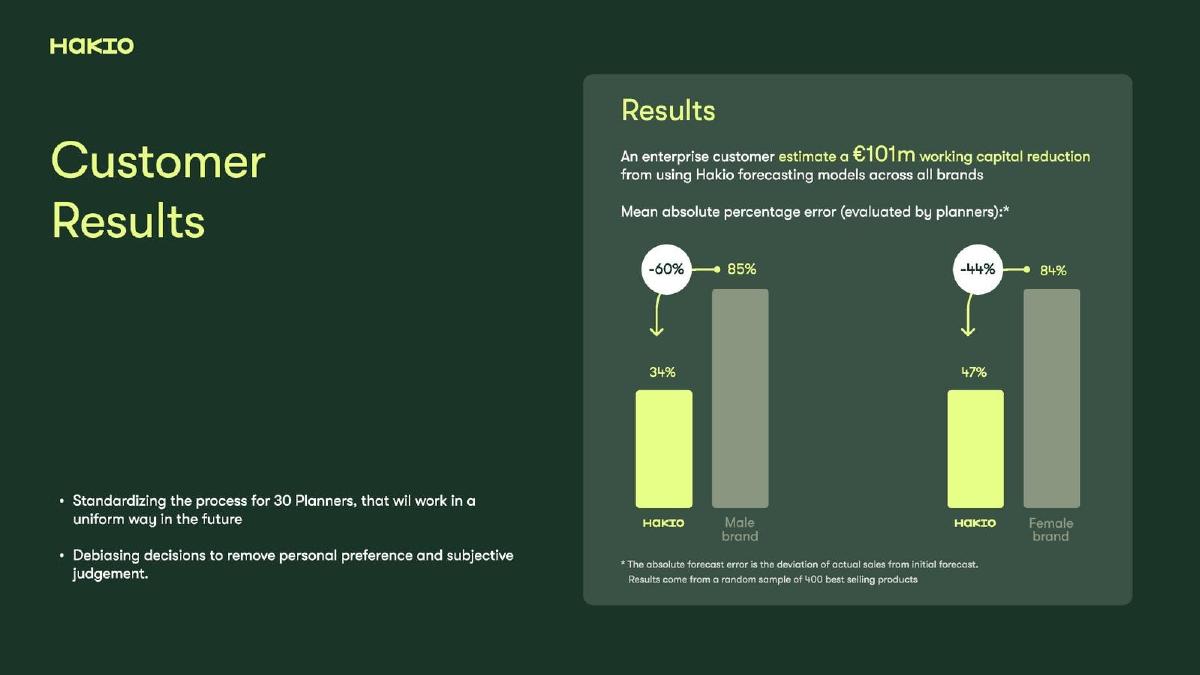
- A single enterprise customer estimated a €101m reduction in working capital using the platform (Slide 7).
- The software reduced forecast error for a male brand from 85% to 34% (Slide 7).
- Market sizing is broken down by industry spend, identifying a €144b total addressable market for planning across all product companies (Slide 8).
- The company plans to target Danish medium-to-large fashion companies in 2024 before international expansion in 2025 (Slide 9).
- The technical approach is summarized by a mathematical formula for sales forecasting that includes model weights and error variables (Slide 6).
- The deck completely omits a team slide, a competition slide, and a specific financial ask.
The 9-Slide Logic of Fashion Forecasting
Hakio’s pitch deck is a focused, data-heavy presentation that prioritizes the 'what' and the 'how' over the 'who.' Raising $4.3M in a Seed round in 2024, the Danish startup leans into the technical superiority of its AI and the massive financial drain of the status quo in fashion retail. The deck is visually clean, using a dark green and lime palette that suggests both sustainability and growth.
Slide 1: Title Slide
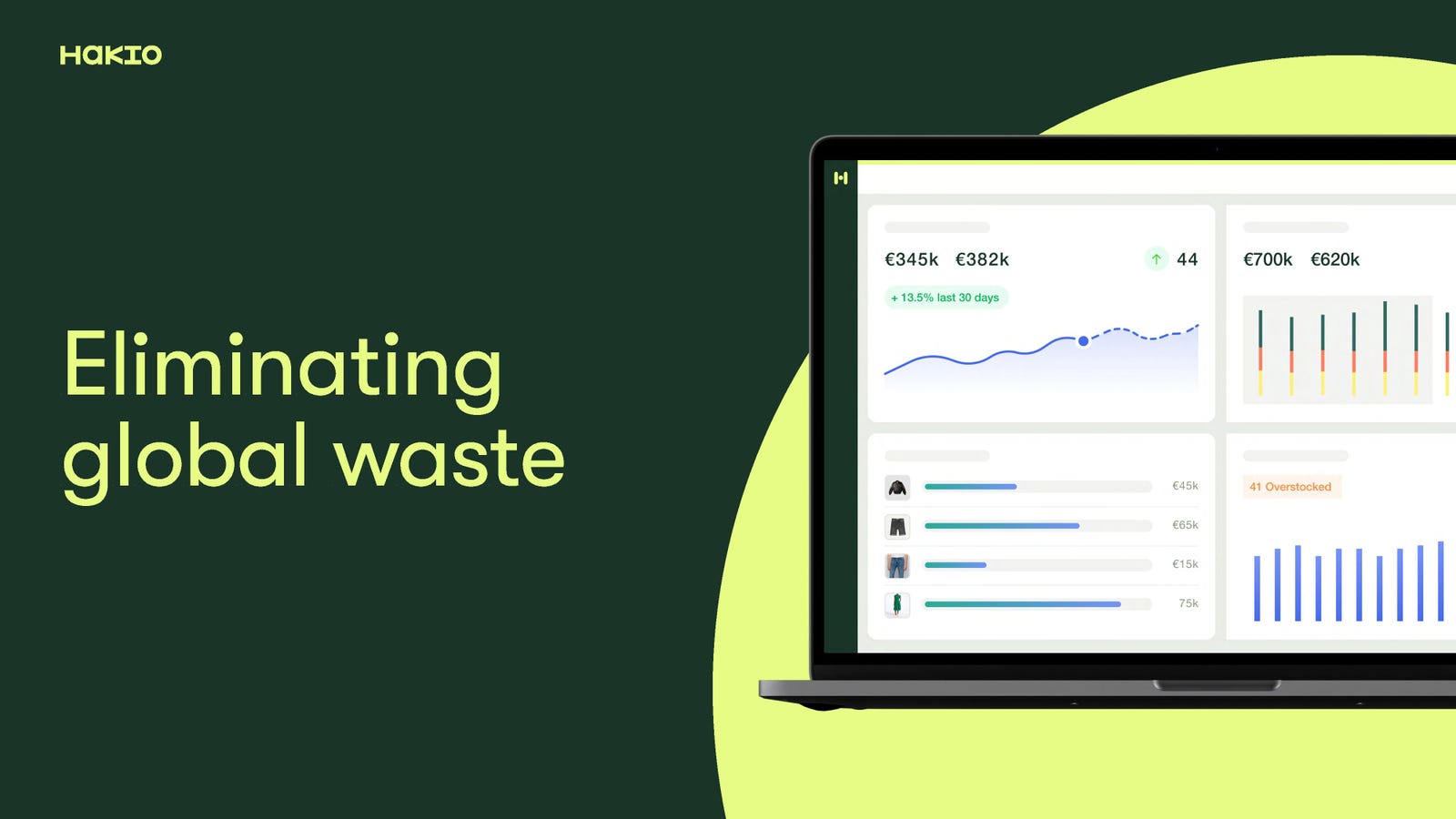
The deck opens with the company logo and a bold mission statement: "Eliminating global waste." A laptop mockup shows a dashboard with financial metrics (€345k, €382k) and inventory alerts ("41 Overstocked"). This immediately positions the company as a B2B SaaS tool focused on bottom-line efficiency rather than just a creative fashion tool.
Slide 2: The Value Proposition
Slide 2 gets straight to the technical hook: "We enhance forecasting accuracy using machine learning algorithms." The subtext explains that they go beyond standard algorithms by using 30-70 attributes to capture market trends. They mention "ensemble modelling" to ensure performance across all SKUs. This is a high-level technical promise designed to appeal to investors looking for defensible AI applications.
Slide 3: The Problem Statement
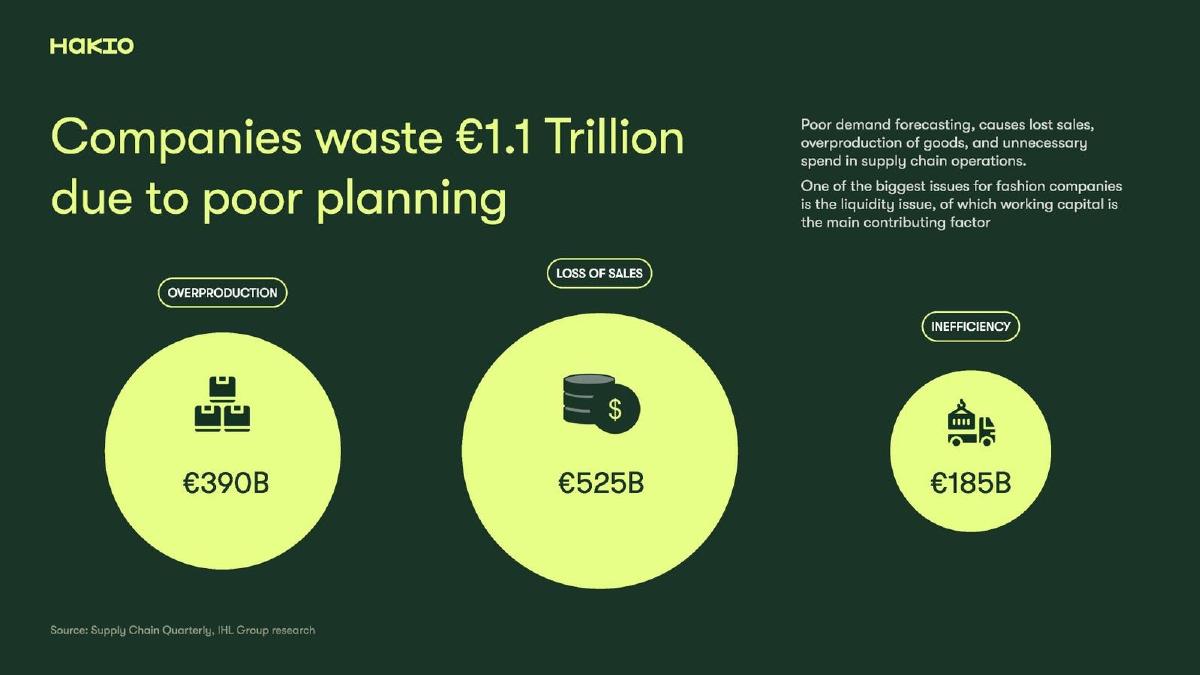
This is the 'Big Number' slide. Hakio claims companies waste €1.1 Trillion due to poor planning. They break this down into three buckets: €390B in overproduction, €525B in loss of sales, and €185B in general inefficiency. Citing Supply Chain Quarterly and IHL Group research, the slide argues that working capital is the main contributing factor to liquidity issues in fashion. It’s a classic, effective problem slide that quantifies the pain point in euros.
Slide 4: Transition to Solution
Slide 4 is a simple transition slide labeled "Solution" with an image of a clothing rack. While aesthetically pleasing, it adds little information and could have been combined with the following slide to save space in such a short deck.
Slide 5: The Product in Action
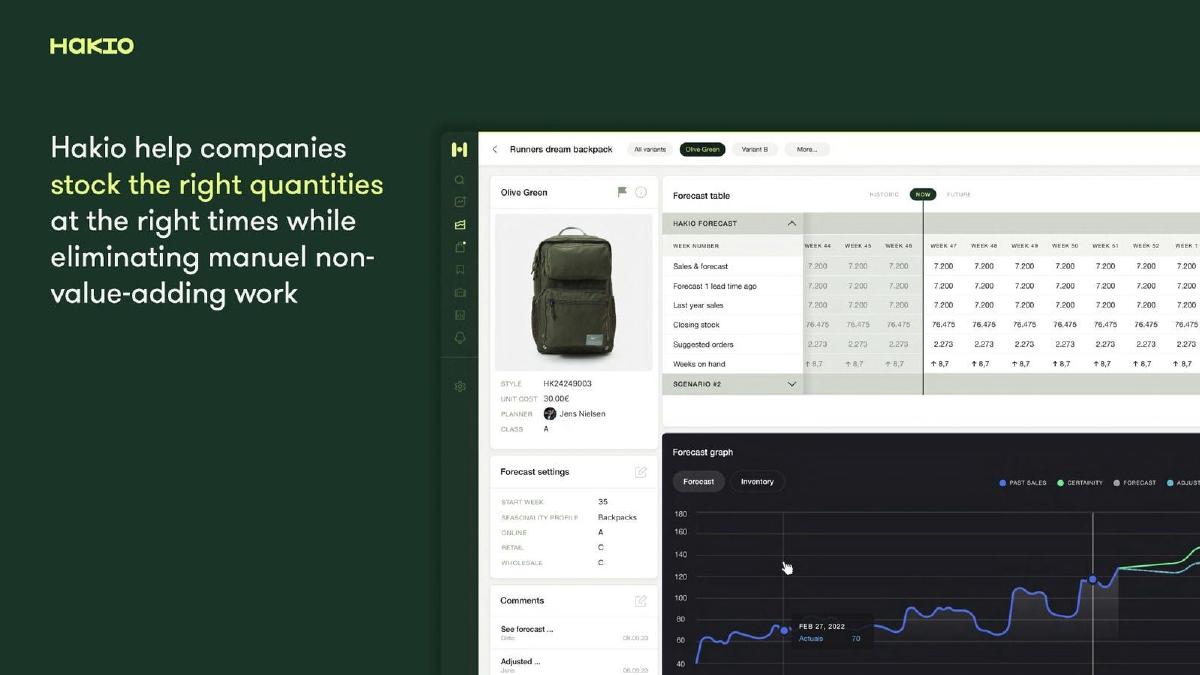
Slide 5 provides a detailed look at the software interface. The text states that Hakio helps companies "stock the right quantities at the right times while eliminating manuel [sic] non-value-adding work." The screenshot shows a "Forecast table" with rows for Sales & forecast, Last year sales, Closing stock, and Suggested orders. It also shows a "Forecast graph" with a certainty interval. This slide proves the product is built and functional, showing exactly how a demand planner would interact with the data.
Slide 6: The Technical "Secret Sauce"
Slide 6 uses a mathematical formula to explain their methodology: Sales = Σ a f(x) + ε. It labels the components: Model weights, Machine learning models, Customer/Style data, and Forecast error. The text explains they maintain a library of models and use "out-of-sample analysis" to weight each model for new customers. This slide is intended to satisfy the technical due diligence of a Seed round, showing that the AI isn't just a wrapper but a sophisticated ensemble of models.
Slide 7: Customer Results and Validation
This is arguably the strongest slide in the deck. It provides concrete ROI: "An enterprise customer estimate a €101m working capital reduction." It also shows a bar chart comparing Hakio’s forecast error to the previous manual process. For a "Male brand," the error dropped from 85% to 34% (a 60% reduction). For a "Female brand," it dropped from 84% to 47% (a 44% reduction). Providing specific, audited-style results from a random sample of 400 products gives the claims immense credibility.
Slide 8: Market Sizing (TAM/SAM/SOM)
Slide 8 quantifies the opportunity. It estimates industry spend on planning at €144b for all product companies, narrowing down to €3.2b for fashion & lifestyle companies with over 50 employees, and finally €0.8b for the apparel-specific segment. By using employee counts (5,500 global companies) and citing LinkedIn statistics, they provide a grounded, bottom-up feel to their market sizing.
Slide 9: Global Potential and Roadmap
The final slide maps out the ARR potential by region: €210m in the US (900 accounts), €350m in Europe (1,500 accounts), and €250m for the rest of the world. It concludes with a simple timeline: targeting Danish companies in 2024 and international markets from 2025. This provides a clear, albeit brief, look at their geographic strategy.
What Hakio Does Well
Quantified Pain and Gain: Hakio avoids vague promises. They cite a €1.1 trillion problem and counter it with a €101m customer saving. The use of specific percentage reductions in forecast error (Slide 7) is exactly what Seed investors need to see to believe in the product's efficacy.
Technical Transparency: Many AI startups hide behind buzzwords. Hakio actually shows a simplified version of their logic (Slide 6) and explains the use of ensemble modeling and specific attribute counts (Slide 2). This builds trust with technical reviewers.
Focus: The deck doesn't try to be everything to everyone. It is clearly focused on the fashion and apparel industry, which allows the metrics and the UI examples to feel highly relevant to that specific vertical.
What is Missing from the Hakio Deck
The Team: The most glaring omission is a team slide. In a Seed round, the founders' backgrounds are often as important as the technology. There is no mention of who is building this or why they are qualified to disrupt fashion supply chains.
The Ask: The deck does not state how much money they are looking for, what the valuation expectations are, or how the funds will be allocated. While this information is often shared in a separate document or follow-up, its absence here makes the deck feel like a teaser rather than a full pitch.
Competition: There is no mention of existing ERP systems, legacy forecasting tools, or other AI competitors in the space. Investors will inevitably ask how Hakio differs from Blue Yonder, SAP, or other startups like 7Learnings.
Unit Economics: While they show customer ROI, they don't show company ROI. There is no mention of their pricing model, CAC (Customer Acquisition Cost), or LTV (Lifetime Value).
Founder Takeaways
Use real data early: If you have a pilot or an early enterprise customer, put their results front and center. Hakio’s Slide 7 is the "closer" of this deck because it moves from theory to proven financial impact.
Map your market by accounts, not just billions: Slide 9 breaks the market down into "accounts" (e.g., 900 accounts in the US). This is much more helpful for a sales-led growth strategy than just saying "The US market is worth $X billion." It shows you know exactly how many doors you need to knock on.
Visual consistency matters: The deck uses a very tight color palette and consistent typography. This professional polish suggests a level of attention to detail that investors associate with a well-run product team.
Frequently asked questions
- How much did Hakio raise with this deck?
- According to publisher-reported facts from Business Insider, Hakio raised $4.3M in a Seed round in 2024. The deck itself does not state the amount raised or the terms of the round.
- What is the core technology behind Hakio?
- Hakio uses machine learning algorithms and ensemble modeling. As stated on Slide 2 and Slide 6, they use 30-70 attributes to capture market abnormalities and combine multiple prediction models to ensure high accuracy for all SKUs.
- Who are the founders of Hakio?
- The provided 9-slide deck does not include a team slide or mention the founders by name. This is a significant omission for a Seed-stage deck, which usually emphasizes founder-market fit.
- What specific problem does Hakio solve for fashion brands?
- Hakio addresses the 'liquidity issue' caused by poor demand forecasting. Slide 3 notes that €390B is lost to overproduction and €525B to lost sales, primarily due to unnecessary working capital being tied up in inventory.
- What is Hakio's go-to-market strategy?
- As per Slide 9, Hakio is focusing on Danish medium-to-large fashion companies throughout 2024. They plan to expand internationally starting in 2025, targeting a global market they estimate at €810m in total ARR potential.