Pliant’s Series A deck is a lean, 10-slide document that prioritizes momentum over exhaustive technical detail. The company, a Berlin-based fintech, raised $28M in 2023 by positioning itself as the modern alternative to legacy banking systems for European SMBs. The deck excels at demonstrating product-market fit through high-conviction metrics, such as >200% MRR retention and a 40% demo-to-activation conversion rate. While it lacks a formal 'Ask' slide or detailed unit economics, it compensates with a powerful team slide featuring 100+ years of collective fintech experience. The narrative fol…
Key takeaways
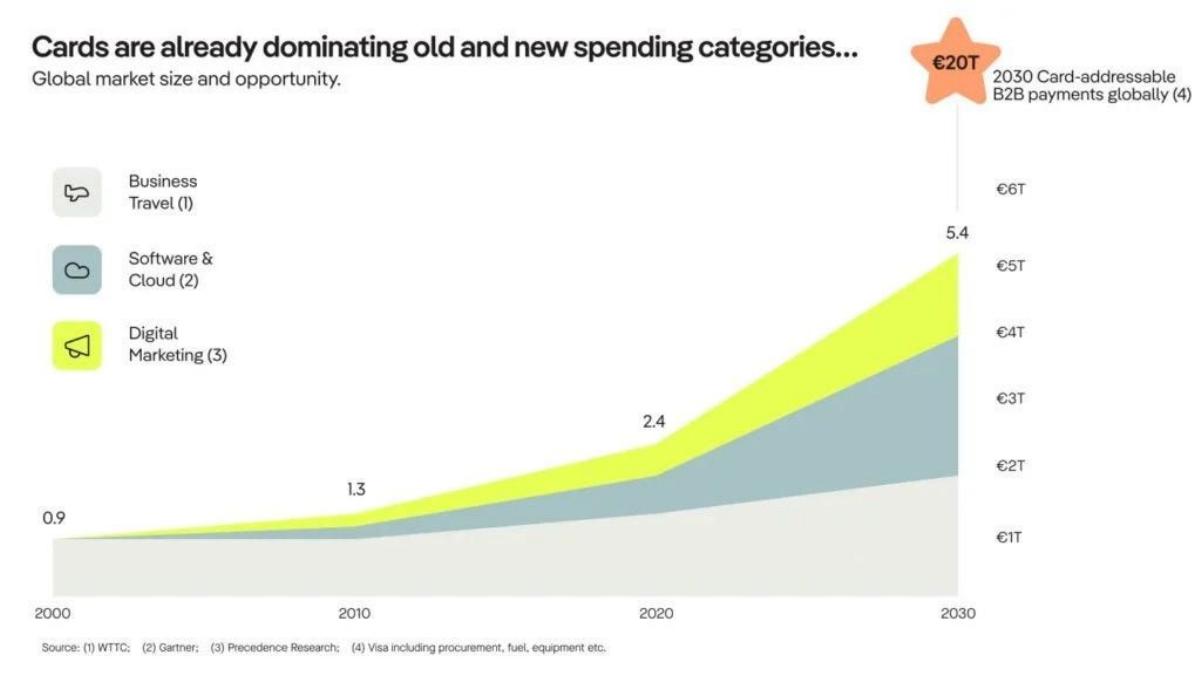
- The deck identifies a €20T card-addressable B2B payment market by 2030 on slide 3.
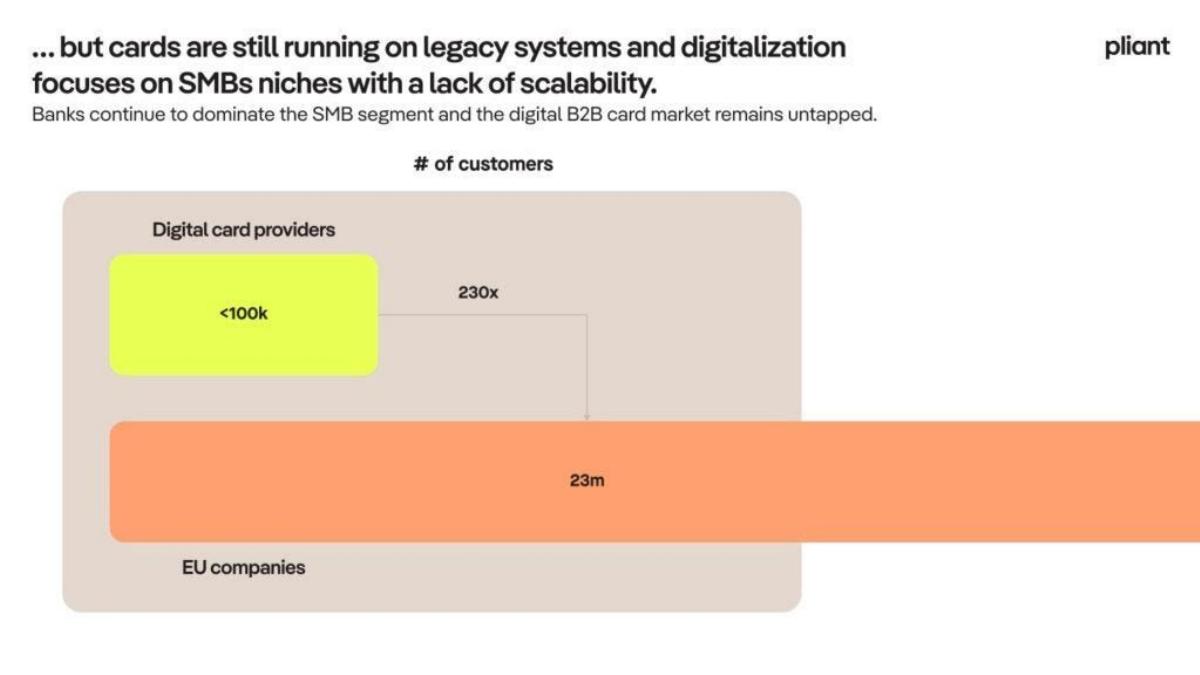
- Pliant claims a massive market gap, noting that digital card providers currently serve <100k of the 23m EU companies (slide 4).
- Financial highlights on slide 7 report >200% MRR retention after one year, a top-tier SaaS metric.
- Operational efficiency is signaled by a 40% conversion rate from demo to activation (slide 7).
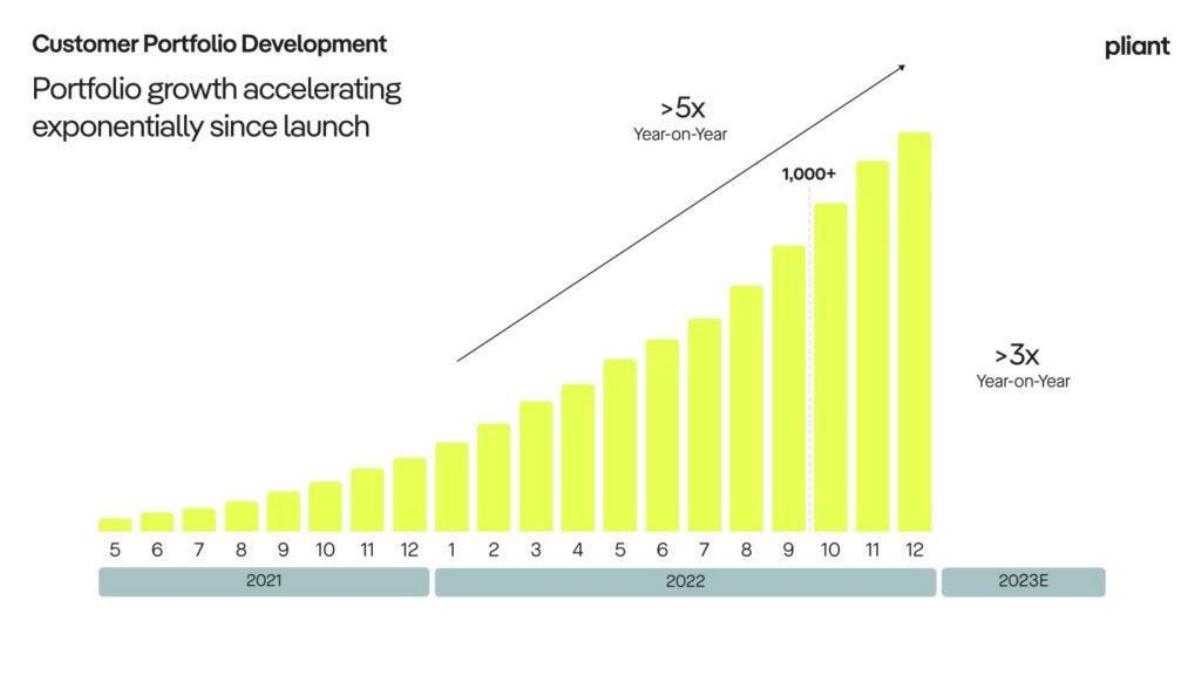
- The customer base grew by >5x year-over-year, reaching over 1,000 customers by late 2022 (slide 8).
- The platform is live in 8 EU countries and includes credit lines as a core offering (slide 7).
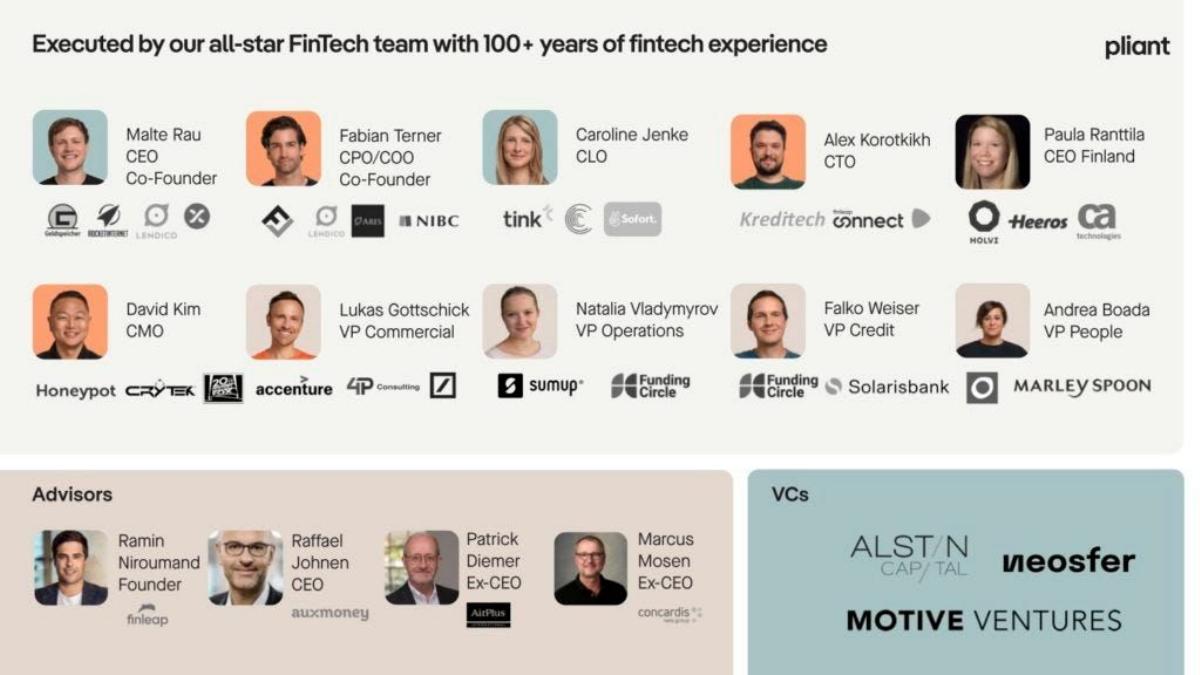
- The team slide emphasizes institutional credibility, citing 100+ years of fintech experience and backing from VCs like Motive Ventures and Neosfer (slide 9).
- The deck completely omits a specific funding 'Ask' or a breakdown of how the $28M will be allocated.
The Narrative Arc: From Macro Opportunity to Micro Execution
Pliant’s 10-slide deck is a study in brevity and momentum. As reported by Business Insider, this deck helped secure a $28M Series A in 2023. The structure is lean, focusing on the massive gap between legacy banking capabilities and the modern needs of European SMBs. By leading with the 'why' of B2B cards before diving into their specific growth metrics, Pliant builds a case for cards as the ultimate B2B payment rails.
Slide 1: Title and Visual Hook
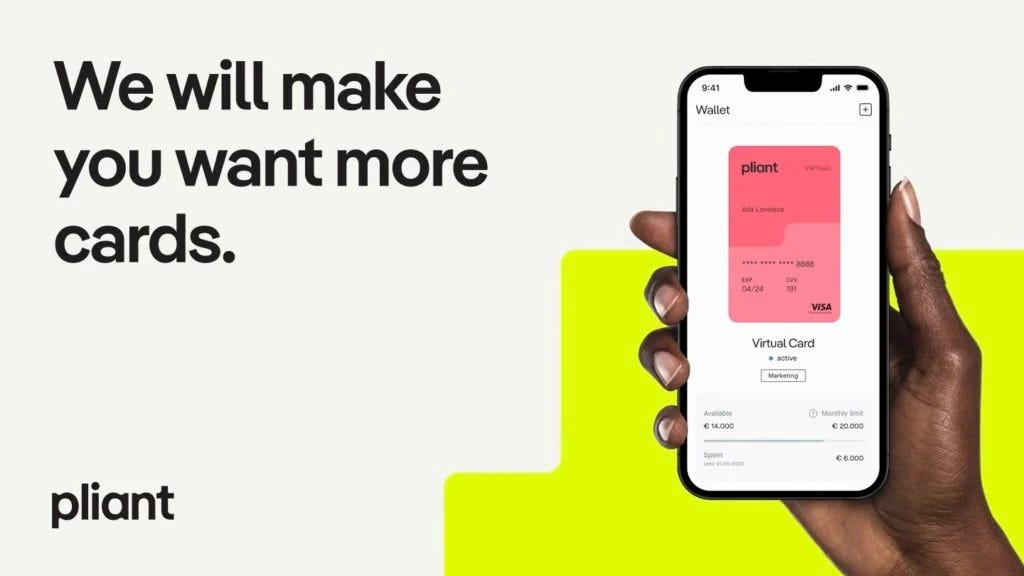
The deck opens with the bold statement: "We will make you want more cards." This is paired with a high-quality product shot of a virtual card on a mobile device. It establishes the brand identity immediately—clean, modern, and focused on the user experience. The slide does not list the round size or date, keeping the focus entirely on the mission.
Slide 2: The Value Proposition of Cards
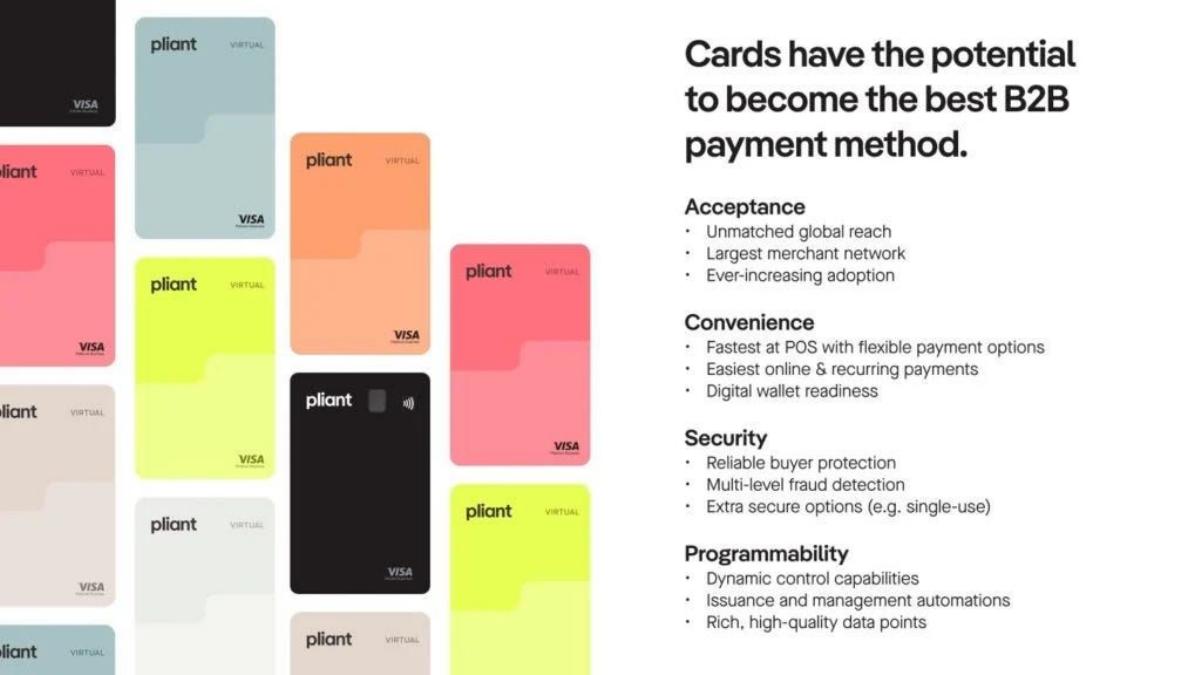
Slide 2 serves as a foundational argument for the card industry. It breaks down why cards are superior to other B2B payment methods across four pillars: Acceptance (global reach), Convenience (speed at POS), Security (fraud detection), and Programmability (automation). This slide is designed to educate investors who might view cards as a commodity, reframing them as a high-tech software layer.
Slide 3: Market Size and Addressable Opportunity
Pliant presents a compelling macro-economic chart on slide 3. It projects the 2030 Card-addressable B2B payments globally at €20T . The chart tracks growth from 2000 to 2030, highlighting specific high-growth spend categories: Business Travel, Software & Cloud, and Digital Marketing. By citing sources like Gartner and WTTC, Pliant grounds its ambitious projections in third-party data.
Slide 4: The Legacy Gap
This slide identifies the specific market inefficiency Pliant intends to exploit. It contrasts the 23m EU companies with the <100k currently served by digital card providers. The slide explicitly states that banks continue to dominate the SMB segment but lack scalability, leaving the digital B2B card market largely untapped. The visual uses a simple box-in-box diagram to show that digital providers have captured less than 1/230th of the total market.
Slide 5: The Product Solution
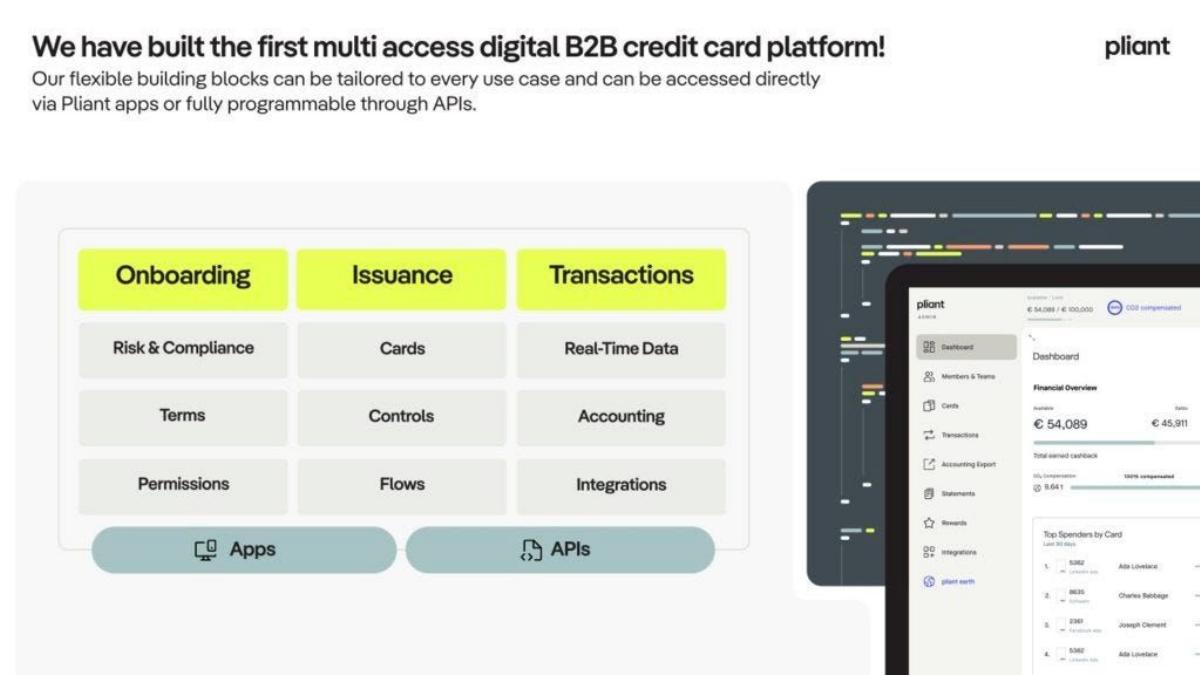
Slide 5 introduces the "first multi-access digital B2B credit card platform." It uses a grid of 'building blocks' to explain the technical architecture. The platform is divided into three core functions: Onboarding (Risk, Terms, Permissions), Issuance (Cards, Controls, Flows), and Transactions (Real-Time Data, Accounting, Integrations). Crucially, it notes that these can be accessed via Apps or APIs , signaling a dual-track strategy to capture both end-users and embedded finance partners.
Slide 6 & 7: Traction and Key Highlights
Slide 6 is a simple transition slide titled "Pliant to date." It is followed by Slide 7, which contains the most critical data in the deck. The company categorizes its success into three buckets:
Financial Highlights: >5x customer base growth, >200% MRR retention after 1 year, and ~4x ARR growth. · Operational Highlights: Demo to activation conversion around 40% and customer churn <0.1%. · Strategic Highlights: Live in 8 EU countries and piloting with large European banks.
The >200% MRR retention is a 'holy grail' metric for investors, indicating that Pliant’s product is deeply embedded in customer workflows.
Slide 8: Customer Portfolio Development
This slide provides a visual representation of the growth mentioned on the previous slide. It shows a bar chart of customer acquisition from May 2021 through December 2022. The chart shows a clear exponential curve, crossing the 1,000+ customer mark in late 2022. A projection for 2023 suggests a >3x Year-on-Year growth target, maintaining the narrative of aggressive scaling.
Slide 9: The Team and Backers
The 'All-Star' team slide is densely packed with logos and faces. It lists 10 key executives, including founders Malte Rau and Fabian Terner. The slide emphasizes 100+ years of fintech experience , with logos from Tink, SumUp, Funding Circle, and Solarisbank. Below the team, it lists advisors and current VCs, including Motive Ventures, Neosfer, and Alstin Capital . This slide is designed to de-risk the investment by showing that the leadership has 'been there, done that' in the fintech space.
Slide 10: The Mission Statement
The deck concludes with a simple mission statement: "Make cards the best B2B payment method globally." It mirrors the opening slide, providing a clean bookend to the presentation. Notably, there is no 'Ask' slide here—no mention of the $28M target or how the funds will be used, which suggests this version of the deck was used for storytelling rather than a cold pitch.
What Pliant Does Well
Pliant excels at metric-driven storytelling . Instead of spending five slides on product features, they use one slide (Slide 5) to explain the 'how' and two slides (Slide 7 and 8) to prove the 'result.' The inclusion of >200% MRR retention is a masterstroke; it immediately differentiates them from low-margin commodity card issuers by suggesting a high-value, 'sticky' software component. The team slide is also exceptionally strong, using recognizable logos to borrow institutional authority.
What is Missing from the Deck
The most glaring omission is the Financial Ask and Use of Funds . While we know from publisher reports that they raised $28M, a standard pitch deck usually includes a slide detailing how that capital will be deployed (e.g., 40% engineering, 30% marketing, 30% geographic expansion). Additionally, the deck lacks a Competitive Landscape slide. In a crowded market with players like Brex, Ramp, and Spendesk, failing to explicitly state their 'moat' against these competitors is a missed opportunity to control the narrative. Finally, there is no mention of Unit Economics (LTV/CAC ratios), which are usually scrutinized heavily in Series A fintech rounds.
Founder Takeaways: What to Copy
Founders should emulate Pliant’s clarity of market sizing . Slide 3 doesn't just show a big number; it breaks down the specific categories of spend that drive that number. This makes the TAM (Total Addressable Market) feel achievable rather than imaginary. Furthermore, the 'Building Blocks' visualization on Slide 5 is an excellent way to explain a complex technical platform without getting bogged down in code or architecture diagrams. It allows an investor to see the breadth of the offering at a single glance. Lastly, the use of retention as a primary growth metric is a powerful way to signal product-market fit that goes beyond simple top-line revenue growth.
Frequently asked questions
- What is Pliant's core value proposition?
- Pliant positions itself as a 'multi-access digital B2B credit card platform.' According to slide 5, the platform offers flexible building blocks for onboarding, issuance, and transactions that can be accessed via their own apps or integrated into other systems through APIs. This allows them to serve both standard SMB needs and more complex, programmable use cases that legacy banks struggle to support.
- How does Pliant justify the market opportunity?
- On slide 3, the company cites a €20 trillion card-addressable B2B payment market by 2030. They specifically target three growing categories: Business Travel, Software & Cloud, and Digital Marketing. Slide 4 highlights the 'untapped' nature of the market, showing that current digital card providers have reached less than 0.5% of the 23 million companies in the European Union.
- What are the most impressive metrics in the deck?
- The standout figure is the >200% MRR retention after one year, mentioned on slide 7. This suggests that existing customers are not only staying with the platform but significantly increasing their spend. Additionally, the deck reports a >5x increase in the customer base and a demo-to-activation conversion rate of approximately 40%, indicating strong sales efficiency.
- Who is behind the company?
- Slide 9 showcases an 'all-star' team with over 100 years of combined fintech experience. Founders Malte Rau and Fabian Terner have backgrounds at companies like Rocket Internet and Lendico. The broader leadership team includes veterans from SumUp, Funding Circle, and Solarisbank, providing the regulatory and operational credibility required for a high-growth fintech firm.
- What is missing from this pitch deck?
- The deck is notably missing a slide detailing the specific funding amount sought or the intended use of proceeds. It also lacks a detailed competitor matrix, unit economics (like CAC or LTV), and a clear roadmap for future product development beyond the current 8 EU countries. These omissions suggest the deck was likely used as a high-level teaser or for a round where the lead was already secured.