Plum Fintech’s 9-slide deck is remarkably lean, relying heavily on the pedigree of its founders and the application of behavioral economics. Founded by early employees from TransferWise and Tictail, the team used their 'insider' status to validate a simple premise: people are bad at saving, so an AI-driven chatbot should do it for them. The deck avoids dense financial modeling in favor of high-level market gaps—specifically that 97% of savings earn less than inflation (Slide 5). With early traction showing 20% month-over-month user growth (Slide 7), Plum successfully pitched a vision of 'auto…
Key takeaways
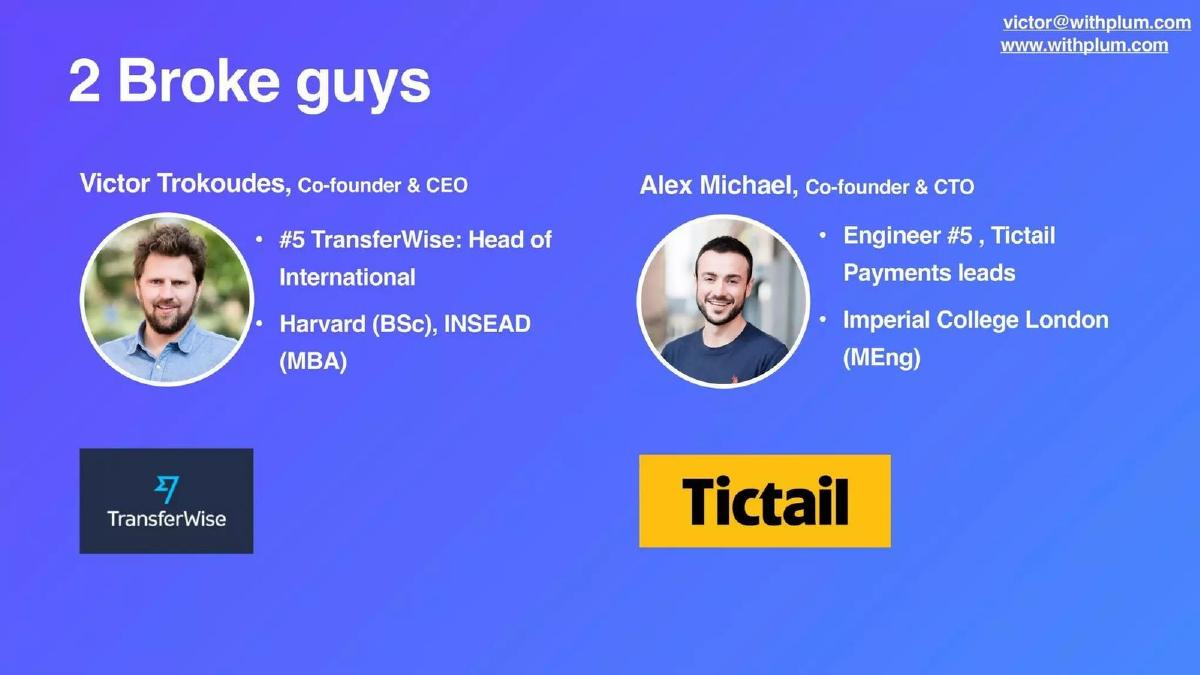
- The deck relies on founder pedigree, highlighting Victor Trokoudes as TransferWise employee #5 and Alex Michael as Tictail employee #5 (Slide 2).
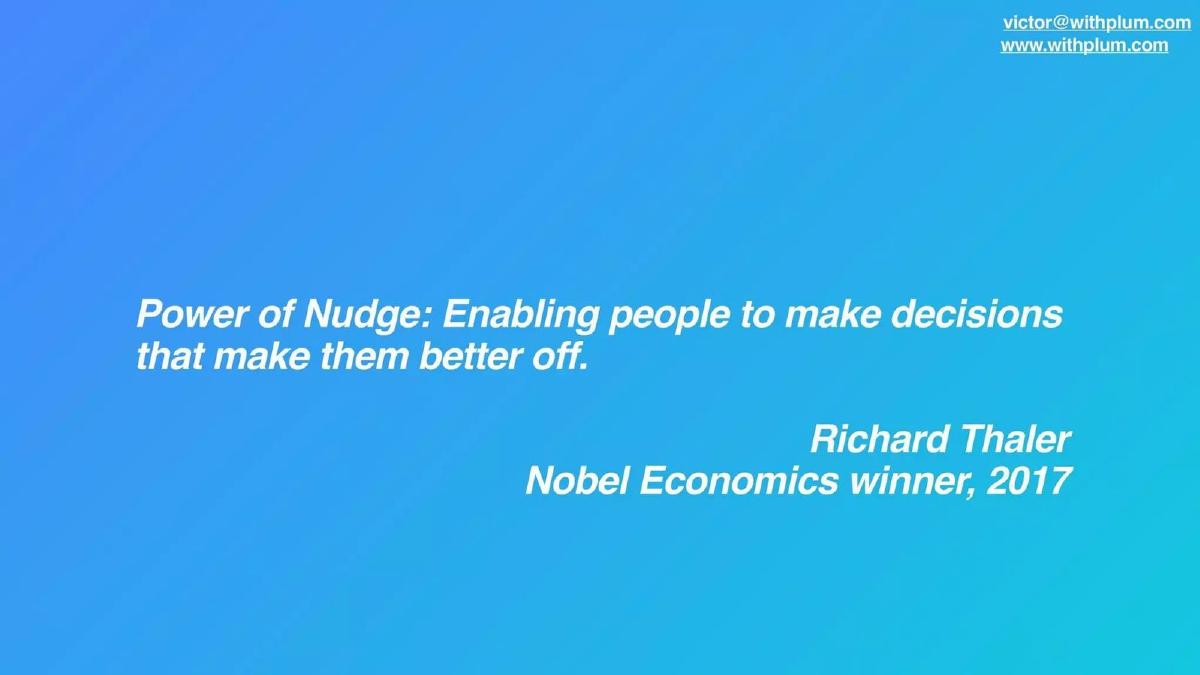
- Plum anchors its entire product philosophy on Richard Thaler’s 'Nudge' theory, explicitly citing the 2017 Nobel Economics winner (Slide 3).
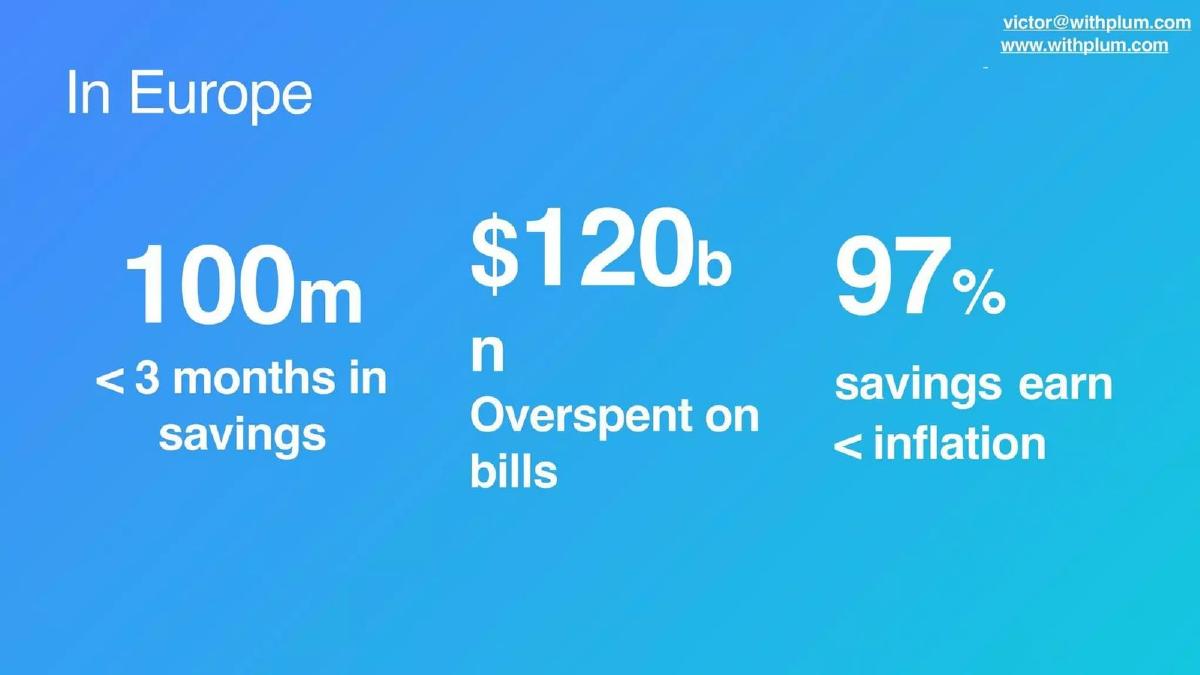
- The problem is quantified by a massive market gap: 100 million people in Europe have less than 3 months of savings (Slide 5).
- The product is positioned as a simple AI chatbot interface, removing the friction of traditional banking apps (Slide 4).
- Plum claims a 4% return as a core value proposition, contrasting it against the fact that 97% of savings earn less than inflation (Slide 5, Slide 6).
- Early traction is demonstrated through high-velocity growth metrics: 20% MoM user growth and 50% MoM growth in savings (Slide 7).
- The monetization strategy is a three-step funnel: acquire users, generate revenue via 'switching' services, and scale through recurring investment fees (Slide 8).
- At the time of this deck, the company had already raised $1.8m to date (Slide 9).
The Power of the 'Insider' Pitch
Plum Fintech’s pitch deck is a fascinating example of how much weight a founder’s resume carries in the venture capital world. With only nine slides, the deck doesn't spend time explaining the intricacies of Open Banking or the technical architecture of their AI. Instead, it sells a narrative of behavioral change backed by individuals who helped build some of Europe’s most successful fintech and e-commerce companies. This is a 'momentum' deck, designed to show that a proven team has found a massive problem and is already moving fast.
The Introduction and the 'Broke Guys'
Slide 1: Title Slide The deck opens with a clean, minimalist logo. There is no tagline, no mission statement, and no date. It relies entirely on the brand identity they were building at the time.
Slide 2: Team Titled '2 Broke guys,' this slide is the most important one in the deck. It introduces Victor Trokoudes (CEO) and Alex Michael (CTO). The 'broke' moniker is a tongue-in-cheek reference to the problem they are solving, but the bullet points tell a different story. Trokoudes was employee #5 at TransferWise (now Wise) and served as Head of International. Michael was engineer #5 at Tictail and led payments. This immediately signals to investors that these founders have seen 'hyper-growth' from the inside and know how to scale a fintech product. Their education (Harvard, INSEAD, Imperial College London) further solidifies their 'safe bet' status.
The Philosophical Foundation
Slide 3: The Nudge Plum anchors its product in behavioral economics. By quoting Richard Thaler, the 2017 Nobel Economics winner, they frame their chatbot as a tool for 'enabling people to make decisions that make them better off.' This moves the conversation away from 'we built an app' to 'we are solving a fundamental human psychological failure.'
Slide 4: Meet Plum This slide introduces the product: 'A Chatbot that uses AI to manage peoples money the way they should...' The visual is a simple iPhone mockup showing a conversational interface. In 2016, chatbots were a major trend, seen as the 'frictionless' successor to traditional apps. The UI shows the bot confirming a withdrawal and reporting a savings balance of £678.23, making the abstract concept of 'AI management' feel concrete and user-friendly.
Market Opportunity and Product Value
Slide 5: The European Gap Plum identifies three staggering statistics in Europe: 100 million people have less than 3 months of savings, $120 billion is overspent on bills, and 97% of savings earn less than inflation. This slide defines the TAM (Total Addressable Market) not in dollars, but in the sheer volume of underserved people. It sets up a 'three-pronged' problem that their solution will eventually address: saving, bill-switching, and investing.
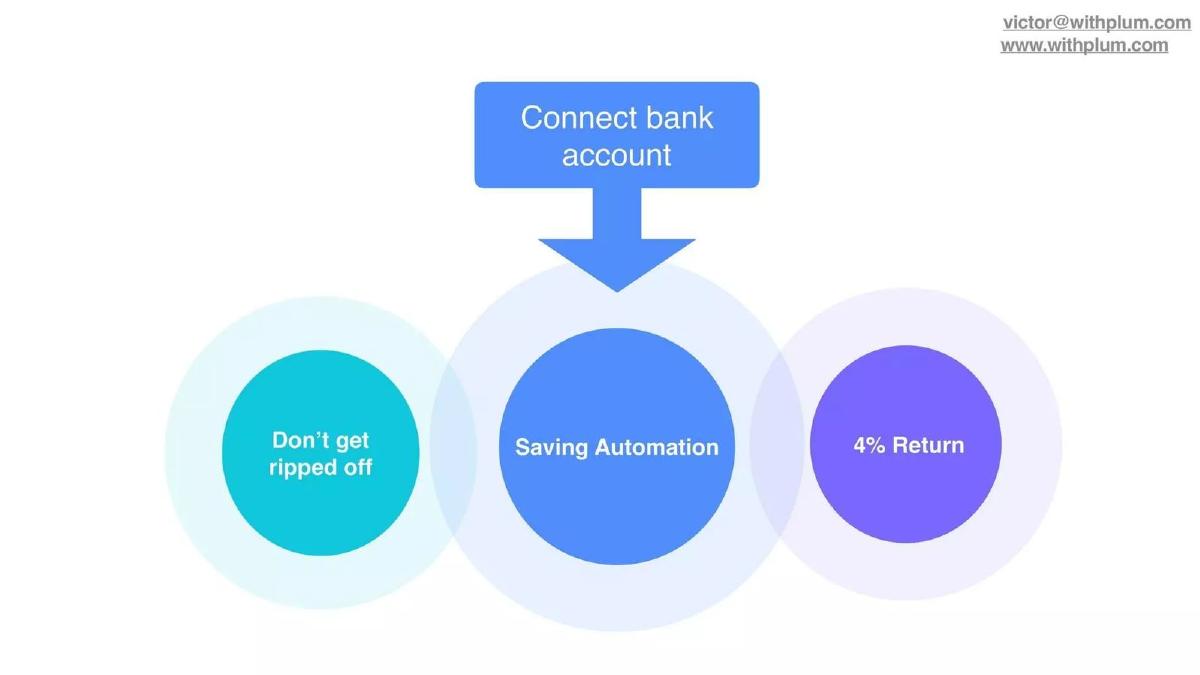
Slide 6: The Solution Loop This slide uses a simple flow diagram. The user connects their bank account, which triggers three outcomes: 'Don’t get ripped off' (addressing the $120b overspent on bills), 'Saving Automation' (addressing the 100m people with no savings), and '4% Return' (addressing the 97% of savings losing to inflation). It is a direct response to the problems listed on the previous slide.
Traction and Business Model
Slide 7: Growth Metrics The deck moves into hard data. Plum claims 20% month-over-month (MoM) user growth and 50% MoM growth in savings. For an early-stage startup, these are the 'up and to the right' numbers investors crave. The fact that savings are growing faster than users (50% vs 20%) suggests that existing users are increasing their engagement with the platform over time.
Slide 8: The Revenue Funnel Plum outlines a clear path to profitability. Step 1 is user acquisition. Step 2 is 'Month 1 Revenue' through 'Switching' (likely taking a commission when users switch to cheaper energy or insurance providers). Step 3 is 'Recurring Revenue' through 'Investing.' This shows a sophisticated understanding of Customer Lifetime Value (LTV)—they hook the user with a free utility (saving) and monetize through high-margin financial services later.
The Close
Slide 9: The Ask and the Status The final slide includes another quote from Thaler: 'I will spend my prize money as irrationally as possible.' Below this, it states '$1.8m Raised to date.' This is a subtle way of showing that other investors have already validated the concept. It provides contact information and a simple waving hand emoji, maintaining the friendly, conversational tone of the brand.
What Works in This Deck
Founder-Market Fit: The team slide is the strongest asset. Investors are buying the founders' experience at TransferWise and Tictail as much as they are buying the Plum app. · Clarity of Mission: By using the 'Nudge' theory, they provide a psychological 'why' that is much more compelling than just 'we help people save.' · Logical Flow: The deck follows a perfect 'Problem -> Solution -> Traction -> Revenue' sequence, despite its brevity.
What is Missing
Competitive Analysis: There is no mention of other fintechs like Chip, Revolut (which was expanding rapidly at the time), or US-based incumbents like Acorns. · Unit Economics: While they show growth, they don't show the cost of acquisition (CAC) or the specific margins on 'switching' or 'investing.' · Technical Depth: For a product claiming to use 'AI,' there is zero explanation of how the algorithm works or how they ensure security and compliance with banking regulations. · The 'Ask': The deck mentions what they have raised ($1.8m), but it does not explicitly state how much they are looking for in the current round or what the milestones for that capital will be.
What a Founder Should Copy
The 'Problem/Solution' Mirror: Slide 5 and Slide 6 are a perfect pair. Every problem identified in the market slide is directly answered in the solution slide. This creates a satisfying narrative loop. · Pedigree Highlighting: If you were an early employee at a unicorn, put that front and center. Use the logos of your previous employers to borrow credibility. · Focus on One Metric: Plum focuses on MoM growth. If you are early-stage, don't clutter your traction slide with 10 different KPIs. Pick the one that shows the most 'heat' and make it the hero of the slide.
Frequently asked questions
- Why is the Plum deck so short?
- Plum’s deck is likely a 'teaser' or a deck used for a follow-on seed/Series A bridge. When founders have high-profile backgrounds (like being early employees at TransferWise), they often need less 'proof' on paper because their execution capability is assumed. The brevity focuses the investor on the two most important things: the team and the initial traction.
- How does Plum plan to make money according to the deck?
- Slide 8 outlines a clear monetization funnel. It starts with user acquisition, moves to 'Switching' (likely referring to utility or bill switching commissions) in the first month, and culminates in long-term recurring revenue through investment products. This shows a transition from a free savings tool to a comprehensive wealth management platform.
- What is the significance of the Richard Thaler quote?
- By citing a Nobel Prize winner, Plum elevates its product from a 'simple app' to a 'scientific solution.' It suggests that their automated savings algorithm isn't just a feature, but a manifestation of proven behavioral economics designed to overcome human irrationality regarding money.
- Is the lack of a detailed competitor slide a weakness?
- In 2016, the 'auto-savings' space was relatively new in Europe. While competitors like Digit or Acorns existed in the US, Plum likely felt that the market gap (100m people with no savings) was so large that the primary 'competitor' was consumer inertia, not other apps. However, in a more mature market, this omission would be a red flag.
- What does '4% Return' on Slide 6 refer to?
- The deck doesn't explicitly detail the underlying financial instrument for this 4% return. Given the era and the 'investing' mention on Slide 8, it likely refers to expected returns from a peer-to-peer lending integration or a specific investment portfolio, rather than a standard savings account rate, which Slide 5 notes usually loses to inflation.