PlusPlus, a software platform for enterprise program managers, raised a significant $62M Seed round in 2022. The deck is a masterclass in product-led storytelling, eschewing traditional market size slides in favor of deep-dives into specific features like mentorship matching, live events, and onboarding tracks. By leading with high-tier logos like Netflix, Salesforce, and LinkedIn, PlusPlus establishes immediate credibility for its claim that 'E-Learning Isn't Enough.' The deck focuses heavily on the 'Why Leaders Care' and 'Why Program Managers Care' frameworks, directly addressing the pain p…
Key takeaways
- The deck leads with massive social proof, listing Netflix, Salesforce, and Shopify as partners on Slide 2.
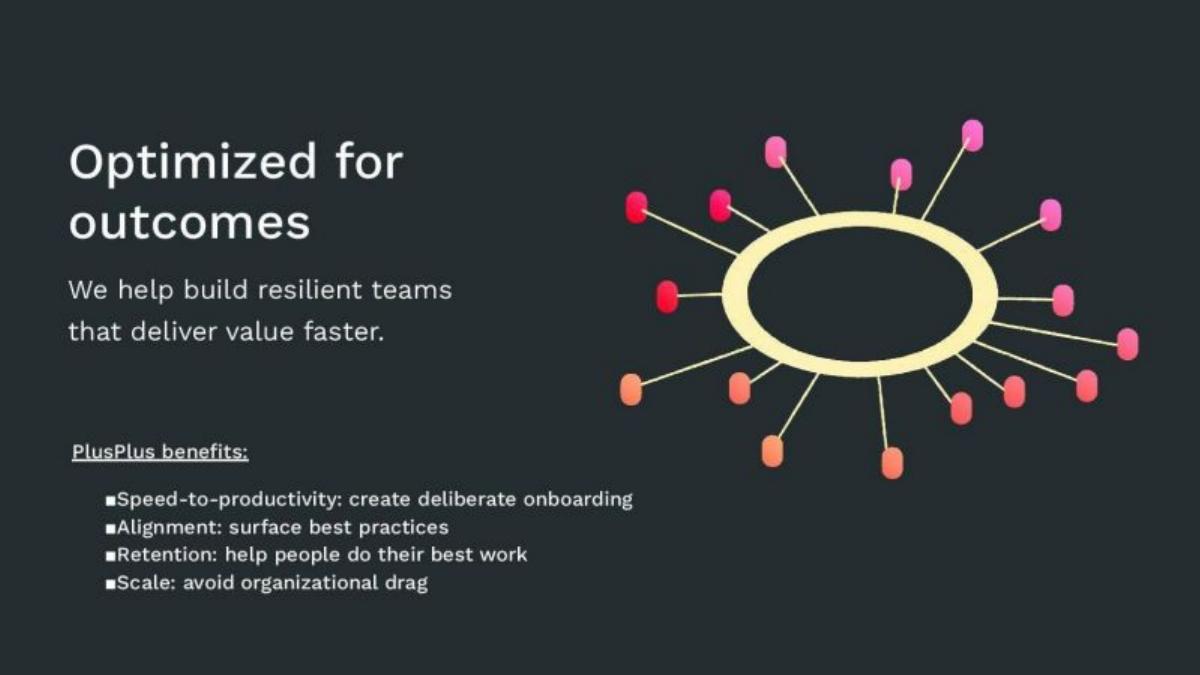
- PlusPlus positions its value proposition around four core pillars: Speed-to-productivity, Alignment, Retention, and Scale (Slide 3).
- The narrative explicitly challenges the status quo by stating 'E-Learning Isn't Enough' on Slide 4.
- Product features are segmented by user persona, specifically highlighting benefits for Program Managers (Slide 7) and Leaders (Slide 6).
- The platform integrates diverse learning types including Event Series, Articles, Office Hours, and Videos into a single searchable catalog (Slide 7).
- Mentorship is treated as a core product feature rather than an add-on, focusing on 'high-impact matches' (Slide 8).
- The deck uses a 'Why not a Wiki?' comparison to differentiate its structured, trackable content from stale internal documentation (Slide 11).
- LinkedIn is cited as a major case study, using the platform to scale training for 6,000 employees (Slide 12).
The Product-Centric Path to a $62M Seed Round
PlusPlus entered the market in 2022 with a bold proposition: that the way large enterprises handle internal knowledge is fundamentally broken. Their pitch deck for the $62M Seed round is a highly focused, product-driven narrative that prioritizes utility and social proof over abstract market projections. By the time an investor reaches the end of these slides, the functionality of the platform is unmistakable, even if the financial specifics are kept behind the scenes.
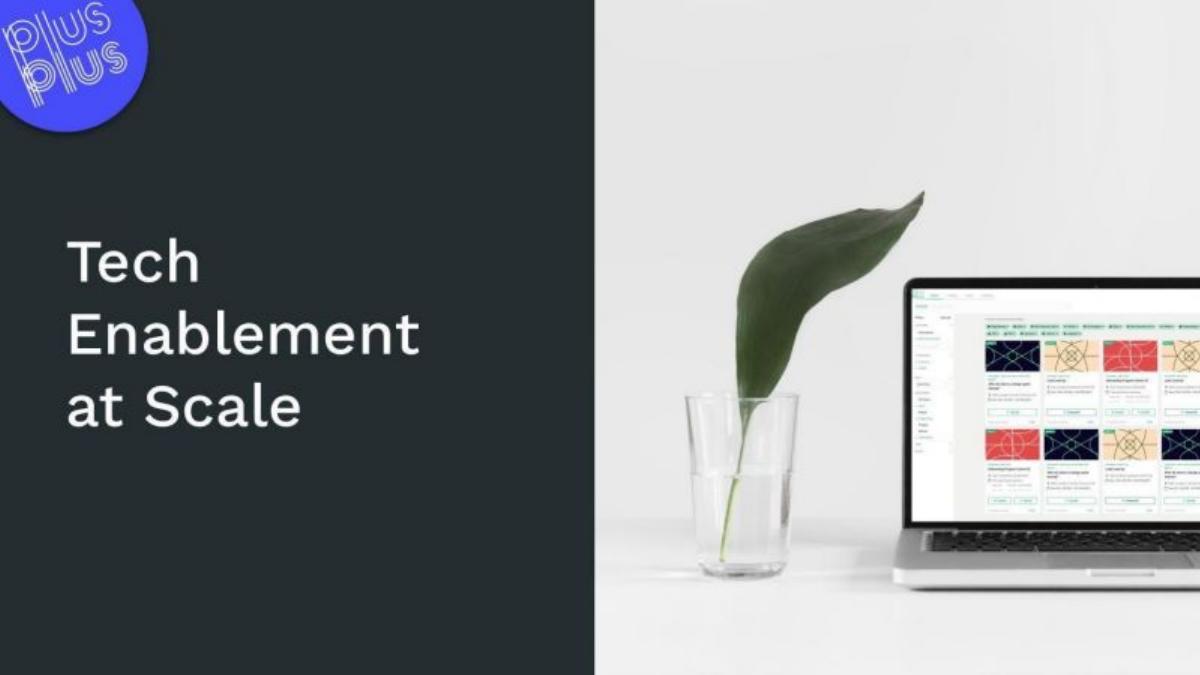
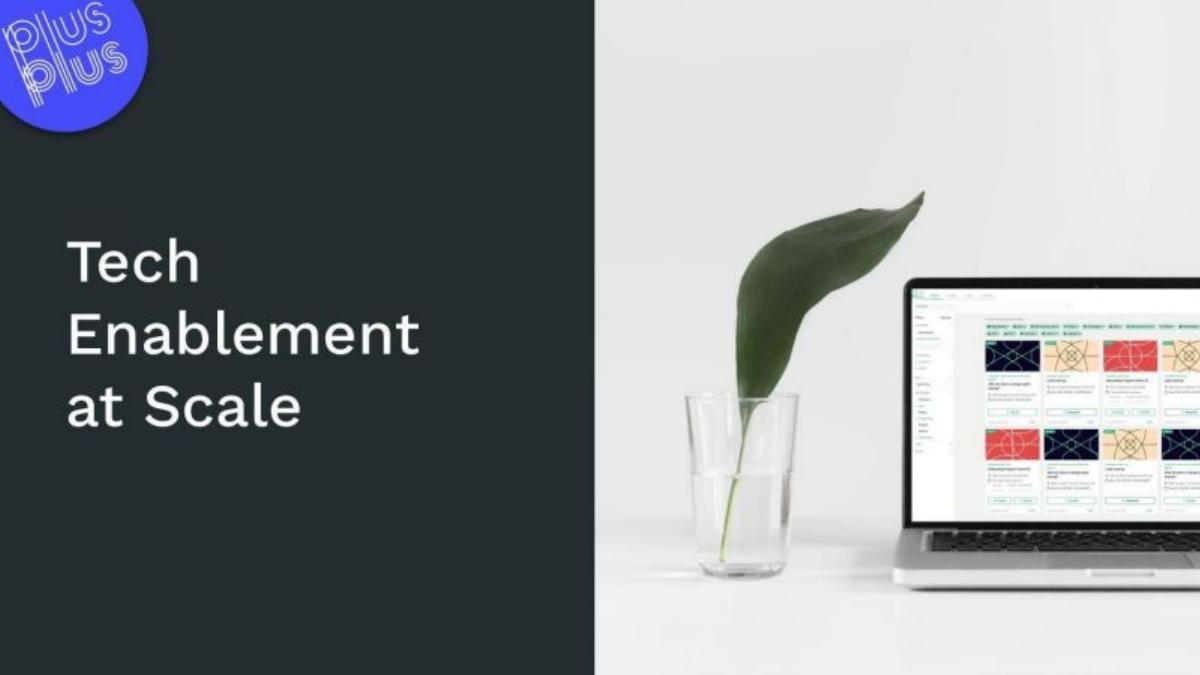
Slide 1: The Vision Statement
The deck opens with a minimalist title slide: "Tech Enablement at Scale." The imagery features a clean workspace with a laptop displaying the PlusPlus interface. This immediately signals that the company is targeting the technology sector and enterprise-level operations. The branding is understated, allowing the core value proposition—scale—to take center stage.
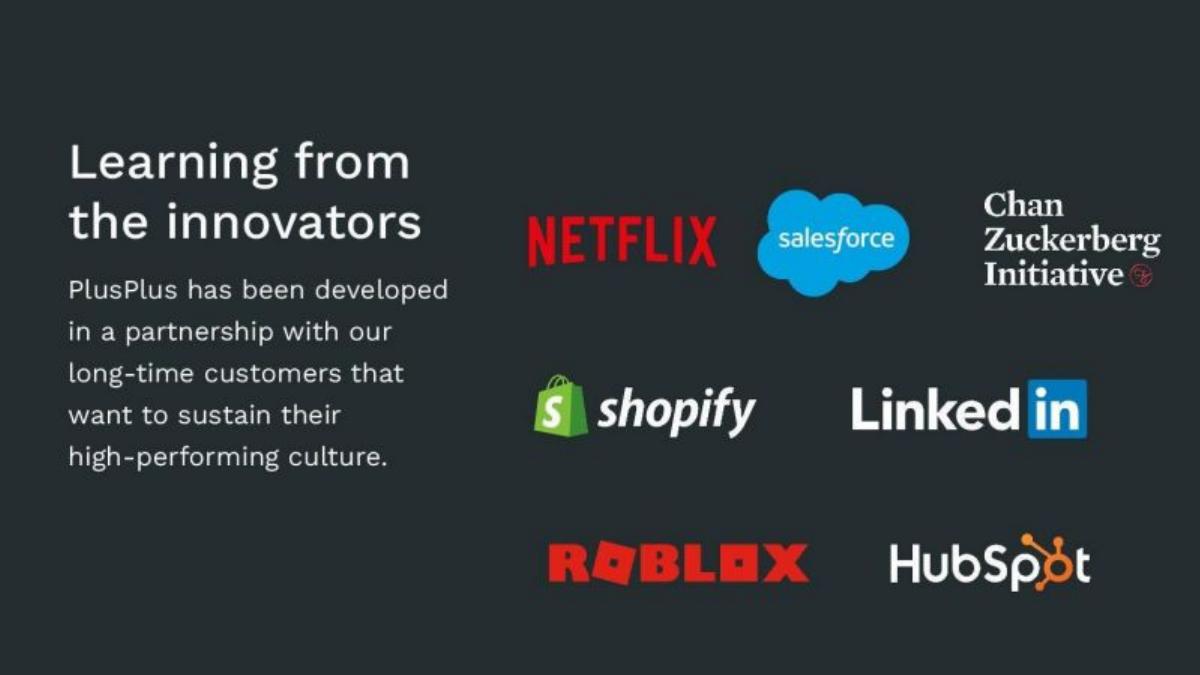
Slide 2: Immediate Social Proof
PlusPlus does not wait until the end of the deck to show off its customers. Slide 2, titled "Learning from the innovators," displays the logos of Netflix, Salesforce, Chan Zuckerberg Initiative, Shopify, LinkedIn, Roblox, and HubSpot. The text notes that the product was developed in partnership with these "long-time customers." For a Seed round, this level of blue-chip validation is extraordinary and likely served as the primary catalyst for the $62M raise. It tells investors that the product is already battle-tested by the most sophisticated engineering cultures in the world.
Slide 3: Defining the Outcomes
Slide 3 moves into the value proposition, titled "Optimized for outcomes." It lists four specific benefits: Speed-to-productivity (onboarding), Alignment (best practices), Retention (helping people do their best work), and Scale (avoiding organizational drag). The graphic shows a hub-and-spoke model, suggesting that PlusPlus acts as the central nervous system for a company's collective intelligence.
Slide 4: The Anti-Thesis of E-Learning
On Slide 4, the deck takes a stand: "E-Learning Isn't Enough." This is a classic 'enemy' slide. It argues that generic e-learning fails because it lacks company-specific context. PlusPlus positions itself as the tool that allows "internal experts" to host workshops and tech talks without needing formal instructional designers. This targets the bottleneck in most companies: the experts are too busy to teach, and the teachers don't know the tech.
Slide 5: Driving Culture Through Insights
Slide 5, "Drive culture forward," introduces the concept of peer-to-peer knowledge sharing. It features a mock-up of an expert profile (Charlie Palmer, Sr. Staff Data Scientist) and lists why leaders should care: reduced burnout and increased retention. By making internal experts visible and accessible, PlusPlus claims to keep ideas "free-flowing."
Slide 6: Onboarding and Velocity
Slide 6 focuses on "Tracks." The headline is "Get new-hires up to speed, faster." The product screenshot shows an "Eng Onboarding" track with steps like "Setting up your environment" and "Meet with a PM." The business case here is "product velocity." If new engineers can ship code faster because of a guided onboarding experience, the ROI of the software becomes easy to calculate.
Slide 7: The Searchable Catalog
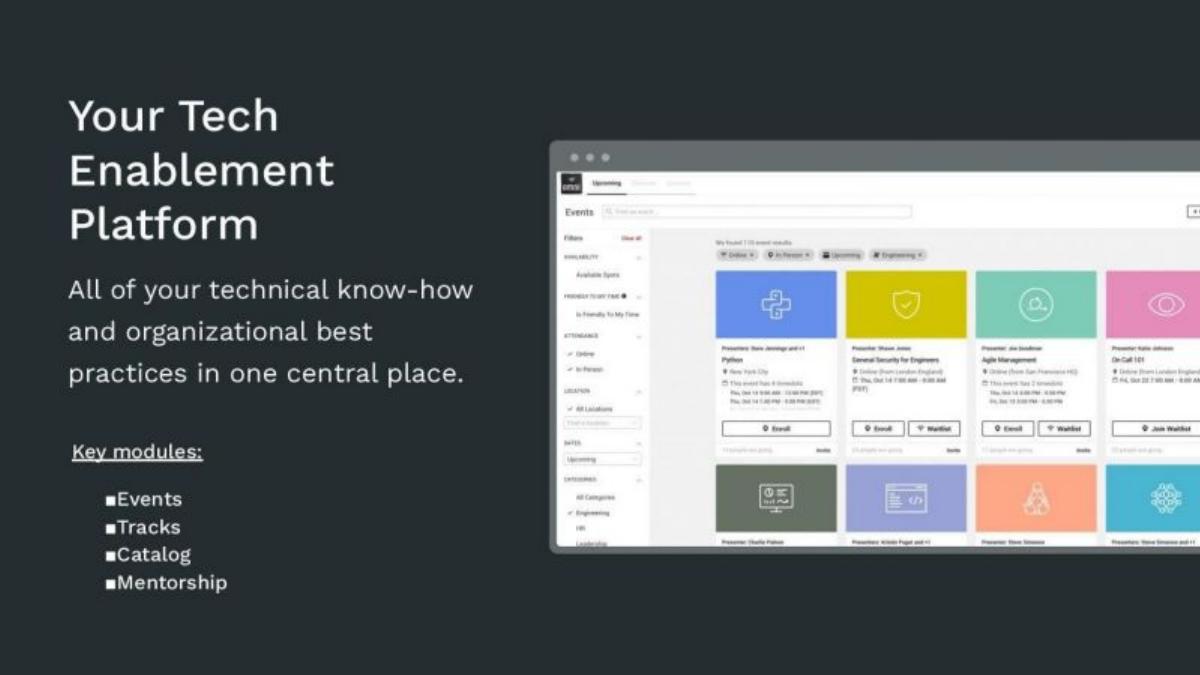
Slide 7 addresses the "where is that document?" problem. Titled "It's all there. It's all searchable," it shows a catalog interface that blends event series, articles, office hours, tracks, courses, and videos. For Program Managers, the benefit is a "single source-of-truth" that reduces the reliance on scattered and out-of-date documentation.
Slide 8: Formalizing Mentorship
Slide 8 introduces "Mentorship" as a core feature. The goal is to "Make high-impact matches" and allow employees to seek out experts "without it feeling weird." This addresses a common cultural friction point in large companies where junior employees are hesitant to reach out to senior staff. The UI shows a "Connect" portal with mentor profiles and availability.
Slide 9: Enterprise-Grade Infrastructure
Slide 9 emphasizes that the platform is "Enterprise-grade and integrated." The focus here is on assignment, automation, and discovery. This slide is meant to reassure IT and Operations buyers that the tool can handle the complexity of a large organization and integrate with existing workflows.
Slide 10: The Integrated Solution Roadmap
Slide 10 provides a visual journey of a new hire. It starts at "HRIS" and "Workflow Automation" and moves through "Codified Knowledge," "Practice," "Support," and "Assessment & Surveys" to reach the final goal: "Fully Enabled Employees." This slide is crucial because it shows how PlusPlus fits into the broader HR tech stack, connecting disparate elements like quizzes, office hours, and manager portals.
Slide 11: The Competitive Comparison
Slide 11, "Why not a Wiki?" is a direct comparison between PlusPlus and traditional internal documentation tools. It lists the flaws of Wikis—stale, untrackable, non-communal—and counters them with PlusPlus's strengths: richer context, assigned learning, and "multiplayer" cohort practice. This is a vital slide for overcoming the "we already have Confluence/Notion" objection.
Slides 12-13: Deep-Dive Case Studies
The final two content slides are dedicated to specific success stories. Slide 12 highlights LinkedIn , stating they use PlusPlus to scale training and mentorship for 6,000 employees . Slide 13 features CZI (Chan Zuckerberg Initiative), focusing on cross-pollinating knowledge between engineers, scientists, and policy leaders. These slides reinforce the message that PlusPlus is for complex, high-stakes environments.
What Makes This Deck Effective?
The PlusPlus deck is effective because it is unapologetically specific . It doesn't waste time on a "Problem" slide that describes the general concept of learning; it assumes the audience knows that enterprise learning is hard. Instead, it focuses on the specific friction points of Program Managers and Leaders. The use of "Why Leaders Care" and "Why Program Managers Care" bullet points on almost every slide ensures that the pitch addresses the motivations of both the buyer and the user.
Furthermore, the social proof is integrated rather than tacked on. By mentioning that the product was built in partnership with Netflix and Salesforce, the founders bypass the need to prove their product-market fit. The logos do the heavy lifting, allowing the rest of the deck to focus on product features and the "Integrated Solution" vision.
What is Missing?
As a teardown of the provided 14 slides, several standard pitch deck elements are absent:
Team Slide: There is no information about the founders' backgrounds or why they are the right people to build this. · Market Size (TAM): The deck lacks a slide quantifying the total addressable market for enterprise enablement software. · Business Model: While we know it is a software platform, there are no details on pricing tiers, seat costs, or contract structures. · The Ask: The deck does not explicitly state how much money is being raised or how the funds will be allocated, though the catalogue facts confirm a $62M round. · Financials/Traction: Other than the number of employees at LinkedIn, there are no metrics regarding revenue growth, churn, or user engagement rates.
Founder Takeaways: What to Copy
1. Use Persona-Based Benefits: PlusPlus does an excellent job of explaining why different stakeholders should care. If you are selling enterprise software, your deck should clearly distinguish between the benefits for the end-user (Program Managers) and the executive buyer (Leaders).
2. The 'Enemy' Narrative: Identifying a common but flawed tool (the Wiki) and explaining exactly why it fails creates a clear gap for your product to fill. Don't just say you are better; say why the current alternative is "stale" or "untrackable."
3. Visualizing the Journey: Slide 10's "Integrated Solution" map is a great way to show how a product fits into a complex ecosystem. Founders should aim to visualize the "before and after" of their user's journey through the platform.
4. Lead with Social Proof: If you have high-tier customers, don't hide them on slide 15. Put them on slide 2. It changes the way an investor views every subsequent slide, shifting the conversation from "Will this work?" to "How big can this get?"
Frequently asked questions
- What is the core problem PlusPlus is trying to solve?
- PlusPlus addresses 'organizational drag' and the limitations of traditional e-learning. As stated on Slide 4, they believe e-learning lacks the context of company-specific tools and systems. They aim to help internal experts share insights to keep teams unblocked, focusing on speed-to-productivity and cultural alignment in large enterprises.
- How does PlusPlus differentiate itself from internal wikis?
- Slide 11 provides a direct comparison. While wikis are described as 'stale,' 'untrackable,' and 'non-communal,' PlusPlus offers 'richer context,' the ability to assign learning to employees with completion tracking, and 'multiplayer' cohort-based practice. It moves from passive documentation to active, guided enablement.
- Who are the primary target users for the PlusPlus platform?
- The deck identifies two primary stakeholders: Program Managers and Leaders. Program Managers benefit from a single source of truth and reduced friction in hosting workshops (Slide 4, 7). Leaders care about reducing burnout, increasing employee Net Promoter Scores (eNPS), and boosting product velocity (Slide 5, 6).
- What kind of social proof does PlusPlus provide?
- The company provides significant enterprise validation. Slide 2 lists Netflix, Salesforce, Shopify, Roblox, HubSpot, and LinkedIn. Slide 12 specifically mentions that LinkedIn uses the platform for 6,000 employees, and Slide 13 highlights a partnership with the Chan Zuckerberg Initiative (CZI) for cross-pollinating internal knowledge.
- What is missing from this pitch deck?
- The 14 slides provided do not include a team slide, a financial 'ask' (valuation or specific funding goal), a competitive landscape map (other than the Wiki comparison), or detailed unit economics. It is primarily a product and vision deck focused on the 'how' and 'why' of the platform.