Optimity's 12-slide seed deck is a masterclass in using a single, dominant metric to frame a competitive advantage. By highlighting a 77% participation rate against an industry average of 10% (Slide 5), the company positions itself as the solution to the chronic engagement failure of traditional wellness programs. The deck effectively transitions from a massive macro problem—a $1.1 trillion employer cost (Slide 3)—to specific product features like 'microactivities' (Slide 7). With $342K in ARR and blue-chip clients like Microsoft and PwC (Slide 10), the narrative is grounded in commercial rea…
Key takeaways
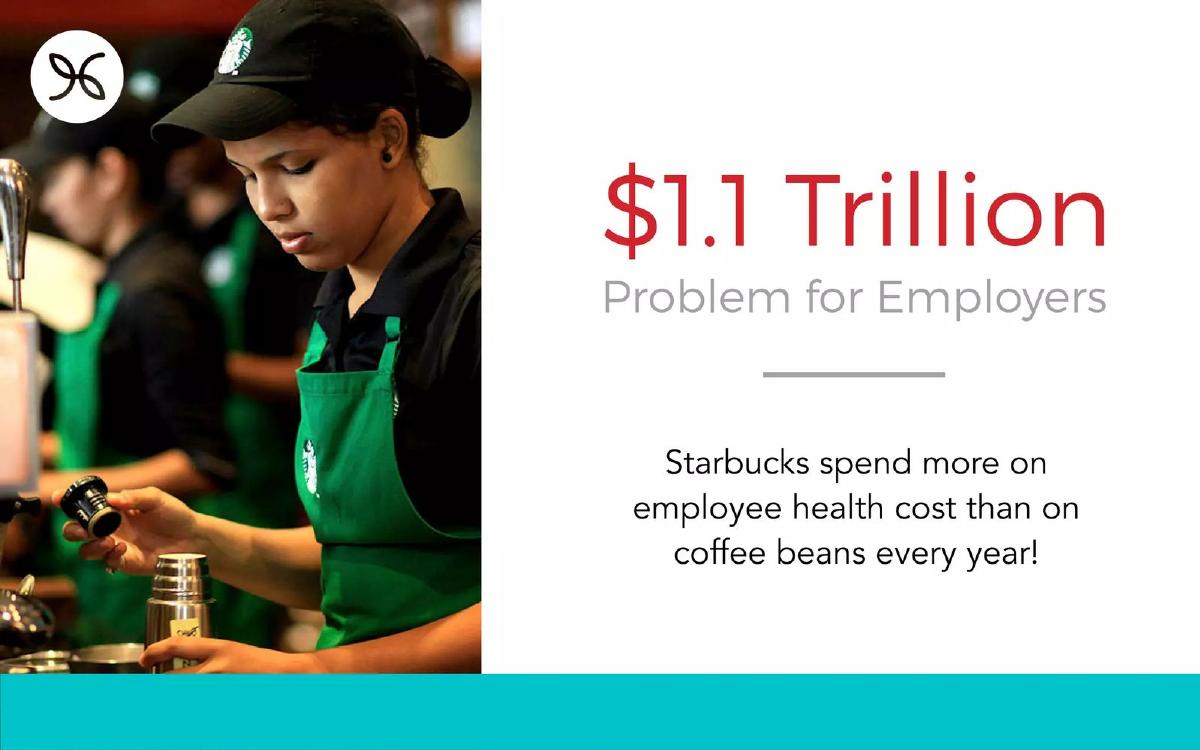
- The deck identifies a $1.1 trillion health cost problem for employers, using Starbucks as a specific example (Slide 3).
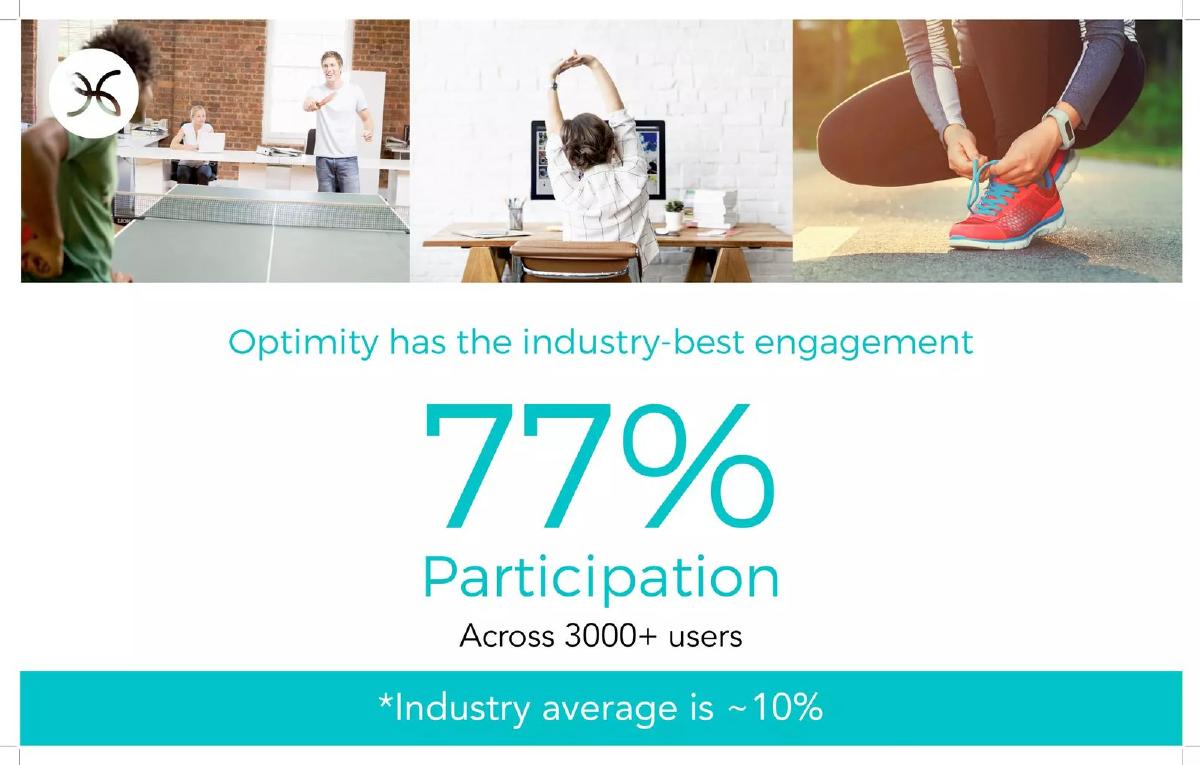
- Optimity claims a 77% participation rate across 3,000+ users, significantly higher than the 10% industry average (Slide 5).
- The product is positioned as a 'Pocket Health Coach' focusing on the 'middle majority' rather than just the 'super fit' or 'sick' (Slides 4 and 6).
- Revenue grew from $13,846 in Q2 2016 to a projected $342K ARR by Q3 2017 (Slide 10).
- The company lists high-profile corporate clients including PwC, Microsoft, and KPMG (Slide 10).
- The ROI claims are validated by third-party 'Insurance Research Labs' and Sun Life Financial (Slide 9).
- The leadership team features experience from IMS Health, TD Bank, and AMD (Slide 11).
- The deck completely omits a specific funding 'Ask' slide and detailed financial projections beyond the current ARR.
Introduction: The Engagement-First Pitch
Optimity’s pitch deck is a concise, 12-slide presentation that focuses heavily on a single pain point in the corporate wellness industry: engagement. The deck, used during their 2019 Seed round, attempts to bridge the gap between high-level employer costs and granular user behavior. By focusing on the 'middle majority,' Optimity differentiates itself from the crowded field of fitness apps and disease management platforms.
Slides 1-2: The Visual Hook and Product Overview
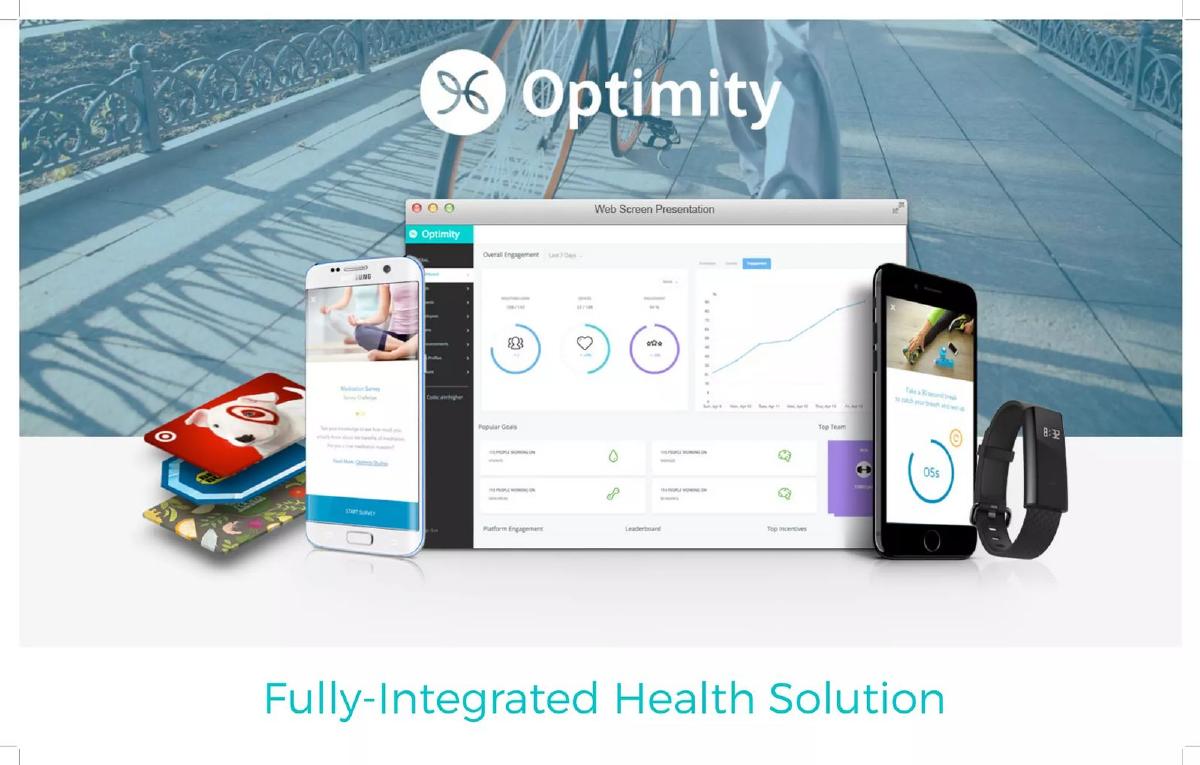
The deck opens with a lifestyle-oriented title slide featuring a professional walking with a bicycle, reinforcing the 'Live. Work. Play.' tagline. Slide 2 immediately follows with a 'Fully-Integrated Health Solution' collage. This slide is critical because it shows the product across multiple platforms: a web dashboard, a smartphone app, and a wearable device (specifically a Fitbit-style tracker). It also hints at a rewards ecosystem by displaying gift cards for retailers like Target and Starbucks, suggesting that incentives are a core part of the engagement strategy.
Slide 3: The $1.1 Trillion Problem
Optimity uses a classic 'shock and awe' metric to establish the market need. Slide 3 states there is a $1.1 Trillion Problem for Employers . To make this abstract number visceral, they use a specific corporate anecdote: 'Starbucks spend more on employee health cost than on coffee beans every year!' This is a powerful framing device because it highlights that health costs are no longer a secondary concern—they are a primary operational expense that can exceed the cost of raw materials.
Slide 4: Identifying the Gap in the Market
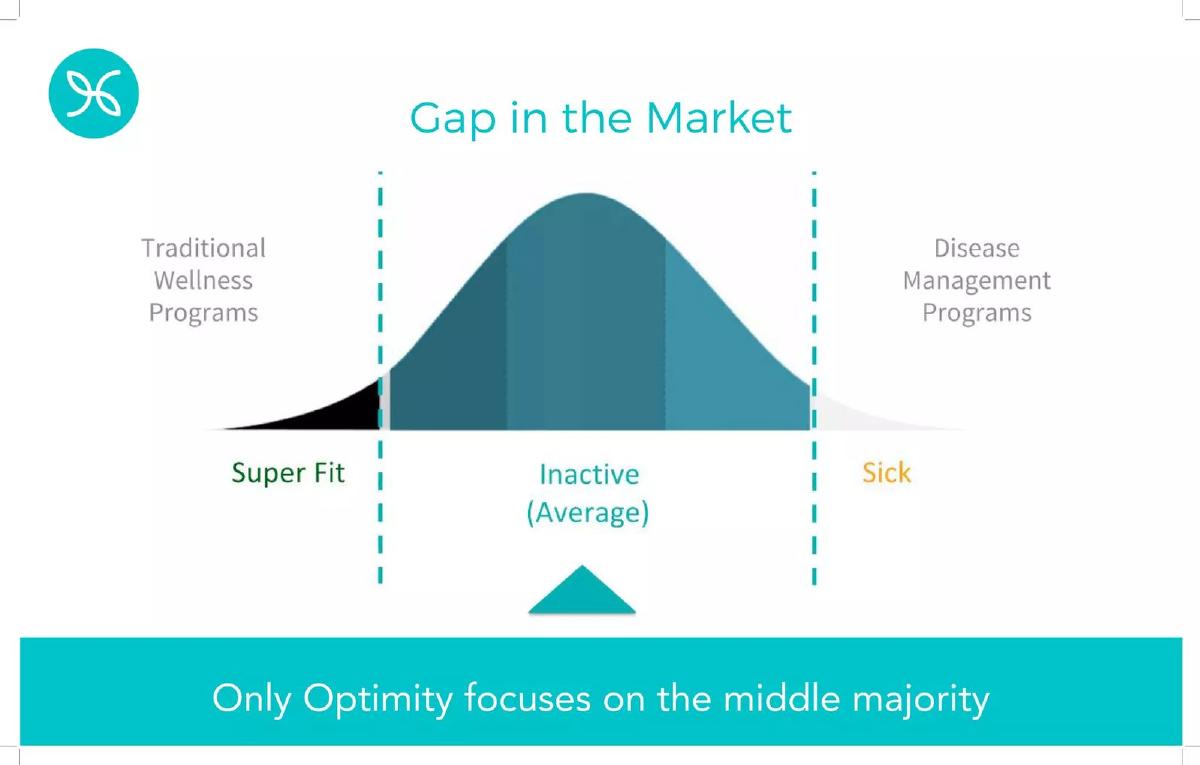
Slide 4 uses a bell curve to visualize their market positioning. They categorize the workforce into three segments: 'Super Fit,' 'Inactive (Average),' and 'Sick.' They argue that 'Traditional Wellness Programs' only capture the super fit, while 'Disease Management Programs' only capture the sick. The text at the bottom, 'Only Optimity focuses on the middle majority,' identifies their target user base. This is a strategic move, as the 'middle majority' represents the largest portion of any workforce and the greatest opportunity for aggregate cost savings.
Slide 5: The 'Killer' Metric
If there is one slide that likely secured their funding, it is Slide 5. It features a massive 77% Participation figure in teal text. Below it, they note this is 'Across 3000+ users.' The kicker is the footnote: 'Industry average is ~10%.' By showing an 8x improvement over the industry standard, Optimity effectively argues that they have solved the fundamental flaw of their competitors. This slide transforms the company from 'just another wellness app' into a high-performance engagement engine.
Slides 6-7: The Solution and Personalization
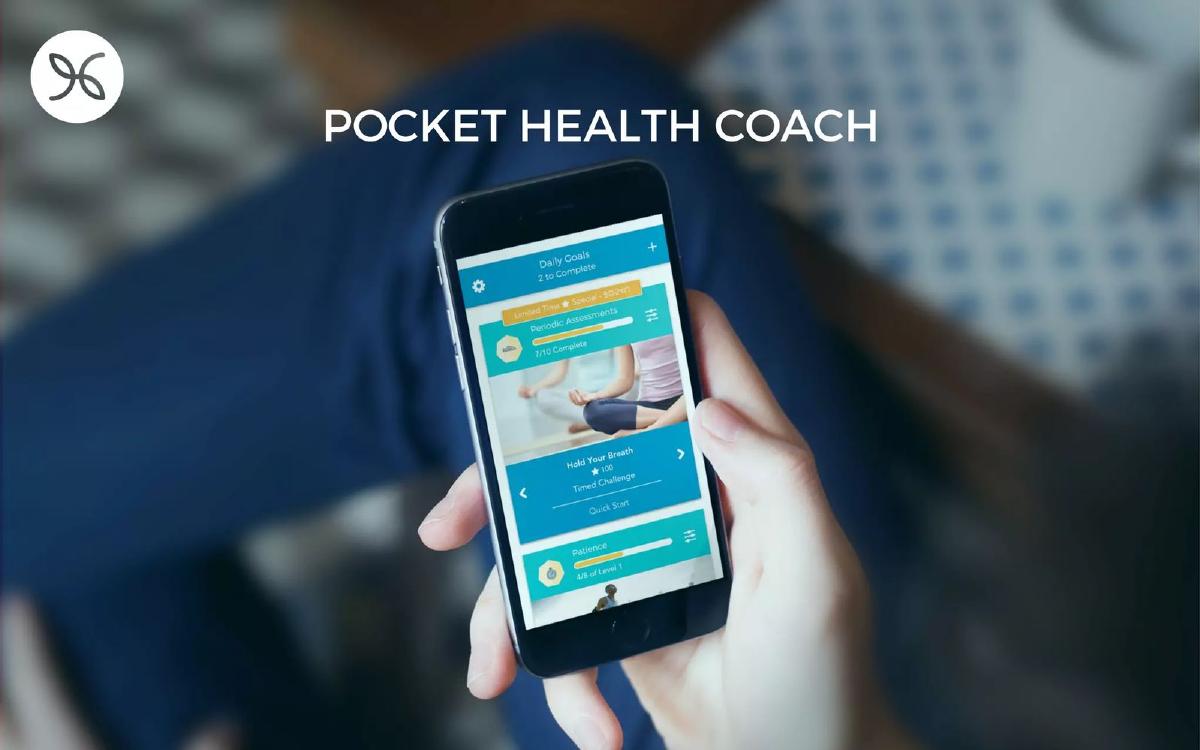
Slide 6 introduces the 'Pocket Health Coach' via a high-resolution mobile mockup. The UI shows daily goals, periodic assessments, and timed challenges like 'Hold Your Breath.' Slide 7 delves into 'Data-Driven Personalization' through 'Microactivities.' The slide claims these are 'Adaptive, personalized activities to reduced [sic] medication usage.' While the grammar is slightly off, the message is clear: the app uses data to nudge users toward small, healthy behaviors that lead to long-term medical cost reductions.
Slides 8-9: Proving the ROI
Slide 8 is a simple transition slide titled 'PROVEN COST SAVINGS.' Slide 9 backs this up by stating the 'ROI' is 'Insurer Backed.' They cite a 'Claims analysis supported by Insurance Research Labs' and feature the logo of Sun Life Financial . For a B2B health startup, third-party validation from a major insurer is the ultimate form of social proof, as it mitigates the risk for future enterprise buyers who are skeptical of wellness ROI claims.
Slide 10: Traction and Revenue Growth
Slide 10 provides a bar chart showing quarterly revenue growth. The figures are specific: starting at $13,846 in Q2 2016 and growing to $150,984 in Q2 2017 . The slide headlines a $342K ARR . To the right, they display the logos of PwC, Microsoft, and KPMG . This slide demonstrates both momentum and the ability to close 'Big Four' and 'Big Tech' accounts, which is a significant hurdle for early-stage startups.
Slide 11: The Team
The team slide features three key members. Jane Wang (CEO) is backed by logos for IMS Health and Biogen Idec , suggesting deep roots in health data and pharma. Nicholas Raditsis (VP Client Success) shows TD Bank and CPS Management Partners , indicating a focus on enterprise relationships. Stephan Massin (CTO) brings hardware/software experience from AMD and ATI . The team appears well-balanced between industry expertise and technical execution.
Slide 12: The Conclusion
The final slide repeats the 'Live. Work. Play.' tagline and provides contact information for Jane Wang, including her email and the company’s AngelList (angel.co) and website URLs. Notably, there is no 'Ask' on this slide or anywhere else in the deck.
What Optimity Does Well
The deck is exceptionally disciplined. It doesn't get bogged down in the science of health; instead, it focuses on the business of health . By framing the problem as a financial burden for employers and the solution as a high-engagement tool, they speak the language of both HR departments and venture capitalists. The use of a 77% engagement rate as a recurring theme provides a strong 'north star' for the entire presentation.
What Is Missing
The most glaring omission is the Ask . There is no information on how much money they are raising, the terms of the round, or the specific milestones they intend to hit with the new capital. Additionally, the deck lacks a Competition slide. While they contrast themselves against 'traditional programs' on Slide 4, they do not name specific competitors like Virgin Pulse or Limeade. Finally, there is no Go-To-Market (GTM) strategy. We see that they have signed Microsoft and PwC, but we don't know how they plan to scale that acquisition process to the next 1,000 companies.
Founder's Takeaway
Founders should study how Optimity uses comparative metrics . If your industry has a known 'failure rate' (like the 10% engagement in wellness), and you have a metric that significantly beats it, that should be the centerpiece of your deck. Furthermore, using a relatable analogy—like the Starbucks coffee bean comparison—is a highly effective way to make a massive, abstract market size feel relevant and urgent.
Frequently asked questions
- What is Optimity's core value proposition?
- Optimity positions itself as a 'Pocket Health Coach' that solves the engagement problem in corporate wellness. While traditional programs see 10% engagement, Optimity claims 77% by focusing on the 'middle majority'—average, inactive employees—rather than just those who are already fit or those who are chronically ill.
- How does Optimity demonstrate traction?
- Traction is shown through both user engagement and revenue. The deck cites 3,000+ users with a 77% participation rate (Slide 5) and a revenue climb from $13,846 in Q2 2016 to $150,984 in Q2 2017, reaching a $342K ARR (Slide 10). They also display logos for Microsoft, PwC, and KPMG.
- Who is the target customer for this platform?
- The primary customer is the enterprise employer. The deck frames the problem around employer costs ($1.1 trillion) and highlights that companies like Starbucks spend more on health than on their core product (coffee beans). The end-users are the employees, specifically the 'middle majority' who are currently underserved by traditional wellness tools.
- What is missing from the Optimity pitch deck?
- The deck lacks a formal 'Ask' slide detailing how much capital is being raised and how it will be used. It also omits a detailed competitor landscape, a go-to-market strategy, and long-term financial projections. While it mentions 'proven cost savings,' it does not provide specific unit economics or LTV/CAC ratios.
- How does the team background support the business?
- The team slide (Slide 11) shows a mix of health data, client success, and technical expertise. CEO Jane Wang comes from IMS Health and Biogen Idec, providing industry credibility. VP Client Success Nicholas Raditsis brings banking and management experience, while CTO Stephan Massin has a technical background from AMD and ATI.