Pluto AI’s pitch deck is a classic example of a high-speed Demo Day presentation designed for verbal accompaniment. Spanning only 8 slides, it focuses on the massive inefficiencies in the U.S. water infrastructure, specifically citing $500k in annual losses per plant. The company positions itself as an AI-driven intelligence layer that converts raw sensor data into actionable maintenance recommendations. While the deck succeeds in establishing a clear value proposition and early traction—notably pilots with two of the world’s ten largest water companies—it lacks a detailed business model, com…
Key takeaways
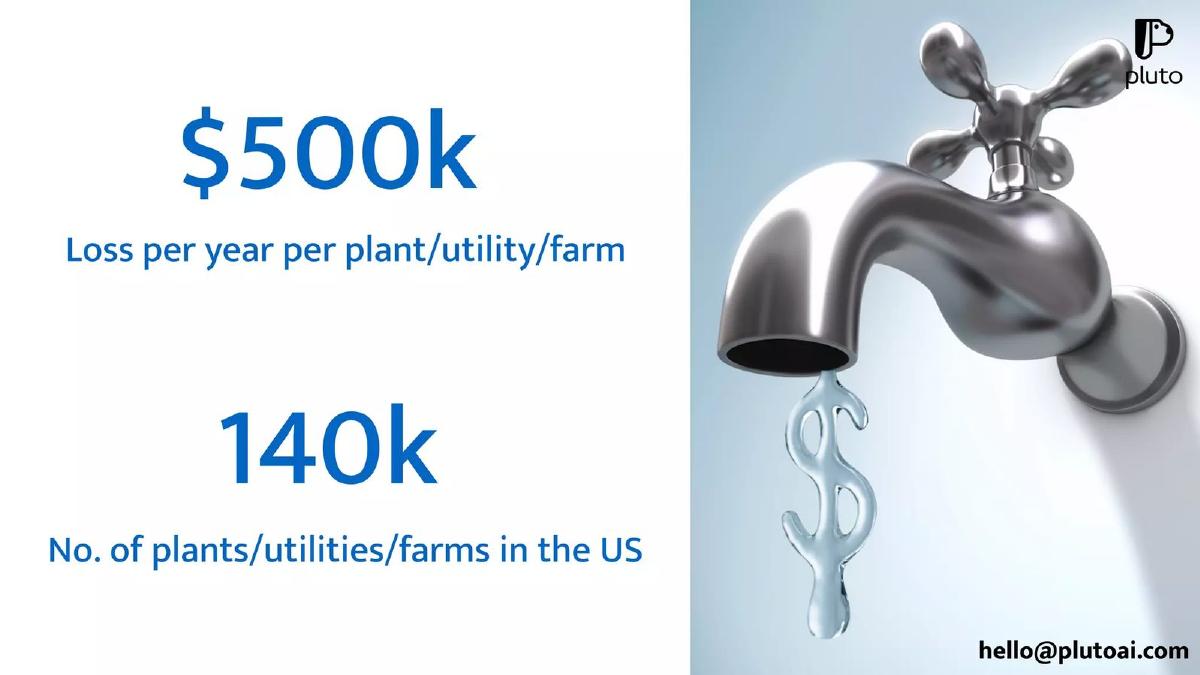
- The company identifies a specific financial pain point of $500k in annual losses per water plant, utility, or farm (Slide 3).
- Pluto AI targets a total addressable market of 140,000 plants in the U.S. (Slide 3 and Slide 5).
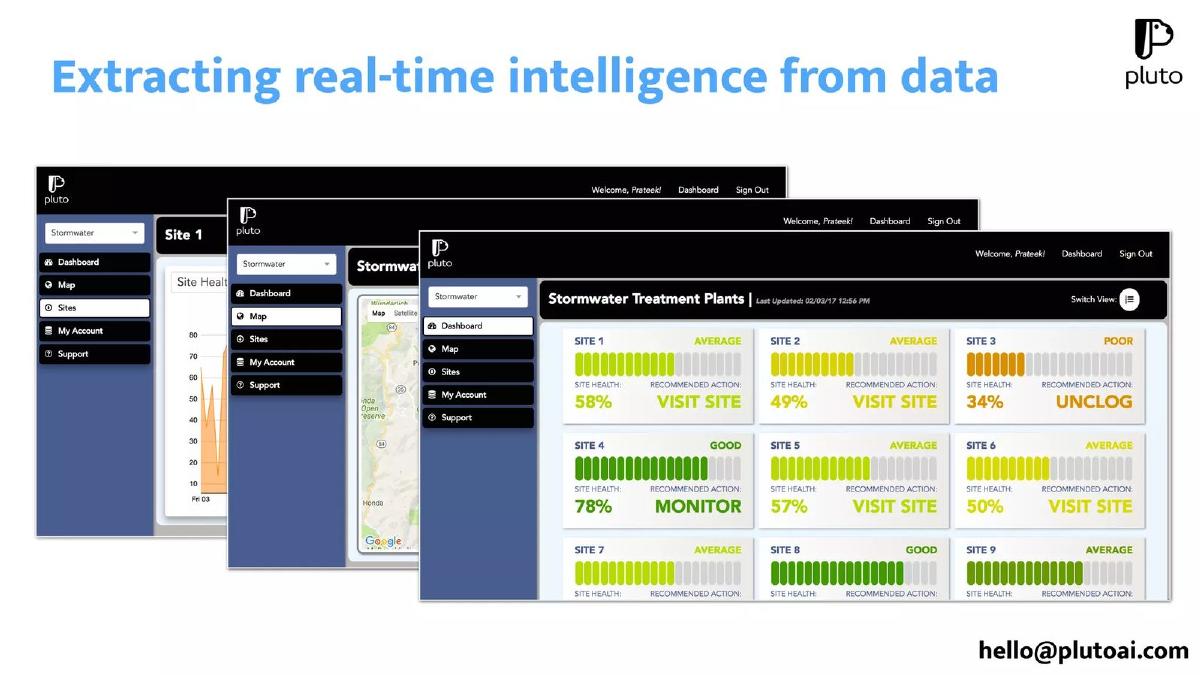
- The product interface provides real-time health scores and specific recommended actions like 'Visit Site' or 'Unclog' (Slide 4).
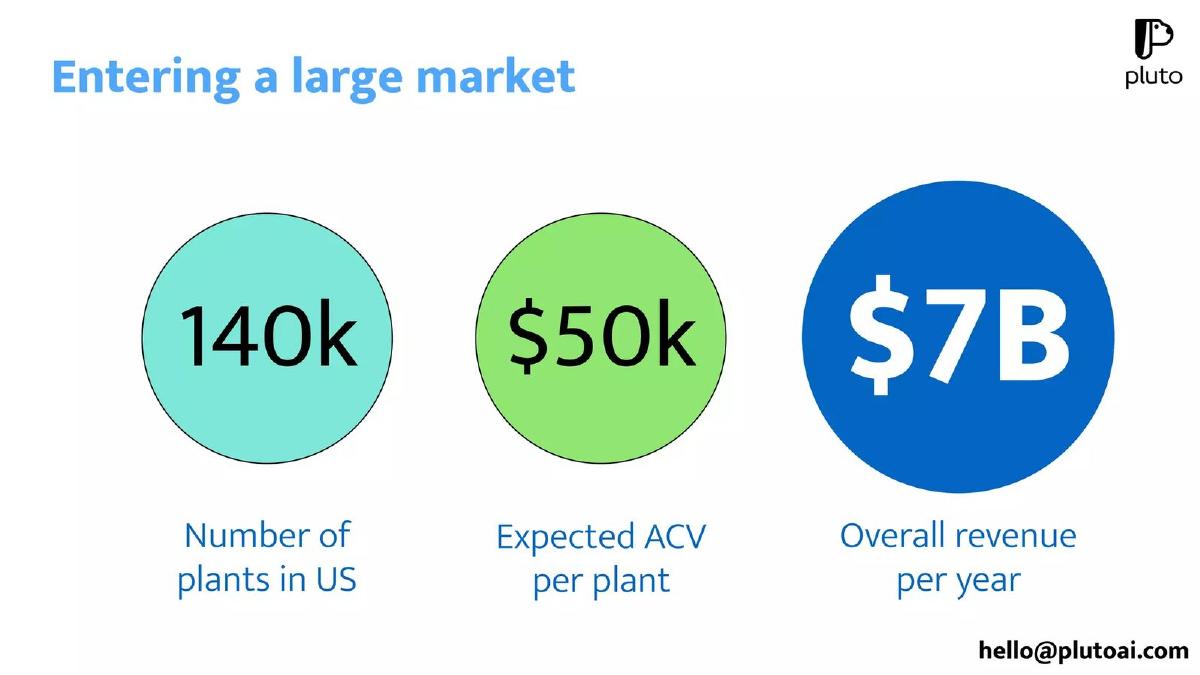
- The business model assumes an expected Annual Contract Value (ACV) of $50k per plant, leading to a $7B annual revenue opportunity (Slide 5).
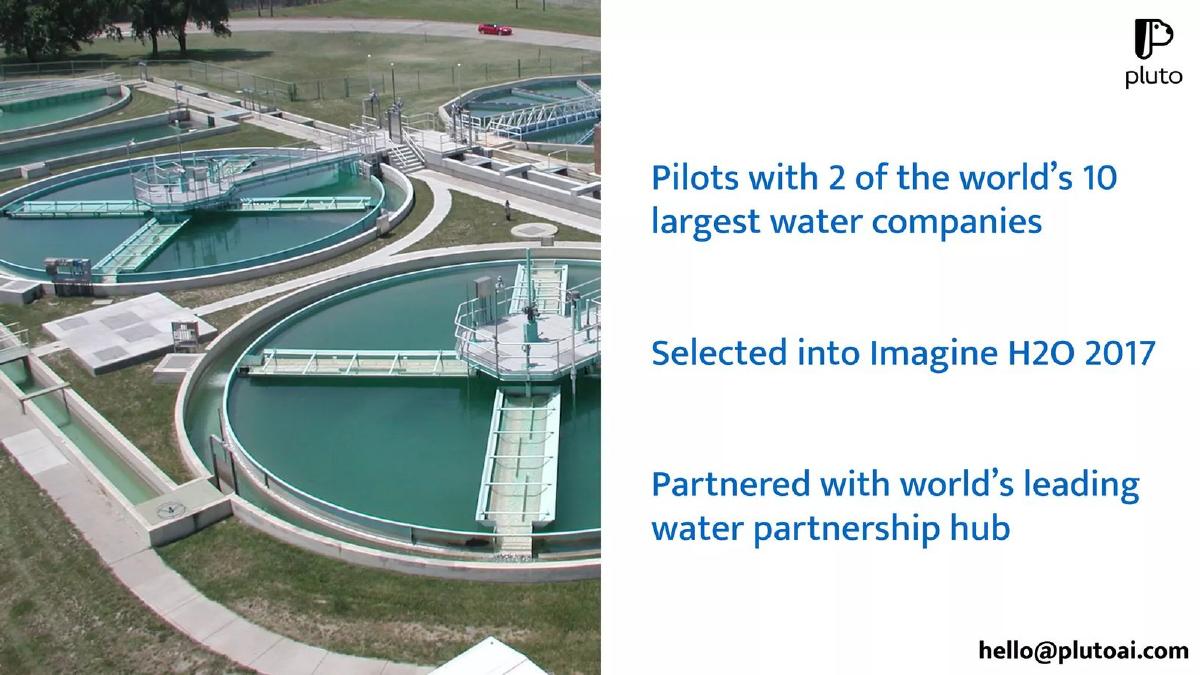
- Early validation is demonstrated through pilots with two of the world’s ten largest water companies (Slide 6).
- The startup was selected for the Imagine H2O 2017 accelerator program (Slide 6).
- The founding team consists of three people, with founder Prateek Joshi highlighting experience at NVIDIA and Microsoft Research (Slide 7).
- The deck concludes with a macro-impact statement: 2.1 trillion gallons of clean water are lost in the U.S. every year (Slide 8).
Pluto AI: A Demo Day Deep Dive
The Pluto AI pitch deck, presented as part of 500 Startups Demo Day Batch 19, is a masterclass in brevity. With only eight slides, the deck is designed to support a three-minute pitch where the speaker provides the narrative and the slides provide the visual proof points. It focuses heavily on the 'Why Now' and the 'So What,' highlighting a massive, antiquated industry ripe for digital transformation.
Slide 1: Title and Positioning
The cover slide is functional and direct. It features the Pluto logo—a stylized dog head forming the letter 'P'—and the tagline: "Analytics Platform For Smart Water Management." The background image of blue financial charts and a 3D pie chart immediately signals that this is a B2B enterprise tool focused on ROI and data, rather than a consumer-facing environmental app.
Slide 2: The Problem Statement
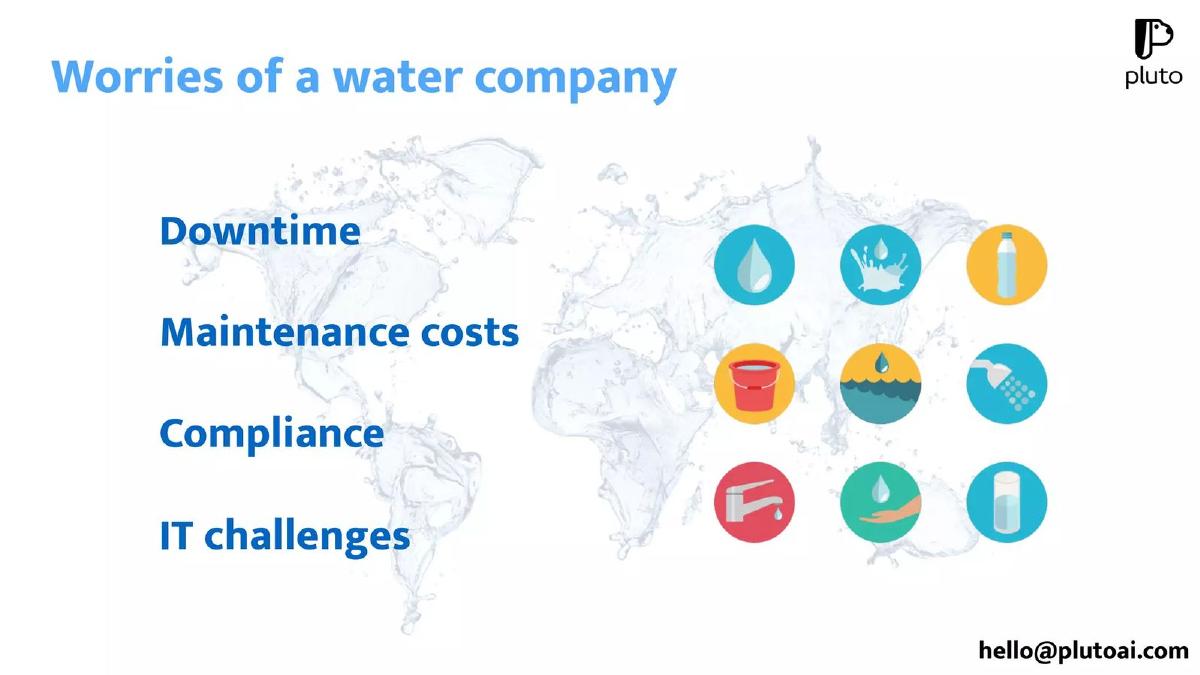
Slide 2, titled "Worries of a water company," lists four primary pain points: Downtime, Maintenance costs, Compliance, and IT challenges. By using the word 'worries,' the deck attempts to humanize the industrial problem. The icons on the right represent various water use cases (showers, taps, buckets, bottles), suggesting the platform's versatility across different types of water infrastructure.
Slide 3: Quantifying the Pain
This is one of the most critical slides in the deck. It moves from qualitative 'worries' to quantitative 'losses.' It states there is a "$500k Loss per year per plant/utility/farm" and identifies "140k No. of plants/utilities/farms in the US." The visual of a silver faucet dripping a dollar sign is a literal representation of the 'leaking' revenue Pluto AI intends to stop. This slide sets the stage for the market size calculation later in the deck.
Slide 4: The Solution and Product Interface
Slide 4, "Extracting real-time intelligence from data," showcases the actual software interface. The dashboard is clean and emphasizes 'Site Health' percentages (ranging from 34% to 78% in the examples). The most important feature shown here is the "Recommended Action" column. By showing commands like "VISIT SITE," "MONITOR," and "UNCLOG," Pluto AI demonstrates that it isn't just a data collector, but a decision-support tool that tells operators exactly what to do to prevent the $500k loss mentioned previously.
Slide 5: Market Opportunity
The "Entering a large market" slide provides the math for the company's upside. It takes the 140k plants from Slide 3 and applies an "Expected ACV per plant" of $50k . This results in an "Overall revenue per year" of $7B . This is a classic bottom-up market sizing approach that investors prefer over vague 'trillion-dollar industry' claims, as it is based on a specific price point per unit.
Slide 6: Traction and Validation
To counter the skepticism often faced by small teams in heavy industry, Slide 6 lists impressive credentials. It claims "Pilots with 2 of the world’s 10 largest water companies," selection into "Imagine H2O 2017" (a prestigious water tech accelerator), and a partnership with the "world’s leading water partnership hub." These logos and milestones provide the 'social proof' necessary to convince investors that a small startup can actually sell to massive, slow-moving utilities.
Slide 7: The Team
The "Team obsessed with data" slide focuses on Prateek Joshi (Founder) . Rather than long biographies, the slide uses a 'logo wall' of previous employers to establish technical credibility. The presence of NVIDIA, Microsoft Research, Cisco, Avast, Juniper Networks, and Apcera suggests a high level of expertise in machine learning, infrastructure, and cybersecurity. The note "Team of 3" indicates a very lean operation, which is common for a seed-stage company at Demo Day.
Slide 8: The Macro Impact and Call to Action
The final slide returns to the big picture: "2.1 trillion gallons of clean water is lost in the US every year." This serves as a powerful closing statement that combines the financial opportunity with environmental impact. The call to action is simple: "Want to do something about it? Come talk to us at hello@plutoai.com."
What Pluto AI Does Well
The deck is exceptionally focused. It identifies a specific, high-value problem ($500k loss per plant) and offers a clear, actionable solution (the 'Recommended Action' dashboard). By focusing on 'Site Health' and 'Maintenance,' Pluto AI avoids the trap of being a generic 'AI for everything' company and instead targets a specific operational budget line item.
The use of ACV (Annual Contract Value) to calculate market size is also a strong point. It tells investors exactly how much Pluto AI expects to charge a single customer, which makes the $7B total addressable market feel grounded in reality rather than speculation.
What is Missing from the Pluto AI Deck
Because this is a Demo Day deck, several standard pitch components are omitted to save time:
Business Model Details: While the ACV is mentioned, the deck doesn't explain the pricing structure (e.g., per sensor, per site, or tiered SaaS). · Competitive Landscape: There is no mention of existing SCADA systems or other industrial IoT competitors. Investors would want to know why a water plant wouldn't just use their existing hardware provider's software. · Technology Deep Dive: The deck mentions 'AI' and 'Data,' but doesn't explain what makes their algorithms proprietary or how they integrate with legacy hardware. · The Ask: There is no slide detailing how much money the company is raising or what the milestones for the next 18 months are. · Unit Economics: There is no mention of Customer Acquisition Cost (CAC) or the length of the sales cycle, which is notoriously long in the utility sector.
Founder Lessons: What to Copy
1. Use Prescriptive UI: If you are building an analytics tool, don't just show graphs. Show the 'Action' your software recommends. Pluto AI’s use of 'UNCLOG' and 'VISIT SITE' on Slide 4 is a perfect example of showing value, not just data.
2. Quantify the 'Cost of Inaction': Slide 3 doesn't just say water management is expensive; it puts a $500,000 price tag on the problem for every single plant. This makes the $50k ACV on Slide 5 look like a bargain (a 10x ROI).
3. Leverage Accelerator Pedigree: If you have been through a top-tier program like 500 Startups or Imagine H2O, make it a focal point of your traction slide. For early-stage companies, these 'stamps of approval' are often as important as revenue.
4. Keep the Team Slide Lean: If your team is small, don't hide it. Use the logos of the companies you've worked for to signal that while the team is small in number, it is 'heavy' in experience. Pluto AI’s Slide 7 does this effectively by surrounding a single founder photo with world-class tech logos.
Frequently asked questions
- What specific problem does Pluto AI solve?
- Pluto AI addresses the high costs and operational risks associated with water management. According to Slide 2 and Slide 3, water companies face downtime, high maintenance costs, compliance issues, and IT challenges. These inefficiencies result in an estimated $500,000 loss per year for every individual plant, utility, or farm due to clean water loss and infrastructure failure.
- How does the Pluto AI platform work for a facility manager?
- The platform acts as an intelligence layer for existing data. As shown on Slide 4, the dashboard monitors multiple sites (e.g., Stormwater Treatment Plants) and assigns a 'Site Health' percentage. Crucially, it provides 'Recommended Actions' such as 'Monitor,' 'Visit Site,' or 'Unclog,' moving from simple data visualization to predictive or prescriptive maintenance.
- What is the estimated market size for Pluto AI's solution?
- Pluto AI calculates a $7 billion annual revenue opportunity in the United States. This figure is derived from the 140,000 plants, utilities, and farms currently operating in the U.S., multiplied by an expected Annual Contract Value (ACV) of $50,000 per facility, as detailed on Slide 5.
- What kind of traction did Pluto AI have at the time of this deck?
- The company reported significant early-stage validation on Slide 6. They had secured pilots with two of the ten largest water companies globally, were selected for the Imagine H2O 2017 cohort, and established a partnership with a leading water partnership hub. This suggests strong industry interest despite the small team size.
- Who is behind Pluto AI?
- Slide 7 identifies Prateek Joshi as the Founder. The team is described as a 'Team of 3' with a focus on data science and engineering. The slide highlights the founder's and team's previous experience at high-profile technology and research institutions including NVIDIA, Microsoft Research, USC, Cisco, Avast, Juniper Networks, and Apcera.