Plum presents a concise 9-slide deck that leverages the pedigree of its founders—early employees at TransferWise and Tictail—to establish immediate credibility. The product is positioned as an AI-powered chatbot designed to automate savings and optimize bill spending based on behavioral economics. While the deck is light on detailed financial projections and competitive analysis, it highlights significant early traction, including 20% month-over-month user growth and 50% growth in total savings. The revenue model is simplified into a three-step funnel: user acquisition, immediate revenue from…
Key takeaways
- The team slide (Slide 2) leverages high-profile 'early employee' status at TransferWise and Tictail to build instant founder-market fit.
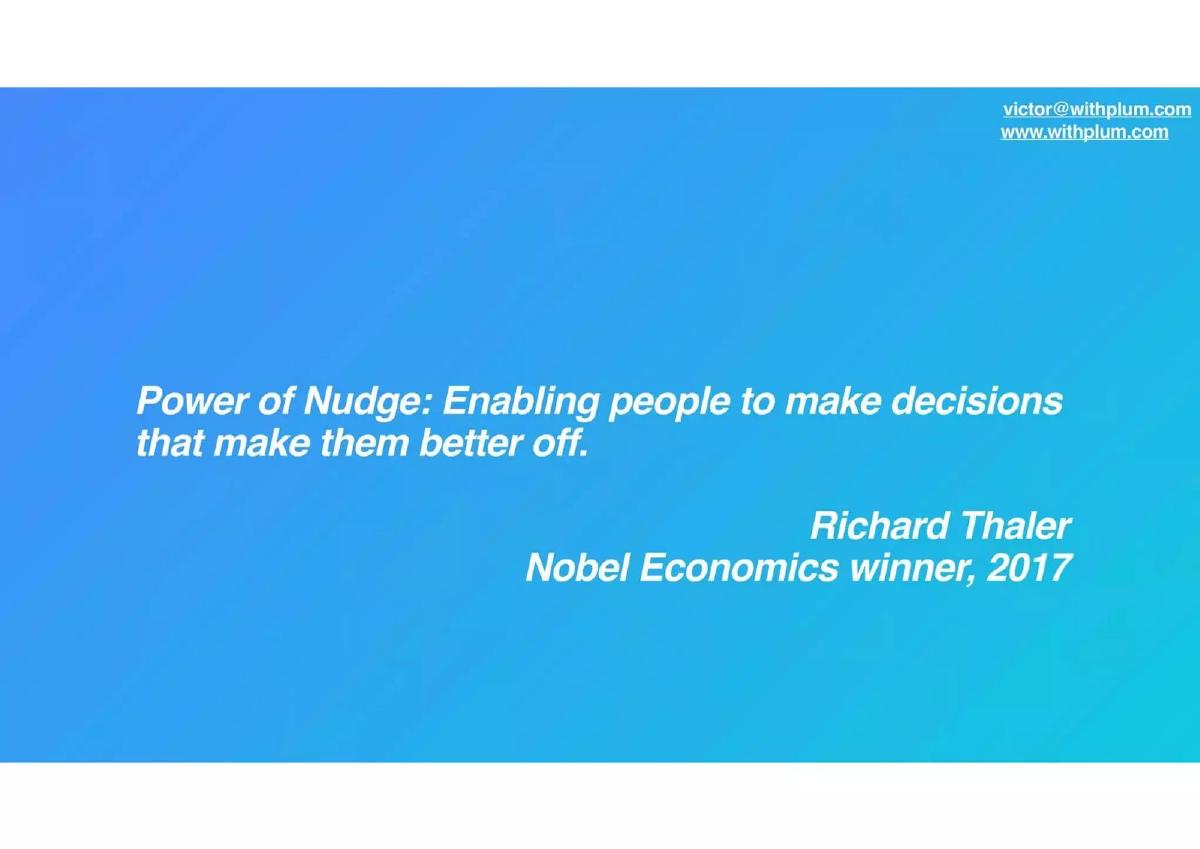
- Plum anchors its entire philosophy on Richard Thaler’s 'Nudge' theory, citing his 2017 Nobel Prize to validate their behavioral approach (Slide 3).
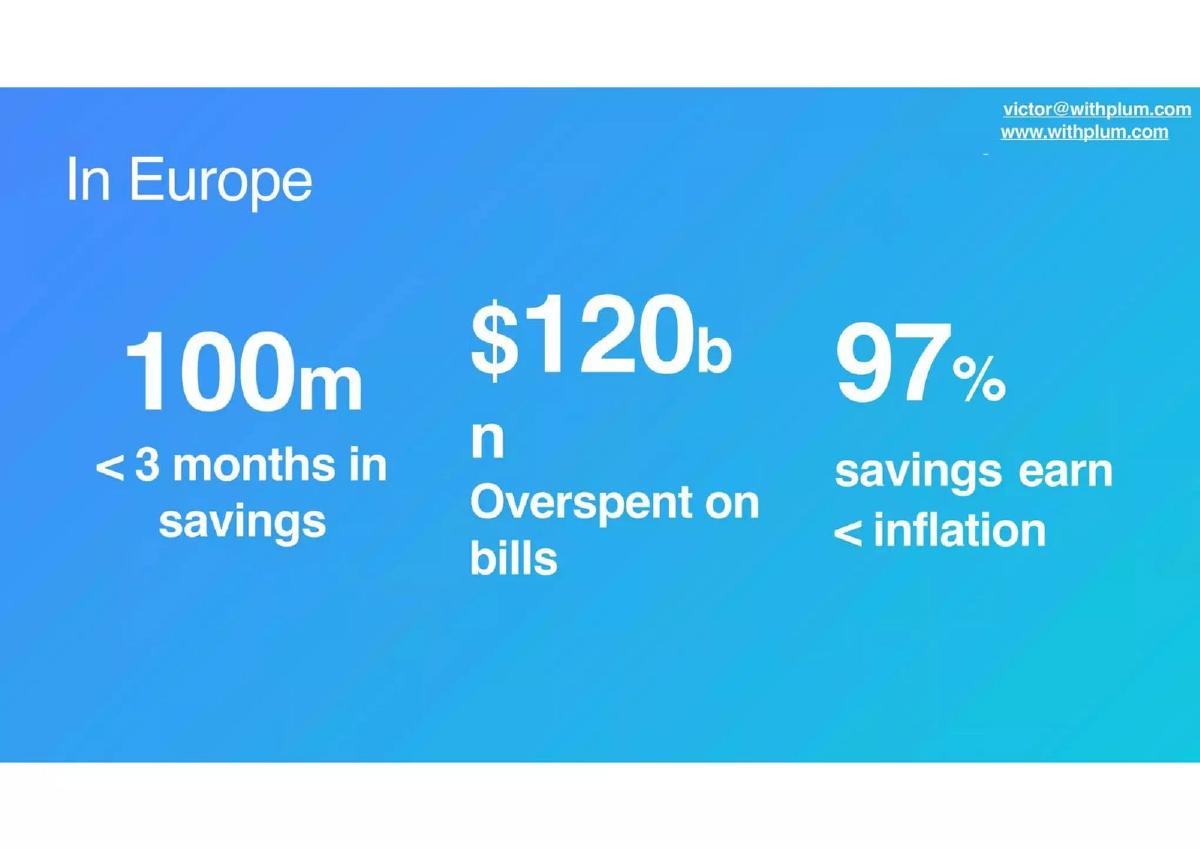
- The problem is quantified with three stark metrics: 100m Europeans have minimal savings, $120b is overspent on bills, and 97% of savings lose value to inflation (Slide 5).
- The product is presented as a simple chatbot interface, emphasizing ease of use and automated micro-savings (Slide 4).
- Traction is demonstrated through high-velocity growth rates: 20% MoM user growth and 50% MoM savings growth (Slide 7).
- The business model relies on a transition from 'Switching' revenue (one-time) to 'Investing' revenue (recurring) (Slide 8).
- The deck omits a formal 'Ask' for a new round, instead noting that $1.8m has already been raised to date (Slide 9).
- There is a total absence of a competitor matrix, detailed unit economics, or a specific roadmap for the 'Investing' phase.
The Power of Brevity in Fintech Fundraising
Plum’s pitch deck is an exercise in minimalism. At only nine slides, it avoids the dense spreadsheets and technical jargon that often plague fintech presentations. Instead, it focuses on three core pillars: the pedigree of the founders, the psychological theory behind the product, and early evidence of viral growth. By positioning themselves as the '2 Broke guys' who helped build TransferWise and Tictail, the founders create a narrative of insiders who saw a flaw in the system and left to fix it.
Slide 1: Title Slide
The deck opens with a clean, branded title slide. It features the Plum logo—a stylized, smiling fruit icon—against a purple-to-blue gradient. There is no tagline or mission statement here, relying entirely on the brand identity to set a modern, tech-forward tone.
Slide 2: The '2 Broke Guys' Team Slide
This is arguably the strongest slide in the deck. Rather than listing generic responsibilities, it highlights 'Founder-Market Fit' through previous successes. Victor Trokoudes is identified as Co-founder & CEO, noting he was the 5th employee at TransferWise and served as Head of International. Alex Michael, Co-founder & CTO, was the 5th engineer at Tictail and led payments. By including the logos of TransferWise and Tictail, Plum borrows the credibility of two highly successful European startups. The educational background (Harvard, INSEAD, Imperial College London) further reinforces a high-pedigree image.
Slide 3: The Philosophical Anchor
Plum uses Slide 3 to establish its intellectual foundation. It quotes Richard Thaler, the 2017 Nobel Economics winner, on the 'Power of Nudge.' This slide serves to validate the product's core mechanism—behavioral economics—without needing to explain the complex algorithms behind the AI. It suggests that Plum isn't just a tool, but a scientifically backed method for improving financial health.
Slide 4: Meet Plum - The Product
Slide 4 introduces the interface. Plum is defined as 'A Chatbot that uses AI to manage peoples money the way they should...' The visual is a simple iPhone mockup showing a Facebook Messenger-style interaction. The chat log demonstrates the automation: the bot notifies the user that £5.00 is being saved, asks if they want to withdraw, and reports a total savings balance of £678.23. The copy 'I'm just a robot' with a sunglasses emoji emphasizes the automated, low-friction nature of the service.
Slide 5: The European Market Problem
The problem slide uses three massive numbers to define the opportunity in Europe. First, '100m' people have less than 3 months in savings, indicating a lack of financial resilience. Second, '$120b' is overspent on bills, representing a massive pool of 'found money' that Plum can help users reclaim. Third, '97%' of savings earn less than inflation, meaning traditional bank accounts are effectively losing money for users. This slide successfully creates a sense of urgency and scale.
Slide 6: The Solution Workflow
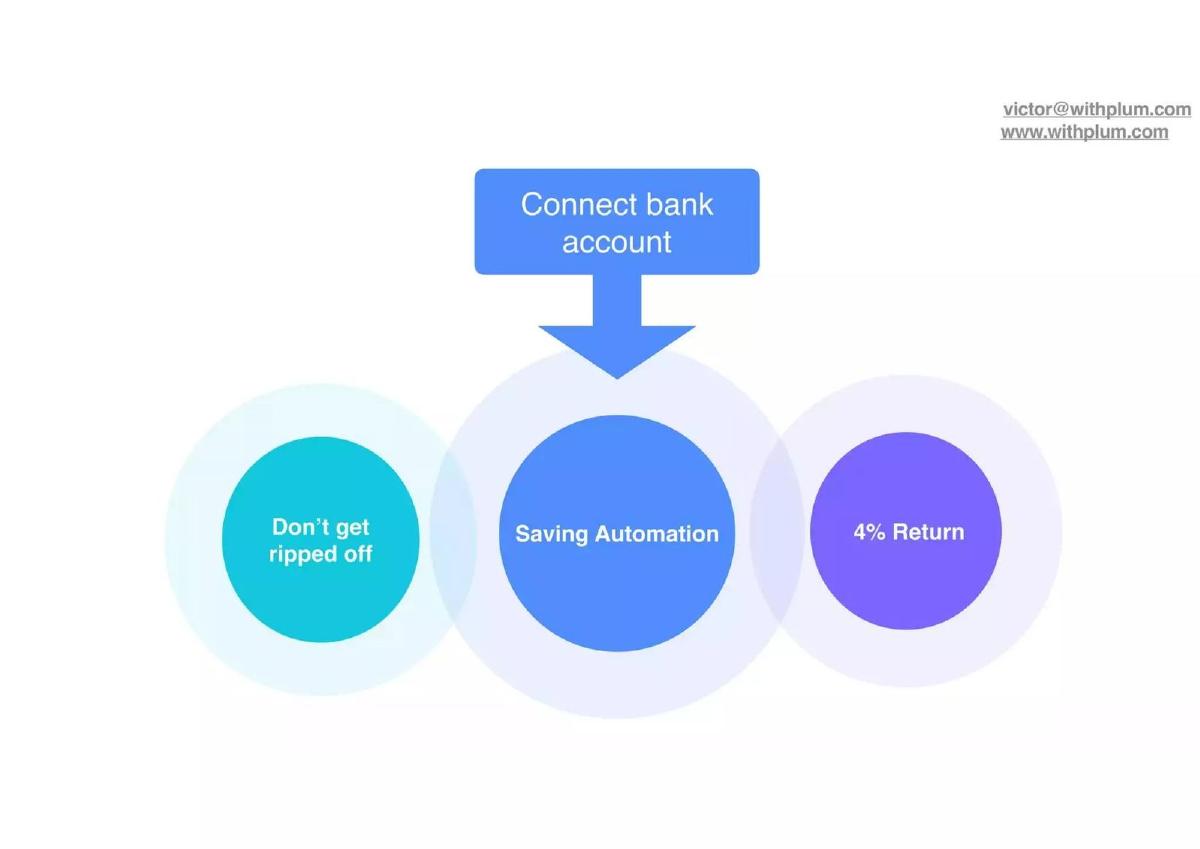
Slide 6 simplifies the user journey into three circles connected to a 'Connect bank account' prompt. The three value propositions are: 'Don’t get ripped off' (bill optimization), 'Saving Automation' (the core engine), and '4% Return' (the investment upside). This is a high-level conceptual slide that explains what the user gets, rather than how the technology works under the hood.
Slide 7: Traction and Growth
Traction is presented through two key metrics on Slide 7: '20% MoM user growth' and '50% MoM in Savings.' These figures are impressive because they show that not only is the user base growing, but the existing users are increasing their commitment to the platform at an even faster rate. This suggests high retention and increasing utility over time.
Slide 8: The Revenue Model
The business model is depicted as a linear progression on Slide 8. It starts with user acquisition, moves to 'Month 1 Revenue' via 'Switching' (likely lead generation fees from utility providers), and culminates in 'Recurring Revenue' through 'Investing.' This reveals Plum’s long-term strategy: use free automated savings to hook the user, generate immediate cash through bill switching, and then capture long-term assets under management (AUM) through investment products.
Slide 9: The Closing and The Ask
The final slide ends with another Richard Thaler quote: 'I will spend my prize money as irrationally as possible.' Below this, it states '$1.8m Raised to date.' Interestingly, the deck does not specify how much they are currently looking to raise or what the valuation is. It functions more as a 'company update' or a 'teaser' deck than a formal request for a specific dollar amount. Contact information for the CEO is provided at the bottom.
What Plum Does Well
The deck excels at social proof . By highlighting their early roles at TransferWise, the founders signal to investors that they know how to build a 'unicorn' fintech. Furthermore, the use of a Nobel Prize winner’s theory provides a level of academic 'air cover' that makes the product feel more substantial than a simple savings app. The visual simplicity is also a major plus; each slide has a single, clear message, making it easy to digest in under two minutes.
What is Missing
The most glaring omission is a Competitive Landscape . In the mid-to-late 2010s, the 'automated savings' space was becoming crowded with players like Digit, Acorns, and Chip. Plum does not explain why its chatbot approach is superior to a standalone app or a traditional bank’s 'round-up' feature. Additionally, there is no Unit Economics slide. While they mention 'Switching' revenue, they don't disclose the Average Revenue Per User (ARPU) or the Cost Per Acquisition (CPA), which are critical for evaluating a B2C fintech's sustainability. Finally, the Regulatory/Compliance aspect is ignored; operating a financial service in Europe requires significant licensing, which is a major barrier to entry and a key risk factor for investors.
Founder's Playbook: What to Copy
Founders should emulate Plum’s Traction Slide (Slide 7) . Instead of showing a confusing 'hockey stick' graph with no axis labels, Plum uses two simple, high-impact percentages. This is much harder to argue with and stays in the investor's mind. The Revenue Funnel (Slide 8) is also a great template for companies with multi-stage monetization; it clearly shows how a user evolves from a 'free' acquisition into a 'recurring' revenue source. Lastly, if you have a high-pedigree background, use the Team Slide (Slide 2) format—put the logos of your previous successful companies front and center; they are more recognizable than your job title.
Frequently asked questions
- What is the core product offering of Plum according to the deck?
- Plum is described on Slide 4 as an AI-powered chatbot designed to manage money automatically. The primary functions shown on Slide 6 include connecting a bank account to enable 'Saving Automation,' helping users avoid being 'ripped off' (likely through bill switching), and providing a '4% Return' through investment features.
- How does Plum plan to make money?
- Slide 8 outlines a three-stage revenue funnel. First, they acquire users. Second, they generate 'Month 1 Revenue' through 'Switching'—which typically refers to commissions earned when users switch utility or insurance providers. Third, they aim for 'Recurring Revenue' through 'Investing' services, though the specific fee structure for investing is not detailed.
- What market gap is Plum trying to fill?
- Plum targets the European market, specifically addressing three pain points listed on Slide 5: the lack of emergency funds (100m people with <3 months savings), inefficient spending ($120b wasted on bills), and poor returns on traditional savings (97% of savings earn less than the rate of inflation).
- Who are the founders and why are they relevant?
- The founders are Victor Trokoudes (CEO) and Alex Michael (CTO). As shown on Slide 2, Trokoudes was the 5th employee at TransferWise and Head of International, while Michael was the 5th engineer at Tictail and led payments. This 'early employee' pedigree suggests they have experience scaling high-growth fintech and e-commerce platforms.
- What is missing from this pitch deck?
- The deck is extremely minimalist. It lacks a competitive landscape analysis, a detailed marketing/CAC strategy, a slide on regulatory compliance (crucial for fintech), and specific financial projections. It also does not state a current funding goal, only mentioning the $1.8m previously raised on Slide 9.