Podozi’s 9-slide deck from 2015 is a lean, visual-heavy presentation that targets the intersection of e-commerce and personalized beauty for women of color. The startup identifies a massive $25.1 billion market and highlights a specific pain point: the prevalence of knock-off products and the difficulty of finding skin-tone-specific matches. With a monthly revenue of $10,000 and a 40% monthly growth rate at the time of the deck, the founders leveraged early traction and high-profile partnerships with brands like Revlon and Wet n Wild to validate their model. While the deck lacks a formal 'Ask…
Key takeaways
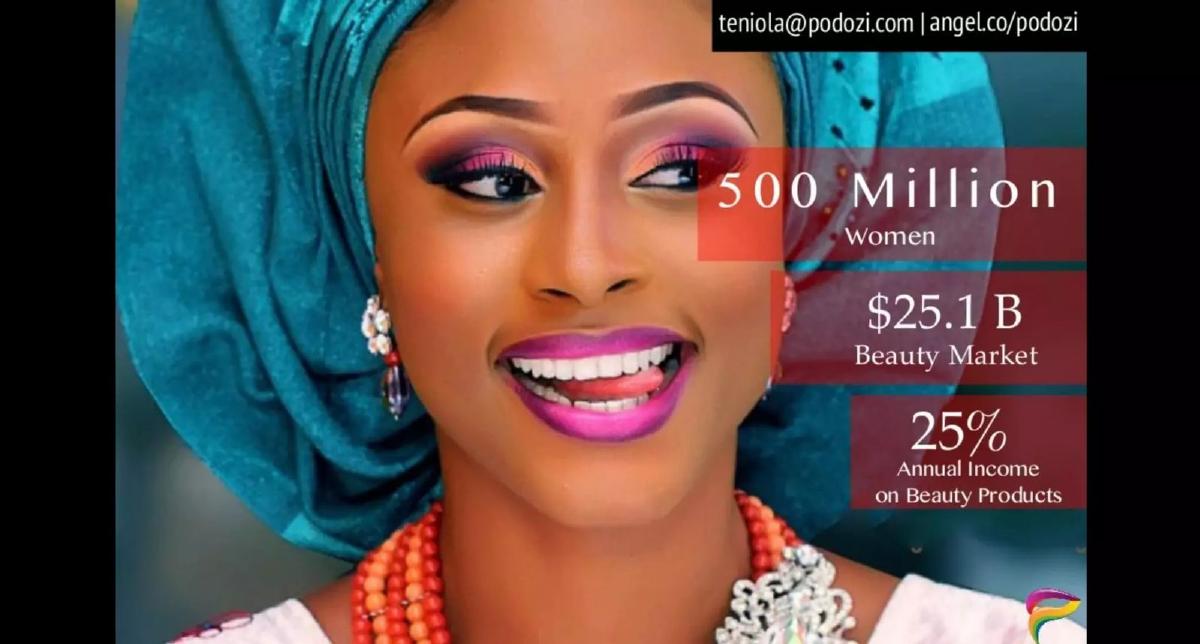
- The total addressable market is defined as 500 million women within a $25.1 billion beauty market (Slide 2).
- Podozi claims that 25% of annual income in their target demographic is spent on beauty products (Slide 2).
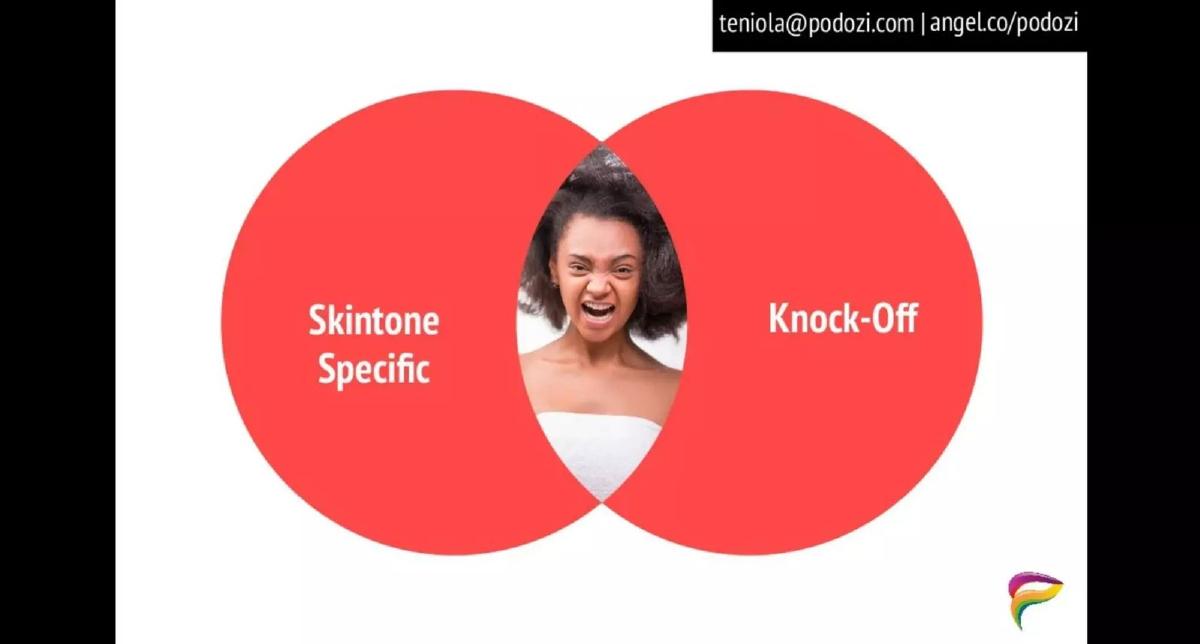
- The core problem is visualized as a Venn diagram intersection of 'Skintone Specific' needs and the risk of 'Knock-Off' products (Slide 3).
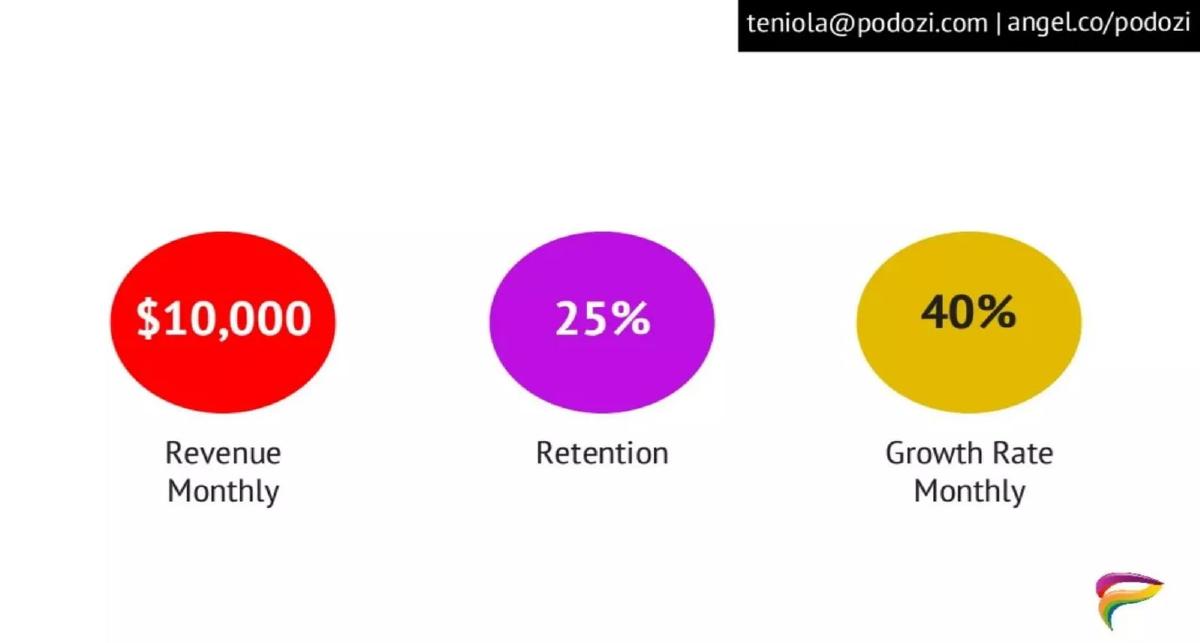
- At the time of the deck, the company reported $10,000 in monthly revenue and a 40% monthly growth rate (Slide 5).
- Customer retention was stated at 25% (Slide 5).
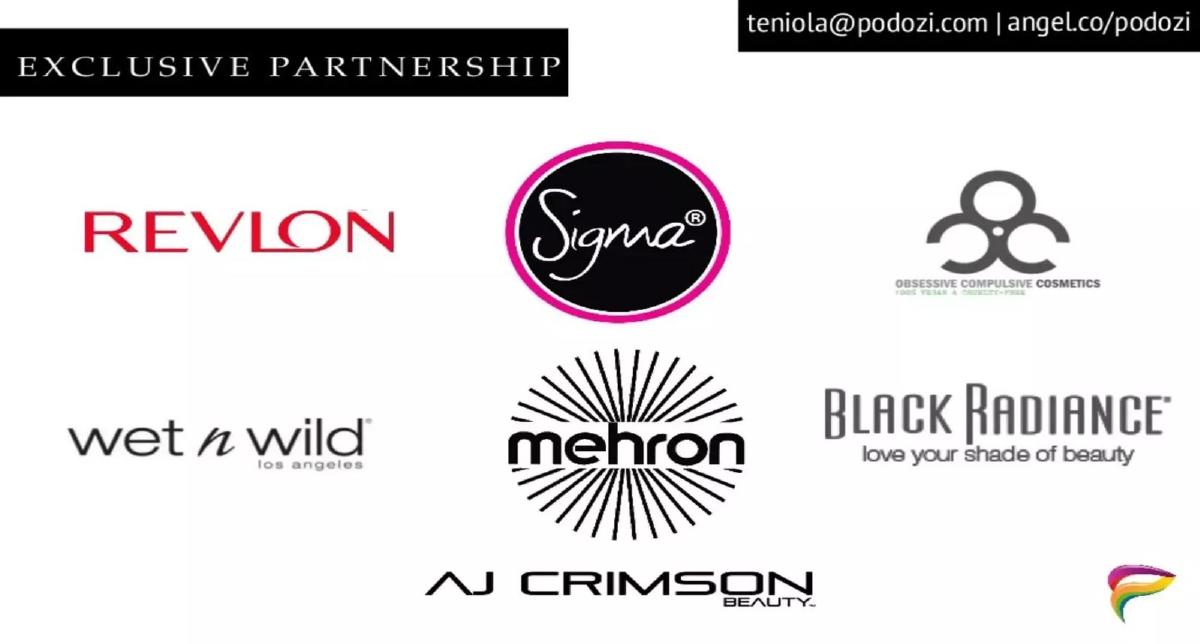
- The startup secured 'Exclusive Partnerships' with major global brands including Revlon, Sigma, and Wet n Wild (Slide 6).
- The founding team brings over 22 combined years of experience across product development, the beauty industry, and software (Slide 7).
- The deck uses a high-level endorsement from L’Oréal CEO Jean-Paul Agon to validate the African market's potential (Slide 8).
The 9-Slide Strategy: Podozi’s Lean Pitch
Podozi’s pitch deck is an exercise in minimalism. In an era where decks often stretch to 20 or 30 slides, this 2015 deck manages to cover the essential bases of market, problem, solution, and traction in just nine pages. The company, which raised $120,000 according to catalogue facts, focuses heavily on the 'why now' and the 'who' rather than getting bogged down in complex financial modeling.
Slide 1: Title and Positioning
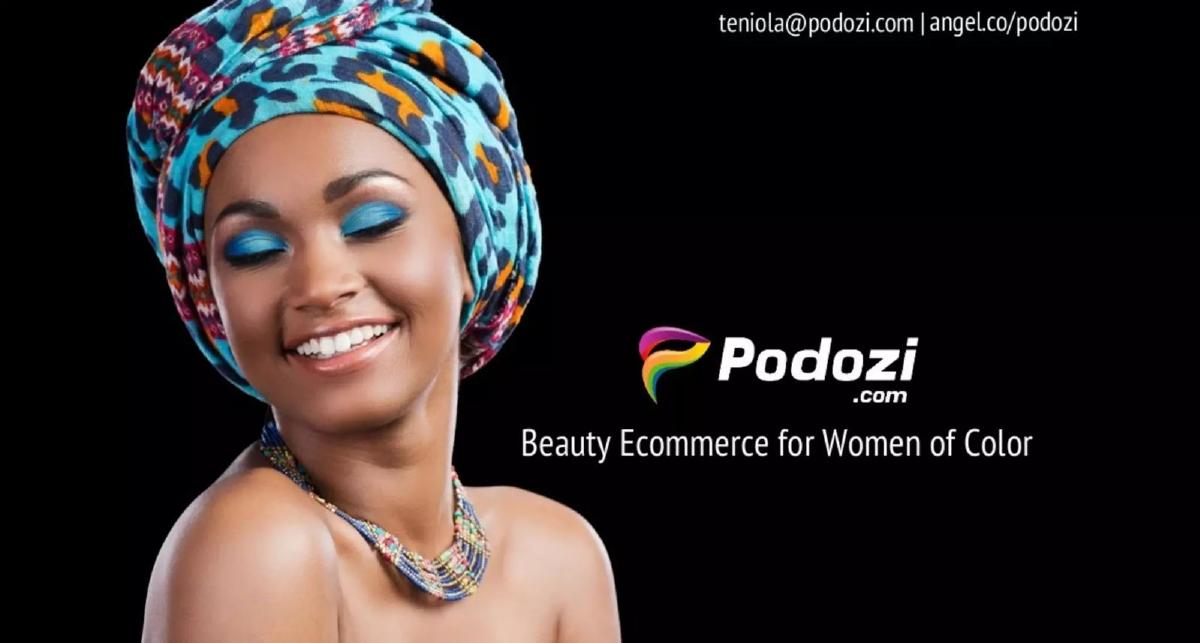
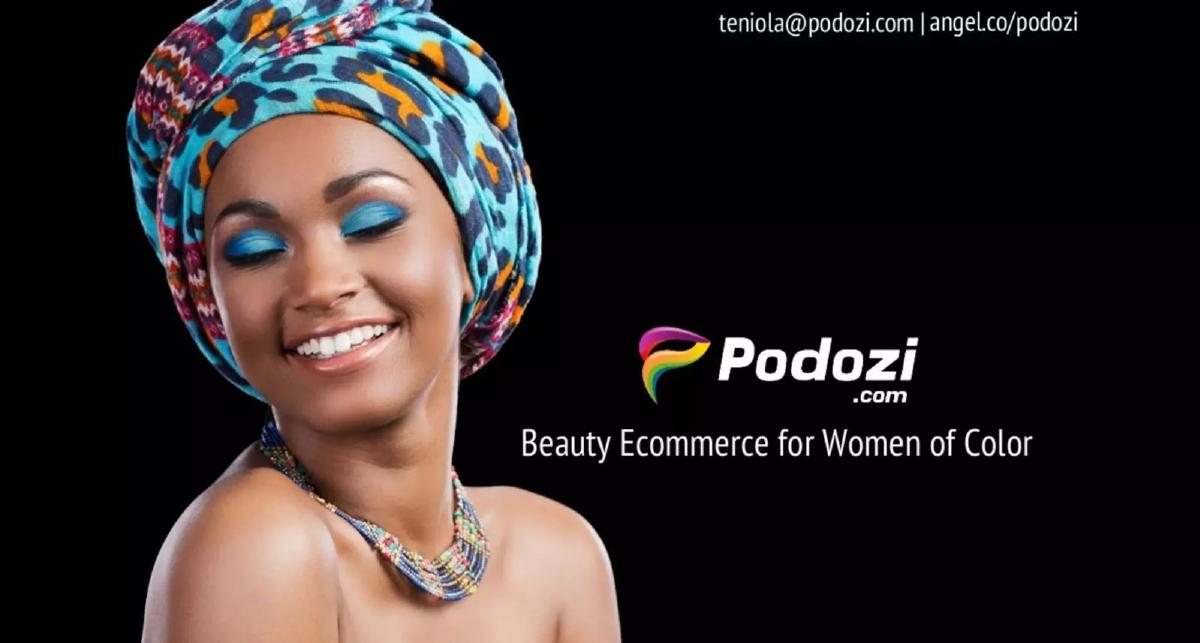
The cover slide is clean and high-impact. It features a high-quality image of a woman of color, immediately identifying the target demographic. The tagline, "Beauty Ecommerce for Women of Color," is a direct and unambiguous value proposition. Contact information for Teniola is provided at the top right, along with an AngelList link, suggesting this deck was used for early-stage outreach.
Slide 2: The $25.1 Billion Opportunity
Podozi moves straight to the market size. They identify a target of 500 Million Women and a $25.1 B Beauty Market . The most compelling stat on this slide is the claim that this demographic spends 25% of Annual Income on Beauty Products . This is a powerful metric for investors because it suggests high customer lifetime value (LTV) and a deeply ingrained spending habit that is resistant to economic downturns.
Slide 3: The Problem Visualization
Instead of a bulleted list of grievances, Slide 3 uses a Venn diagram. It places an image of a frustrated consumer at the intersection of "Skintone Specific" and "Knock-Off." This effectively communicates the two-pronged pain point: the difficulty of finding the right shade and the prevalence of counterfeit goods in the African market. It frames the problem as both a discovery issue and a trust issue.
Slide 4: The Solution and Business Model
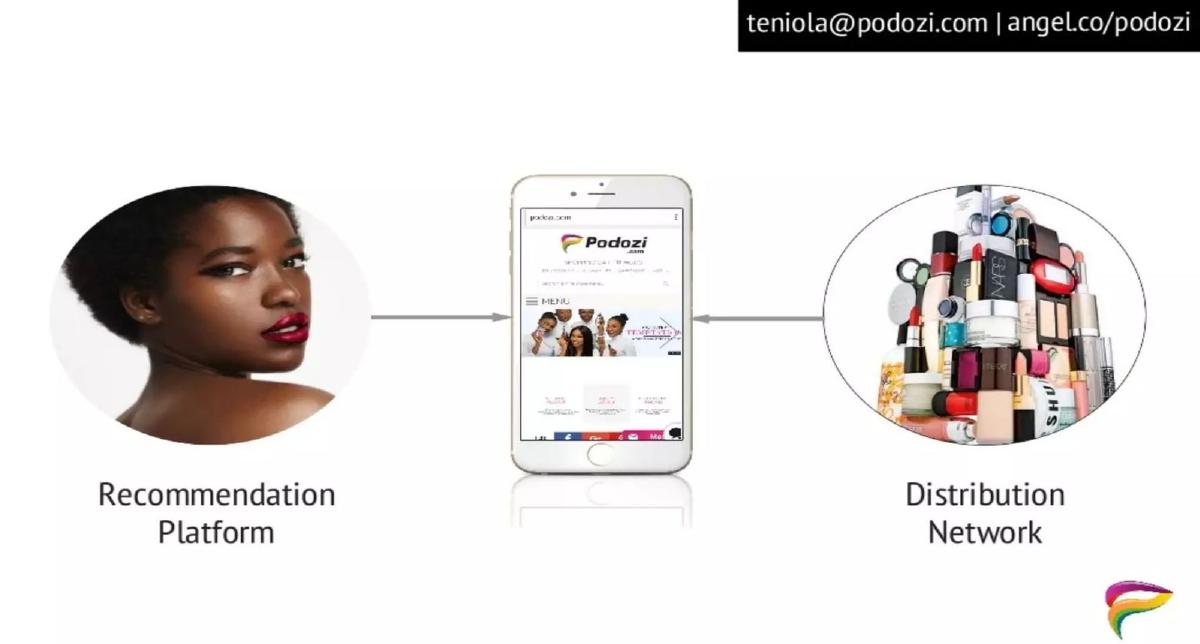
Slide 4 illustrates the Podozi ecosystem. It positions the startup as the bridge between the consumer and the products. The three components are a "Recommendation Platform," a mobile-optimized interface (shown on an iPhone), and a "Distribution Network." This suggests that Podozi isn't just a shop; it is a tech-enabled curator that handles the logistics of getting authentic products to the end-user.
Slide 5: Traction and Growth Metrics
This is the 'meat' of the deck for most investors. Podozi reports $10,000 Monthly Revenue , 25% Retention , and a 40% Monthly Growth Rate . While $10k is a modest absolute number, the 40% month-over-month growth is the figure that attracts venture capital. The 25% retention rate provides a baseline for cohort health, though it is unclear over what time period that retention is measured.
Slide 6: Exclusive Partnerships
Validation is key in e-commerce, especially when fighting 'knock-offs.' Slide 6 displays logos for Revlon, Sigma, Obsessive Compulsive Cosmetics, Wet n Wild, Mehron, Black Radiance, and AJ Crimson Beauty . Labeling these as "Exclusive Partnerships" gives Podozi a significant competitive moat, as it implies these global brands have chosen Podozi as their primary or sole gateway to this specific market segment.
Slide 7: The Team
The team slide highlights a balanced trio of founders. 'Wale (CEO) brings 5+ years of product and e-commerce experience. Teniola (COO) is the industry expert with 10+ years in beauty. 'Seye (CTO) provides the technical backbone with 7+ years in software development. This covers the three pillars of a tech startup: building the product, understanding the market, and managing the business.
Slide 8: External Validation (The L’Oréal Quote)
Podozi uses a quote from Jean-Paul Agon, Chairman/CEO of L’Oréal : "Soon, the emerging countries of Africa will become our first market, before the US and Western Europe." This is a classic 'borrowed authority' move. By citing the leader of the world’s largest beauty company, Podozi validates their choice of geography without having to provide their own macroeconomic data.
Slide 9: The Closing
The final slide repeats the contact information and the AngelList URL. The closing statement, "Africa is the NEW GOLD mine," reinforces the high-upside narrative of the previous slide. However, as noted in the takeaways, this slide lacks a specific call to action or funding goal.
What Works in This Deck
Visual Clarity: The deck avoids 'wall of text' syndrome. Every slide has a single, clear focus. The use of high-quality imagery reinforces that this is a beauty-centric business where aesthetics matter.
Focus on Growth: By highlighting a 40% monthly growth rate, the founders show that they have moved past the idea stage and are in the execution phase. This is critical for a $120k raise, which is typically a seed or pre-seed round.
Strategic Partnerships: Listing Revlon and Wet n Wild as exclusive partners immediately solves the 'trust' problem mentioned on Slide 3. It tells the investor that the supply chain is secured and the brands themselves believe in Podozi’s distribution model.
What is Missing
The Ask: The most glaring omission is a slide detailing how much money they are raising and what they plan to do with it. Investors need to know if the $120k is for inventory, marketing, or hiring more developers.
Unit Economics: While revenue and growth are present, there is no mention of Customer Acquisition Cost (CAC) or margins. In e-commerce, knowing the cost to acquire a customer versus their lifetime value is essential to understanding if the business can scale profitably.
Competitor Analysis: The deck assumes a vacuum. It doesn't mention other local e-commerce giants (like Jumia or Konga) or how Podozi intends to defend its niche against them as they expand their beauty categories.
What a Founder Should Copy
The Venn Diagram Problem Slide: Slide 3 is an excellent way to visualize a complex market gap. It shows exactly where the current market fails and where the startup fits in. It’s much more memorable than a list of bullet points.
The Authority Quote: If you are operating in an emerging market or a niche that investors might be skeptical of, find a quote from a global industry leader that validates the macro trend. It saves you three slides of data and carries more weight.
Minimalist Metrics: Slide 5 is a great template for early traction. Pick your three strongest numbers and put them in large, colorful circles. It forces the investor to look at your successes rather than getting lost in a spreadsheet of secondary data.
Frequently asked questions
- What is the primary problem Podozi is solving?
- According to Slide 3, Podozi addresses the difficulty women of color face in finding authentic, skin-tone-specific beauty products. The deck highlights a market saturated with 'knock-offs,' positioning Podozi as a trusted recommendation platform and distribution network that ensures product authenticity and fit.
- How much traction did Podozi have when this deck was used?
- Slide 5 shows that Podozi had reached $10,000 in monthly revenue. More importantly, they were demonstrating a 40% monthly growth rate and a 25% customer retention rate, indicating early product-market fit in the e-commerce space.
- Who are the key partners mentioned in the deck?
- Slide 6 lists several 'Exclusive Partnerships' with well-known international and niche beauty brands. These include Revlon, Sigma, Obsessive Compulsive Cosmetics, Wet n Wild, Mehron, Black Radiance, and AJ Crimson Beauty.
- What is the background of the founding team?
- The team consists of three key members shown on Slide 7: 'Wale (CEO) with 5+ years in product development and e-commerce; Teniola (COO) with 10+ years in the beauty industry; and 'Seye (CTO) with 7+ years in software development.
- Does the deck include a financial exit strategy or 'The Ask'?
- No. The 9-slide deck is notably missing a slide detailing the investment sought, the valuation, or the specific use of funds. It also does not outline an exit strategy, focusing instead on the market opportunity and current growth metrics.