point.me presents a compelling case for a travel rewards search engine by focusing on the friction inherent in the current airline loyalty ecosystem. The deck identifies a massive market opportunity, citing that $16 billion in points and miles go unredeemed annually. The company demonstrates product-market fit through early traction metrics, including 26,000 subscribers and $2 million in revenue, achieved with no marketing spend. By contrasting the 'onerous' traditional booking process with their streamlined interface, point.me positions itself as a necessary utility for the estimated 10 tril…
Key takeaways
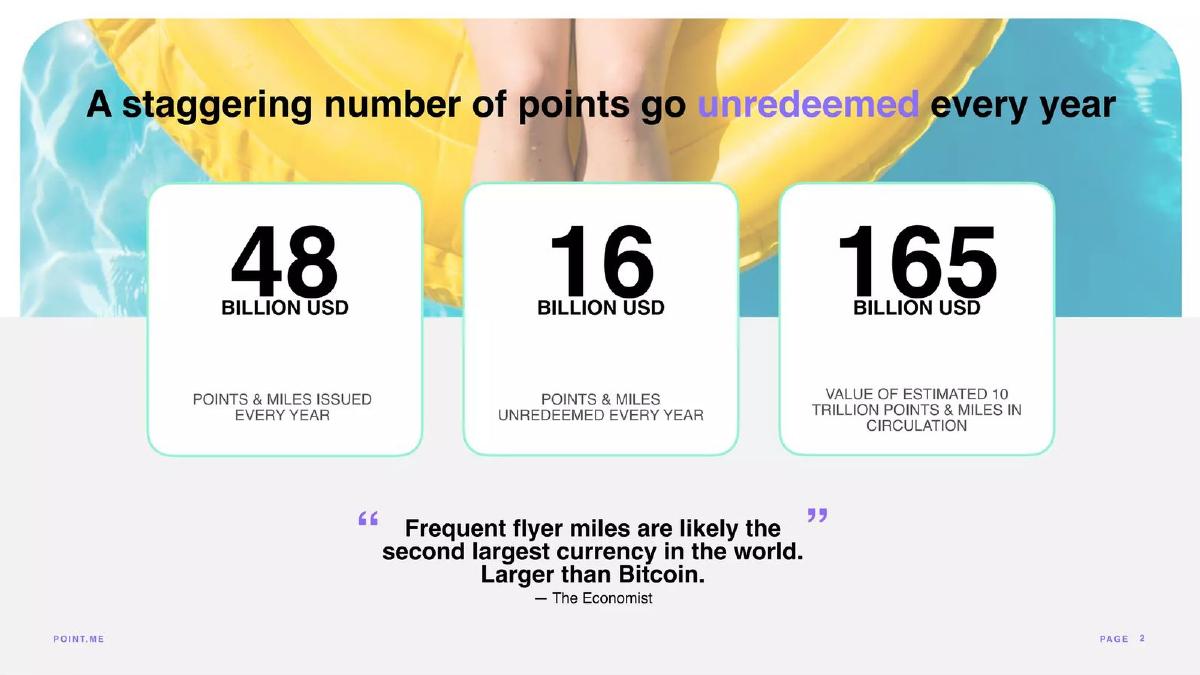
- The deck identifies a massive market gap, noting that $16 billion in points and miles go unredeemed every year (Slide 2).
- Frequent flyer miles are described as the second largest currency in the world, larger than Bitcoin, citing The Economist (Slide 2).
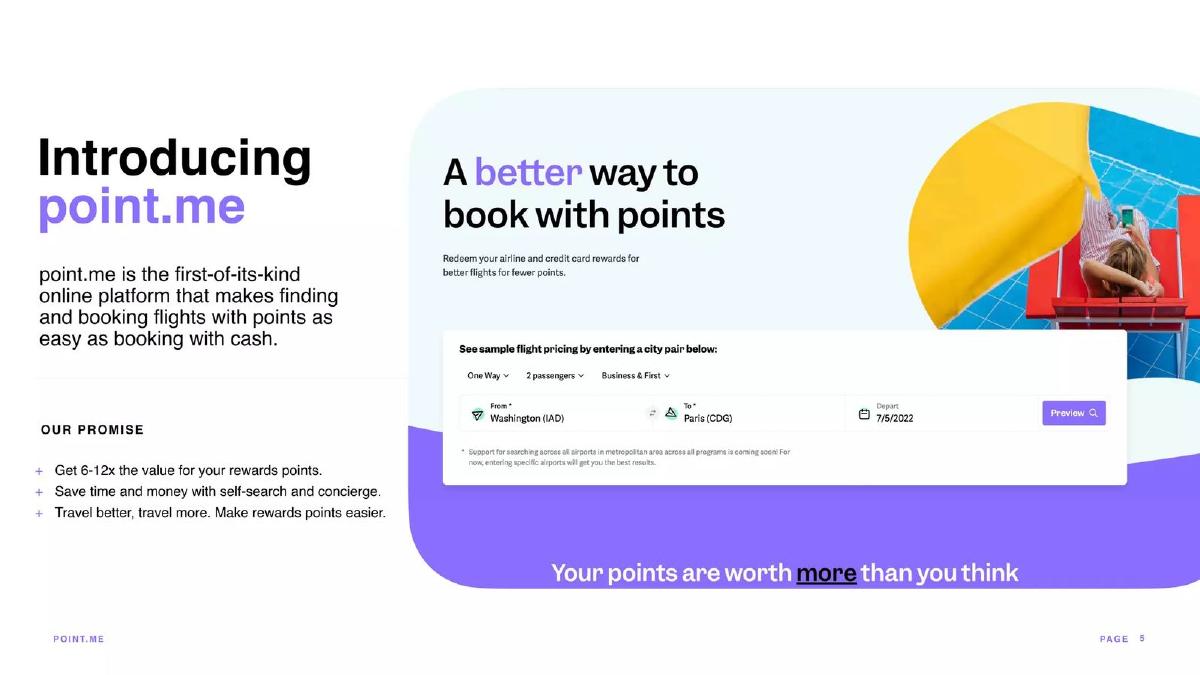
- The product offers a significant value proposition, claiming users can get 6-12x the value for their rewards points (Slide 5).
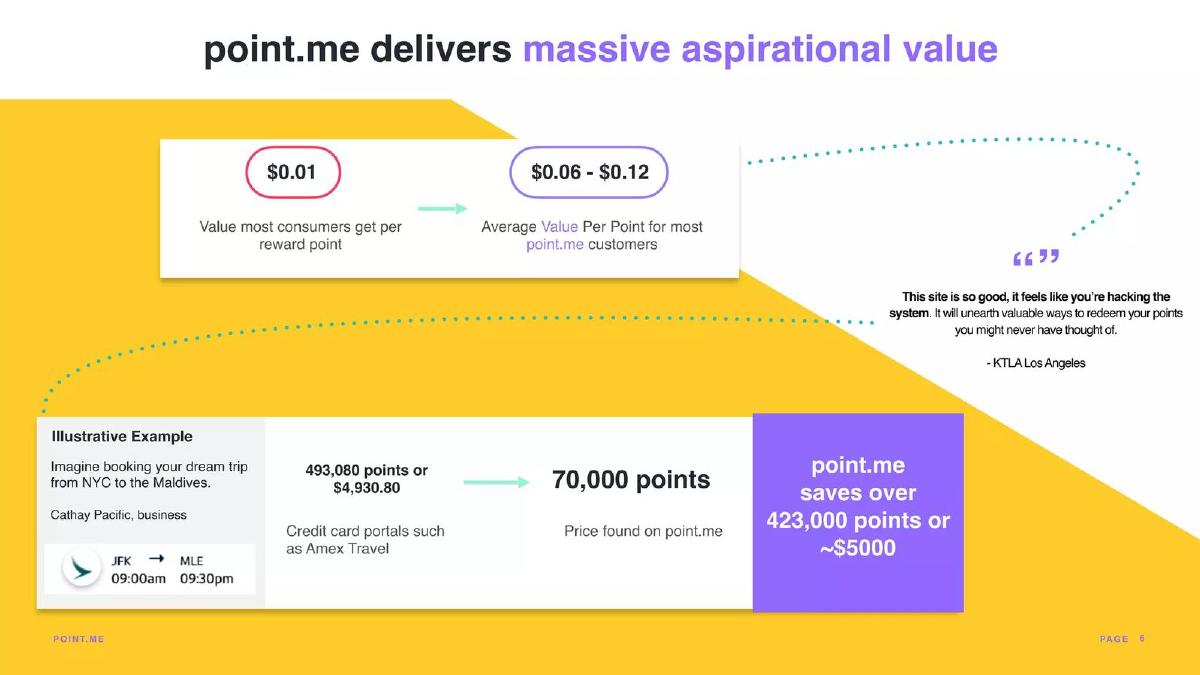
- A specific illustrative example shows a flight from NYC to the Maldives costing 70,000 points on point.me versus 493,080 points on credit card portals (Slide 6).
- Early traction is strong, with over 26,000 subscribers and $2M in revenue generated with zero marketing (Slide 11).
- The company maintains a low churn rate of 4.3% for its consumer services (Slide 11).
- The business model is diversified across consumer services, white-label integrations, B2B, and affiliate channels (Slide 11).
- The deck highlights a previous $2M seed round supported by notable investors including PAR Capital and founders of Google Flights (Slide 15).
The Hook: A $16 Billion Opportunity
Slides 1-2: The Problem and Market Size
The deck opens with a clean, brand-focused title slide before immediately diving into the 'staggering' numbers that define the market. Slide 2 establishes the scale: $48 billion in points are issued annually, and $16 billion go unredeemed. By quoting The Economist's claim that frequent flyer miles are the second largest currency in the world—larger than Bitcoin—the founders successfully frame a niche travel tool as a major fintech opportunity. The use of '10 trillion points in circulation' (Slide 2) provides the necessary 'Total Addressable Market' (TAM) context without using a standard, often-ignored TAM pyramid.
Slides 3-4: The User Pain Point
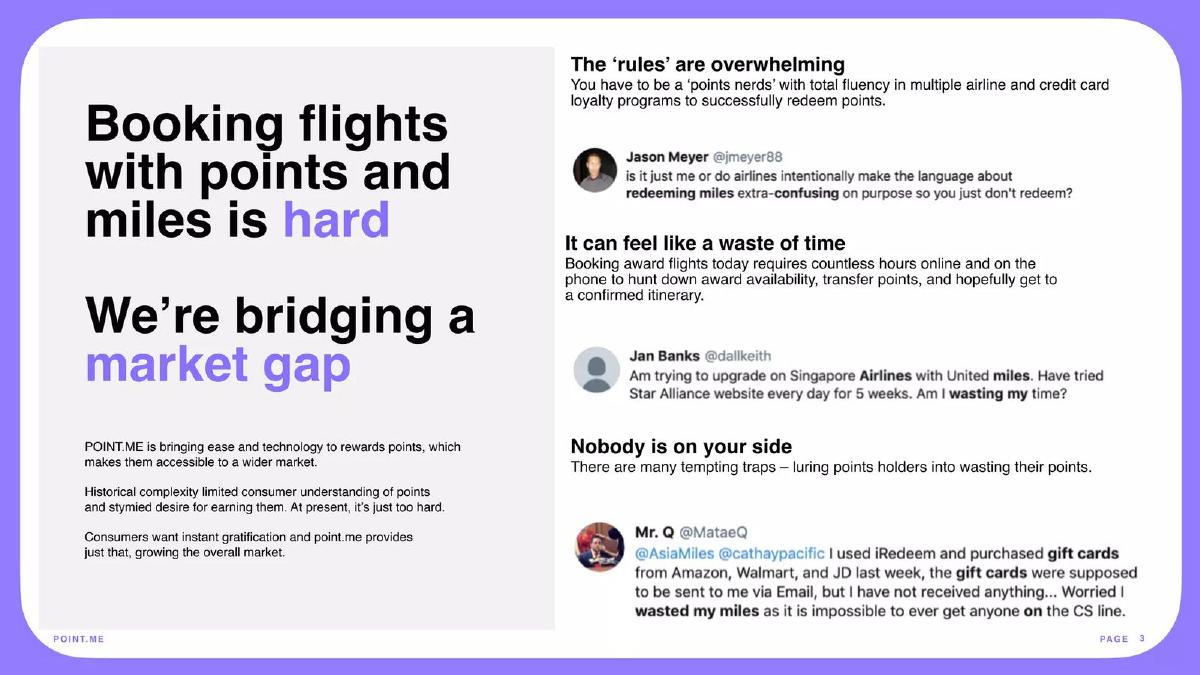
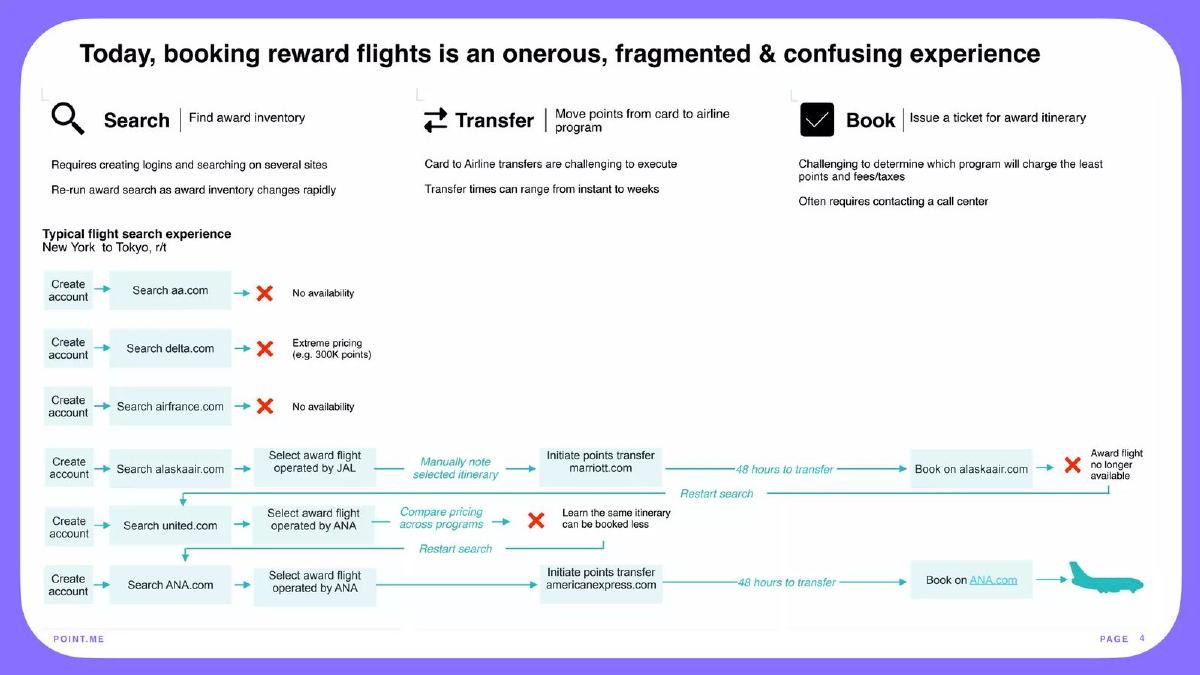
Slide 3 uses social proof in the form of tweets to humanize the problem. By showing real users complaining about 'wasting time' and 'confusing language,' the deck validates that the problem isn't just theoretical. Slide 4 is perhaps the most important functional slide in the deck. It maps out the 'onerous' current user journey for a flight from New York to Tokyo. It visualizes the frustration of creating multiple accounts and hitting dead ends, which sets the stage for the solution to look like a hero product.
The Solution: Making Points as Easy as Cash
Slides 5-7: Product Introduction and Value Proposition
Slide 5 introduces the platform with a simple promise: 'Get 6-12x the value for your rewards points.' This is a bold claim that is immediately backed up by Slide 6. The 'Illustrative Example' on Slide 6 is a masterclass in pitch deck clarity. It compares a business class trip to the Maldives: 493,080 points on a standard credit card portal versus 70,000 points found on point.me. The headline 'saves over $5000' makes the subscription cost (which isn't explicitly stated here but implied by the 'subscriber' count later) feel negligible.
Slides 8-10: Product Walkthrough
These slides show the actual interface. Slide 8 highlights the three-step process: Search, Compare, and Step-by-step guidance. Slide 9 introduces the 'Concierge' service, showing that the company caters to both self-serve 'points nerds' and high-net-worth individuals who want a 'white glove' experience. Slide 10 emphasizes real-time results and includes a small but vital detail: a CO2 emissions tracker, signaling that the platform is modern and socially conscious.
Traction and Business Model
Slide 11: The 'Real Revenue' Proof
This is the 'meat' of the Series A deck. The company claims $2M in revenue and 26,000 subscribers with 'no marketing.' For a Series A, this is an exceptionally strong signal of organic product-market fit. The slide also breaks down the expansion strategy into B2B and White Label integrations. Mentioning a partnership with a 'major card issuer' that reached ~1M members (Slide 11) suggests that the technology is scalable and enterprise-ready, moving beyond a simple consumer app.
Slide 12: Media Validation
Slide 12 is a 'logo wall' of press coverage. While many decks include this, point.me includes specific quotes from Forbes, Bloomberg, and The New York Times. The quote from God Save The Points calling it the '"Google Flights" of booking with points' is a powerful shorthand that investors can easily grasp and repeat to their investment committees.
The Team and The Backers
Slides 13-15: Why This Team?
Slide 13 attempts to define their 'unfair advantages,' focusing on the intersection of loyalty expertise and proprietary tech. Slide 14 introduces the leadership. CEO Adam Morvitz and President Tiffany Funk are positioned as industry experts. The team slide is clean, though it lacks the 'previous exits' or 'big tech' logos often seen in Silicon Valley decks, relying instead on their specific domain expertise in the loyalty space. Slide 15 closes the loop on credibility by listing their $2M seed investors. The inclusion of the 'Google Flights / ITA Software Founders' is a massive endorsement, as it suggests the people who built the modern flight search engine believe point.me has built the equivalent for rewards.
What Works and What is Missing
What Works
The Comparison Slide: Slide 6 is the strongest slide in the deck. It takes a complex value proposition and turns it into a simple 'before and after' math problem that any investor can understand. · Organic Traction: Citing $2M in revenue with zero marketing spend is a high-quality signal that the product solves a genuine pain point. · Market Framing: Comparing loyalty points to Bitcoin and global currency (Slide 2) elevates the company from a 'travel tool' to a 'wealth management' or 'fintech' play.
What is Missing
The Ask: The deck does not include a slide detailing how much they are raising in this specific round or how they plan to spend the capital. While the source listing mentions a $10M Series A, the slides themselves are silent on the terms. · Unit Economics: While they mention a 4.3% churn rate, there is no mention of Customer Acquisition Cost (CAC) or Lifetime Value (LTV). Since they claim to have done 'no marketing,' these figures might be speculative, but investors usually want to see the projected economics of paid growth. · Financial Projections: There are no forward-looking charts showing revenue growth targets for the next 3-5 years. · Competitor Analysis: The deck assumes a 'market gap' but does not explicitly name or differentiate from other award search tools like ExpertFlyer or Roame.
Founder Takeaways
Founders should copy the way point.me uses social proof . Instead of just listing logos, they use specific, high-impact quotes that define their category (e.g., the 'Google Flights for points' comparison). Additionally, the visualized user journey on Slide 4 is an excellent way to explain a technical or process-heavy problem to an outsider. By showing the 'red Xs' of a manual search, they make the 'green checkmarks' of their product feel inevitable. Finally, if you have revenue without marketing , make it the centerpiece of your traction slide as point.me did on Slide 11; it is the most effective way to prove that your product is 'pulled' by the market rather than 'pushed' by ad spend.
Frequently asked questions
- What is the core problem point.me is solving?
- The deck argues that booking flights with points is 'hard' and 'onerous.' It cites that $16 billion in value is lost annually because consumers find the rules overwhelming and the search process too time-consuming. Slide 4 illustrates a typical manual search process that involves creating multiple accounts and facing frequent 'no availability' results, which point.me aims to automate.
- How does point.me generate revenue?
- According to Slide 11, the company has four primary revenue streams: direct-to-consumer subscriptions, white-label partnerships with card issuers (reaching ~1M targeted members), B2B services for corporate employee travel, and affiliate partnerships with travel agencies. They report $2M in revenue from these channels prior to launching paid marketing.
- What is the 'Unfair Advantage' claimed by the team?
- Slide 13 outlines a three-part advantage: deep knowledge and business logic regarding loyalty rules, established relationships with major credit card issuers and airlines, and advanced proprietary search technology. The team includes founders and executives with backgrounds in loyalty consulting and engineering, which they claim makes the product 'unmatchable.'
- Who are the key investors in point.me?
- Slide 15 lists several high-profile backers from their $2M seed round, including PAR Capital, the founders of Google Flights/ITA Software, Jeffrey Katzenberg’s WndrCo, Gaingels, and Alumni Ventures. This cap table provides significant industry credibility, particularly the involvement of the Google Flights architects.
- What metrics are used to prove traction?
- The primary traction metrics cited on Slide 11 include 26,000+ subscribers, $2M in revenue, and a 4.3% churn rate. They also mention a successful 6-month co-brand pilot with a major card issuer that outperformed management expectations for engagement and conversion.