PointCatcher’s deck identifies a significant market inefficiency: while B2B accounts for 90% of all commerce, the $60 billion loyalty industry is currently dominated by large B2C corporations. The company proposes a 'Rewards Network' that allows small businesses and B2B entities to issue spendable points using a $1 = 1Pt equivalent. Leveraging the Intuit Card Link Platform for bank-level security, PointCatcher seeks to build a social network for points, enabling organic growth through business-to-customer and business-to-supplier engagement. Their financial projections for 'Year One' show a t…
Key takeaways
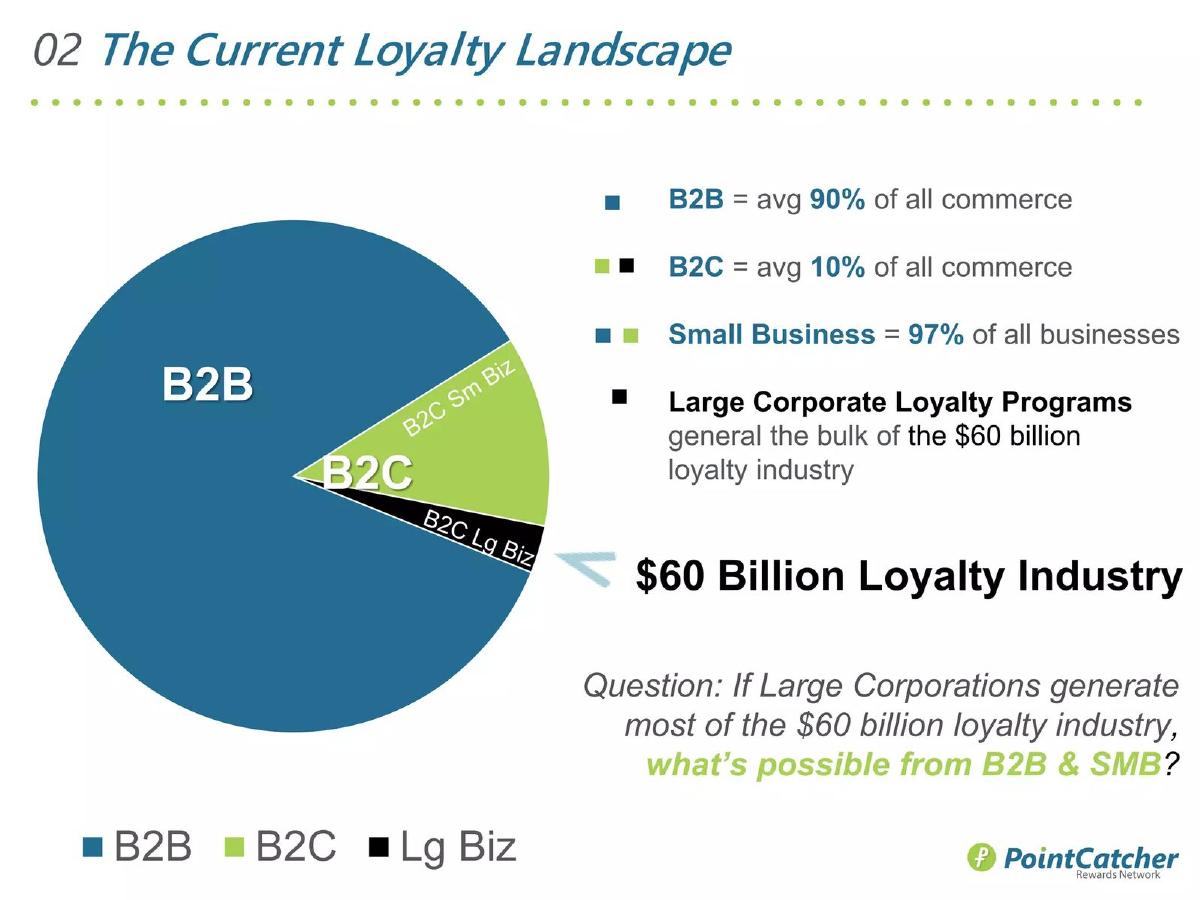
- The deck identifies that B2B represents 90% of commerce but is underserved by the $60 billion loyalty industry (Slide 2).
- Small businesses make up 97% of all businesses, representing a massive untapped segment for loyalty programs (Slide 2).
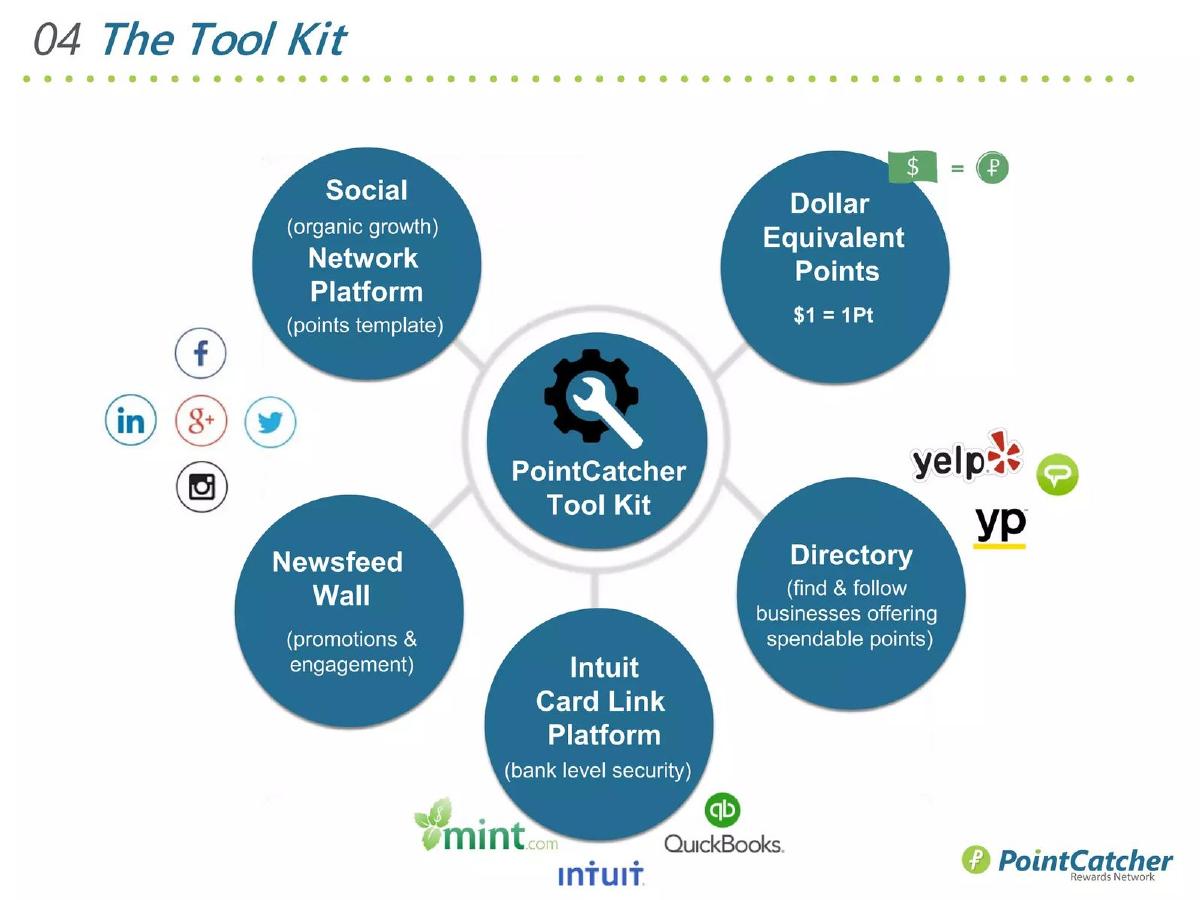
- The 'Tool Kit' relies on the Intuit Card Link Platform to provide bank-level security and integration with Mint and QuickBooks (Slide 4).
- PointCatcher uses a simplified value proposition where $1 equals 1 Point to ensure consumer clarity (Slide 4).
- The business model requires businesses to set their own reward rates and invite customers, while consumers link cards to earn spendable points (Slide 6).
- Market size is framed through the lens of social network growth, citing the time it took platforms like Google+ and LinkedIn to reach 50 million users (Slide 8).
- Financial projections for 2015 estimate monthly income growing from near-zero in January to $80,000 by December (Slide 10).
- The company projects reaching profitability (income exceeding costs) by June of their first year (Slide 10).
Executive Summary: The B2B Loyalty Opportunity
PointCatcher presents a vision for a unified rewards network that bridges the gap between traditional B2C loyalty programs and the massive, yet underserved, B2B and SMB markets. The deck argues that the current $60 billion loyalty industry is top-heavy, serving only large corporations while ignoring the 90% of commerce that happens in B2B transactions. By providing a 'Tool Kit' that integrates with existing financial software, PointCatcher attempts to commoditize loyalty programs for the average business owner.
Slide 01: Title Slide
The deck opens with a clean, minimalist title slide featuring the PointCatcher logo and the tagline 'Rewards Network.' The branding uses a blue and green color palette, which is maintained throughout the presentation. No specific mission statement or 'Uber for X' analogy is present here.
Slide 02: The Current Loyalty Landscape
This slide serves as the 'Problem' and 'Opportunity' combined. It uses a pie chart to illustrate a stark contrast in the market. It states that B2B equals an average of 90% of all commerce , yet 'Large Corporate Loyalty Programs generate the bulk of the $60 billion loyalty industry.' The slide further notes that Small Business represents 97% of all businesses . The core question posed to the investor is: 'If Large Corporations generate most of the $60 billion loyalty industry, what’s possible from B2B & SMB?' This is a strong framing of a market inefficiency.
Slide 04: The Tool Kit
Slide 4 details the product ecosystem. PointCatcher positions itself as a central hub connected to five key pillars:
Social Network Platform: Focused on organic growth and providing a points template. · Dollar Equivalent Points: A simple $1 = 1Pt conversion rate to avoid consumer confusion. · Directory: A discovery tool for users to find businesses offering spendable points, featuring logos of Yelp and Yellow Pages (yp). · Intuit Card Link Platform: The technical backbone, promising 'bank level security' and integration with Mint.com and QuickBooks . · Newsfeed Wall: A feature for promotions and engagement.
This slide is crucial because it explains how they bypass the need for new hardware at the point of sale by using card-linking technology.
Slide 06: How It Works
This slide breaks down the user journey for two distinct groups. For Businesses , the process is a four-step cycle: Create Account, Set Rate (illustrated with a 5% icon), Invite Customers, and Engage Suppliers. For Consumers , the steps are: Sign Up, Link Cards Via Intuit, Follow Member Business, and Earn Spendable Points. The inclusion of 'Engage Suppliers' in the business flow reinforces the B2B focus mentioned earlier in the deck.
Slide 08: Market Size
Rather than providing a traditional Total Addressable Market (TAM) figure in dollars, Slide 8 asks, 'What IS the size of a Social Network....for Points?' It features a chart titled 'Time to reach 50 million users,' comparing Google+ (88 days), MySpace (1046 days), Twitter (1096 days), Facebook (1325 days), and LinkedIn (2354 days). The slide concludes by stating they are 'putting the power in the hands of PEOPLE and BUSINESSES to grow their own point networks.' While this suggests viral potential, it lacks the rigorous financial market sizing typically expected in a Series A or even a Seed deck.
Slide 10: Projections
The '2015 / Year One Projections' slide provides a month-by-month look at the first year of operations. The X-axis includes numbers in parentheses, which appear to represent the number of participating businesses or users, growing from 3 in January to 1,600 by December . The financial data shows:
Monthly Income: Starts near $0 and climbs to $80,000 by December. · Monthly Costs: Starts at approximately $3,000 and rises to $30,000 by December. · Profitability: The lines cross in June , indicating the point at which the company expects to become cash-flow positive.
The steep hockey-stick growth in the final quarter suggests an aggressive scaling assumption.
Slide 13: Contact Information
The final slide features a piggy bank graphic with a PointCatcher coin. It lists Barbara Wescott as the Founder, providing a direct email address and a Florida-based phone number (850 area code). The website URL is also clearly displayed.
What PointCatcher Does Well
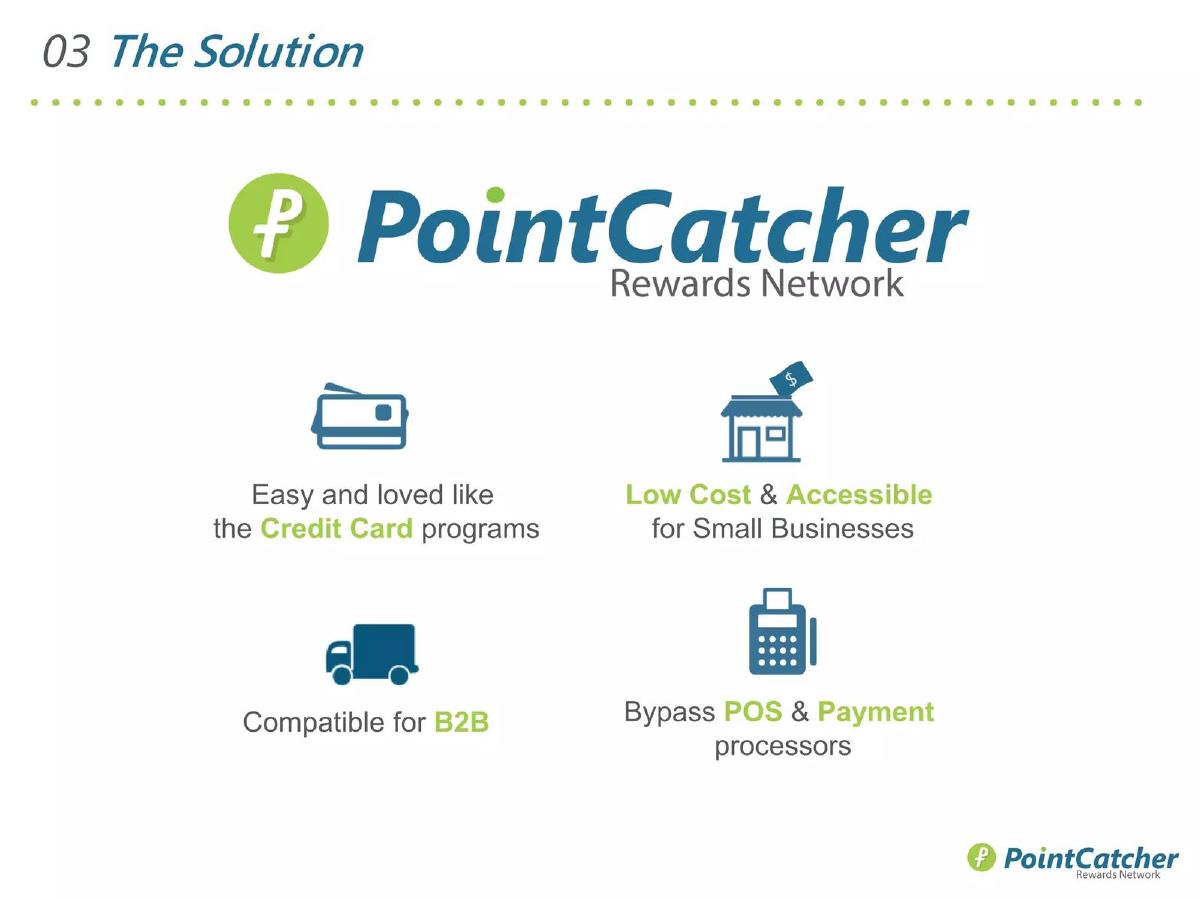
The deck excels at identifying a 'Why Now' and 'Why This' gap in the market. By highlighting that 90% of commerce is B2B but loyalty is almost exclusively B2C, they create a compelling narrative for a blue-ocean strategy. The integration with Intuit (Slide 4) is a significant credibility booster, as it suggests the technical hurdle of transaction tracking has already been solved through a partnership or existing API, rather than requiring the startup to build its own payment rails.
What is Missing from the Deck
Despite the clear market gap, the deck has several glaring omissions that would make a professional investor hesitate:
No Team Slide: Aside from the founder's name on the final slide, there is no information about the team's background. In early-stage investing, the 'who' is often more important than the 'what.' · No Competition Analysis: The loyalty space is crowded with players like Belly, FiveStars, and various credit card-native rewards. The deck fails to explain why a business would choose PointCatcher over these established competitors. · No Capital Ask: There is no mention of how much money is being raised, the valuation, or the specific milestones the funding will help achieve. · Vague Revenue Model: While Slide 10 shows income, it doesn't explain how that income is generated. Is it a subscription fee for businesses? A transaction fee on points? A spread on the dollar-to-point conversion?
Founder's Takeaway: What to Copy
Founders should look at Slide 2 as a masterclass in 'Problem Framing.' Instead of just saying 'loyalty is big,' they used a pie chart to show exactly where the money is not going, which immediately makes the investor feel like they've discovered a secret. Additionally, the 'How It Works' slide (Slide 6) is excellently simplified; it uses clear icons and minimal text to explain a two-sided marketplace, which is usually difficult to visualize.
Conclusion
PointCatcher has a strong conceptual foundation based on a massive market imbalance. The reliance on card-linking technology is a smart move to reduce friction. However, the deck feels more like a product pitch than an investment vehicle. To be successful, the founders would need to supplement these slides with a deep dive into their unit economics, a robust competitive matrix, and a clear explanation of their go-to-market strategy beyond 'organic social growth.'
Frequently asked questions
- What is the core problem PointCatcher is trying to solve?
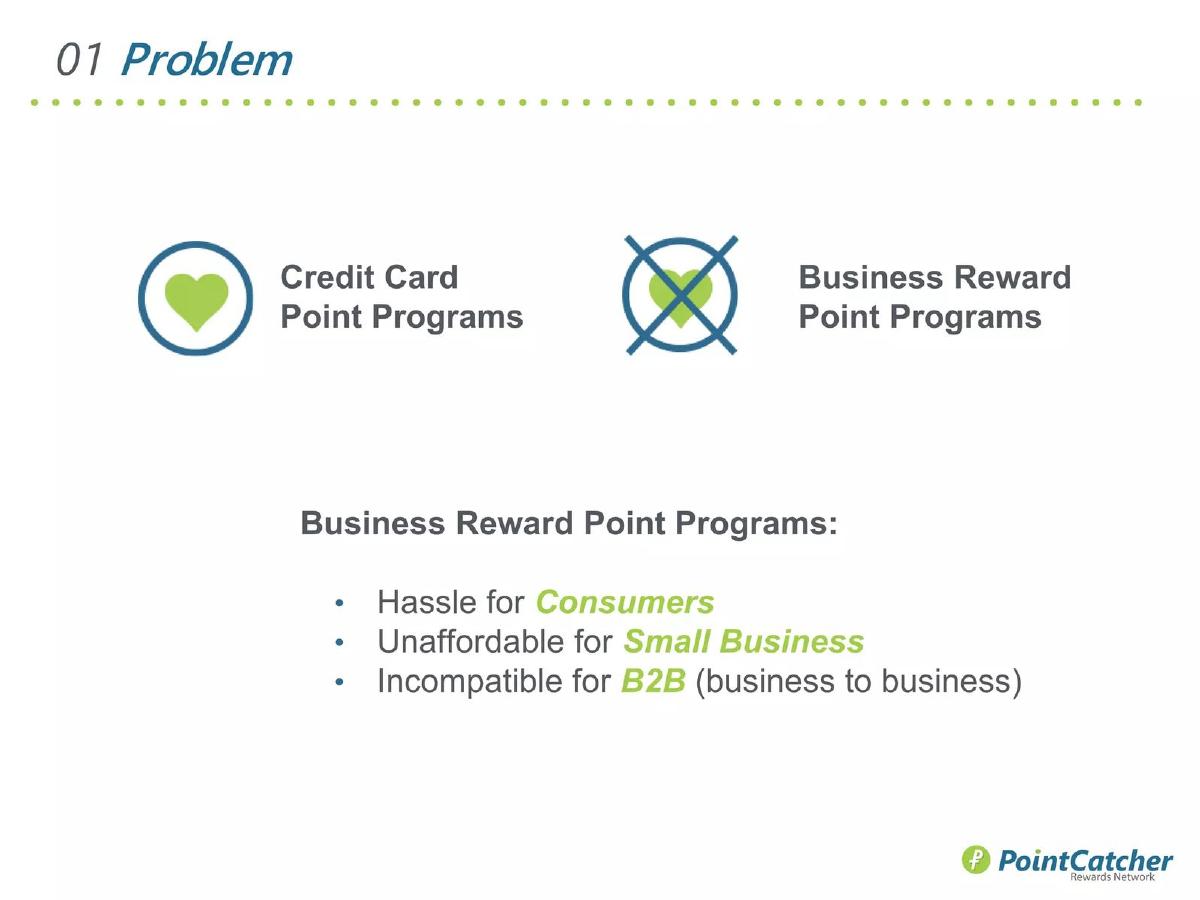
- PointCatcher addresses the lack of loyalty infrastructure for small businesses (SMBs) and B2B companies. Slide 2 points out that while large corporations generate the bulk of the $60 billion loyalty industry, they only represent a small fraction of total businesses. PointCatcher aims to give the other 97% of businesses—specifically those in the B2B sector which accounts for 90% of commerce—the tools to run their own rewards programs.
- How does the technology integrate with existing financial systems?
- According to Slide 4, the platform utilizes the Intuit Card Link Platform. This allows for 'bank level security' and creates a bridge to established financial tools like Mint.com and QuickBooks. By linking directly to consumer and business cards, PointCatcher removes the friction of manual point tracking at the point of sale.
- What is the revenue model for PointCatcher?
- The deck does not explicitly detail the fee structure (e.g., SaaS fees, transaction percentages, or lead generation fees). However, Slide 10 shows 'Monthly Income' scaling alongside the number of users (indicated in parentheses on the X-axis). By December of Year One, they project $80,000 in income from 1,600 users/entities, suggesting a high ARPU (Average Revenue Per User) if those numbers represent businesses.
- How does PointCatcher plan to acquire users?
- The strategy relies on a 'Social Network Platform' approach. Slide 4 and Slide 8 emphasize organic growth and 'putting the power in the hands of people and businesses to grow their own point networks.' Slide 6 outlines a viral loop where businesses invite their customers and engage their suppliers to join the network, theoretically lowering customer acquisition costs.
- What critical information is missing from this pitch deck?
- The deck is missing several standard components required for a professional fundraise. There is no 'Team' slide to validate the founders' expertise, no 'Competition' slide to show how they differ from existing loyalty apps, and no 'Ask' slide detailing how much money they are raising or how they will spend it. Additionally, the 'Market Size' slide (Slide 8) uses social network growth rates as a proxy rather than calculating TAM/SAM/SOM.