Chili Piper’s 17-slide Series B deck effectively captures the urgency of the 'speed to lead' problem in B2B marketing. The presentation moves rapidly from industry-wide pain points—such as the fact that 79% of marketing leads never convert—to a specific product solution that doubles conversion rates. The deck is particularly strong on unit economics, showing a stark contrast between their 'Low End' and 'High End' customer segments, with the latter boasting a 159% net dollar retention and a 9.7 CLV/CAC ratio. By anchoring their TAM in the existing Salesforce and CRM ecosystem, they present a $…
Key takeaways
- The deck identifies a massive gap in the sales funnel: the 42-hour average B2B lead response time (Slide 3).
- Product differentiation is built on deep, native CRM integrations rather than just simple scheduling (Slide 12).
- Chili Piper demonstrates extreme transparency by showing poor metrics for their 'Low End' segment to highlight the strength of their 'High End' core business (Slide 14).
- The company achieved a 141% overall Net Revenue Retention, driven by a 159% retention rate in their enterprise segment (Slide 14).
- Traction is visualized through an ARR curve that grew from $2.0M in 2019 to a projected $10.0M in 2021 (Slide 13).
- The TAM calculation is grounded in the 150,000 B2B companies already using Salesforce, resulting in a $7.8B market (Slide 11).
- The 'Ask' is clearly defined as $33M to move from 'doubling to tripling' growth through specific marketing, sales, and R&D initiatives (Slide 16).
- The team slide emphasizes global scale, noting 134 employees across 22 cities and 84 countries (Slide 15).
The Narrative: From Pressure to Automation
Chili Piper’s Series B deck is built on a foundation of increasing pressure. It starts by establishing that B2B marketing teams are under more stress than ever, then identifies a specific, fixable leak in the sales bucket: the handoff from marketing to sales. The narrative is linear and logical, moving from the macro problem to the micro solution, supported by impressive enterprise-grade unit economics.
Slides 1-4: The Problem of 'Speed to Lead'
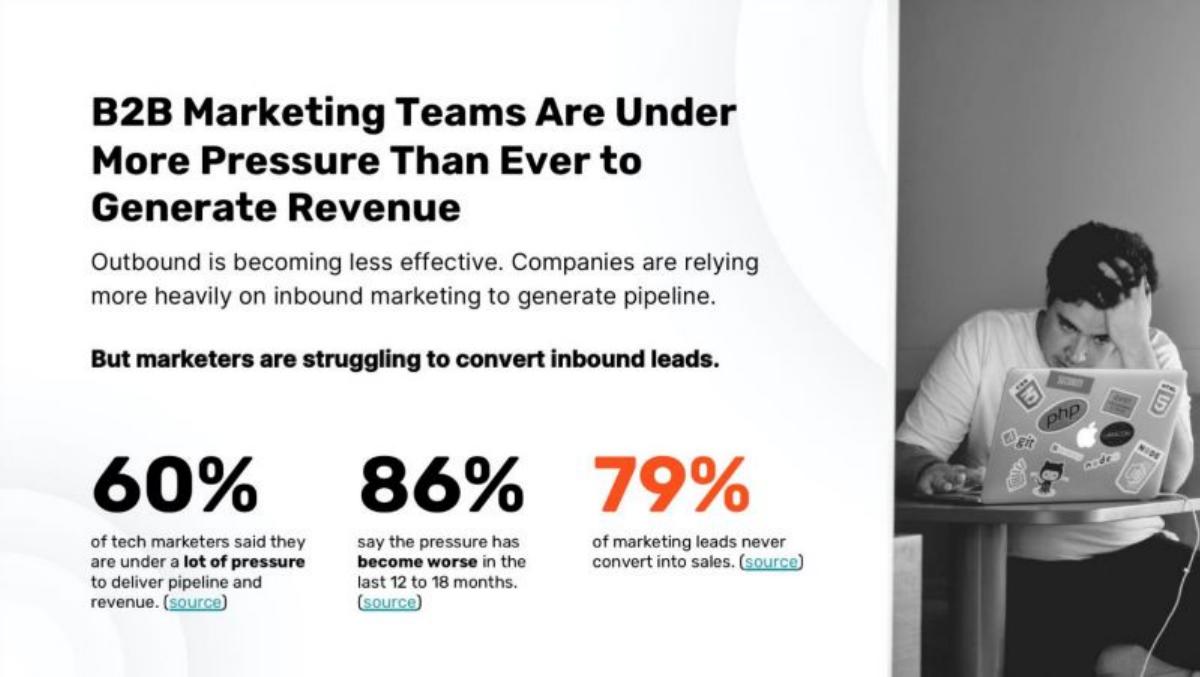
The deck opens with a clear mission statement on Slide 1 : 'Inbound Conversion Platform.' This immediately positions the company as a revenue-generator rather than a mere utility tool. Slide 2 introduces the 'Pressure' narrative, citing that 60% of tech marketers are under significant pressure to deliver pipeline, while 79% of marketing leads never convert to sales. This sets the stakes high.
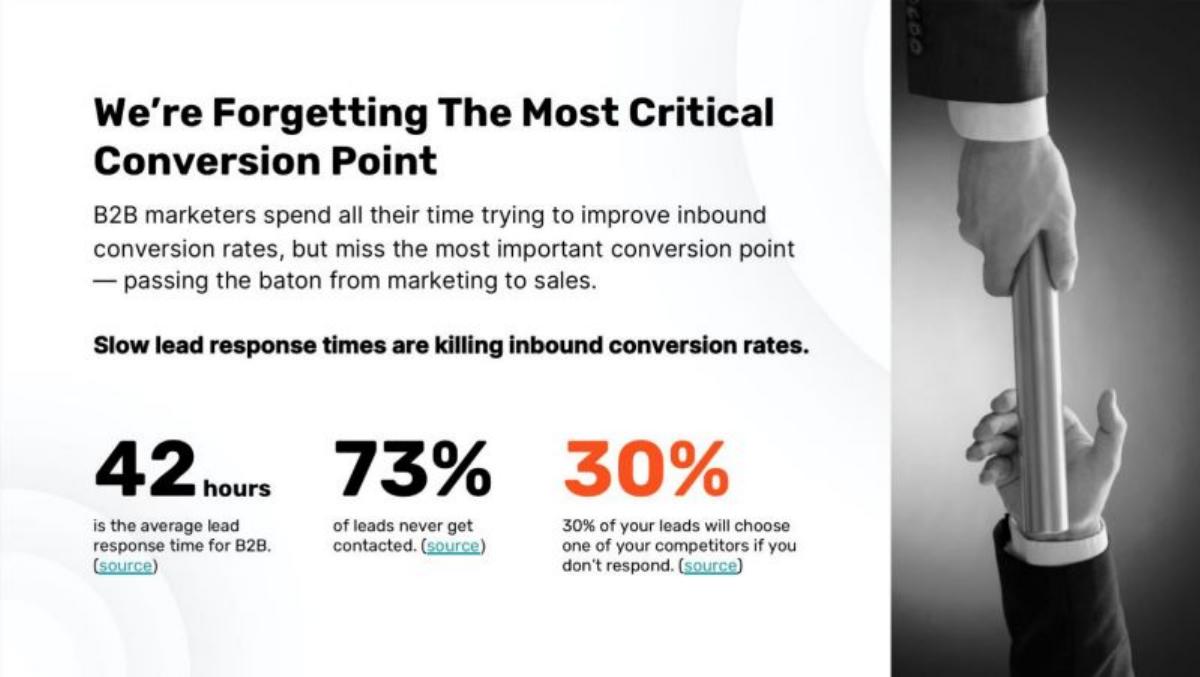
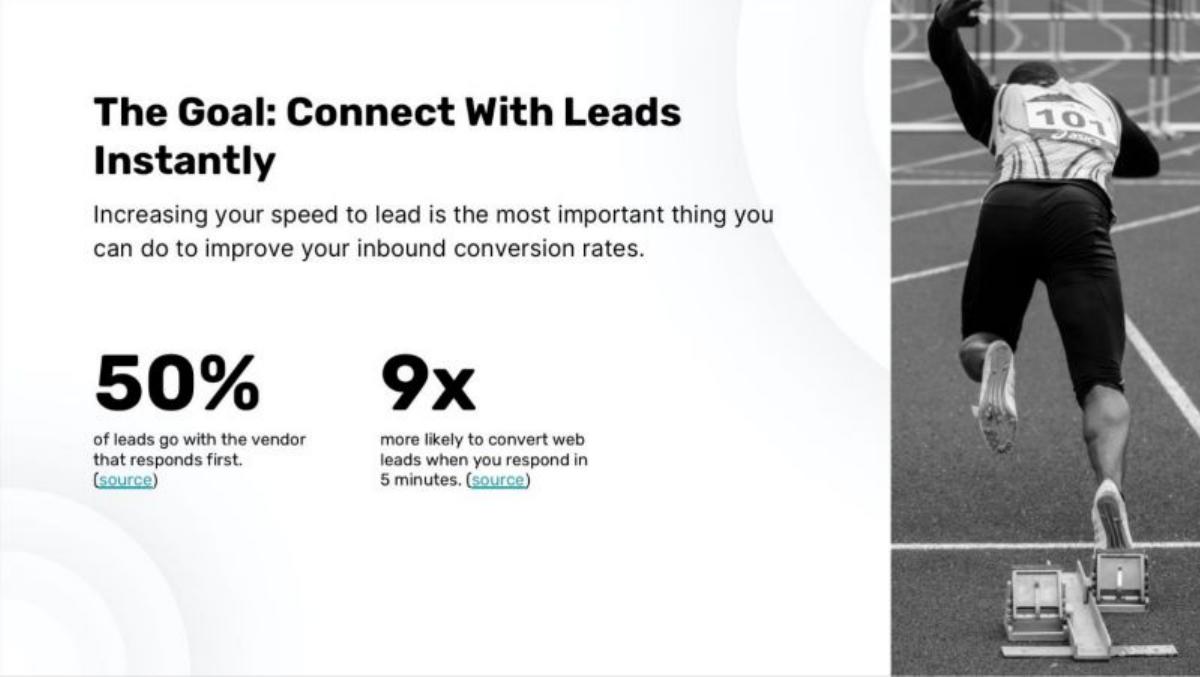
Slide 3 identifies the 'Critical Conversion Point'—the baton pass from marketing to sales. The data here is damning: the average B2B lead response time is 42 hours, and 73% of leads never get contacted. Slide 4 defines the goal as 'Connect With Leads Instantly,' providing the 'Why' for the product: companies are 9x more likely to convert leads when they respond within five minutes.
Slides 5-8: The Solution and Product Deep Dive
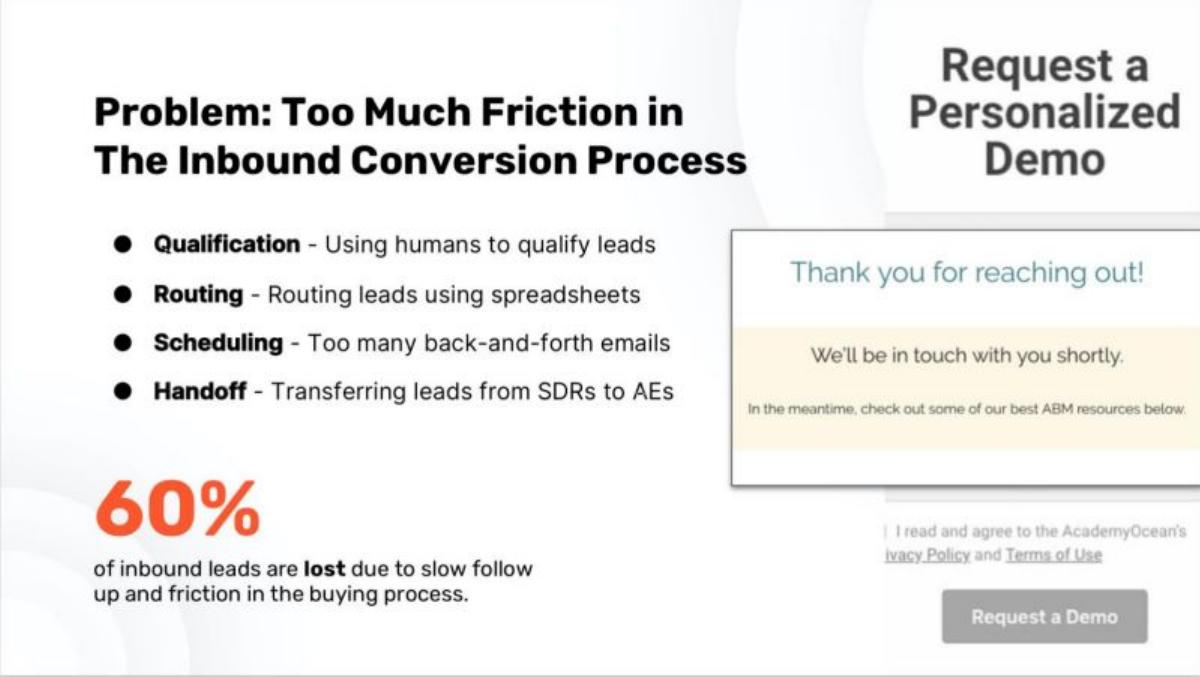
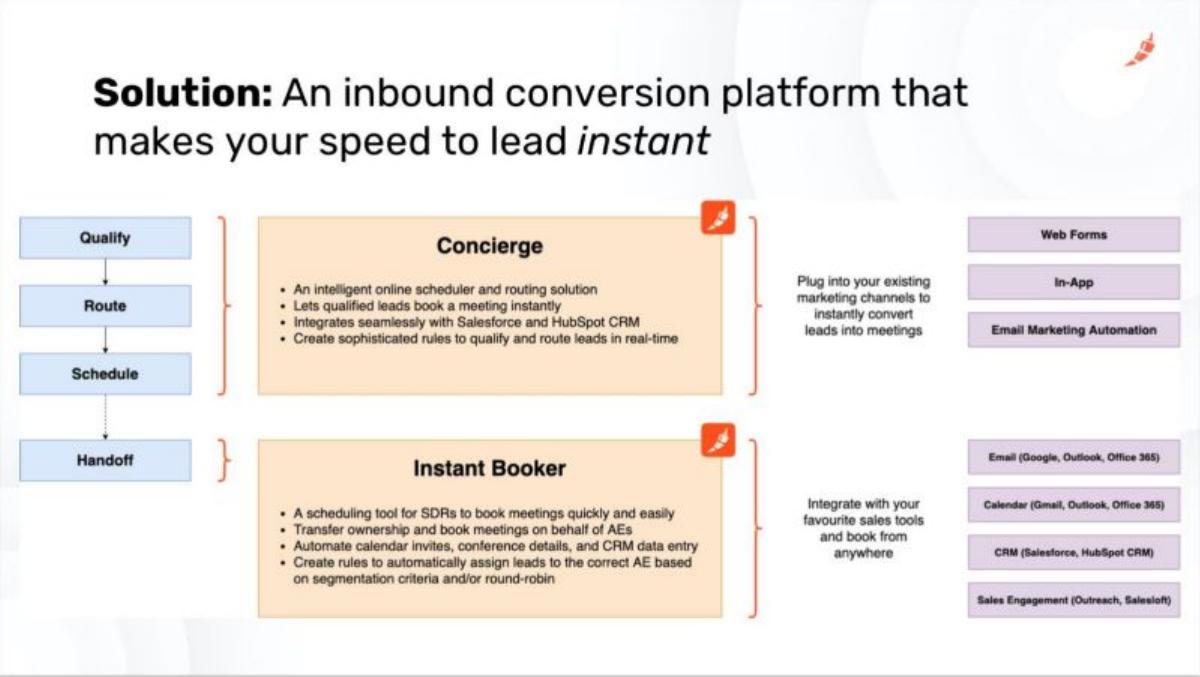
Slide 5 summarizes the friction points: Qualification (using humans), Routing (using spreadsheets), Scheduling (back-and-forth emails), and Handoff (SDR to AE). It claims 60% of leads are lost to this friction. Slide 6 introduces the platform solution, divided into two core products: Concierge (for web forms) and Instant Booker (for SDRs).
Slide 7 focuses on Concierge, showing a screenshot of the interface and claiming that with real-time routing and booking, 'Conversion Rate Doubles.' Slide 8 showcases Instant Booker, an extension for Chrome or Outlook that allows one-click handoff meetings. The focus here is on 'Fast, error-free handoff scheduling,' a specific pain point for sales development teams.
Slides 9-10: Future Vision and Social Proof
On Slide 9 , the company signals its ambitions beyond simple web forms, mentioning 'In-Person Events' and 'Stand-Alone Lead Distribution' for webinars and content downloads. This suggests a roadmap toward becoming a centralized routing engine for all lead sources.
Slide 10 provides heavy-hitting social proof. It features testimonials from Apollo and ChowNow, with the former claiming a 50% lift in meetings and 300% revenue growth. The bottom of the slide is a 'who's who' of high-growth tech logos, including Spotify, Shopify, Airbnb, and Gong, which validates the product's efficacy in the enterprise segment.
Slides 11-12: Market Size and Competitive Landscape
Slide 11 presents a $7.8B TAM. Unlike many decks that use vague 'industry report' numbers, Chili Piper bases its TAM on the number of companies using specific CRMs (Salesforce, HubSpot, etc.) multiplied by their own $12K ACV. This makes the number feel grounded in reality.
Slide 12 addresses competition. It categorizes rivals into 'Scheduling Tools' (Calendly, ScheduleOnce) and 'Chat Tools' (Drift, Qualified). The differentiation is clear: Chili Piper offers deeper CRM integrations and more sophisticated routing rules than simple scheduling links, and more structured data handling than chat bots.
Slides 13-14: Traction and Unit Economics
Slide 13 shows a classic 'hockey stick' growth curve, with ARR moving from $2.0M in 2019 to $3.0M in 2020, and a projected jump to $10.0M in 2021. The slide notes they were bootstrapped until their 2019 Seed round, emphasizing capital efficiency.
Slide 14 is perhaps the most important slide in the deck. It breaks down their 141% Net Revenue Retention. Crucially, it separates the 'Low End' ( =10 seats). While the low end has poor metrics (0.3 CLV/CAC), the high end—which represents 88% of their revenue—is phenomenal, with 159% Net Dollar Retention and a 9.7 CLV/CAC. This level of transparency builds immense credibility with Series B investors.
Slides 15-17: Team and The Ask
Slide 15 introduces the executive team and highlights the company's global footprint: 134 employees across 84 countries. This remote-first, global structure is presented as a scaling advantage. Slide 16 delivers the 'Ask': $33M to accelerate growth. It outlines three clear pillars for the spend: Marketing, Sales hiring for enterprise, and faster Product development. Slide 17 is a promotional slide for the source of the deck and not part of the original pitch.
What Chili Piper Does Well
Specific Problem Identification: They don't just say 'sales is hard.' They point to the 42-hour response gap and the 'baton pass' as the specific points of failure. · Segmented Metrics: By admitting their 'Low End' business isn't performing well, they make the 'High End' metrics (159% retention) much more believable. It shows they know exactly who their ideal customer is. · Integration-Led Growth: They lean heavily into their native CRM connections as a moat, which is a strong argument for enterprise defensibility. · Logical TAM: The TAM calculation is bottom-up and tied directly to their ACV and known CRM market shares.
What is Missing
Detailed Product Roadmap: While they mention events and lead distribution, there is little detail on how the technology will evolve to maintain its lead over competitors who are also moving into routing. · Profitability Timeline: As a Series B deck focused on 'accelerating growth,' there is no mention of a path to profitability or burn rates. · Churn Analysis: While they show 'Logo Churn' on Slide 14, they don't explain why the low-end churn is so high (-57%) or what specific product changes will address it.
What Other Founders Should Copy
The 'Pressure' Opener: Start with the emotional and professional stakes of your target customer. If they are 'under pressure,' show that you understand why. · The Unit Economics Split: If you have a 'prosumer' and an 'enterprise' segment, don't average their metrics. Show them separately to prove that your core business is healthy. · The 'Baton Pass' Analogy: Use simple, visual metaphors (like the relay race on Slide 3) to explain complex B2B processes. · Bottom-Up TAM: Calculate your market size based on your actual ACV and the number of logos in your CRM-defined universe. It is much more persuasive than a $100B Gartner quote.
Frequently asked questions
- What is the core problem Chili Piper solves according to the deck?
- The deck identifies 'friction in the inbound conversion process' as the primary problem. Specifically, it highlights that B2B companies take an average of 42 hours to respond to leads, causing 79% of those leads to never convert. Chili Piper automates the qualification, routing, and scheduling of these leads to make the response 'instant.'
- How does Chili Piper differentiate itself from competitors like Calendly or Drift?
- On slide 12, Chili Piper distinguishes itself from 'Scheduling Tools' (Calendly) by offering instant qualification and routing directly from web forms. It differentiates from 'Chat Tools' (Drift) by using real-time routing based on deep, native CRM data, allowing for more sophisticated lead segmentation and account ownership rules.
- What are the key financial metrics shared in the Series B deck?
- The deck shows an ARR trajectory reaching $10M by 2021. It also highlights a 141% Net Revenue Retention. Most notably, for their core business (customers with 10+ seats), they report a 159% Net Dollar Retention, a $130K Customer Lifetime Value (CLV), and a 9.7 CLV/CAC ratio.
- How does the company define its Total Addressable Market (TAM)?
- Chili Piper calculates a $7.8B TAM by multiplying their $12K Average Contract Value (ACV) by the number of potential customers. This includes 150,000 B2B companies on Salesforce and over 500,000 companies on other CRM platforms.
- What was the specific funding goal and intended use of proceeds?
- The company sought $33M for its Series B. The funds were earmarked for three initiatives: marketing programs to accelerate awareness, hiring sales staff to target enterprise accounts, and faster product development to capture identified market opportunities.