Room AHH presents a vision for a unified platform connecting interior designers, stylists, and suppliers, leveraging the rise of influence marketing. The deck, spanning 29 slides (15 available for review), is heavy on 'Why Now' justifications and competitive landscape mapping but remarkably light on the 'How.' It identifies a gap in the UK market where internet penetration has reached 96% (Slide 9), yet it fails to showcase a user interface, a specific revenue model, or a clear path to execution beyond vague milestones like 'Digital Product Go Live' (Slide 29). While the team possesses divers…
Key takeaways
- The platform aims to unify interior designers, stylists, and suppliers, citing a lack of existing platforms for influence-led customer acquisition (Slide 7).
- The founders highlight a 96% internet penetration rate in UK households as a primary driver for digital design adoption (Slide 9).
- The deck lists two distinct market 'Routes'—Enabler Models like Shopify and D2C models like Houzz—to contextualize their space (Slides 21, 23).
- A theoretical LTV to CAC ratio of 26.5 is claimed for a 'Wholesaler Model,' though no supporting data or timeframe is provided (Slide 27).
- The team consists of Anand Kapoor (Law/Design), Anshul Kapoor (Business/Entrepreneurship), and John Whalley (Graphic Design/Branding) (Slide 3).
- The deck completely omits a product demonstration, screenshots, or a detailed breakdown of how the platform actually functions.
- Financial projections, current traction, and a specific funding 'Ask' are missing from the reviewed slides.
- Next milestones are listed generically as 'Digital Product Go Live,' 'Full Product Launch,' and 'Traction' (Slide 29).
Executive Summary: A Market Thesis in Search of a Product
The Room AHH pitch deck is a classic example of a 'top-down' market analysis. It spends a significant amount of time explaining why the interior design market is ripe for disruption due to internet growth and the rise of influencers, but it fails to show the specific tool the founders have built to capture this opportunity. The deck relies on generic illustrations and competitive funding tables rather than proprietary technology or early traction data.
Slide 1: Title and Branding
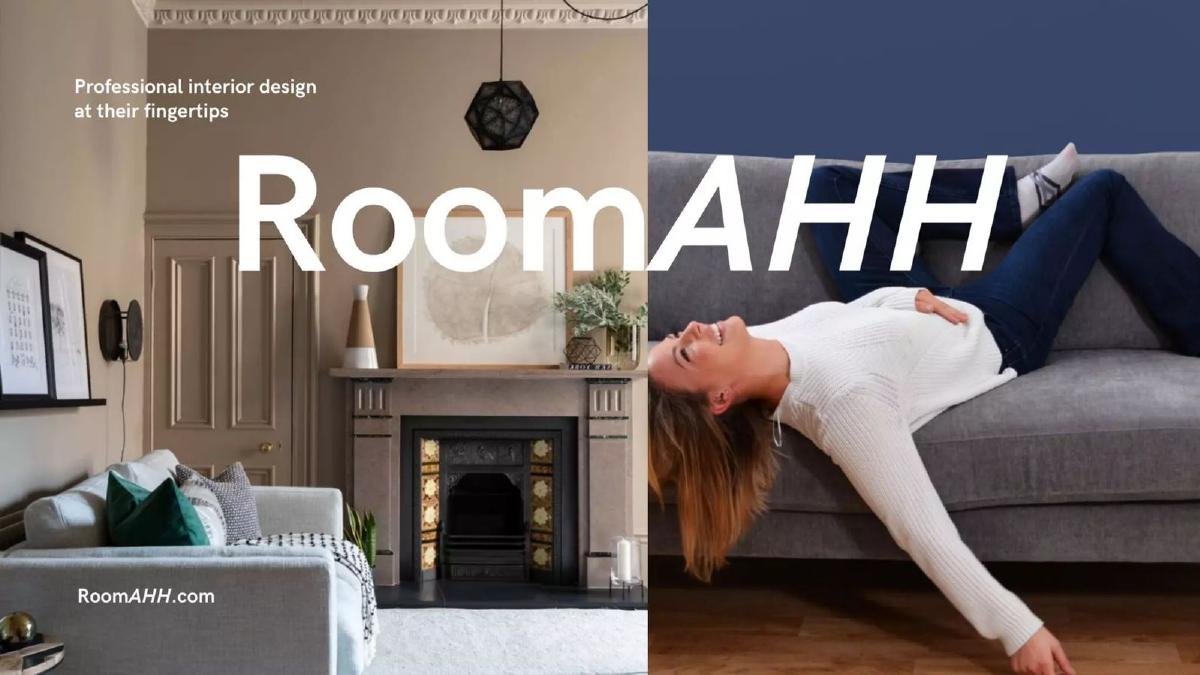
The cover slide features a split-screen image: a professionally designed living room on the left and a woman relaxing on a sofa on the right. The tagline is "Professional interior design at their fingertips." The branding is clean, but the slide provides no immediate clarity on whether this is a service, a marketplace, or a SaaS tool.
Slide 3: The Team
The team slide introduces three founders: Anand Kapoor, Anshul Kapoor, and John Whalley. The biographies are dense. Anand is positioned as the design and law expert, having worked with Zaha Hadid. Anshul is the business strategist with ties to the Goldman Sachs GS10KSB program. John is the creative lead. While the team appears experienced in their respective fields, there is a notable absence of a Technical Co-founder or CTO, which is a red flag for a company claiming to be a "digital product" (Slide 29).
Slides 5, 7, and 9: The "Why Now" and Problem Statement
Slide 5 uses four icons to argue for the market opportunity: growth of design software, lack of a unified platform, increased mobile spending, and growth of internet users. Slide 7 narrows the focus, stating that "any one with a goodeye can begin to amplify the work of a good Interior Designer." The problem identified is the lack of a platform that turns these stylists into acquisition channels. Slide 9 reinforces this with a Statista quote noting that UK household internet access reached 96% in 2020. This section is well-researched but feels more like a general industry report than a specific startup's 'aha' moment.
Slides 11, 13, 15, 17, and 19: Operating Model and Audience
These slides use a series of generic illustrations to categorize the business. Slide 11 introduces the "Operating Model" but only shows an illustration of a man with a laptop—no actual model is described. Slide 13 claims "High Relevance" and "High Differentiation" without explaining how. Slides 15 and 17 list keywords associated with Interior Designers (e.g., "Revenue," "Portfolio," "Ego-Massage") and Suppliers (e.g., "Leads," "Insights," "Market Research"). Slide 19 summarizes "Target Audience Needs." This section is repetitive and lacks the specific value proposition details required to understand the platform's mechanics.
Slides 21 and 23: Competitive Landscape
These slides are perhaps the most informative for an investor, as they map out the competition. Slide 21 looks at "Enabler Models," listing Shopify, Shopmatic, and Rooomy along with their funding amounts. Slide 23 looks at "Direct to Consumer" models like Modsy and Houzz. By listing these companies, Room AHH is trying to signal the size of the 'prize,' but it doesn't explicitly state how it will beat these well-funded incumbents.
Slides 25, 27, and 29: The Future and Metrics
Slide 25 mentions "Target Audience Unmet Needs," but the text is faded and difficult to read, suggesting a design error. Slide 27 presents a "Wholesaler Model" with an LTV to CAC ratio of 26.5. In the venture world, an LTV/CAC ratio above 3 is considered good; 26.5 is astronomical and likely theoretical, as no supporting data (average order value, churn rate, or cost per lead) is provided to justify it. Finally, Slide 29 lists "Next Milestones," confirming that the digital product has not yet gone live.
What Room AHH Does Well
The deck identifies a legitimate trend: the professionalization of the 'influencer-stylist.' By recognizing that many people have the aesthetic ability to drive sales but lack the logistical backend to connect with designers and suppliers, Room AHH has found a niche. The competitive analysis (Slides 21 and 23) is also helpful for situating the company within the broader e-commerce and design ecosystem.
What is Missing from the Deck
Product Screenshots: There is not a single image of the actual software. For a "digital product," this is a fatal omission. · Business Model Specifics: While "Wholesaler Model" is mentioned, the deck doesn't explain if they take a commission, charge a subscription, or sell leads. · Traction: There are no waitlist numbers, pilot partner names, or signed letters of intent from the suppliers mentioned on Slide 17. · The Ask: The deck does not state how much money is being raised or how that capital will be deployed. · Technical Roadmap: Given the lack of a CTO on the team slide, a roadmap explaining how the product will be built (in-house vs. agency) is essential.
Founder Takeaways: Lessons from Room AHH
Avoid the 'Dictionary' Slide: Slides 15, 17, and 19 are essentially lists of nouns. Investors know that suppliers want "Sales" and "Revenue." Instead of listing these generic needs, show how your specific features satisfy them. For example, instead of writing "Analytics," show a mockup of a dashboard that gives a supplier data they can't get elsewhere.
Back Up Your Ratios: Claiming an LTV/CAC of 26.5 (Slide 27) without a footnote explaining the math is a quick way to lose credibility. If the number is a projection, label it as such and provide the assumptions behind it.
Show, Don't Tell: If your milestone is "Digital Product Go Live," you should at least have wireframes or a prototype to show. A deck full of generic illustrations (like those on Slides 11 and 13) suggests that the product is still just an idea, which significantly lowers the valuation and investor interest.
Focus on the 'How': The deck does a good job explaining the 'Why' (market growth) and the 'Who' (the team), but it completely ignores the 'How.' A successful pitch needs to bridge the gap between a large market opportunity and the specific technical solution being proposed.
Frequently asked questions
- What problem is Room AHH trying to solve?
- According to Slide 7, the company believes there is currently no platform that unifies interior designers, stylists, and suppliers. They specifically point to the rise of influence marketing, noting that while many people have a 'good eye,' there is no infrastructure to turn these influencers into customer acquisition channels for designers who already have their inventory sorted.
- Who are the founders and what is their background?
- The team includes Anand Kapoor, who has a background in Law and Sports Law and has worked with design figures like Zaha Hadid; Anshul Kapoor, an associate teaching fellow at Lancaster University with a background in business and healthcare; and John Whalley, a graphic designer with experience in brand development across retail and energy sectors (Slide 3).
- How does Room AHH compare itself to the rest of the market?
- The deck categorizes the market into two routes. Route 1 is the 'Enabler Model,' featuring companies like Shopify ($122.3M funding) and Rooomy ($13M funding). Route 2 is the 'Direct to Consumer' retail model, featuring Modsy ($74.4M funding) and Houzz ($25.5M funding). Room AHH appears to position itself as a hybrid or a new entrant addressing unmet needs in these categories (Slides 21, 23).
- What are the key metrics provided in the deck?
- The deck is light on internal metrics. It cites a 96% internet penetration rate in the UK (Slide 9) and a theoretical LTV to CAC ratio of 26.5 for a 'Wholesaler Model' (Slide 27). However, it does not provide current user counts, revenue, or historical growth data, suggesting the company may be in the pre-product or very early ideation stage.
- What is the current status of the Room AHH product?
- Based on Slide 29, the product has not yet launched. The 'Next Milestones' listed are 'Digital Product Go Live' followed by 'Full Product Launch' and then 'Traction.' There are no screenshots or feature lists in the deck to indicate the current level of technical development.