Suzy’s 14-slide deck is a highly focused sales and fundraising hybrid that prioritizes social proof and operational speed over traditional financial modeling. The company positions itself as a 'human intelligence platform' capable of delivering 500 consumer responses in under an hour (Slide 3). Rather than relying on abstract market size projections, the deck utilizes seven distinct case studies covering everything from Super Bowl ad testing to non-alcoholic beverage innovation. While it lacks a team slide, financial projections, and a specific 'ask,' the deck successfully communicates a clea…
Key takeaways
- The platform claims a proprietary database of over 1 million U.S. consumers (Slide 3).
- Speed is the primary differentiator, with the ability to deliver 500 responses in less than one hour (Slide 3).
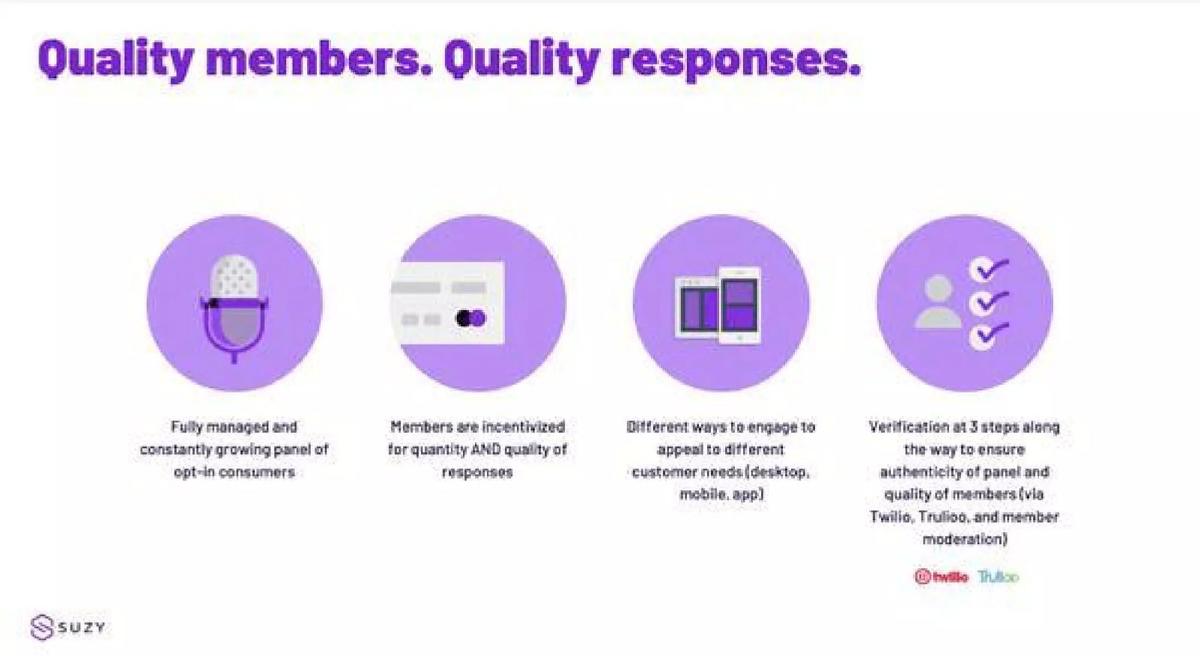
- Suzy uses a three-step verification process for panel quality involving Twilio and Trulioo (Slide 4).
- The deck lists major brand logos including P&G, Nestle, and Coca-Cola as active users (Slide 1).
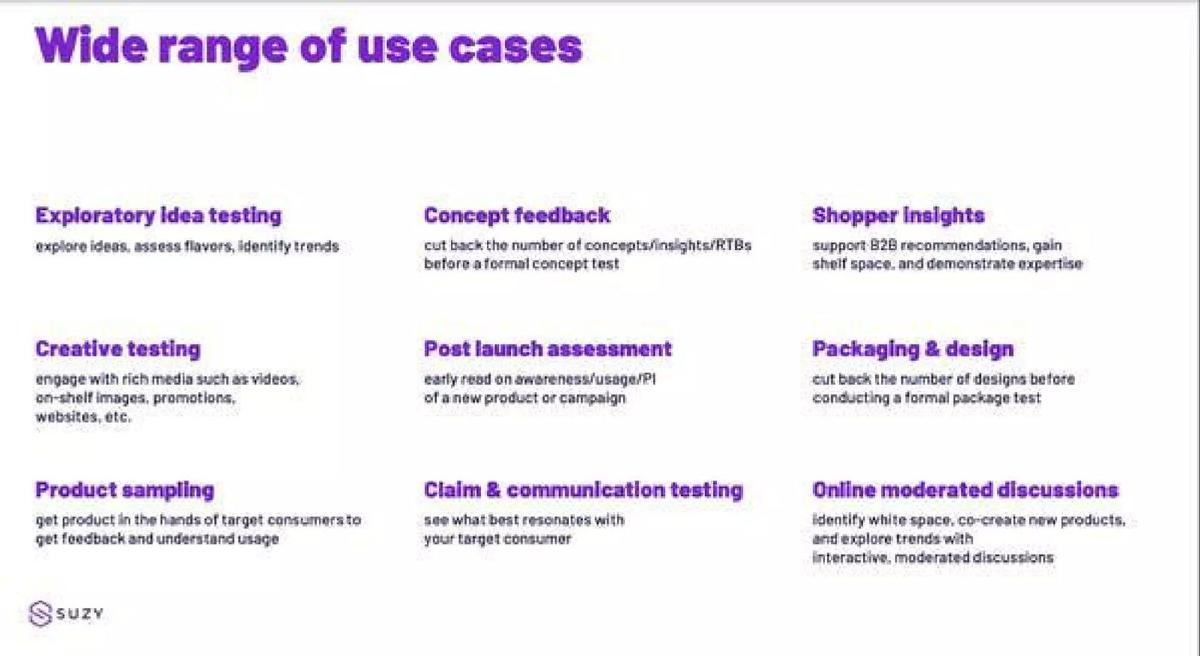
- Product versatility is demonstrated through nine distinct use cases, ranging from product sampling to claim testing (Slide 5).
- A major beverage company case study shows a 10-month development cycle where each research phase took only one week (Slide 7).
- Advertising testing for the 2019 Super Bowl resulted in a 70% increase in brand recognition for a client (Slide 14).
- The deck completely omits a team slide, financial history, and the specific fundraising terms.
The Strategy of Social Proof: A Teardown of Suzy
Suzy’s pitch deck is an anomaly in the world of venture capital presentations. While most startups spend their time defending their TAM (Total Addressable Market) or explaining their technical architecture, Suzy spends the vast majority of its 14 slides showing exactly how Fortune 500 companies use their tool. This is a 'show, don't tell' deck that relies on the prestige of its client list and the undeniable speed of its results.
Slides 1-2: The Hook and the Problem
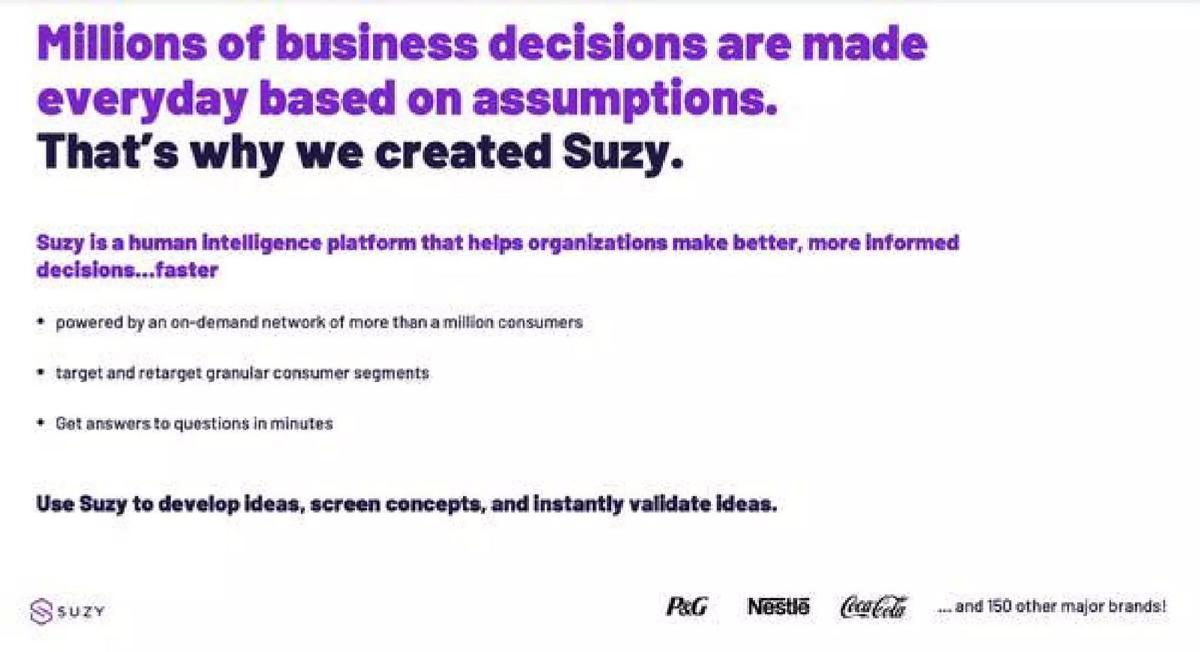
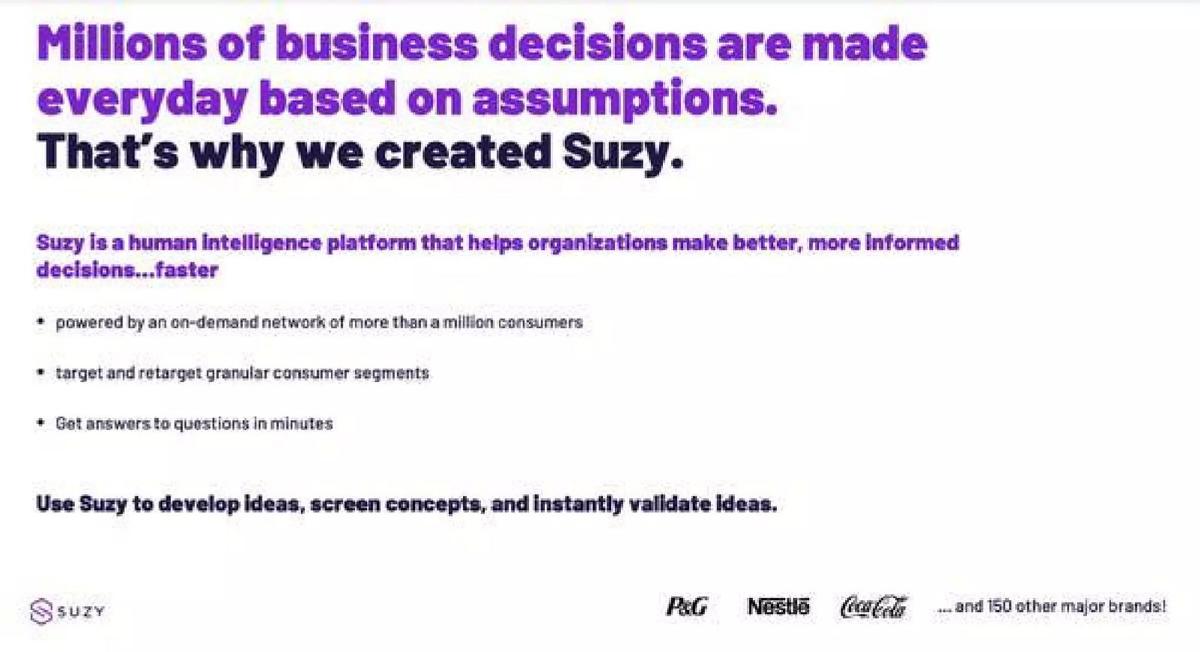
Slide 1 opens with a bold problem statement: 'Millions of business decisions are made everyday based on assumptions. That’s why we created Suzy.' It immediately establishes the platform as a 'human intelligence platform' and highlights a 'million-plus' consumer network. The bottom of the slide is anchored by heavy-hitting logos: P&G, Nestle, and Coca-Cola, with a note mentioning 150 other major brands. This is a high-authority start that eliminates the need for a 'Why Now' slide; the 'Why' is the failure of current decision-making processes.
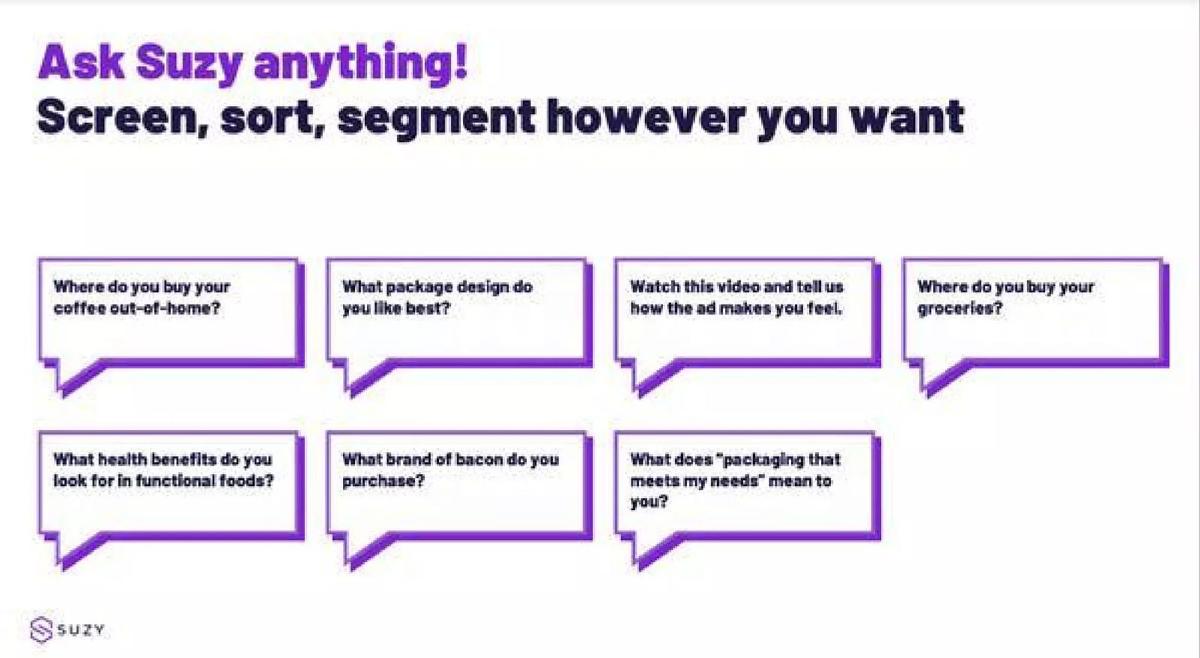
Slide 2 , titled 'Ask Suzy anything!', provides concrete examples of the platform in action. Instead of abstract features, it shows speech bubbles with specific queries like 'What brand of bacon do you purchase?' and 'Where do you buy your coffee out-of-home?' This slide serves to demystify the product immediately, showing that it is a direct line to consumer sentiment.
Slides 3-4: The Differentiators and Quality Control
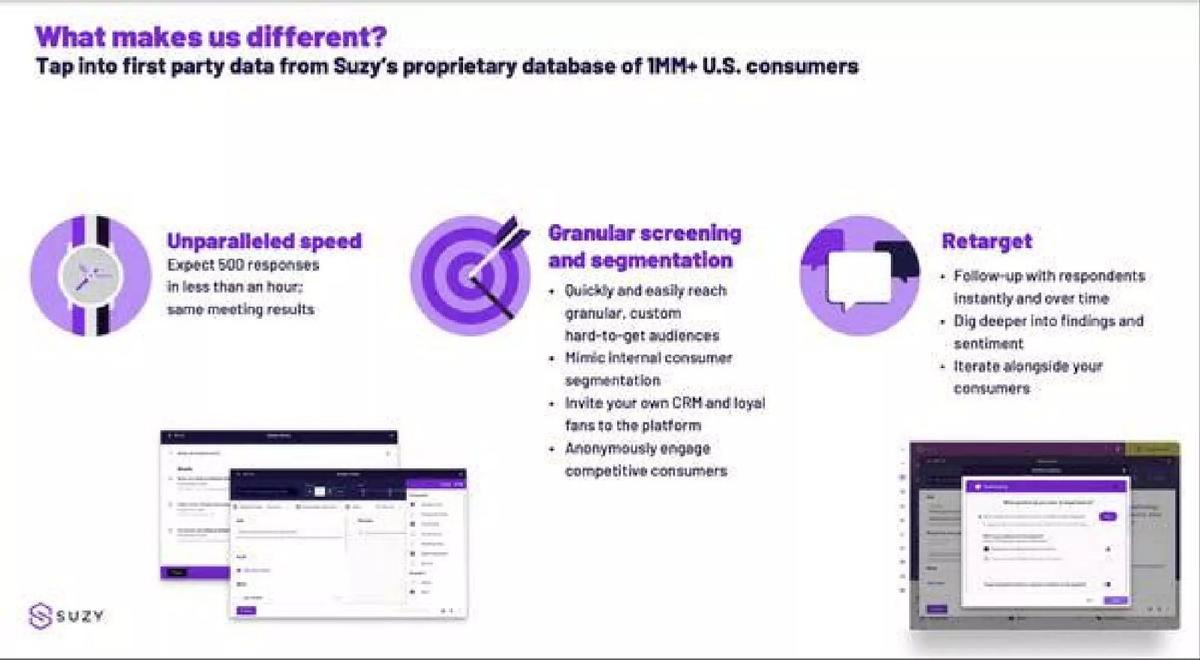
Slide 3 gets into the 'How.' It identifies three pillars: Unparalleled speed, Granular screening, and Retargeting. The most impressive metric in the entire deck appears here: 'Expect 500 responses in less than an hour.' For anyone who has worked in traditional market research—where 500 responses can take weeks—this is the 'magic' moment of the pitch. It also mentions the ability to 'invite your own CRM' and 'anonymously engage competitive consumers.'
Slide 4 addresses the 'garbage in, garbage out' risk inherent in survey platforms. It details a three-step verification process using Twilio and Trulioo. By naming these third-party providers, Suzy borrows their credibility to prove that their 1MM+ consumer panel is composed of real, authenticated humans. This is a crucial slide for institutional investors who might be skeptical of self-reported data panels.
Slides 5-6: Use Cases and Toolkits
Slide 5 provides a grid of nine use cases. This is a versatility play. It lists everything from 'Exploratory Idea testing' to 'Product sampling' and 'Online moderated discussions.' By showing such a wide range, Suzy argues that they aren't just a survey tool, but a full-stack research department in the cloud.
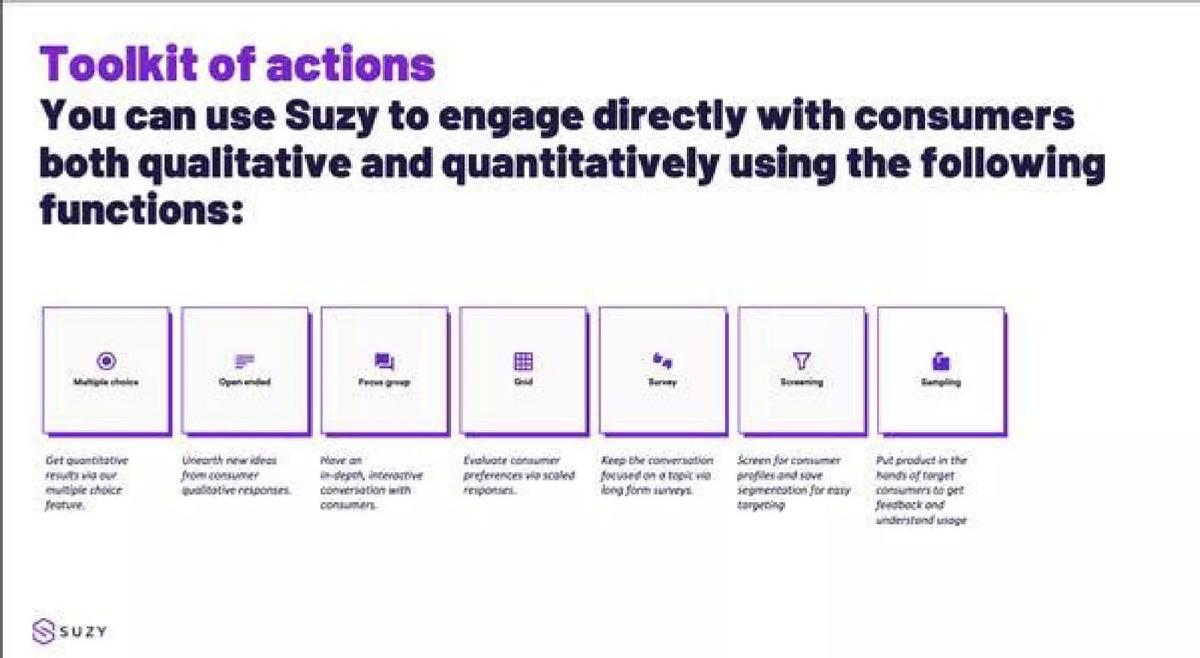
Slide 6 breaks down the 'Toolkit of actions.' It lists the functional capabilities: Multiple choice, Open ended, Focus group, Grid, Survey, Screening, and Sampling. This slide is likely intended for the 'Product' portion of a due diligence checklist, ensuring the investor knows the platform has all the standard features of a legacy research firm, but with the added benefit of Suzy's speed.
Slides 7-10: The CPG Case Studies
The deck then moves into a series of highly detailed case studies. Slide 7 follows a major beverage company through a four-phase innovation cycle. The 'Results' section notes that while the end-to-end project took 10 months, each research phase on Suzy took only one week. This highlights the 'iterative' nature of the platform.
Slide 8 focuses on 'Tracking Competitive Purchases' for a spirits company. It provides specific data points: 42% of consumers found a competitor's flavors appealing, and 65% would continue to purchase. This shows that Suzy can be used for defensive market intelligence, not just offensive product development.
Slide 9 and Slide 10 cover a healthy snack brand and a bread brand, respectively. Slide 9 emphasizes speed (36 hours for results), while Slide 10 shows a package design test that was completed in just 3 hours. The consistent theme across these slides is the compression of time.
Slides 11-14: Retail, Insurance, and The Super Bowl
Slide 11 moves into retail/shopper insights, showing how a CPG team used Suzy to pitch a snack cooler idea to a grocery customer within a single hour. This is a powerful 'B2B2C' use case where Suzy helps its clients win their own sales pitches.
Slide 12 (Cookie company name testing) and Slide 13 (Insurance policy sentiment) continue the trend of showing industry breadth. Slide 13 is particularly important as it moves away from physical goods into the service sector (insurance), proving the platform's utility for complex financial products.
Slide 14 is the 'closer.' It details advertising testing for the 2019 Super Bowl. A frozen food brand used Suzy to choose between two commercials. The result was a '70% increase in brand recognition.' Ending the deck with a Super Bowl case study is a classic 'prestige' move, signaling that Suzy is trusted with the highest-stakes marketing decisions in the world.
What Works in the Suzy Deck
1. Extreme Specificity: The deck avoids vague promises. By stating '500 responses in less than an hour' (Slide 3) and 'Total Time: 3 hours' (Slide 10), it gives investors a tangible metric to compare against competitors.
2. Industry Breadth: By including case studies for spirits, insurance, bread, cookies, and beverages, Suzy proves that its market isn't just a niche corner of CPG, but any company that sells to humans.
3. Third-Party Validation: The use of Twilio and Trulioo logos (Slide 4) and the Fortune 500 logo cloud (Slide 1) creates a 'safety' net for investors. It suggests that if these giants trust the data, the investor should too.
What is Missing from the Suzy Deck
1. The Team: There is no mention of the founders, the board, or the engineering team. For a technology platform, this is a significant omission, though likely intentional for a later-stage round where the business performance is the primary focus.
2. Financials and Unit Economics: The deck contains no revenue figures, growth rates (YoY/MoM), or CAC/LTV (Customer Acquisition Cost / Lifetime Value) metrics. This information was likely reserved for a secondary data room.
3. The Ask: There is no slide detailing how much capital is being raised or how it will be deployed. This makes the deck feel more like a 'Company Overview' than a 'Fundraising Pitch.'
4. Competition: There is no competitive landscape slide. Suzy ignores legacy players like Nielsen or Kantar, as well as newer digital rivals, choosing instead to focus entirely on its own ecosystem.
What a Founder Should Copy
1. The 'Outcome' Format: Every case study in this deck follows a 'Background -> Objective -> Outcome -> Time' format. This is an incredibly effective way to communicate value. Founders should stop describing features and start describing 'Outcomes' in this structured way.
2. Speed as a Feature: If your product is faster than the status quo, make that the centerpiece. Suzy mentions time-to-insight on almost every slide. They don't just say they are fast; they prove it with timestamps (1 hour, 3 hours, 36 hours).
3. Visual Simplicity: The deck uses a consistent purple and white palette with clean iconography. It looks professional and enterprise-ready without being cluttered. The use of high-quality stock imagery for the case studies (the bread, the cookies, the Super Bowl trophy) makes the deck feel premium.
Final Thoughts: Suzy’s deck is a masterclass in building a narrative through customer success. While it breaks many 'rules' of early-stage pitching (no team, no financials), it succeeds by making the product's value proposition so clear and so well-validated that those omissions feel like secondary details to be handled in due diligence.
Frequently asked questions
- Why does the deck omit a team slide?
- At a later stage, especially for a company founded in 2009 that has raised over $100 million, the brand's traction often speaks louder than individual resumes. Suzy likely uses this deck for strategic partnerships or late-stage investors who are already familiar with the leadership or prioritize the enterprise client list (Netflix, Coca-Cola, etc.) over founder pedigree.
- How does Suzy verify the quality of its 1 million consumers?
- According to Slide 4, Suzy employs a three-step verification process to ensure authenticity. This includes integration with Twilio and Trulioo for identity verification, alongside internal member moderation. This addresses a common investor concern regarding 'botting' or low-quality data in the market research industry.
- What is the primary value proposition compared to traditional research?
- Speed and iteration. Slide 3 highlights that users can expect 500 responses in under an hour, allowing for 'same meeting results.' Slide 7 further illustrates this by showing that research phases that typically take months can be compressed into one-week sprints, significantly reducing the time-to-market for new products.
- What specific industries does Suzy target?
- While the platform is broad, the deck heavily emphasizes Consumer Packaged Goods (CPG), spirits, insurance, and retail. Case studies feature a beverage company (Slide 7), a spirits company (Slide 8), a healthy snack brand (Slide 9), a bread brand (Slide 10), and a cookie company (Slide 12).
- Is there a clear 'Ask' or valuation in this deck?
- No. This deck is a 'pure' narrative and product deck. It does not list a funding goal, a valuation, or a use-of-funds breakdown. This suggests it may be used as a general capabilities deck for investors or as a high-level overview for strategic M&A discussions rather than a cold-pitch seed deck.