Susa Ventures' 2021 deck is a sophisticated LP-facing presentation designed to raise $300M across two vehicles: Susa Ventures IV ($100M Seed) and Susa Opportunities II ($200M). The narrative centers on a 'barbell approach,' where the firm wins competitive seed rounds and then doubles down on winners at the Series B stage. By highlighting a 96 Founder NPS and a portfolio that has created $19B+ in enterprise value, Susa positions itself as a premier partner for both founders and later-stage investors like Founders Fund and Sequoia. The deck is notable for its transparency regarding the power la…
Key takeaways
- The firm employs a 'barbell approach,' sourcing seed deals with Susa IV and leading Series B rounds in top performers with Susa Opp II (Slide 6).
- Susa claims a high founder satisfaction rate, citing a 96 Founder NPS (Slide 4).
- The portfolio has achieved significant scale, with 115+ backed companies creating over $19B in aggregate enterprise value (Slide 9).
- Over 50% of Susa's portfolio Series A rounds are led by top-tier firms including Sequoia, Founders Fund, and Accel (Slide 10).
- The fund strategy for Susa IV targets 40 investments with an average check size of $1.25M and a 1:1 reserve ratio (Slide 8).
- Susa acknowledges the venture power law, showing that 20% of investments in Susa II drive 90% of the fund's returns (Slide 12).
- The Opportunity Fund I, raised in 2019, has already deployed capital into high-profile companies like Whoop, Omio, and Fast (Slide 15).
- LPs are asked for simultaneous commitments to both funds at a 1:2 ratio (Slide 16).
Introduction and Brand Identity
Slide 1: Title Slide
The deck opens with a high-resolution image of a misty rainforest, establishing the visual theme. The text identifies the two vehicles being raised: Susa Ventures IV & Susa Opportunities II . The date is listed as Q1 2021.
Slide 2: The Susa Origin Story
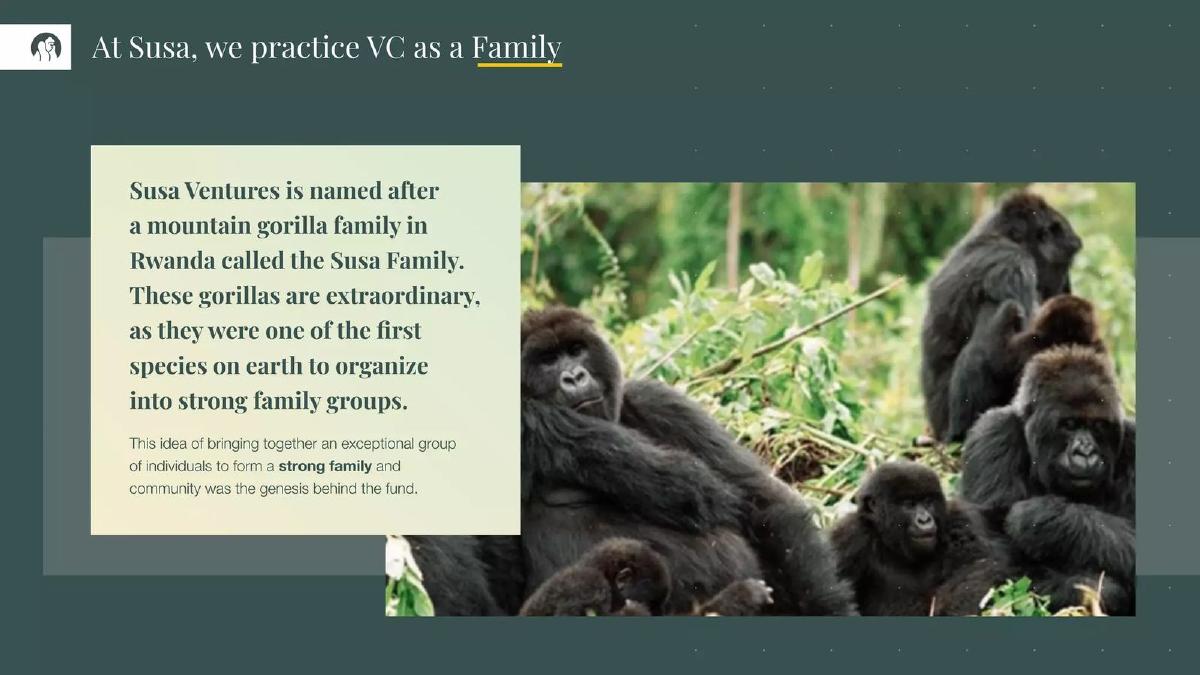
Susa Ventures defines its culture through its namesake. The slide explains that the firm is named after a mountain gorilla family in Rwanda known as the Susa Family . The core message is that these gorillas were among the first to organize into strong family groups, which serves as the genesis for the fund’s community-centric investment philosophy.
The Team and Founder Experience
Slide 3: Operations Team
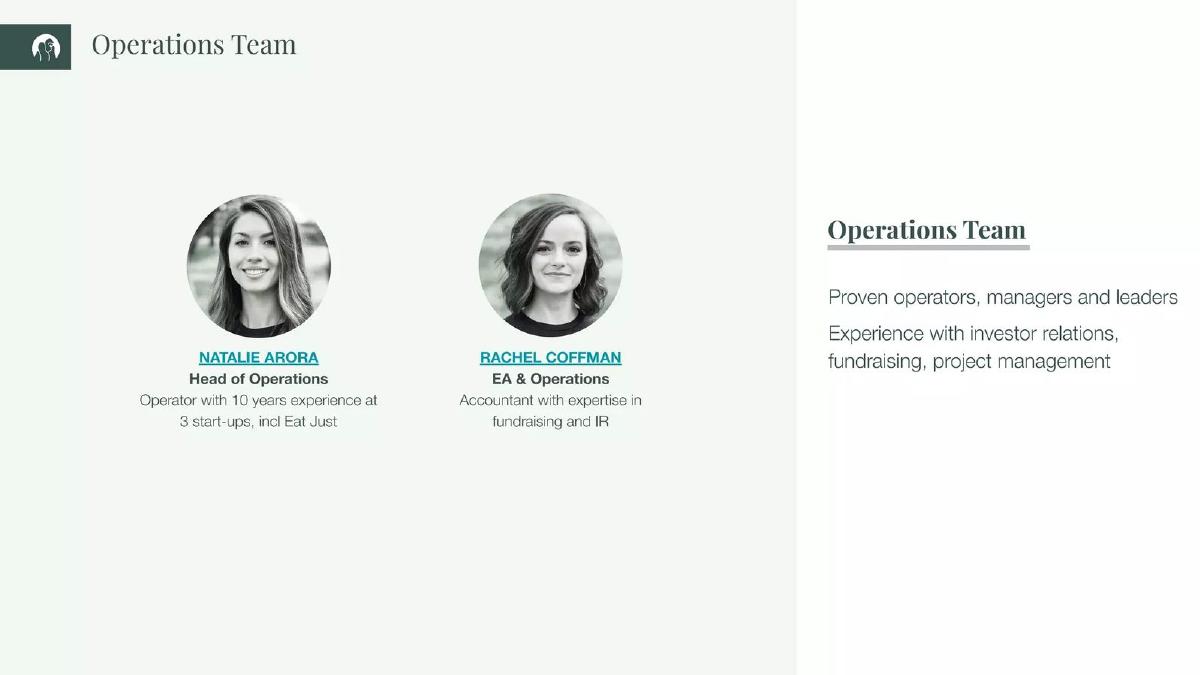
This slide introduces the non-investment leadership. Natalie Arora , Head of Operations, is noted as having 10 years of experience at three startups, including Eat Just. Rachel Coffman is listed as EA & Operations with expertise in fundraising and investor relations (IR). The slide emphasizes that the team consists of proven operators and managers.
Slide 4: Susa Ops | The Susa Founder Experience
Susa presents a compelling metric: a 96 Founder NPS . The slide uses a collage of photos to illustrate their value-add services, including onboarding swag, Susa Bootcamps, Family Dinners, a Mountain Tech Summit, and Holiday Giving events. This is designed to prove to LPs that Susa has a proprietary 'right to win' deals through founder affinity.
Fund Strategy and Structure
Slide 5: The Raise
A simple transition slide stating the firm is raising two new funds: a $100M seed fund and a $200M opportunity fund .
Slide 6: The Barbell Strategy
This is the most critical strategic slide in the deck. It visualizes the 'barbell approach' as the winning strategy for Susa. On the left (Seed), they aim to source and win the best deals. In the middle (Series A), they do pro-rata alongside top-tier funds. On the right (Series B), they use the Opportunity Fund to lead or co-lead rounds in their best-performing companies. This explains why they are raising two different vehicles simultaneously.
Slide 7: Susa II Performance (Redacted)
This slide focuses on the Susa II ($50M, 2016 Vintage) . While the specific financial metrics (DPI, TVPI, IRR) are redacted with placeholders like "$.##", the slide lists high-potential companies including Stord, Viz.ai, Stedi, Sundae, Newfront Insurance, Pex, and Workramp . It also lists the lead investors for the current rounds of these companies, such as Bond, Insight Venture Partners, Stripe, and Meritech.
Slide 8: Susa IV Fund Model
Susa outlines the mechanics for the $100M seed fund. The target is 40 investments with an average check size of $1.25M . Notably, they plan for a 1:1 reserve ratio specifically for pro-rata participation in their best companies, ensuring they don't get diluted before the Opportunity Fund kicks in.
Portfolio Traction and Validation
Slide 9: Aggregate Portfolio Value
Susa highlights the scale of their 'Family.' The slide claims 115+ backed companies have created $19B+ in aggregate enterprise value . These companies have raised over $5B in capital and employ 7,000 people. Logos at the bottom include Expanse, Fast, Flexport, Robinhood, and Stord.
Slide 10: Top-Tier Follow-on Investors
To validate their seed picking ability, Susa shows that over 50% of Series A rounds in their portfolio are led by top-tier firms. The slide features logos from Founders Fund, Sequoia, NEA, Kleiner Perkins, Benchmark, Spark, USV, Index Ventures, Accel, and Andreessen Horowitz, listing specific Susa companies each firm has backed.
Slide 11: The Hit Rate
A timeline from 2013 to 2020 shows the 'hit rate' of seed investments. Companies are color-coded: Green stars represent $500M+ valuations (e.g., Robinhood, Flexport, Expanse, Newfront), while yellow stars represent $150M+ valuations (e.g., Policygenius, Human Interest, Stedi, Sundae). This visualizes a consistent ability to find 'winners' across every vintage year.
Slide 12: The Power Law Analysis
Susa provides an honest look at venture returns, stating that 20% of Susa seed investments drive 90% of returns . A bar chart of Susa Ventures II illustrates the distribution of fair value, showing a few massive winners and a long tail of smaller outcomes. This transparency justifies the need for an Opportunity Fund to concentrate capital in that top 20%.
The Opportunity Fund Evidence
Slide 13: Back-Testing the Strategy
Susa presents a hypothetical model to prove the Opportunity Fund concept. They back-tested the strategy against every Series B round in a Susa company where the Series A was led by a top firm. The chart shows a significant jump from Invested Capital to Fair Market Value (FMV) of Positions , suggesting that leading Series B rounds in their own winners would have yielded high MOIC and TVPI.
Slide 14: Mid-Stage Access
A transition slide asserting that Susa has demonstrated the ability to get allocation in competitive mid-stage deals.
Slide 15: Opportunity Fund I Deployment
This slide tracks the deployment of the first $50M Opportunity Fund I (2019) . It lists 14 investments, including Whoop, Omio, and Nova Credit as 'New investments to Susa.' Other follow-on investments include Stord, Sundae, and Viz.ai. The slide lists co-investors like KKR, Temasek, and Stripe, proving Susa can play in the same rounds as global institutional giants.
Conclusion and Terms
Slide 16: Summary Terms
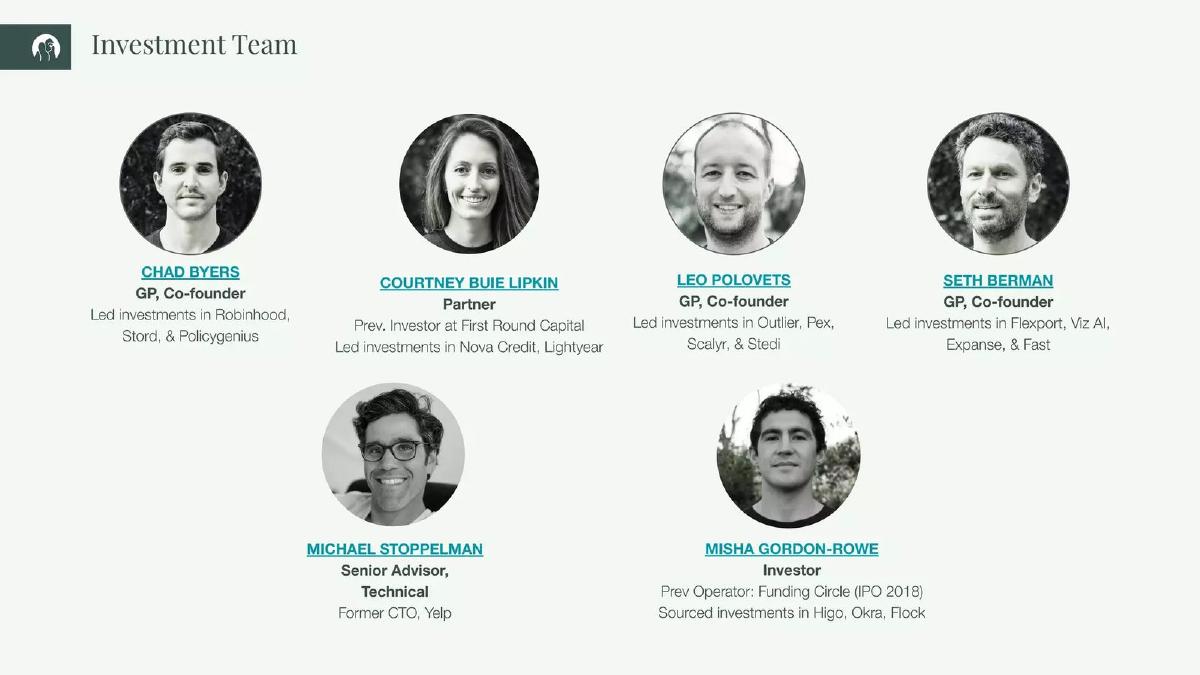
The final business slide provides the 'Ask.' Susa seeks $100M for Fund IV and $200M for Opportunity II , with a required 1:2 ratio for simultaneous commitments. The term is 10 years plus two extensions. Contact info is provided for Seth Berman, Chad Byers, and Leo Polovets .
Slide 17: Closing Slide
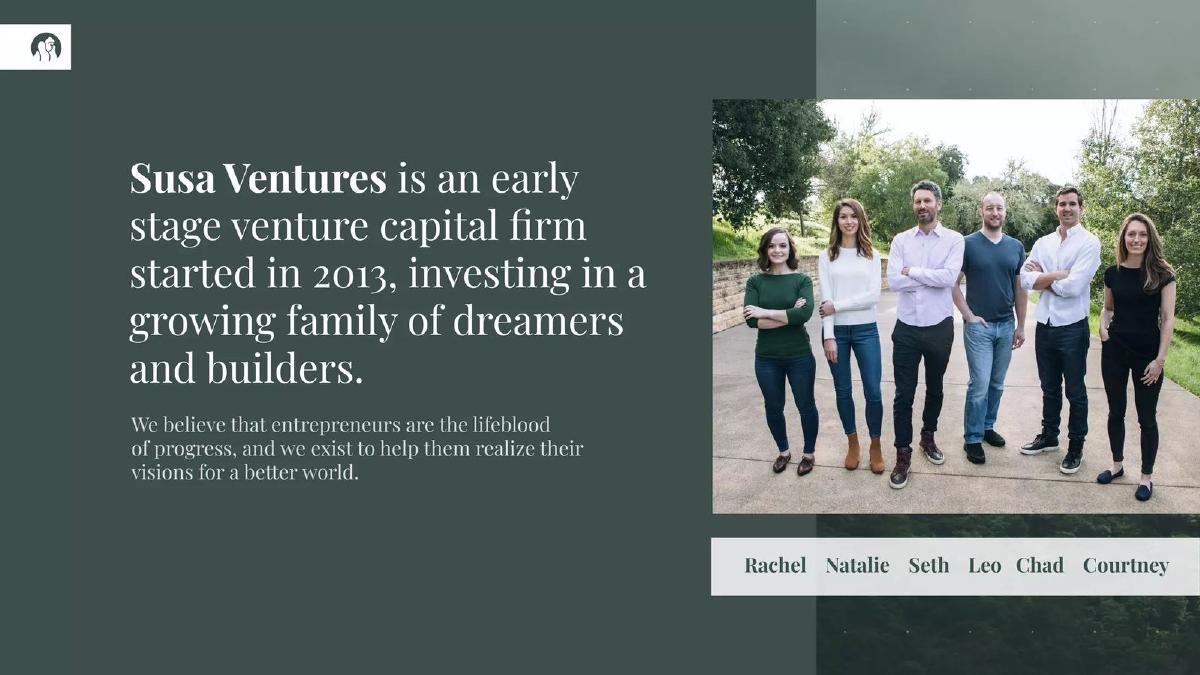
A 'Thank You' slide featuring a group photo of the six-person team in Susa-branded long-sleeve shirts, reinforcing the 'Family' brand identity established at the beginning.
What Works / What is Missing / What to Copy
What Works: The 'Barbell Strategy' is a masterclass in fund positioning. By raising two funds at once, Susa solves the 'lifecycle' problem where seed funds often lack the capital to maintain ownership in their best winners. The use of the 96 NPS score is a brilliant way to quantify 'founder friendliness,' which is usually a vague qualitative claim. Furthermore, the transparency regarding the power law (Slide 12) builds immense trust with sophisticated LPs.
What is Missing: The deck is light on specific sector theses. While it mentions 'Frontier Tech' and 'FinTech' in the catalogue, the slides themselves focus almost entirely on stage and 'picking' ability rather than a specific view on where the world is going. There is also no detailed breakdown of the 'Susa Bootcamps' or the specific curriculum that drives that high NPS, which would have added more weight to their operational claims.
What a Founder Should Copy: Founders should emulate the way Susa uses third-party validation . Slide 10 doesn't just say 'we are good'; it says 'the best firms in the world buy what we sell.' If you are a founder, don't just list your features—list the world-class customers or partners who have already vetted you. Additionally, the clear visual distinction between 'Seed' and 'Series B' strategy on Slide 6 is a great example of how to communicate a complex business model simply.
Frequently asked questions
- What is the 'barbell approach' mentioned in the deck?
- As shown on Slide 6, the barbell approach is Susa's strategy of focusing capital on the two ends of the early-stage lifecycle. They 'source and win' at the Seed stage, maintain pro-rata participation during Series A rounds led by other top-tier firms, and then 'lead or co-lead' Series B rounds in their best-performing companies using their Opportunity Fund.
- How does Susa Ventures prove its value to founders?
- Susa emphasizes 'The Susa Founder Experience' on Slide 4, highlighting a 96 Founder NPS. They showcase tangible community-building efforts such as Susa Bootcamps, Family Dinners, and a Mountain Tech Summit, positioning themselves as a 'Family' rather than just a source of capital.
- What are the specific terms for the new funds?
- According to Slide 16, Susa is raising $100M for Susa Ventures IV and $200M for Susa Opportunities II. They require simultaneous commitments to both funds at a 1:2 ratio. The fund term is 10 years with two possible one-year extensions.
- Which major companies are in the Susa Ventures portfolio?
- Slide 9 and Slide 11 list several high-valuation companies, including Robinhood, Flexport, Stord, Fast, and Expanse. Slide 11 specifically categorizes companies like Robinhood and Flexport as having reached $500M+ valuations.
- Who are the key people at Susa Ventures?
- The deck identifies the leadership team on Slide 16 as Seth Berman, Chad Byers, and Leo Polovets. Slide 3 also introduces the Operations Team, featuring Natalie Arora (Head of Operations) and Rachel Coffman (EA & Operations).