Lil PoP is a food tech startup positioning Makhana, an ancient Indian aquatic crop, as a modern, healthy snack for European consumers. The 18-slide deck emphasizes the nutritional profile of foxnuts—high in manganese, potassium, and protein—while addressing the 'guilty snacking' habits of 40% of Gen-Z. However, the deck suffers from extreme redaction; nearly every critical financial metric, market size figure (TAM/SAM/SOM), and specific use-of-funds detail is replaced with 'XXX' or 'Redacted' placeholders. While the branding is vibrant and the supply chain expertise (navigating Indian raw mat…
Key takeaways
- The product is based on Makhana, described as an age-old Indian plant-based, gluten-free, and protein-rich snack (Slide 2).
- The startup identifies a specific psychological pain point: 40% of Gen-Z and 38% of Millennials feel guilty about unhealthy snacking habits (Slide 1).
- The team claims a strategic advantage in sourcing raw and roasted foxnuts from the Indian market at reasonable rates (Slide 5).
- The product lineup includes four flavors: Organic Mint, Classic Salted, Barbecue, and Cheese (Slide 3).
- Market sizing slides (TAM/SAM/SOM) are entirely redacted, using 'XXX M' and 'XX.x M' as placeholders (Slide 10).
- The funding ask is listed in Swedish Krona (Kr), but the specific amount is redacted as 'XXx Million Kr' (Slide 12).
- Nutritional data for the product shows 350 calories and 9.7g of protein per 100g (Slide 15).
- The founder, Prashant Bhatia, is described as a 3rd-time entrepreneur with experience at BMW and Volvo Cars (Slide 5).
Lil PoP Pitch Deck Teardown
Lil PoP is a sustainability-focused food tech company that aims to commercialize Makhana (foxnuts) for a Western audience. The deck is structured as a standard 18-slide presentation, though it functions more as a template or a highly sanitized version of a real pitch, as almost all proprietary data has been removed.
Slide 1: Title and Brand Identity
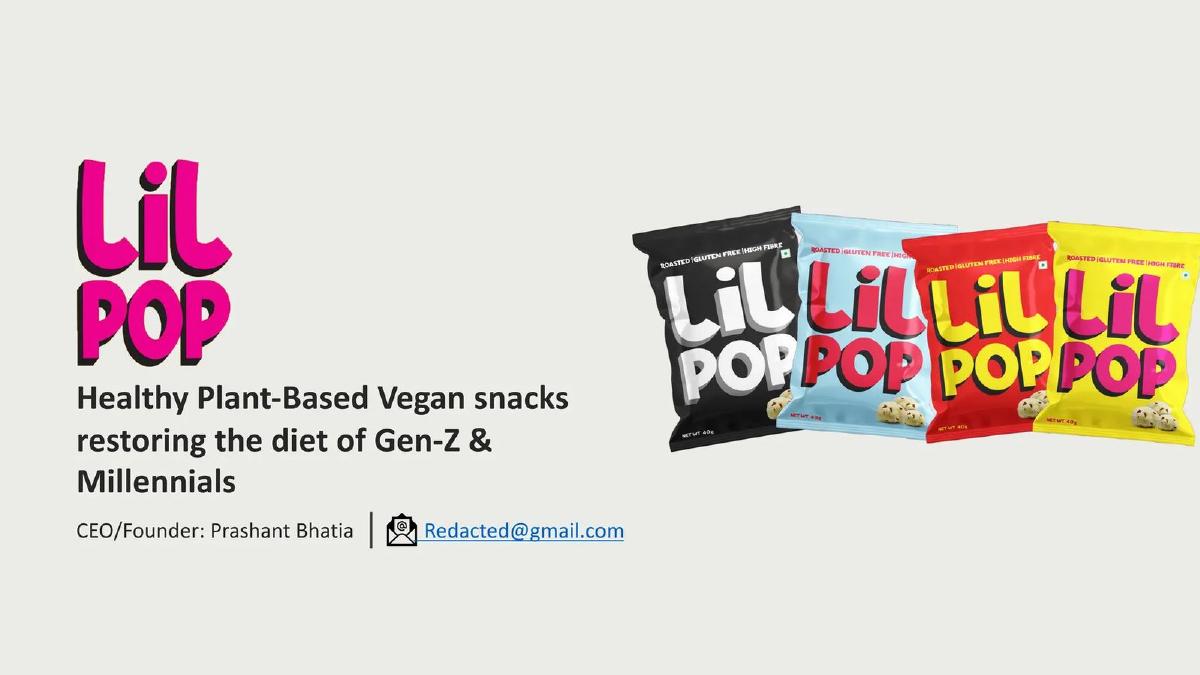
The cover slide introduces Lil PoP as 'Healthy Plant-Based Vegan snacks restoring the diet of Gen-Z & Millennials.' The branding is high-contrast, featuring bright pink, yellow, blue, and black packaging. The CEO and Founder is listed as Prashant Bhatia. The visual emphasis is on the physical product packaging, which appears retail-ready.
Slides 2-3: Problem and Solution
Slide 2 identifies the problem: 'Snacking healthy is Hard.' It cites that 40% of Gen-Z and 38% of Millennials eat healthy foods but feel guilty about their snacks. It characterizes unhealthy snacks as easy to consume, providing instant gratification, and tasty. Slide 3 introduces 'MAKHANA' as the solution, described as an 'age-old Indian plant-based, gluten-free, Protein rich, vegan snack.' The slide claims the product is healthy, delicious, and easy to consume, directly mirroring the 'unhealthy' traits identified in the previous slide but with a healthy twist.
Slide 4: Product Lineup
This slide showcases four distinct flavor profiles: Organic Mint (light blue bag), Classic Salted (black bag), Barbecue (red bag), and Cheese (yellow bag). Each bag is labeled as 'Roasted | Gluten Free | High Fibre' with a net weight of 40g. This establishes the brand's initial SKU (Stock Keeping Unit) breadth.
Slide 5: Why Now and Market Sentiment
Slide 5 attempts to establish market timing. It features a redacted pie chart with the headline 'XXXX of the European population is willing to pay more.' The text asserts that consumers globally are seeking healthy and environmentally responsible food and are willing to pay a premium for it. This slide is intended to justify a higher price point than mass-market potato chips.
Slide 6: The Team
The team slide highlights three individuals. Team 1 is responsible for 'Processing & Producing.' Team 2's name and details are redacted. Team 3 is the CEO and Founder, Prashant Bhatia, described as a '3rd-time Entrepreneur' with previous experience at automotive giants BMW and Volvo Cars. The slide also claims a core competency: the expertise to navigate 'purchasing barriers of raw & roasted foxnuts from the Indian Market at a reasonable rate.'
Slide 7: Business Model and Pricing
Titled 'On the shelf,' this slide shows three product variations (the 40g bag, a smaller bag, and a bowl of loose foxnuts). However, the pricing is redacted as 'XXx KR' for all three items. This makes it impossible to determine the price-per-gram or the target retail tier (e.g., convenience vs. premium organic).
Slides 8-9: Market Growth and Competition
Slide 8 notes that 'Demand for on-the-go nutrition is growing.' It lists 2022 revenue as '$Xx bn' and a CAGR (Compound Annual Growth Rate) for 2022-2027 as 'Xx.x%.' Slide 9 is a competitive matrix. While the competitors' names are redacted, Lil PoP claims to have five out of six 'checkmarks' for competitive advantages, missing only one (the fifth column), while competitors are shown lacking in most categories.
Slides 10-11: Milestones and Market Sizing
Slide 10 contains a roadmap with timeframes of 1-2 months, 3-6 months, 6-12 months, and 1-2 years, but the actual milestones are redacted. Slide 11 presents the TAM (Total Addressable Market), SAM (Serviceable Addressable Market), and SOM (Serviceable Obtainable Market) using circles. The figures are redacted as 'XXX M' and 'XX.x M.' The focus is on the 'GenZ & Millennials snack market.'
Slides 12-13: Financials and Funding Ask
Slide 12 is a placeholder for financials, completely redacted. Slide 13 states the funding requirement is 'XXx Million Kr' (Swedish Krona). The stated goal is 'To make Europe's snacking habits healthy.' The 'Use of Funds' section is divided into three icons (logistics, contract/legal, and reporting), but the specific allocations are redacted.
Slides 14-17: Appendix and Technical Details
The appendix provides the most technical detail in the deck. Slide 14 discusses the plant-based market in Europe, projecting it to reach '$XX.xx billion' by 2029. Slide 15 mentions reaching consumers and 'giving back to farmers,' though the methods are redacted. Slide 16 provides a detailed nutritional breakdown of foxnuts (Euryale ferox), noting they are high in manganese and potassium with 9.7g of protein per 100g. Slide 17 outlines a 4-stage production process, though the stages themselves are redacted.
Slide 18: Closing
The final slide repeats the branding and contact information for Prashant Bhatia, summarizing the brand attributes: Healthy, Fun, Delicious, Easy to consume, On-the-go, and Guilt-free.
What Lil PoP Does Well
The deck excels at visual branding . The packaging design is professional, vibrant, and clearly differentiates the flavors. By using bright, 'pop-art' style colors, the brand successfully targets the Gen-Z and Millennial demographic it identifies in the problem slide. The choice of colors (pink, yellow, cyan) deviates from the typical 'earthy' greens and browns of health food, which helps it stand out as a 'fun' snack rather than a 'medicinal' one.
Furthermore, the problem identification is sharp. Instead of just focusing on nutrition, the founders tap into the psychological aspect of 'snack guilt.' By framing the product as a way to 'restore the diet' of young consumers, they create a narrative of redemption through consumption, which is a powerful marketing angle in the wellness space.
The supply chain focus on Slide 6 is a critical inclusion. For a product like Makhana, which is primarily grown in specific regions of India (Bihar), proving that the team has the 'expertise to navigate purchasing barriers' is essential for investors worried about raw material volatility and international logistics.
What is Missing from the Lil PoP Deck
The most glaring issue is the total lack of data transparency . While it is common to redact decks for public sharing, this version removes every single metric required to evaluate a business. There are no actual market sizes, no unit economics (COGS, margins), no historical revenue, and no specific funding amount. Without these, the deck is a brand concept rather than a business case.
The competitive landscape is also poorly defined. By redacting the names of competitors on Slide 9, the founders miss the opportunity to show they understand the specific 'New Age' snack brands they will be fighting for shelf space against (e.g., Hippeas, Proper, or other Makhana brands like Taali). Investors need to see how Lil PoP compares to specific, known entities, not just 'Redacted' columns.
Finally, the Go-To-Market (GTM) strategy is absent. Slide 15 mentions 'reaching consumers,' but the actual channels (D2C, retail partnerships, Amazon, specialty grocers) are redacted. For a consumer packaged goods (CPG) startup, the distribution strategy is often more important than the product itself.
Founder's Guide: What to Copy
Founders should look at the Nutritional Appendix (Slide 16) as a model for how to present superfood data. Instead of just saying a product is 'healthy,' Lil PoP provides a granular breakdown of minerals (Manganese, Potassium, Magnesium) and macro-nutrients. This builds credibility with health-conscious investors and provides 'reasons to believe' for the marketing claims made earlier in the deck.
The Problem/Solution alignment between Slides 2 and 3 is also worth emulating. The founders use identical icons and headers ('Easy to consume,' 'Tasty') to show how their solution directly maps to the positive attributes of the problem (unhealthy snacks) while stripping away the negative attributes (guilt/unhealthiness). This creates a very clean, logical flow that is easy for an investor to follow in a 30-second skim.
Lastly, the Team Slide (Slide 6) correctly highlights 'unfair advantages.' By mentioning the ability to source raw materials at a 'reasonable rate' from India, the team addresses a major operational risk (supply chain) as a core strength. Founders should always identify the one 'hard' part of their industry and explain why they specifically are better at it than anyone else.
Frequently asked questions
- What is the primary product offered by Lil PoP?
- Lil PoP produces snacks made from Makhana, also known as foxnuts. These are derived from the Euryale ferox plant, an aquatic cash crop. The deck positions these as a healthy, vegan, and gluten-free alternative to traditional snacks, specifically targeting the 'on-the-go' nutrition market for younger generations.
- What geographic market is the company targeting?
- The deck explicitly targets the European market. Slide 4 mentions the European population's willingness to pay for healthy food, Slide 12 states the mission is to 'make Europe's snacking habits healthy,' and Slide 13 focuses on the growth of the plant-based food market specifically within Europe.
- Who are the key members of the Lil PoP team?
- The deck identifies three team roles. Prashant Bhatia is the CEO and Founder, noted as a third-time entrepreneur with a background at BMW and Volvo Cars. Two other team members are mentioned: one focused on 'Processing & Producing' and another whose specific role title is redacted.
- What are the nutritional benefits claimed for the snack?
- According to Slide 15, foxnuts are a potent source of manganese, potassium, magnesium, iron, thiamine, protein, phosphorus, and amino acids. Per 100 grams, the snack contains 350 calories, 7.7g of dietary fiber, and 9.7g of protein, with a very low fat content of 0.1g.
- How much capital is Lil PoP seeking to raise?
- The exact figure is not disclosed in the deck. Slide 12 lists the funding requirement as 'XXx Million Kr' (Swedish Krona). The use of funds is categorized into three areas—likely logistics, marketing, and operations—but the specific descriptions for these categories are also redacted.