Swept’s 11-slide deck is a lean, high-impact presentation that prioritizes emotional resonance over technical jargon. By focusing on the 'Cleaner’s Reality'—low wages, terrible hours, and a lack of respect—the founders humanized a massive, fragmented market. The deck effectively uses visceral imagery of coffee-stained notebooks to contrast with their sleek mobile solution, which offers translation in over 100 languages. With a clear traction slide showing $440,000 in ARR and a sharp hockey-stick growth curve, the deck proves product-market fit. While it lacks a formal team slide or a detailed…
Key takeaways
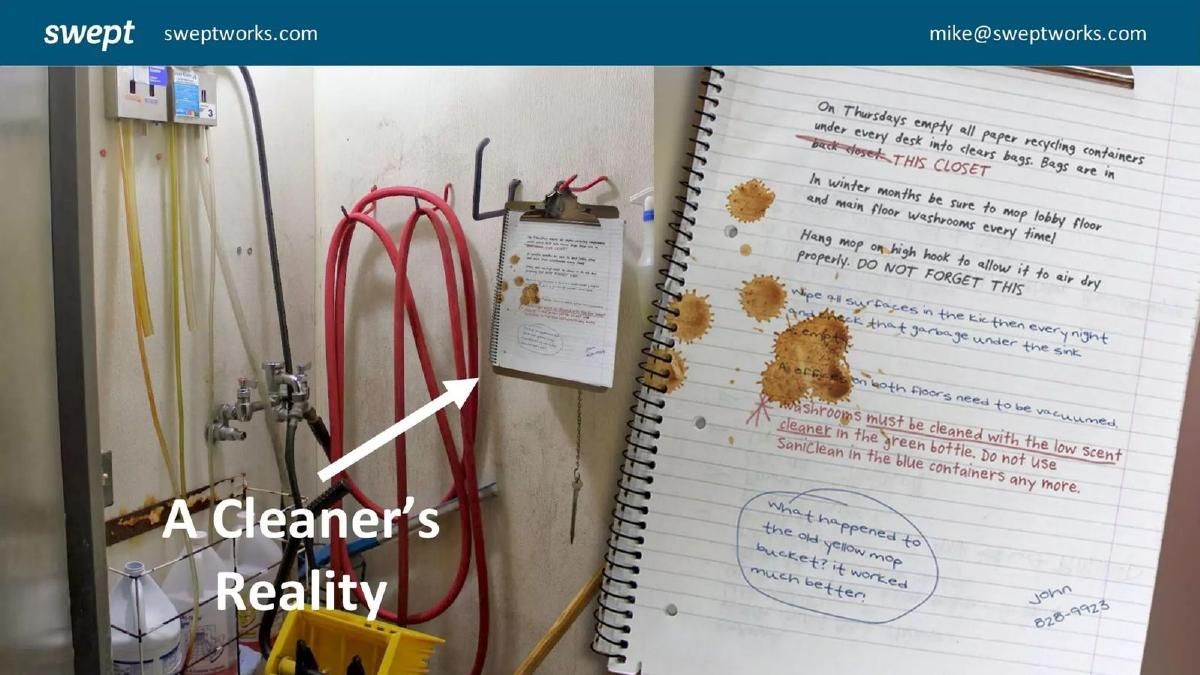
- The deck uses a visceral 'Cleaner’s Reality' slide (Slide 4) to show the outdated, manual state of the industry via a coffee-stained notebook.
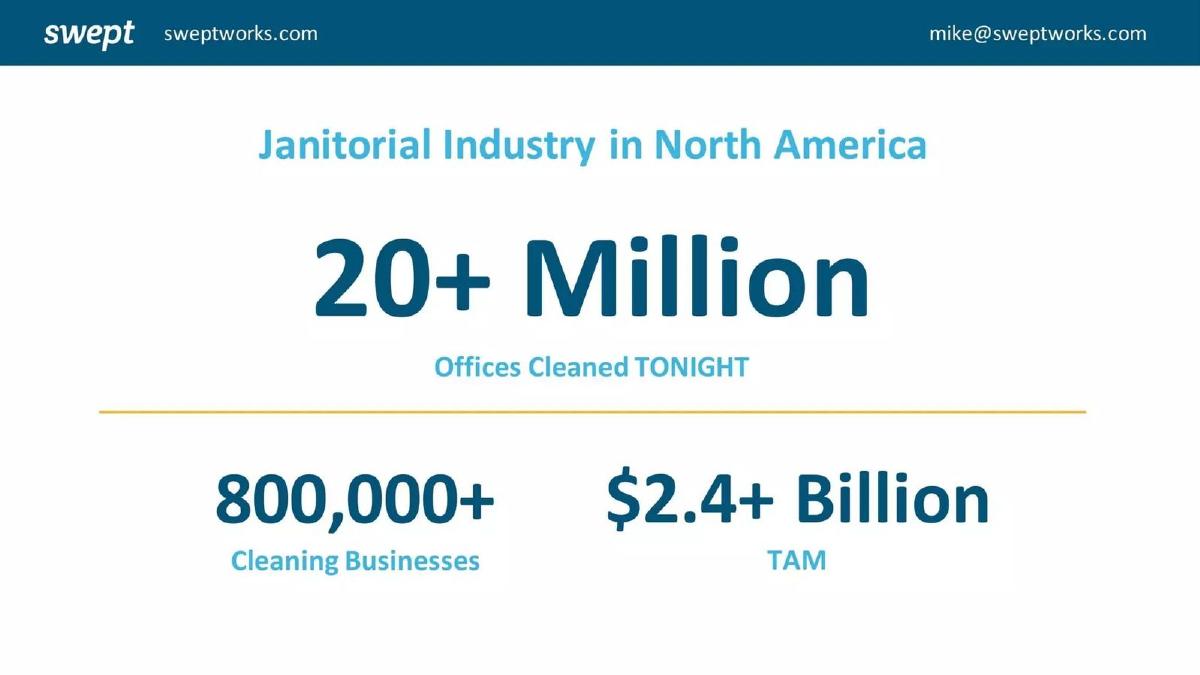
- Swept identifies a massive, fragmented market with 800,000+ cleaning businesses and a $2.4+ Billion TAM (Slide 6).
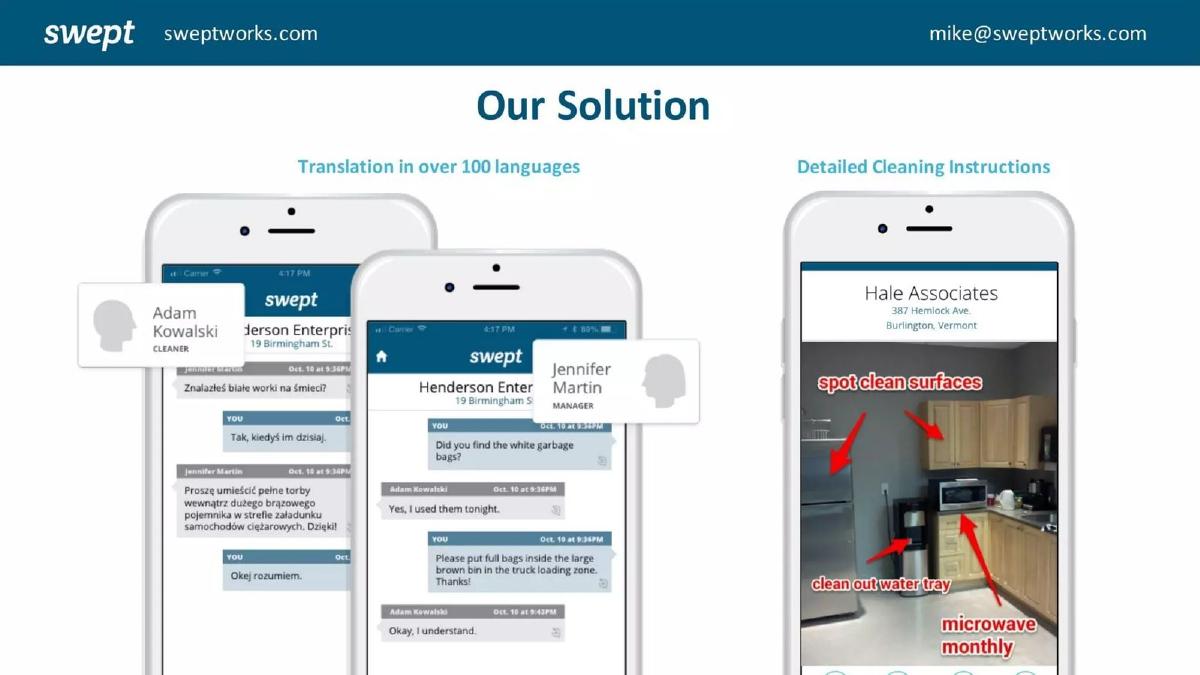
- The product solution emphasizes inclusivity, offering translation in over 100 languages to bridge the gap between managers and cleaners (Slide 5).
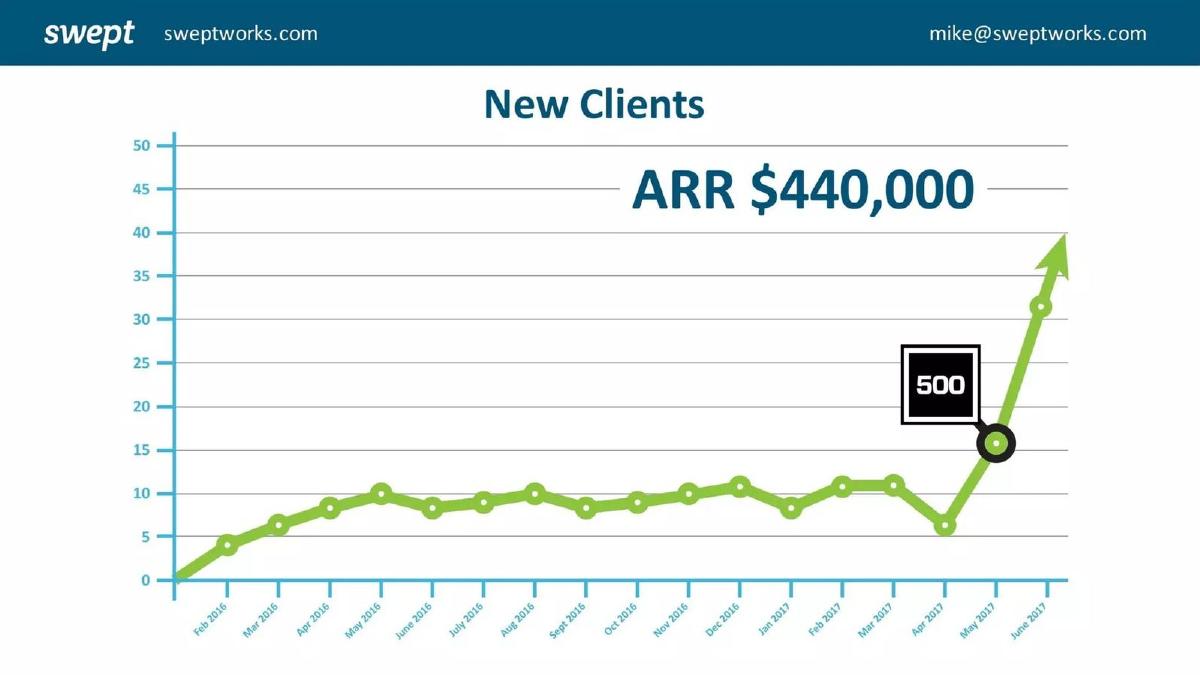
- Traction is presented with a clear hockey-stick growth curve reaching $440,000 in ARR by June 2017 (Slide 2 and Slide 10).
- The deck highlights a significant social pain point, citing a study where 74% of cleaners 'have felt like slaves at work' (Slide 9).
- The competitive landscape is framed emotionally, contrasting a 'suspicious' competitor with Swept’s 'supportive' approach (Slide 7).
- The deck is remarkably brief at 11 slides, omitting traditional sections like Team, Unit Economics, and Financial Projections.
- The repetition of the traction slide (Slide 2 and Slide 10) serves as a bookend to ensure the investor remembers the growth velocity.
The Power of the Unsexy: A Teardown of the Swept Seed Deck
Fundraising for a 'boring' industry like janitorial services is notoriously difficult. Investors often gravitate toward high-glamour sectors like AI, fintech, or consumer social. However, Swept managed to raise $2.7 million by leaning into the grit of the cleaning industry. Their 11-slide deck is a masterclass in using empathy as a wedge to disrupt a legacy market.
The Hook: Immediate Traction
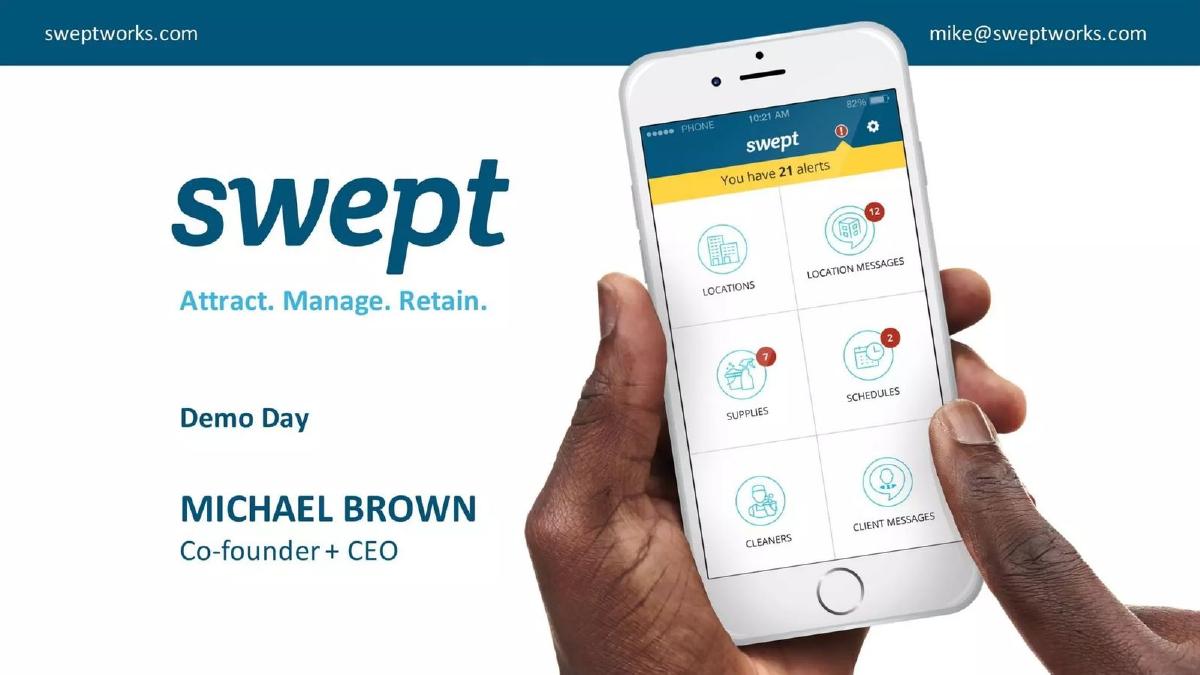
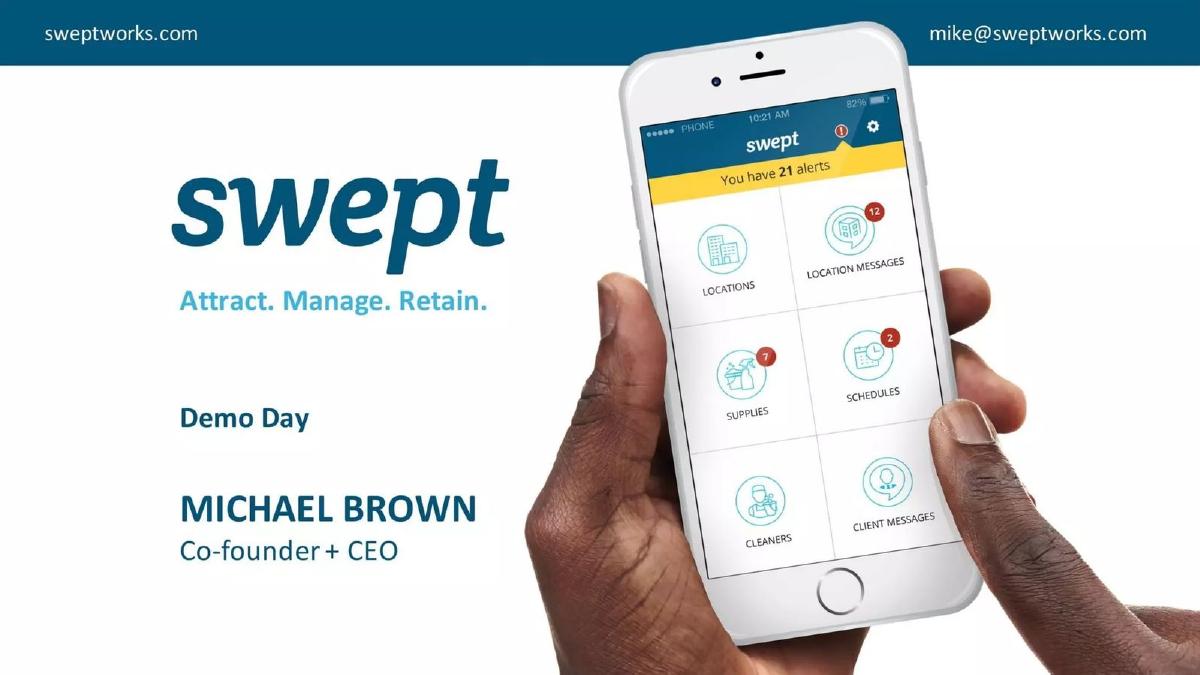
Slide 1: Title Slide The deck opens with a clean, mobile-first visual. The tagline 'Attract. Manage. Retain.' immediately identifies the three core pillars of labor management. It’s not just about 'cleaning'; it’s about the lifecycle of the employee. Michael Brown is listed as Co-founder and CEO.
Slide 2: New Clients and ARR Swept makes a bold move by placing their traction slide second. Usually, traction comes after the problem and solution. By showing a hockey-stick growth curve that culminates in ARR $440,000 by June 2017, they immediately answer the 'does this work?' question. The graph shows a relatively flat 2016 followed by an aggressive spike starting in April 2017, indicating they found a repeatable growth lever.
The Narrative: Humanizing the Problem
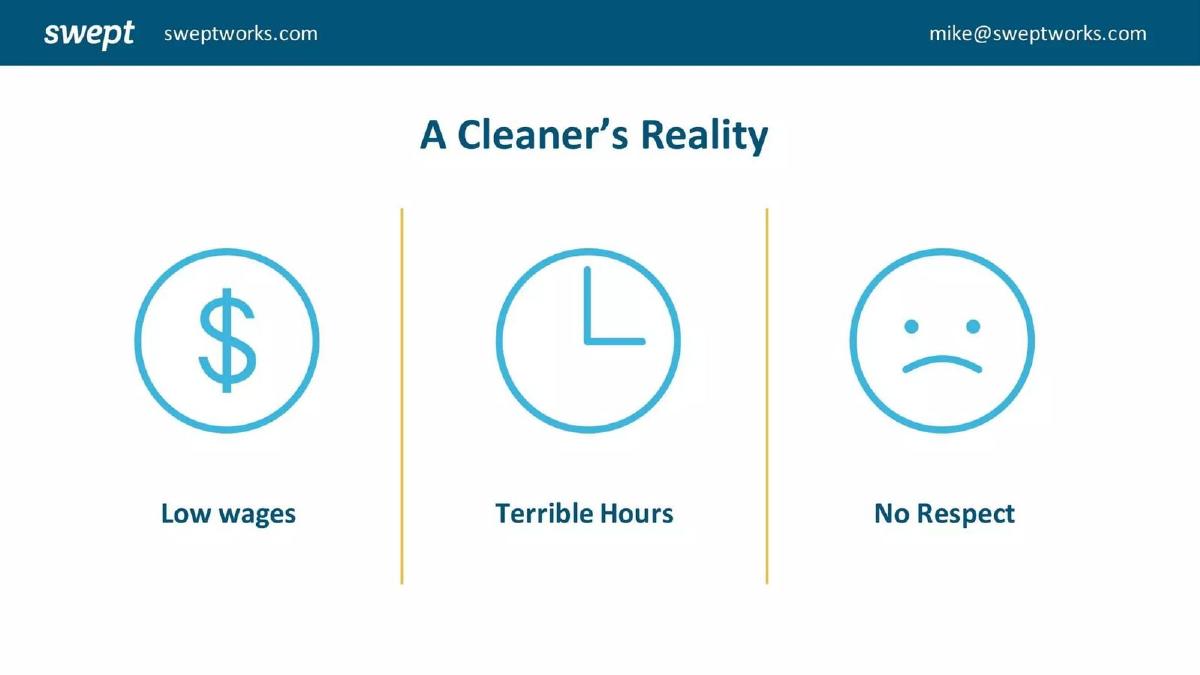
Slide 3: A Cleaner’s Reality (The Abstract) This slide sets the emotional stage. It uses three simple icons to highlight 'Low wages,' 'Terrible Hours,' and 'No Respect.' This isn't just a business problem; it's a social one. By framing the problem this way, Swept positions itself as a mission-driven company.
Slide 4: A Cleaner’s Reality (The Visceral) This is arguably the most important slide in the deck. It shows a real-world photo of a janitorial closet with a coffee-stained, handwritten notebook hanging on a hook. The text in the notebook is messy, with corrections like 'THIS CLOSET' and 'DO NOT FORGET THIS.' It perfectly illustrates the inefficiency, lack of professional tools, and the high margin for error in the current 'analog' system. It makes the need for a digital solution feel urgent and obvious.
The Solution: Bridging the Communication Gap
Slide 5: Our Solution Swept presents its software not as a complex ERP, but as a communication tool. Two key features are highlighted: Translation in over 100 languages and Detailed Cleaning Instructions . The screenshots show a manager (Jennifer Martin) communicating with a cleaner (Adam Kowalski) in Polish and English. This directly addresses the 'No Respect' and 'Low Wages' pain points by empowering workers with clear, understandable instructions in their native tongue.
The Market: Scale and Competition
Slide 6: Janitorial Industry in North America The deck zooms out to show the scale. 20+ Million Offices Cleaned TONIGHT is a powerful stat that emphasizes the daily recurrence of the service. They cite 800,000+ Cleaning Businesses and a $2.4+ Billion TAM . This slide proves that while the industry is 'unsexy,' it is massive and highly fragmented—perfect for a SaaS aggregator.
Slide 7: The Competitive Landscape Swept uses a simple 'Us vs. Them' visual. The competitor side shows magnifying glasses and footprints, implying a culture of surveillance and 'policing.' The Swept side shows a heart and a checkmark, implying a culture of support and trust. This reinforces their brand identity as the 'pro-cleaner' choice, which is a unique competitive moat in a labor-strapped industry.
The 'Why Now': A Social Mandate
Slide 8 & 9: The Shocking Stat Slide 8 is a simple transition: 'In a study of 80,000 cleaners...' Slide 9 delivers the punchline: 74% "... have felt like slaves at work." Citing the Institute of Personnel Management, this slide is designed to stop an investor in their tracks. It transforms the pitch from a software play into a solution for a systemic human rights issue within the labor market. It’s a high-risk, high-reward slide that creates a moral imperative to back the company.
The Close: Reaffirming Growth
Slide 10: New Clients (Reprise) The deck repeats the traction slide from Slide 2. This is a common tactic for Demo Day pitches (where this deck likely originated). It ensures that the final image in the investor's mind is the $440,000 ARR and the upward trajectory. It brings the conversation back from the emotional 'why' to the financial 'how.'
Slide 11: Final Logo The deck ends with the logo and the tagline 'Attract. Manage. Retain.' No specific 'ask' is listed on the slide, which is common for decks intended for public presentation or broad distribution.
What Works
Emotional Resonance: The use of the coffee-stained notebook (Slide 4) and the 'slave' statistic (Slide 9) creates a visceral reaction that most SaaS decks lack. · Clarity of Value Prop: They don't list 50 features. They focus on translation and instructions, which are the highest-leverage problems in the industry. · Traction Front-Loading: By putting the ARR on Slide 2, they earn the right to spend the rest of the deck talking about 'soft' things like respect and culture.
What is Missing
The Team: There is no slide detailing the founders' backgrounds. In the janitorial space, showing 'founder-market fit' (e.g., did they run a cleaning company?) is usually vital. · Unit Economics: There is no mention of CAC (Customer Acquisition Cost), LTV (Lifetime Value), or Churn. For a Seed round, investors usually want to see the 'money in, money out' math. · The Ask: The deck doesn't state how much they are raising or what they will do with the capital. · Roadmap: There is no vision for what Swept becomes next. Is it a marketplace? A payroll provider? A supply chain play?
What a Founder Should Copy
The 'Analog vs. Digital' Visual: If you are disrupting a manual industry, find the 'coffee-stained notebook' equivalent in your sector. Show the mess you are cleaning up. · The Bookend Traction: If your growth is your strongest suit, don't be afraid to show it twice—once to grab attention and once to close the deal. · Niche Feature Focus: Instead of showing a full dashboard, show the one feature that solves the biggest headache (like the 100+ language translation). It makes the product feel 'real' and 'built for the user.'
Frequently asked questions
- Why does the deck repeat the traction slide twice?
- Repetition in a short deck is often a strategic choice for Demo Day presentations. By showing the $440,000 ARR and the hockey-stick growth curve on Slide 2 and again on Slide 10, Swept ensures that the investor's primary takeaway is 'growth.' It anchors the emotional narrative in financial reality, proving that their empathy-led approach is translating into actual market capture.
- How does Swept define its competitive advantage?
- Swept defines its advantage through culture and communication rather than just features. Slide 7 uses iconography to show that competitors focus on 'policing' workers (magnifying glasses and footprints), whereas Swept focuses on 'supporting' them (heart icons and mobile check-ins). This positioning suggests that by improving the cleaner's experience, they naturally improve the business's bottom line through better retention.
- Is the $2.4 Billion TAM realistic for janitorial software?
- Slide 6 claims a TAM of $2.4+ Billion based on 800,000+ cleaning businesses. While TAM figures in pitch decks are often optimistic, Swept grounds this by mentioning that 20+ million offices are cleaned every night. This suggests they are calculating the TAM based on the total spend of the businesses they could potentially serve, rather than just the current software spend in the category.
- What is missing from this deck that a typical VC would expect?
- This deck is missing several 'standard' slides: a Team slide (though the founders are mentioned in the catalogue), a detailed 'Ask' or use of funds, unit economics (CAC/LTV), and a formal roadmap. Because this was likely a Demo Day deck, these details were probably handled in the verbal pitch or the follow-up due diligence phase.
- What makes the 'Solution' slide effective?
- Slide 5 is effective because it solves a specific, high-friction problem: the language barrier. By highlighting 'Translation in over 100 languages,' Swept addresses the reality of the janitorial workforce. It also shows 'Detailed Cleaning Instructions' with visual aids, proving the software is designed for the actual environment (a kitchen) rather than just an office desk.