Switchblade’s 2017 pitch deck presents a hardware-focused solution to a long-standing friction point in ice hockey: the time-consuming process of skate sharpening. By introducing a blade holder with a built-in tightening mechanism, the company claims users can swap for a sharp blade in just 60 seconds without specialized equipment. The deck leans heavily on its intellectual property, citing 23 patent claims, and targets a global market of 1.76 million players. While the product roadmap is ambitious—expanding from blades to gloves, sticks, and full performance skates over five years—the financ…
Key takeaways
- The core value proposition is a 60-second blade replacement system that eliminates the need for professional sharpening services (Slide 5).
- The company identifies a global target market of 1,762,898 hockey players as of 2017 (Slide 7).
- Switchblade claims a significant intellectual property moat with 23 claims on their patents (Slide 9).
- The product roadmap transitions the company from a component manufacturer to a full-scale hockey brand by 2023 (Slide 13).
- Revenue projections show a steady climb, starting at $3,700,000 in Year 1 and reaching $7,631,640 by Year 5 (Slide 15).
- The branding strategy relies on celebrity endorsements and social media dialogue to build emotional connections with consumers (Slide 11).
- The deck omits a formal 'Ask' slide, leaving potential investors unaware of the funding amount or equity offered.
- There is no mention of existing traction, current retail partnerships, or manufacturing costs in the provided slides.
Switchblade Pitch Deck Analysis
The Switchblade pitch deck from 2017 is a classic example of a hardware 'better mousetrap' pitch. It focuses on a specific mechanical innovation in a niche but passionate sporting goods market. The deck follows a logical progression from problem to solution, market size, and future roadmap, though it leaves several operational questions unanswered.
Slide 1: Title Slide
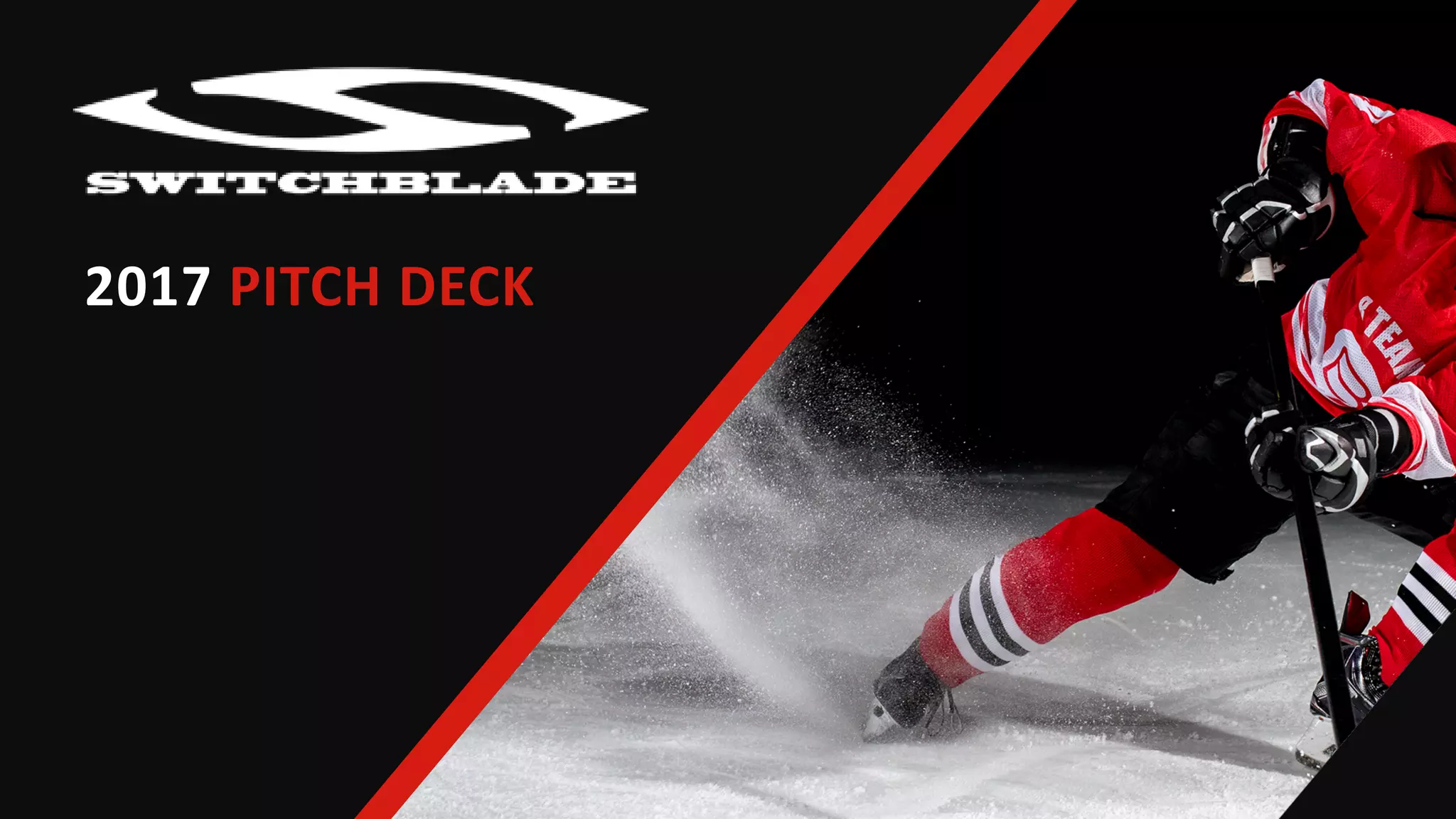
The deck opens with a high-contrast black and red design featuring the Switchblade logo—a stylized 'S' that evokes the shape of a skate blade or a speed track. The imagery of a hockey player kicking up ice shavings immediately establishes the sector. The text is minimal, simply stating '2017 PITCH DECK'.
Slide 3: The Hook
Slide 3 uses a full-bleed action shot of a hockey player with the headline 'A BLADE THAT IS ALWAYS READY FOR ACTION'. This slide serves as an emotional hook rather than a data-heavy slide. It emphasizes the 'always ready' nature of the product, hinting at the solution to the problem of dull blades causing downtime.
Slide 5: The Switchblade Solution
This is the core value proposition slide. It defines the product as 'A NEW SHARP BLADE IN 60 SECONDS'. The text explains that Switchblade eliminates the need for skaters to remove their boots or visit a sharpening shop. The mechanism is described as a 'tightening mechanism, which is incorporated into the blade holder.' This is a critical distinction, as it implies the user must buy the Switchblade holder to use the system, creating a lock-in effect for future blade purchases.
Slide 7: The Opportunity
Switchblade quantifies the market with a very specific number: 1,762,898 hockey players globally in 2017. While the precision of this number suggests thorough research, the slide lacks a source for the data. It frames the opportunity as a demand for 'high-tech recreational gear at reasonable prices.' This suggests the company is targeting the mass amateur market rather than just elite professionals.
Slide 9: Disruptive Innovation and IP
Slide 9 addresses the competitive landscape and defensibility. It claims that skate blade technology has been stagnant since 1976. The key takeaway for investors here is the mention of '23 claims on the patents.' By labeling itself a 'disruptive innovation,' the company signals its intent to change the standard equipment for both professional and amateur teams. The use of an NHL player (Tom Wilson of the Washington Capitals) in the imagery suggests aspirations for top-tier professional adoption.
Slide 11: Establishing Brand Awareness
This slide outlines a five-point marketing strategy. The points are: 01. Build the brand across all distribution channels; 02. Design of packaging and collateral; 03. Celebrity endorsements; 04. Help consumers establish an emotional connection; and 05. Interact through social media. This is a standard retail marketing mix, but it lacks specifics—for example, it does not name which 'celebrities' are being targeted or which 'distribution channels' (e.g., Pure Hockey, Canadian Tire) are in the pipeline.
Slide 13: 5 Year Plan
The roadmap shows a transition from a component supplier to a full-line hockey brand. 2018: Launch of Tron Switchblade Models I, II, and III (Price point, Mid-range, and Pro line). 2019: Expansion into gloves and sticks. 2020: Introduction of a disposable-recyclable blade. 2021-2022: Goaltending and Women’s equipment lines. 2023: A full performance skate. This is an aggressive expansion plan that would require significant capital and manufacturing expertise.
Slide 15: Switchblade Revenues
The final provided slide shows a bar chart of projected total sales. The figures are: Year 1: $3,700,000; Year 2: $4,155,000; Year 3: $4,692,000; Year 4: $5,895,600; Year 5: $7,631,640. These numbers are notably grounded; many startups project $100M+ by Year 5. The sub-$10M projection suggests a more realistic, perhaps niche, business model or a very conservative management team.
What Works in This Deck
Clarity of Problem: Anyone who has played hockey knows the frustration of a lost edge right before a game. The '60-second solution' is a powerful, easily understood hook.
IP Focus: In hardware, patents are everything. Explicitly stating the number of patent claims (23) provides a level of comfort regarding the company's ability to defend its margins against incumbents.
Realistic Projections: The revenue targets feel achievable for a high-end sporting goods component. It suggests the founders have a grasp on the actual volume of the hockey market rather than presenting 'hockey stick' growth curves that are untethered from reality.
What Is Missing
The Team: The provided slides do not include a team slide. In a hardware play, investors need to see engineers with manufacturing experience and executives with connections to major sports retailers.
Unit Economics: There is no mention of the Cost of Goods Sold (COGS) or the retail price point. If the 'tightening mechanism' is expensive to manufacture, the 'reasonable prices' mentioned on Slide 7 might be impossible to achieve.
The Ask: The deck does not state how much money is being raised or what the funds will be used for (e.g., R&D, inventory, or marketing). Without an 'Ask,' the deck functions more as a brochure than a fundraising tool.
Traction: There are no mentions of pre-orders, pilot programs with teams, or letters of intent from distributors. For a 2017 deck, one would expect to see some evidence of market validation beyond just the size of the player population.
What a Founder Should Copy
Specific Market Sizing: Instead of saying 'millions of people play hockey,' Switchblade used a specific number (1,762,898). This implies a level of rigor in their market research that builds credibility.
Visual Consistency: The deck uses a consistent color palette (Black, White, Red) and high-quality photography that aligns with the 'aggressive' and 'high-tech' nature of the sport. It looks like a professional brand from the first slide.
The Roadmap Layout: Slide 13 is an excellent example of how to show a multi-year expansion strategy. It clearly delineates how the company will move from a single product to a platform, then to a full brand, giving investors a sense of the long-term 'exit' potential.
Frequently asked questions
- What is the primary problem Switchblade solves?
- Switchblade addresses the inconvenience and downtime associated with traditional hockey skate sharpening. Currently, skaters must remove their boots and take them to a professional sharpener. Switchblade’s solution allows a player to replace their own blade in 60 seconds using a tightening mechanism built into the holder, requiring no specialized external equipment.
- How large is the market opportunity according to the deck?
- The deck cites a specific global figure of 1,762,898 hockey players in 2017. It frames the opportunity within the broader sports industry trend of providing high-tech recreational gear at 'reasonable prices.' However, it does not provide a Total Addressable Market (TAM) in dollar value, only in player count.
- What is Switchblade’s long-term product strategy?
- The company plans to expand far beyond skate blades. According to the 5-year plan, they intended to launch gloves and sticks in 2019, disposable/recyclable blades in 2020, goaltending equipment in 2021, a women’s line in 2022, and finally, their own line of performance skates in 2023.
- Does the deck provide evidence of a competitive advantage?
- Yes, primarily through intellectual property. Slide 9 states there have been no major changes to skate blade technology since 1976 and highlights that Switchblade holds 23 claims on its patents. This suggests a legal barrier to entry for competitors like Bauer or CCM who might try to replicate the quick-release mechanism.
- What are the financial expectations for the business?
- The revenue graph on Slide 15 projects Year 1 sales of $3,700,000. This grows to $4,155,000 in Year 2, $4,692,000 in Year 3, $5,895,600 in Year 4, and $7,631,640 in Year 5. The deck does not clarify if these are gross or net revenues, nor does it list projected expenses or profitability.