Swift Medical’s 2021 Series B deck is a masterclass in clinical storytelling and market validation. The company successfully identifies a 'hidden crisis' in chronic wound care, backed by staggering figures like $96B in Medicare spend. The deck transitions from this macro problem to a specific technological solution: research-grade clinical imaging accessible via any smartphone. With 4,100 sites already using the platform and 475,000 beds monitored monthly, the traction slides provide the necessary social proof for a $35M round. While the deck is light on specific financial projections and tea…
Key takeaways
- Swift Medical identifies a $20B global market opportunity for AI-powered wound care management on slide 3.
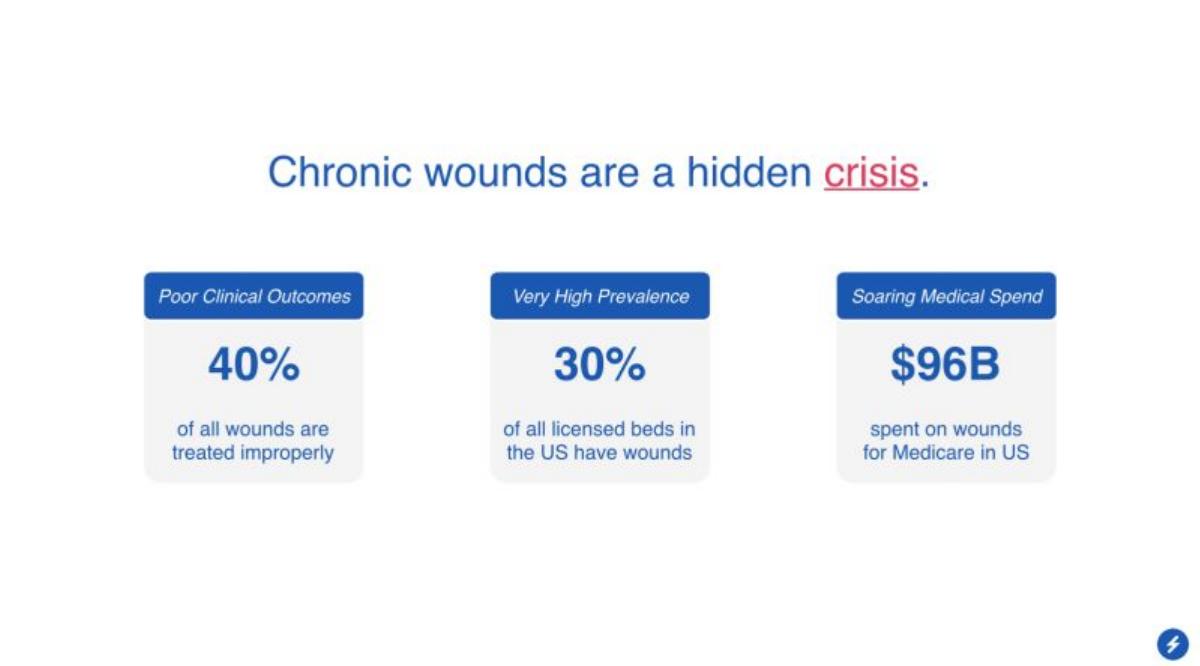
- The 'hidden crisis' is quantified by a $96B annual Medicare spend on wounds in the US, as shown on slide 4.
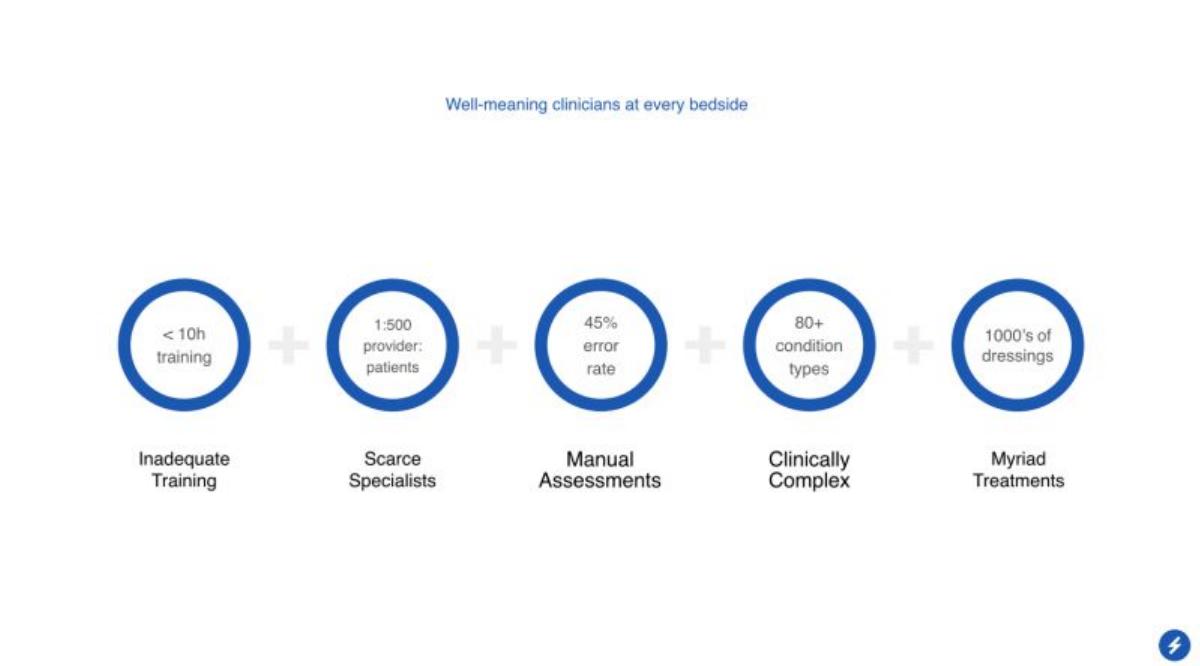
- Clinical inefficiency is highlighted by a 45% error rate in manual wound assessments on slide 5.
- The technology enables 3D imaging and analysis on any smartphone without special attachments, according to slide 9.
- The platform has achieved significant scale with 4,100 sites adopted across every US state, per slide 14.
- The company monitors 475,000 beds monthly, demonstrating high-volume recurring utility on slide 14.
- Clinical outcomes include a 77% decrease in prevalence and a 20% reduction in home visits, as stated on slide 13.
- The deck positions the company as a beneficiary of the post-COVID shift toward remote care and value-based models on slide 7.
The Macro Narrative: Framing a Hidden Crisis
Swift Medical’s Series B deck begins not with a product feature, but with a massive macroeconomic problem. By the third slide, they have already established themselves as the leader in a $20B global market . This is a classic Series B move: moving beyond the 'how it works' of a Seed round and into the 'how big this gets' phase of growth.
Slide 1: Title and Positioning
The deck opens with a clean, blue brand identity. The tagline, "Research-grade clinical imaging at any bedside," is a high-level value proposition that immediately identifies the target user (clinicians) and the core utility (imaging). It sets a professional, medical-grade tone from the outset.
Slide 2: The Technology Pillars
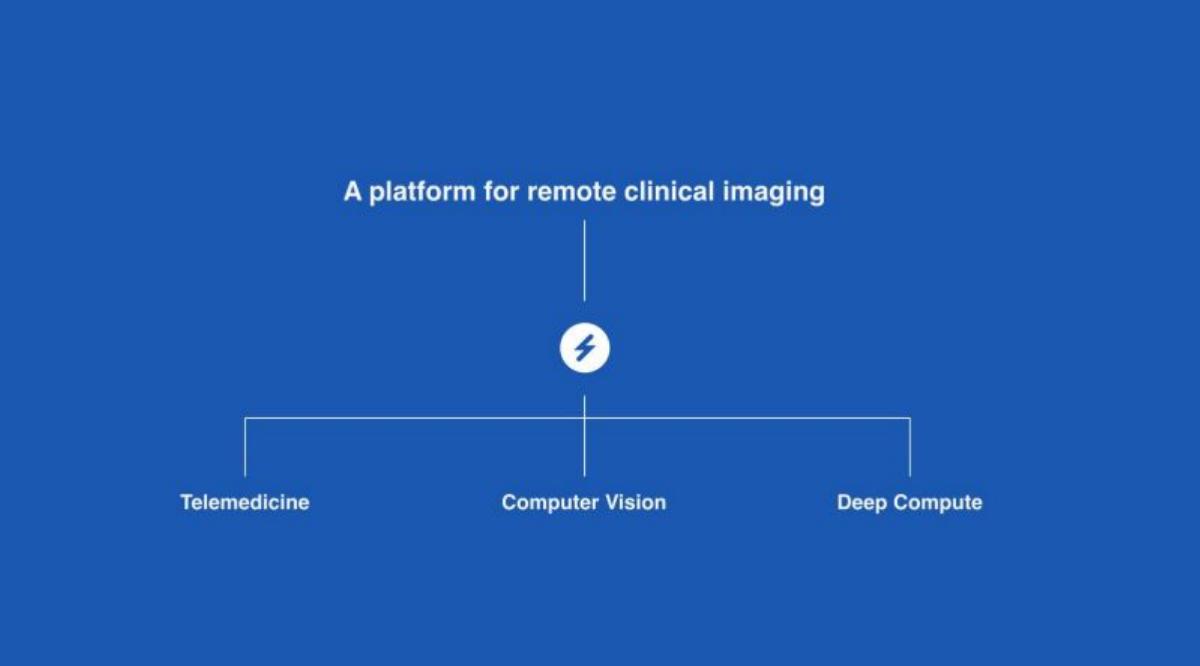
Slide 2 breaks down the platform into three technical components: Telemedicine, Computer Vision, and Deep Compute . This tells investors that Swift isn't just a video calling app for doctors; it is a data-heavy infrastructure play that uses AI to interpret visual information.
Slide 3: Market Opportunity
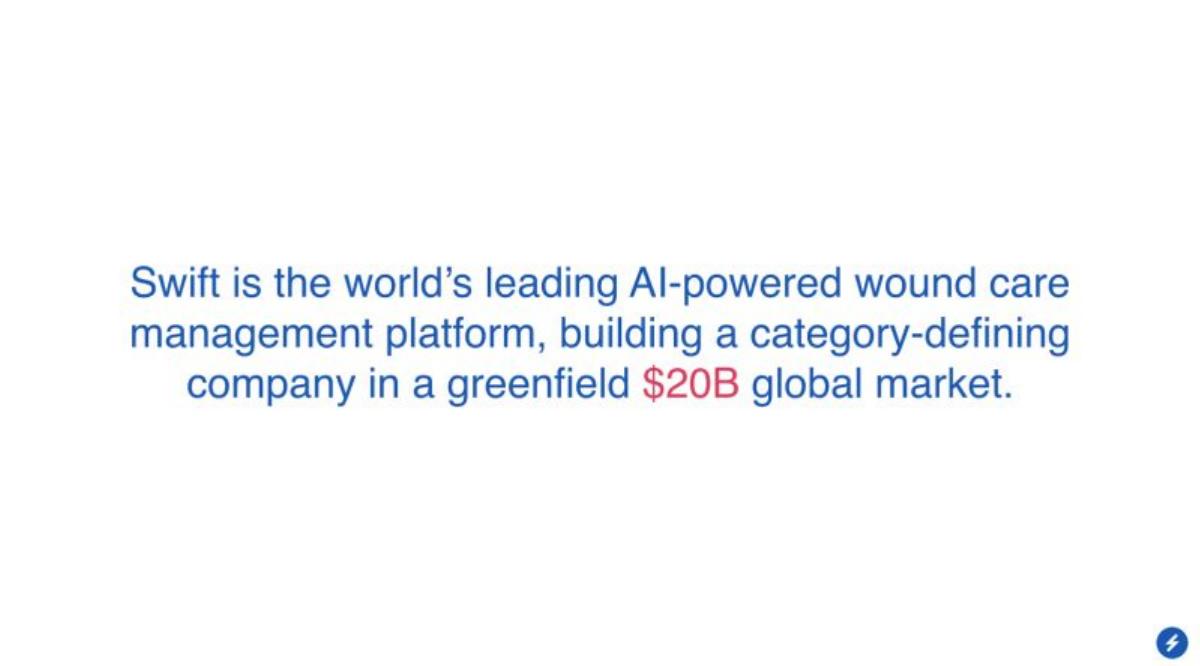
The company claims to be the "world’s leading AI-powered wound care management platform." They define the market as a "greenfield $20B global market." Using the term 'greenfield' suggests a lack of established legacy competitors, which is an attractive prospect for venture capital looking for category-defining companies.
Slide 4: The Hidden Crisis
This is the 'Problem' slide, and it is data-dense. It cites three staggering statistics: 40% of all wounds are treated improperly , 30% of all licensed beds in the US have wounds , and $96B is spent on wounds for Medicare in the US . By linking the clinical problem to the Medicare spend, Swift makes a compelling case that their solution is a necessity for the US healthcare budget, not just a 'nice-to-have' tool.
Slide 5: Clinician Pain Points
Slide 5 focuses on the 'Well-meaning clinicians' who are struggling. It lists the barriers to quality care: less than 10 hours of training , a 1:500 provider-to-patient ratio , and a 45% error rate in manual assessments. This slide humanizes the problem and explains why technology is required to bridge the gap between scarce specialists and the myriad of treatments (1,000s of dressings) available.
Slide 6: The Care Continuum
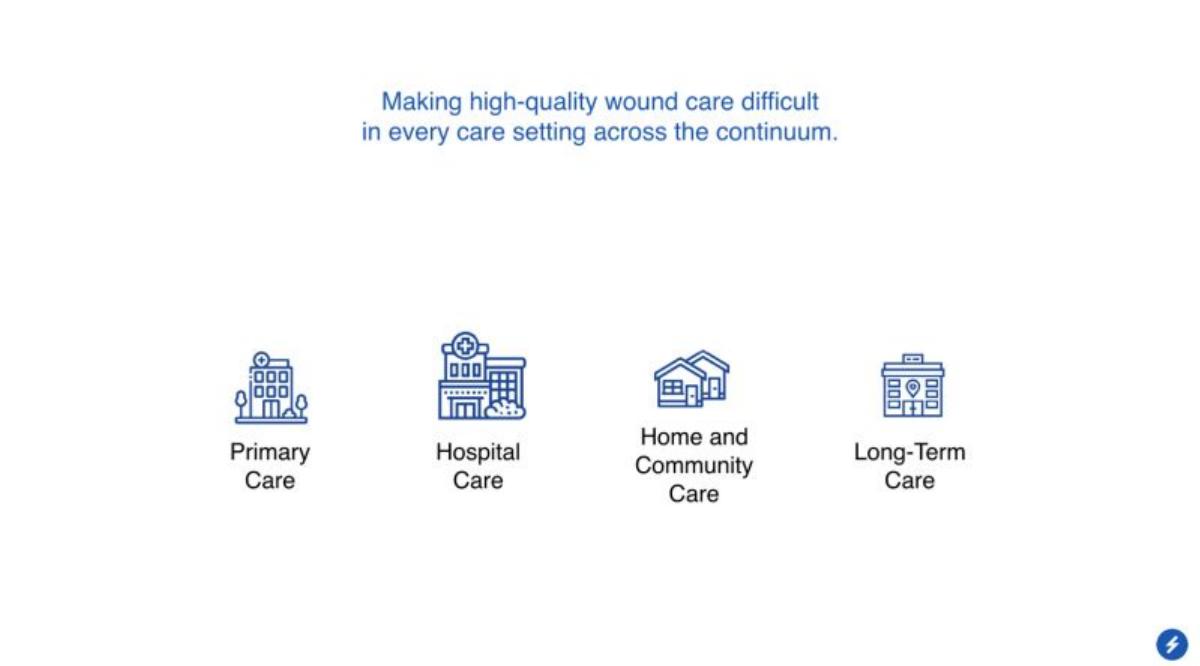
Swift identifies four key settings where wound care is difficult: Primary Care, Hospital Care, Home and Community Care, and Long-Term Care . This slide prepares the investor for the 'Traction' section by showing that the solution is applicable across the entire healthcare spectrum, increasing the Total Addressable Market (TAM).
Slide 7: The COVID-19 Catalyst
Every deck from 2021 had a COVID slide, but Swift’s is more than just a trend-hop. They argue that the pandemic accelerated three permanent shifts: Movement to value-based care , Remote care/evolving coverage , and Hospital in the Home . This provides the 'Why Now?'—a critical element for any fundraise.
Slide 8: The Solution in Action
Slide 8 provides the first visual of the product. A smartphone is shown capturing a wound image with a digital overlay. The text emphasizes "Best-practice wound management across the care continuum from the hospital to the home." The visual proof of the digital measurement (3.1 cm²) directly addresses the 'manual assessment error' mentioned earlier.
Slide 9: Hardware-Agnostic 3D Imaging
This is a key technical differentiator. Swift claims to enable "3D imaging and analysis on any smartphone with no special attachments." In a field where competitors often require proprietary lenses or sensors, a software-only solution that works on a standard iPhone is significantly more scalable and easier to deploy.
Slide 10: Patient Empowerment
Slide 10 shows the patient-facing side of the app. It highlights the ability for patients to "take clinic-grade images in their own homes." This supports the 'Hospital in the Home' trend and suggests a B2B2C model where the provider monitors the patient remotely.
Slide 11: Advanced Insights
Moving from the mobile app to the desktop, slide 11 shows a dashboard of "Advanced insights and clinical intelligence." This is where the 'Deep Compute' mentioned on slide 2 comes to life, providing the data visualization necessary for administrators to manage populations of patients.
Slide 12: User Sentiment
The deck uses three circular charts to show high user satisfaction: 100% find it "Intuitive and easy to use," 90% can "Easily track healing," and 85% make "Faster and more confident care decisions." While the source of this data isn't cited on the slide, it serves to mitigate concerns about clinician adoption of new software.
Slide 13: Proven ROI and Clinical Outcomes
This is arguably the most important slide for a Series B healthcare company. It lists three hard outcomes: a 77% decrease in prevalence , a 20% reduction in home visits , and a 7% reduction in hospitalizations . These numbers are the 'proof in the pudding' that the AI actually works to improve health and save money.
Slide 14: Scale and Traction
The penultimate slide shows a map of North America covered in pins. The metrics are impressive: 4,100 sites adopted across every state and 475,000 beds monitored monthly . This demonstrates that Swift has moved past the pilot phase and is now a standard of care in thousands of facilities.
What Swift Medical Does Well
Swift Medical excels at problem framing . They don't just say 'wounds are bad'; they quantify the cost to the taxpayer ($96B) and the failure rate of the current system (45% error). This makes the adoption of their platform seem like an economic inevitability rather than a speculative tech play.
The deck also does an excellent job of demonstrating versatility . By showing the app in the hands of both a clinician (slide 8) and a patient (slide 10), and then showing the aggregate data for a manager (slide 11), they prove that their platform serves every stakeholder in the healthcare ecosystem.
What is Missing from the Deck
Despite the strong clinical narrative, the deck is missing several standard venture capital components. There is no team slide , which is unusual for a Series B where the pedigree of the leadership and their ability to scale a large organization is a primary concern for investors.
There is also no financial slide . While the traction slide shows site count and bed count, it does not disclose Annual Recurring Revenue (ARR), Churn, or Customer Acquisition Cost (CAC). For a customer-model business, these unit economics are usually central to the Series B conversation. Finally, there is no explicit 'Ask' slide detailing how the $35M will be spent, though the catalogue facts confirm the amount raised.
What Other Founders Should Copy
Founders should emulate Swift’s outcome-oriented approach . Slide 13 is a perfect example of how to present data: clear, bold percentages tied to the three things healthcare buyers care about most: prevalence, labor (home visits), and high-cost events (hospitalizations).
Additionally, the visual simplicity of the deck is worth copying. Each slide has a single, clear message. There are no 'wall of text' slides. Even complex ideas like the clinician's struggle (slide 5) are broken down into simple icons and short phrases. This ensures that the investor stays focused on the narrative rather than getting lost in the details.
Frequently asked questions
- What is the core technology behind Swift Medical?
- Swift Medical utilizes a combination of computer vision, deep compute, and telemedicine to provide research-grade clinical imaging at the bedside. As detailed on slide 9, their proprietary AI allows for 3D imaging and analysis of wounds using standard smartphones, requiring no specialized hardware attachments. This allows both clinicians and patients to capture high-quality data in various settings, from hospitals to private homes.
- How does Swift Medical quantify the problem they are solving?
- The deck frames chronic wounds as a 'hidden crisis' using three key metrics on slide 4: 40% of all wounds are treated improperly, 30% of all licensed US beds have patients with wounds, and $96B is spent annually by Medicare on wound care. They further emphasize the difficulty of care by noting a 45% error rate in manual assessments and the complexity of managing over 80 condition types.
- What kind of traction did Swift Medical show in their Series B deck?
- Swift Medical demonstrated significant market penetration by slide 14, reporting 4,100 sites across every US state. They also highlighted their operational scale by stating they monitor 475,000 beds monthly. This level of adoption across the 'care continuum'—including primary, hospital, home, and long-term care—served as a strong signal of product-market fit for Series B investors.
- What are the reported clinical benefits of using the platform?
- On slide 13, Swift Medical lists three major ROI and clinical outcome metrics: a 77% decrease in wound prevalence, a 20% reduction in home visits, and a 7% reduction in hospitalizations. These figures are critical for their 'value-based care' narrative, suggesting that the platform not only improves patient health but also significantly reduces costs for healthcare systems.
- What is missing from the Swift Medical pitch deck?
- The 15-slide deck is notably missing a dedicated team slide, detailed financial projections, and a specific breakdown of the $35M 'ask' or use of funds. It also lacks a traditional competitor matrix. While the catalogue facts confirm the round size and stage, the deck itself focuses almost entirely on the problem, the technology, and the high-level traction metrics rather than the internal mechanics of the business.