PredictionIO’s 12-slide deck is a masterclass in 'show, don't tell' for technical founders. Eschewing traditional financial charts and dense text, the company focused on the ubiquity of machine learning through high-impact imagery—ranging from autonomous vehicles to movie recommendations. By the time they reached Slide 10, they had established a clear lead in developer mindshare, citing 4,240 stars/forks compared to competitors like Myrrix and Precog. The deck succeeded by positioning PredictionIO as the 'MySQL of Machine Learning,' leveraging open-source adoption as a proxy for future market…
Key takeaways
- The deck uses high-impact imagery on Slides 2 through 5 to establish the broad utility of machine learning across chess, media, and transport.
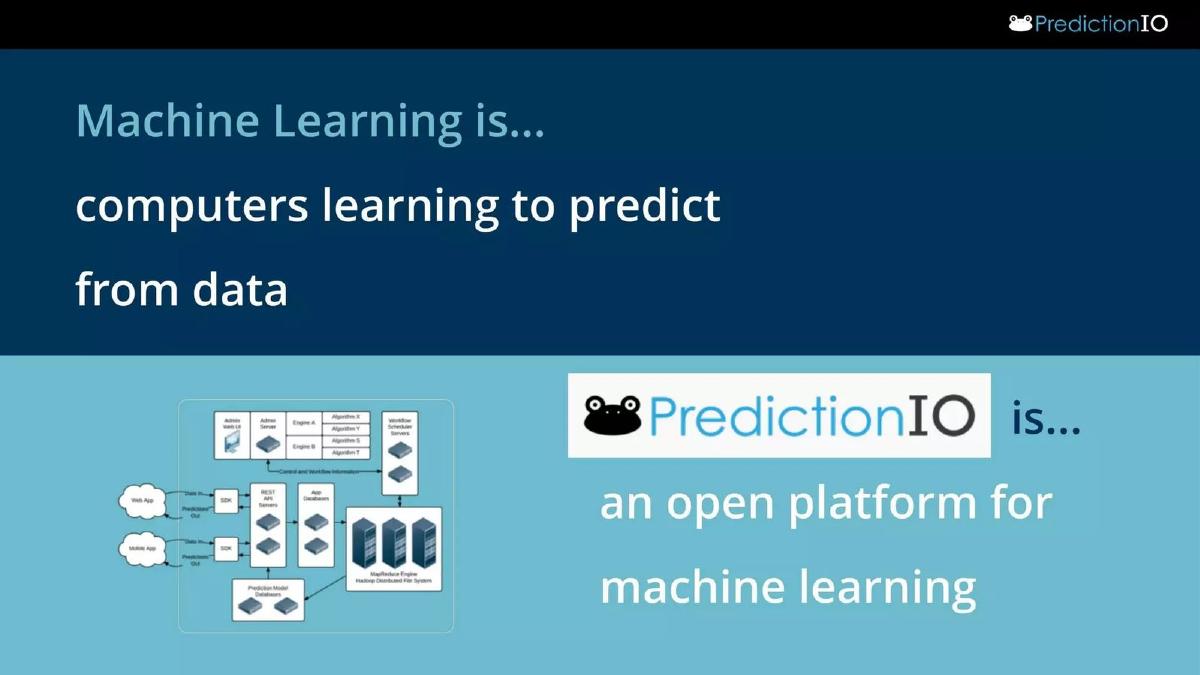
- Slide 6 provides the core definition: 'computers learning to predict from data,' positioning PredictionIO as the 'open platform' for this task.
- Technical architecture is simplified into a single diagram on Slide 6, showing the flow from SDKs to REST APIs and Hadoop systems.
- Slide 10 uses a bar chart to demonstrate a massive lead in developer traction, claiming 4,240 stars/forks, which is 6x the nearest competitor shown.
- The team slide (Slide 11) emphasizes pedigree over history, featuring logos from Stanford, Berkeley, Google, and NVIDIA.
- The deck contains zero financial projections, revenue figures, or pricing models, focusing entirely on adoption metrics.
- There is no 'Ask' slide; the deck concludes with contact information and a GitHub link on Slide 12.
- Visual metaphors, such as the dolphin and frog on Slide 8, are used to imply a shift in software paradigms without using words.
The Minimalist Infrastructure Pitch
PredictionIO’s 2013 seed deck is a fascinating artifact from the early days of the machine learning boom. At 12 slides, it is remarkably brief. It does not follow the standard Sequoia-style template. There is no explicit problem slide, no market size calculation, and no financial model. Instead, the deck focuses on the inevitability of machine learning and the dominance of their open-source community . This teardown explores how they used this narrative to raise $2.7M and eventually exit to Salesforce.
Slides 1-5: Establishing the Context of Machine Learning
Slide 1: Title The deck opens with a simple logo: a stylized frog head next to the name 'PredictionIO.' The dark background and clean typography signal a developer-centric, 'pro-code' tool.
Slide 2: Strategy and Complexity A full-bleed image of a chess board with a focused king piece. This is a visual metaphor for decision-making and strategy, the core outputs of predictive modeling. There is no text on this slide, forcing the presenter to explain the link between data and strategic advantage.
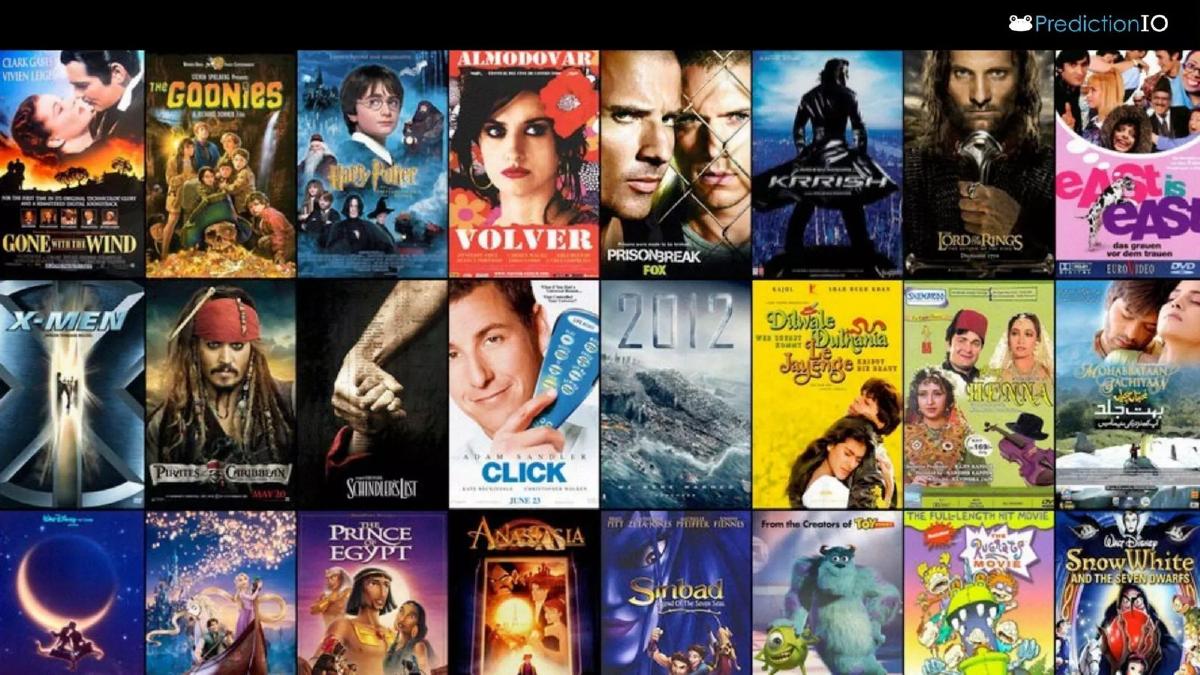
Slide 3: Personalization and Discovery A grid of movie posters (Gone with the Wind, Harry Potter, X-Men, etc.). This slide represents the 'Recommendation' use case. It visually communicates that every media company needs the ability to suggest content to users, a task that requires the machine learning infrastructure PredictionIO provides.
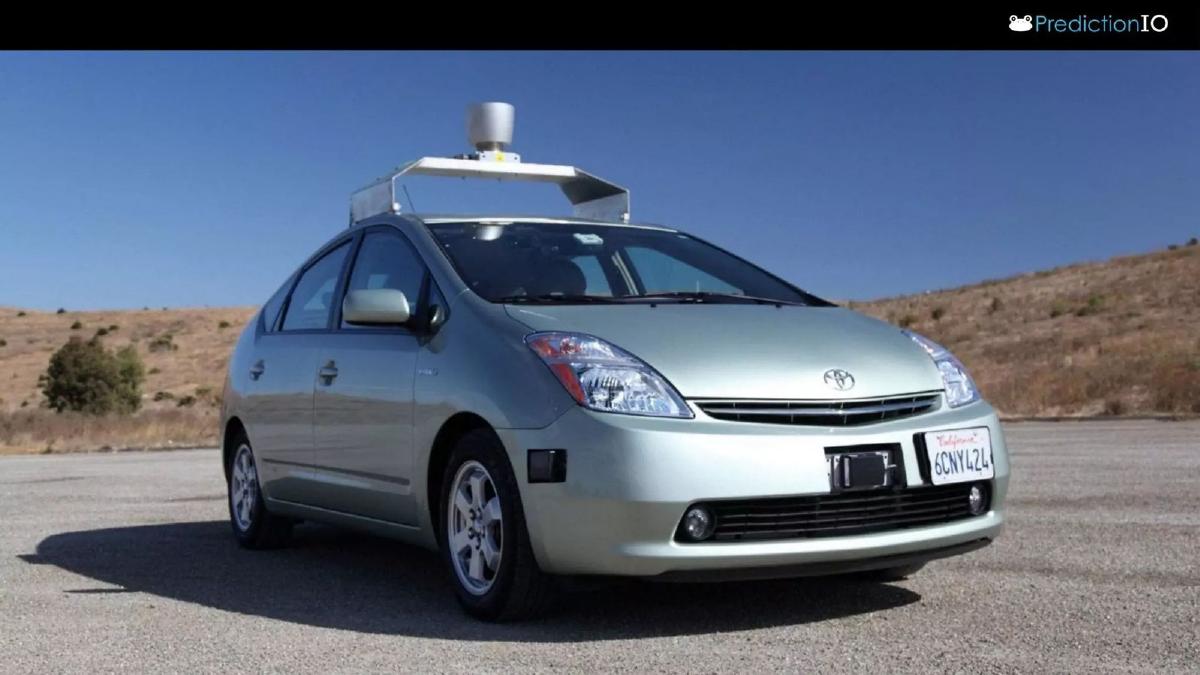
Slide 4: Automation and Robotics An image of an early autonomous Toyota Prius equipped with LIDAR. This expands the scope of the pitch from simple web recommendations to the future of transportation and physical automation. It suggests that PredictionIO isn't just for websites; it's for the next generation of hardware.
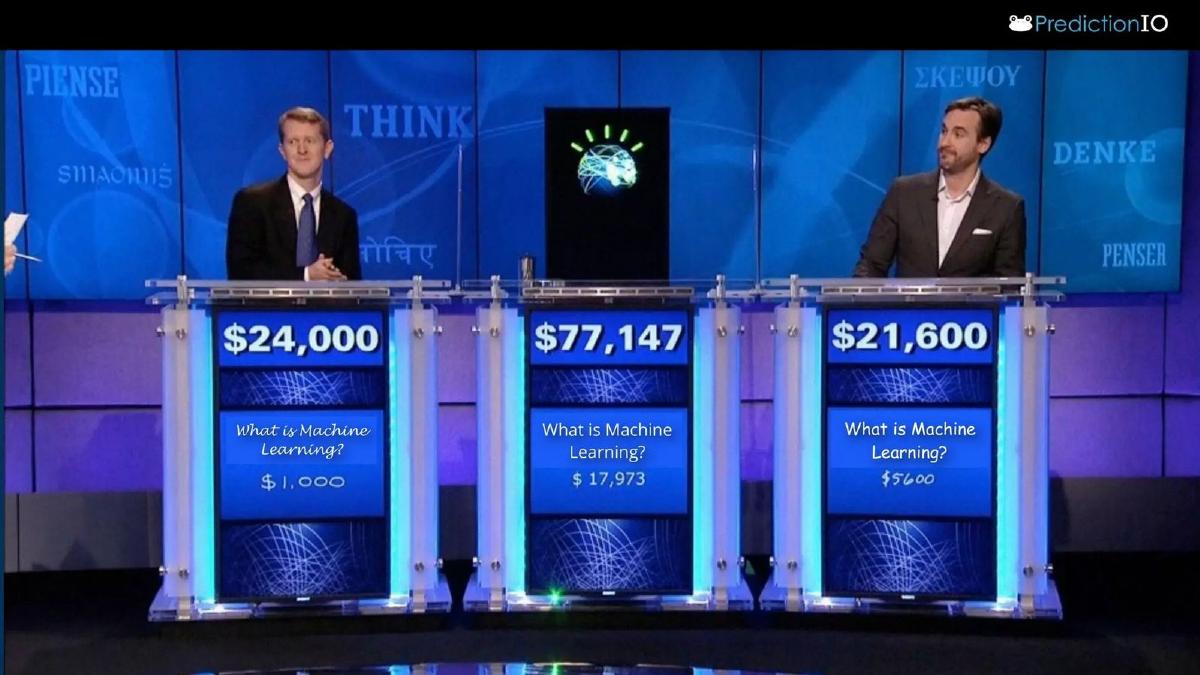
Slide 5: Intelligence and Competition A screenshot of the IBM Watson Jeopardy! challenge. This anchors the technology in the 'cutting edge' of 2013. It shows that while giants like IBM are building bespoke AI, there is a need for a platform that makes this intelligence accessible to every developer.
Slides 6-9: The Product and the Paradigm Shift
Slide 6: The Definition and the Solution This is the first slide with significant text. It defines Machine Learning as 'computers learning to predict from data.' Below this, it introduces PredictionIO as 'an open platform for machine learning.' A technical diagram shows the architecture: Web/Mobile apps connecting via SDKs to a REST API Server, which interacts with Engine Servers, Algorithm Schedulers, and a Hadoop Distributed File System. This is a crucial slide for technical due diligence, showing they have a structured, scalable approach to data processing.
Slide 7: The Complexity of the Past A grayscale image of an old car with a complex neural network diagram overlaid. This represents the 'old way' of doing ML—academic, manual, and difficult to implement. It sets up the contrast for the next slide.
Slide 8: The Standard-Bearer Metaphor This slide features two logos: the MySQL dolphin and the PredictionIO frog. This is the most important 'business' slide in the deck. It tells the investor: 'MySQL became the standard for databases; we will become the standard for machine learning.' It is a bold claim of future market ubiquity without using a single word of marketing fluff.
Slide 9: The Interface A product screenshot inside a laptop frame. It shows the 'Prediction Settings' and 'Training Schedule' UI. This proves the product is real, functional, and has a user-friendly management layer for developers to control their algorithms and data models.
Slides 10-12: Traction, Team, and Contact
Slide 10: The Traction Gap PredictionIO uses a bar chart to show their 'Focus on developer community.' They compare their GitHub stars and forks against competitors like Myrrix (acquired by Cloudera), Precog (acquired by RichRelevance), GraphLab, and Oxdata. PredictionIO claims 4,240 stars/forks , which they highlight as 6x the nearest competitor and 3x their own previous growth. This slide is the 'proof of work' that justifies the investment.
Slide 11: The Pedigree The team slide is visual. It features five headshots and a cloud of prestigious logos: Stanford University, Berkeley, Google, NVIDIA, and UCL . The slide also includes the growth targets: 10x Contributors, 100x Live servers, 1,000x Developer community . This replaces a traditional 'Use of Funds' slide by showing what the scale-up goals are.
Slide 12: The Closing The final slide repeats the 'open machine learning platform' tagline and provides the website, Twitter handle, GitHub link, and a 'founders@' email address. It is a functional, no-nonsense conclusion.
What Works in This Deck
Visual Storytelling: By using full-page images for the first five slides, the founders control the pace of the presentation. They establish the 'Why' (ML is everywhere) before the 'How' (our API). · Competitive Benchmarking: Slide 10 is a knockout. By showing they have already 'won' the developer community compared to companies that were already acquired, they create a sense of FOMO (Fear Of Missing Out) for the investor. · The MySQL Comparison: Comparing themselves to a known, successful open-source giant (MySQL) provides an instant mental model for how the company will scale and eventually monetize. · Technical Clarity: Slide 6 provides enough architectural detail to satisfy a technical investor without overwhelming a generalist.
What Is Missing
The Business Model: There is no mention of how PredictionIO will actually make money. While common in 2013-era open-source pitches, modern decks usually need to hint at an enterprise 'Open Core' or SaaS hosting model. · Market Size (TAM/SAM/SOM): The deck assumes the market for ML is 'huge' but never quantifies it with dollar amounts. · The Ask: The deck does not state how much money they are raising or what the valuation expectations are. This information was likely handled in the verbal pitch or a separate teaser. · Case Studies: While they show movie posters and cars, they don't name a single real-world customer or user who is currently using PredictionIO in production.
What a Founder Should Copy
The 'Traction as Proxy' Slide: If you are building for developers, your GitHub metrics are your revenue. Copy the way Slide 10 visualizes dominance over competitors. · Pedigree Logos: If your team has worked at top-tier places, use the logos. They are more readable than a list of job titles during a quick pitch. · The 'Is...' Definition: Slide 6's simple 'Machine Learning is... PredictionIO is...' format is a perfect way to clear up any confusion about a complex product in under 10 seconds. · Minimalist Design: This deck avoids the 'wall of text' trap. It forces the founder to be a storyteller rather than a reader.
Frequently asked questions
- How did PredictionIO raise $2.7M without a revenue slide?
- In 2013, the 'land and expand' open-source model was highly attractive to VCs. PredictionIO focused on developer adoption as a leading indicator of value. By showing 4,240 GitHub stars/forks on Slide 10—significantly outperforming competitors—they proved they had won the developer community, which investors viewed as a precursor to enterprise monetization.
- What is the significance of the 'Dolphin and Frog' on Slide 8?
- This is a subtle nod to the history of open-source databases. The dolphin is the logo for MySQL. By placing their frog logo next to it, PredictionIO is non-verbally claiming they will be the standard infrastructure for machine learning in the same way MySQL became the standard for relational databases.
- Why does the deck use so many full-page images of movies and cars?
- These slides (3 and 4) serve to ground the abstract concept of 'Machine Learning' in real-world applications. By showing movie posters and a self-driving car, the founders are demonstrating that their technology powers the most valuable features of modern tech giants like Netflix and Google, establishing a massive Total Addressable Market (TAM).
- Is the lack of a 'Problem' slide a mistake?
- While traditional decks start with a problem, PredictionIO starts with 'Possibility.' They assume the investor knows that building ML from scratch is hard. Instead of complaining about the difficulty, they show the 'Magic' of the output (Slides 2-5) and then present themselves as the platform that enables that magic (Slide 6).
- How does the team slide communicate authority without a long bio?
- Slide 11 uses 'Logo Credibility.' By placing photos next to logos for Stanford, Google, and Berkeley, they signal that the founders come from the world's top engineering environments. This 'shorthand' is often more effective in a seed-stage pitch than a dense paragraph about previous job titles.