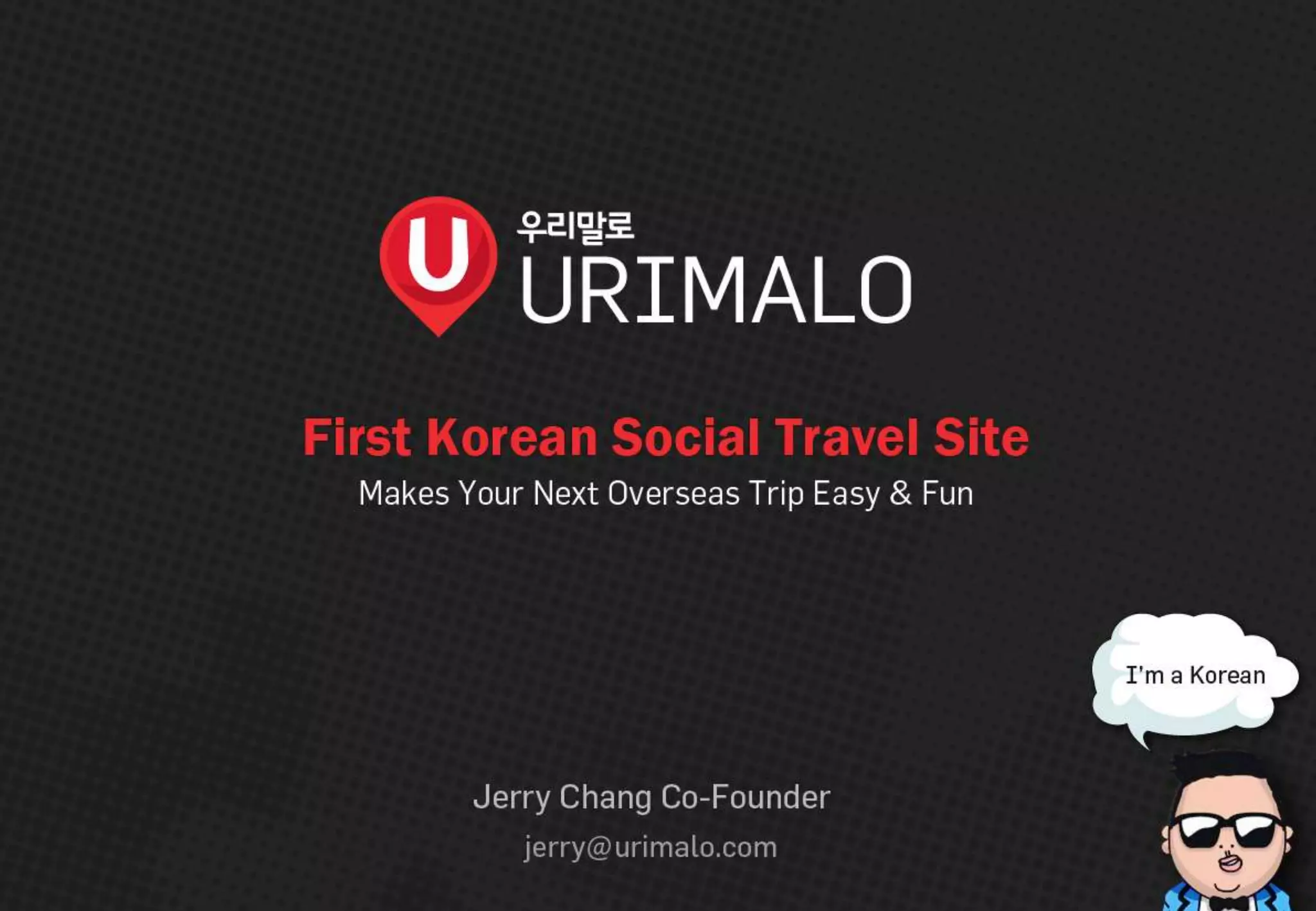
Urimalo presented at SydStart 2013 with a 10-slide deck focused on the South Korean overseas travel market. The company identified a specific friction point: while 14 million Koreans traveled overseas annually at the time, only 5% were 'DIY' travelers due to a lack of localized, trusted information on major Korean portals like Naver. Urimalo proposed a social travel site connecting travelers with 7 million Koreans living overseas for 'trusted advice.' The deck outlines a community marketplace model, targeting a $3.78 million annual revenue goal by capturing 3% of an $800 million addressable m…
Key takeaways
- The deck identifies a massive search dominance by Naver in South Korea, which accounts for the majority of search traffic but lacks quality travel Q&A (Slide 2, 3).
- South Korea's travel market in 2013 consisted of 14 million overseas travelers, but only 5% were DIY, representing a significant growth opportunity (Slide 2).
- The core value proposition is 'Trusted Advice' facilitated by connecting travelers with the 7 million Koreans living abroad (Slide 4).
- The product includes a map-based interface for both desktop and mobile, integrating rich imagery from Instagram and Foursquare (Slide 5, 6).
- Urimalo proposes a 'Community Market Place' where users can purchase specialized travel experiences, such as a '$20 Sydney in Gangnam Style' tour (Slide 7).
- The company estimates its addressable market at $800 million per year, based on a $60 spend per person (Slide 8).
- The revenue target is $3.78 million per year, which represents a 3% market share capture (Slide 8).
- The team slide highlights previous success with 'native signal,' claiming 50K+ downloads, and lists two angel investors: Adrian Bunter and Philip Argy (Slide 9).
Urimalo Pitch Deck Analysis: The Social Travel Bridge
The Urimalo pitch deck, presented at SydStart 2013, is a fascinating artifact of a specific era in tech. It leans heavily into the global cultural phenomenon of 'Gangnam Style' to explain its brand identity and market positioning. While the aesthetic is playful and cartoonish, the underlying business case addresses a very real problem: the linguistic and cultural isolation of the South Korean internet ecosystem.
Slide 1: Title and Branding
The cover slide introduces Urimalo as the 'First Korean Social Travel Site.' It features Co-Founder Jerry Chang and a cartoon avatar reminiscent of Psy. The tagline, 'Makes Your Next Overseas Trip Easy & Fun,' sets a broad consumer-facing tone. The logo uses a location pin with a 'U,' signaling a map-based or destination-focused service.
Slide 2: (South) Korean Facts
This slide establishes the market context. It highlights a population of 50 million with 14 million overseas travelers. Crucially, it notes that while Naver and Daum dominate the search engine market (leaving Google with a small sliver), only 5% of trips are 'DIY.' This 5% is described as 'growing fast,' which is the core thesis of the investment opportunity: the transition from group tours to independent social travel.
Slide 3: The Problem Space
Urimalo quantifies the demand on Naver: 500,000 searches and 30,000 Q&A entries per month. However, the slide uses illustrations to show that these results are often untrustworthy (represented by a masked character) or lead to outdated 'bus tours' rather than the 'Gangnam style' trips modern travelers want. The 'BUT!!!' in large red text emphasizes the gap between high search volume and low-quality results.
Slide 4: The Solution - Trusted Advice
The solution is a social loop. By connecting the 14 million travelers with the 7 million Koreans living overseas, Urimalo creates a network of 'Friends & Experts.' The slide emphasizes 'Trusted Advice' as the primary product. This is a classic marketplace play: leveraging an underutilized asset (local knowledge of expats) to serve a high-intent audience (travelers).
Slide 5: Product Interface
This slide provides a visual of the platform across desktop and mobile (iPhone). The interface is heavily map-centric, showing a high density of pins around Sydney, Australia. The sidebar shows a list of locations with star ratings and photos, indicating a review-and-recommendation engine tailored for Korean users.
Slide 6: Integration and Rich Media
Under the heading 'And more,' Urimalo shows integrations with Instagram and Foursquare. The slide promises 'Rich imagery' and 'More places.' The use of external APIs suggests that Urimalo acts as a curated layer on top of global data, translating and filtering it for the Korean market.
Slide 7: Community Market Place
This is the monetization slide. It depicts a peer-to-peer marketplace where a 'horse-headed' guide (another Gangnam Style reference) offers a '$20 Sydney in Gangnam Style' experience to travelers. This confirms that Urimalo is not just an information site but a transactional platform for local tours and activities.
Slide 8: Market Opportunity and Scaling
The financial projections are presented here. The market size is estimated at $800 million per year, calculated at $60 per person. Urimalo sets a 'Revenue Target' of $3.78 million per year, which they equate to capturing 3% of the addressable market. The bottom of the slide makes a bold, unsubstantiated claim that the technology is 'built to scale to Chinese market,' visualized by a pyramid of Korean flags becoming a Chinese flag.
Slide 9: The Team
The team is presented as Lego-style avatars with real faces superimposed. Jerry Chang (Co-Founder & Managing Director) is joined by Ken You (Software development leader), Jay Jung (Web developer), and Wesley Song (Web designer). The slide also lists two Angel Investors, Adrian Bunter and Philip Argy, and mentions a previous project, 'native signal,' with 50K+ downloads to establish credibility.
Slide 10: Conclusion
The final slide reiterates the 'Urimalo Style' and provides contact information for Jerry Chang. It maintains the cartoon aesthetic to the end, reinforcing the 'Easy and Fun' brand promise.
What Works in This Deck
Specific Market Insight: The deck does an excellent job of explaining the 'Naver problem.' For investors outside of Korea, understanding that the dominant search engine provides poor travel data is a crucial 'why now' and 'why this' factor. By citing the 500k monthly searches, they prove demand exists but is being poorly served.
Supply-Side Identification: Identifying the 7 million overseas Koreans as a pre-built supply of 'experts' is a clever way to solve the cold-start problem of a new social network. It gives the platform immediate utility if they can successfully onboard even a fraction of that diaspora.
Visual Consistency: While the 'Gangnam Style' theme is dated now, in 2013, it was a powerful shorthand for 'Modern Korean Culture.' The deck uses this to create a memorable, high-energy brand identity that stands out from typical corporate travel pitches.
What is Missing
The Ask: The most significant omission is the lack of a funding request. We do not know how much capital Urimalo was seeking or what milestones that capital would achieve. This is a critical failure for a pitch deck intended for fundraising.
Unit Economics: While the deck mentions a $3.78 million revenue target, it doesn't explain how they get there. What is the take rate on the $20 tours? What is the cost to acquire a traveler (CAC)? Without these numbers, the revenue target is just an arbitrary goal.
Go-To-Market Strategy: The deck explains what they are building but not how they will get users. How do they reach the 14 million travelers? Is it through SEO, partnerships, or paid social? The 'scale to China' claim is also left entirely unexplained, which usually raises red flags for investors regarding focus.
Founder's Playbook: What to Copy
Leverage Local Monopolies: If you are building for a market dominated by a specific player (like Naver, Baidu, or even a specific vertical incumbent), use their search volume to prove your market size. Urimalo successfully turned Naver's dominance into a proof point for their own necessity.
Identify Your 'Unfair' Supply: Every marketplace needs a supply side. Urimalo's use of the Korean diaspora is a great example of identifying a specific group of people who have the information travelers need and a cultural incentive to provide it. Look for similar 'hidden' supply chains in your own industry.
Show, Don't Just Tell, the Product: Slide 5 is effective because it shows the product on both desktop and mobile. Even if these were just mockups at the time, they give the investor a concrete sense of the user experience and the data density of the platform.
Final Thoughts
The Urimalo deck is a high-personality pitch that captures the spirit of the 2013 Australian/Korean startup bridge. It identifies a legitimate market gap created by language barriers and localized search algorithms. However, as a fundraising tool, it is incomplete. It functions better as a 'vision deck' to generate interest rather than a 'transactional deck' to close a round, primarily due to the missing financial specifics and the lack of a clear investment ask. For modern founders, the lesson is to balance brand personality with the hard data that professional investors require to assess risk and scalability.
Frequently asked questions
- What is the primary problem Urimalo is trying to solve?
- Urimalo targets the inefficiency of travel planning for South Koreans. Slide 3 points out that while Naver sees 500,000 travel searches and 30,000 Q&A queries monthly, the results are often untrustworthy or lack the 'Gangnam style' (modern/trendy) appeal. The deck suggests that current options are limited to rigid bus tours rather than personalized, social experiences.
- How does Urimalo plan to monetize its platform?
- The deck introduces a 'Community Market Place' on Slide 7. This suggests a peer-to-peer model where local experts or Koreans living overseas can sell specific itineraries or guided experiences. The example provided is a $20 tour. Slide 8 calculates revenue based on a $60 per person annual spend within their addressable market.
- What is the significance of the '7m Koreans living overseas' mentioned in the deck?
- This is Urimalo's primary supply-side advantage. Slide 4 illustrates that these 7 million expatriates act as the source of 'Trusted Advice' for the 14 million annual travelers from the mainland. By leveraging this diaspora, Urimalo aims to provide localized expertise that generic search engines or global platforms like TripAdvisor (referenced by logo on Slide 2) might lack for this specific demographic.
- Does the deck provide any evidence of technical capability?
- Slide 9 mentions that the team has previously achieved over 50,000 downloads for a project called 'native signal.' Additionally, Slide 8 claims their technology is 'built to scale to the Chinese market,' implying a modular or multi-language architecture, though no specific technical details or backend infrastructure are described in the slides.
- What are the biggest missing elements in this pitch deck?
- The deck is missing three critical components for a professional fundraise: a clear 'Ask' (how much money they need), a 'Use of Funds' breakdown, and detailed unit economics (CAC/LTV). It also lacks a competitive landscape analysis beyond a brief mention of Naver and Daum, and provides no timeline or roadmap for the 'scale to China' claim.