Vintage Wine Estates (VWE) presents a compelling case for industry consolidation in the premium wine sector. The deck, used for their 2021 SPAC merger with Bespoke Capital Acquisition Corp (BCAC), centers on a 'buy-and-build' philosophy, citing 20+ successfully integrated acquisitions since 2010 (Slide 7). VWE differentiates itself through a balanced revenue mix: 41% Wholesale, 30% Direct-to-Consumer, and 29% B2B (Slide 13). The financial narrative is one of aggressive growth, projecting a 17.5% Net Revenue CAGR through 2023 (Slide 33). By focusing 99% of its volume on the >$10 premium price…
Key takeaways
- VWE has executed 20+ acquisitions since 2010, totaling over $250 million in transaction value (Slide 7).
- The business model is highly diversified across three channels: Wholesale (41%), DTC (30%), and B2B (29%) (Slide 13).
- The company focuses almost exclusively (99%) on the premium wine segment, defined as bottles priced above $10 (Slide 15).
- VWE leverages a massive asset base including approximately $400 million in inventory and fixed assets to secure low-cost capital (Slide 35).
- The Direct-to-Consumer segment includes 19 different wine clubs with over 36,000 members as of June 2020 (Slide 17).
- Strategic expansion into category adjacencies includes hard seltzer, hard cider, and cannabis-infused beverages (Slide 21).
- Financial projections estimate Adjusted EBITDA will grow at a 42.7% CAGR from FY 2020A to FY 2023E (Slide 33).
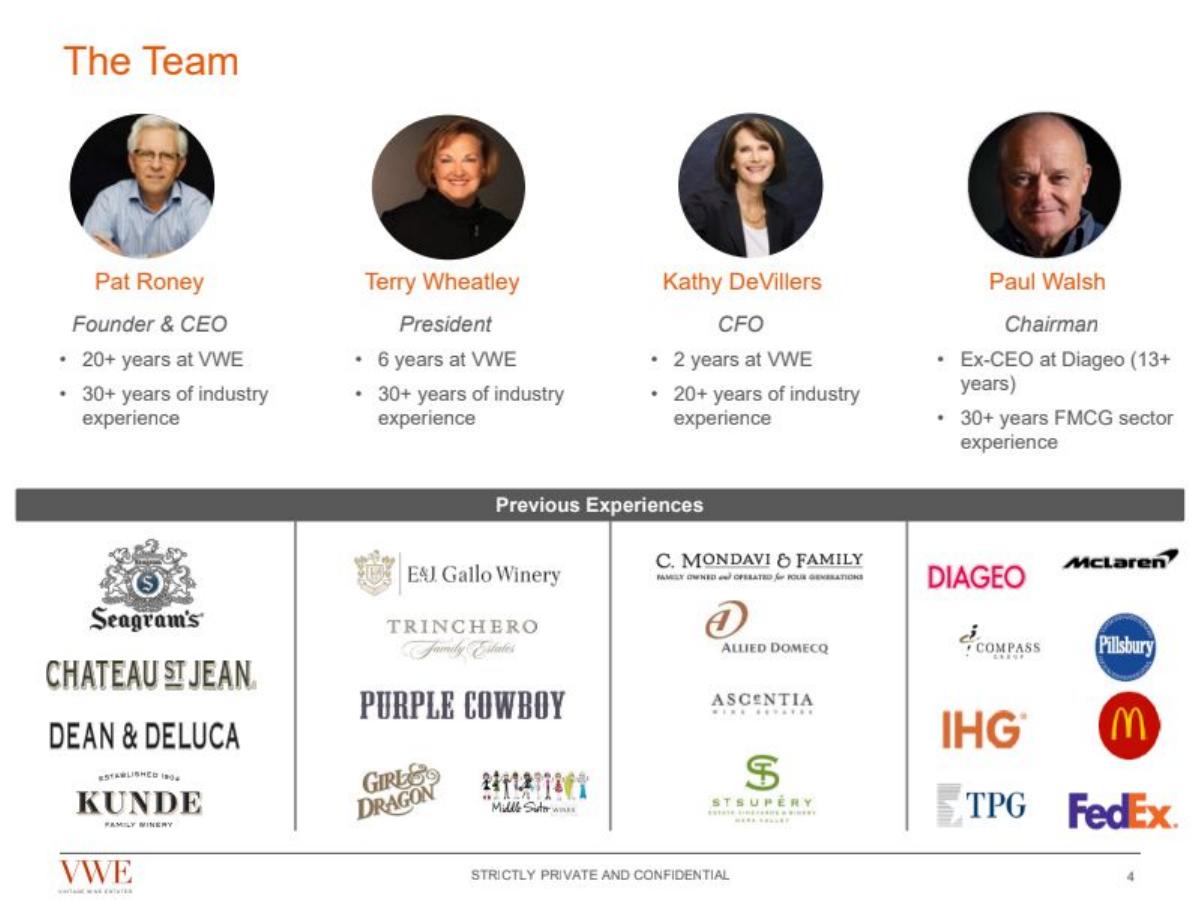
- The partnership with BCAC adds Paul Walsh, former CEO of Diageo, as Executive Chairman to drive M&A and governance (Slide 9).
The Strategy of a Serial Consolidator
The Vintage Wine Estates (VWE) pitch deck is a comprehensive 45-slide document designed for a sophisticated institutional audience. As a SPAC investor presentation, it moves beyond the typical 'problem/solution' framework of a seed-stage deck and focuses heavily on financial engineering, operational scale, and M&A execution . The narrative is clear: VWE is a platform company built to roll up a fragmented industry.
Introduction and Investment Thesis
Slide 7 sets the stage by answering 'Why Vintage Wine Estates?' with six pillars. The most striking figures are the 21% Net Revenue CAGR and 24% Adjusted EBITDA CAGR since 2010. They also emphasize their 'well-invested' nature, citing a $400 million asset base in inventory and fixed assets. This is a crucial point for investors; it suggests the company has 'hard' value backing its equity.
Slide 9 introduces the 'BCAC Value Add.' In SPAC deals, the quality of the sponsor is paramount. VWE highlights Paul Walsh, the former CEO of Diageo, noting his role in creating $80 billion in shareholder value. This slide is intended to de-risk the management transition from a private family-owned business to a public entity by showing 'best-in-class oversight.'
Business Overview: A Three-Pronged Revenue Model
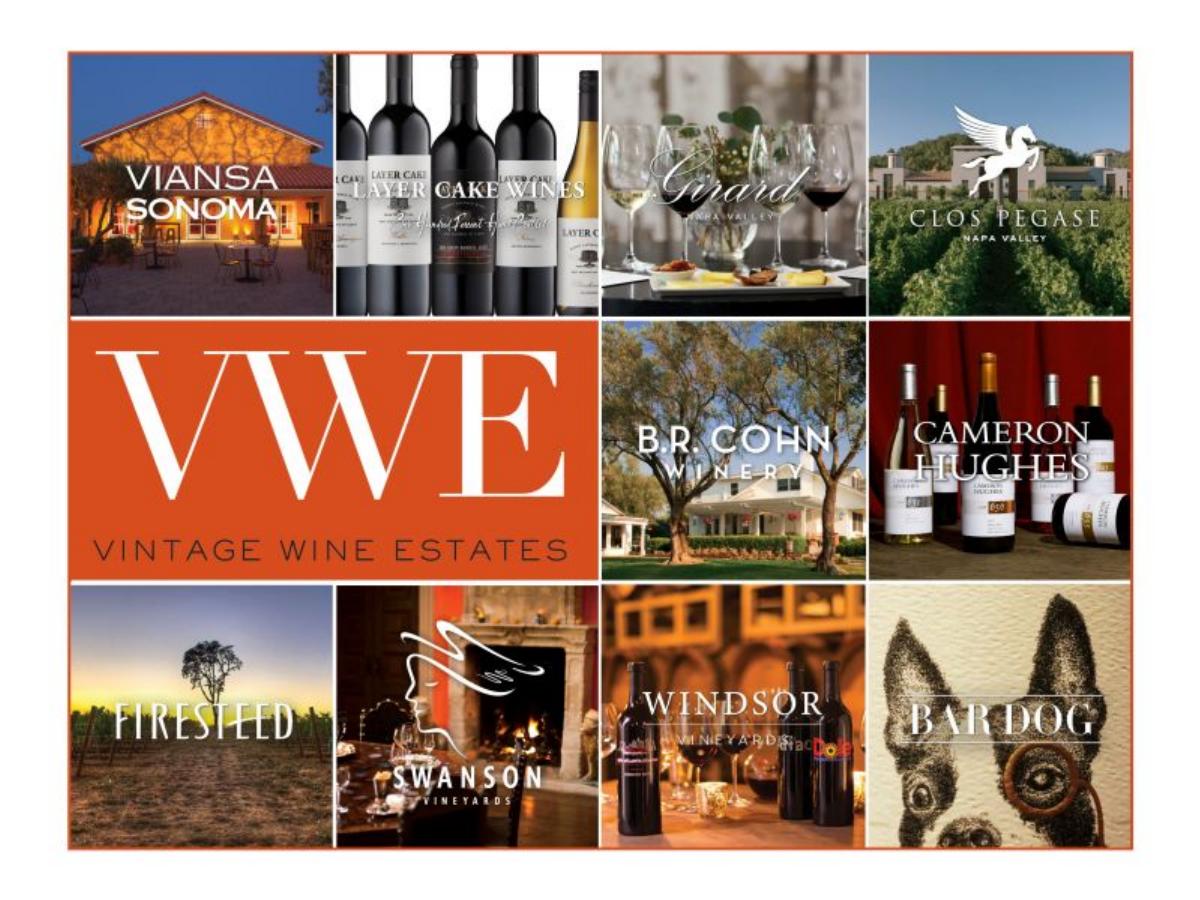
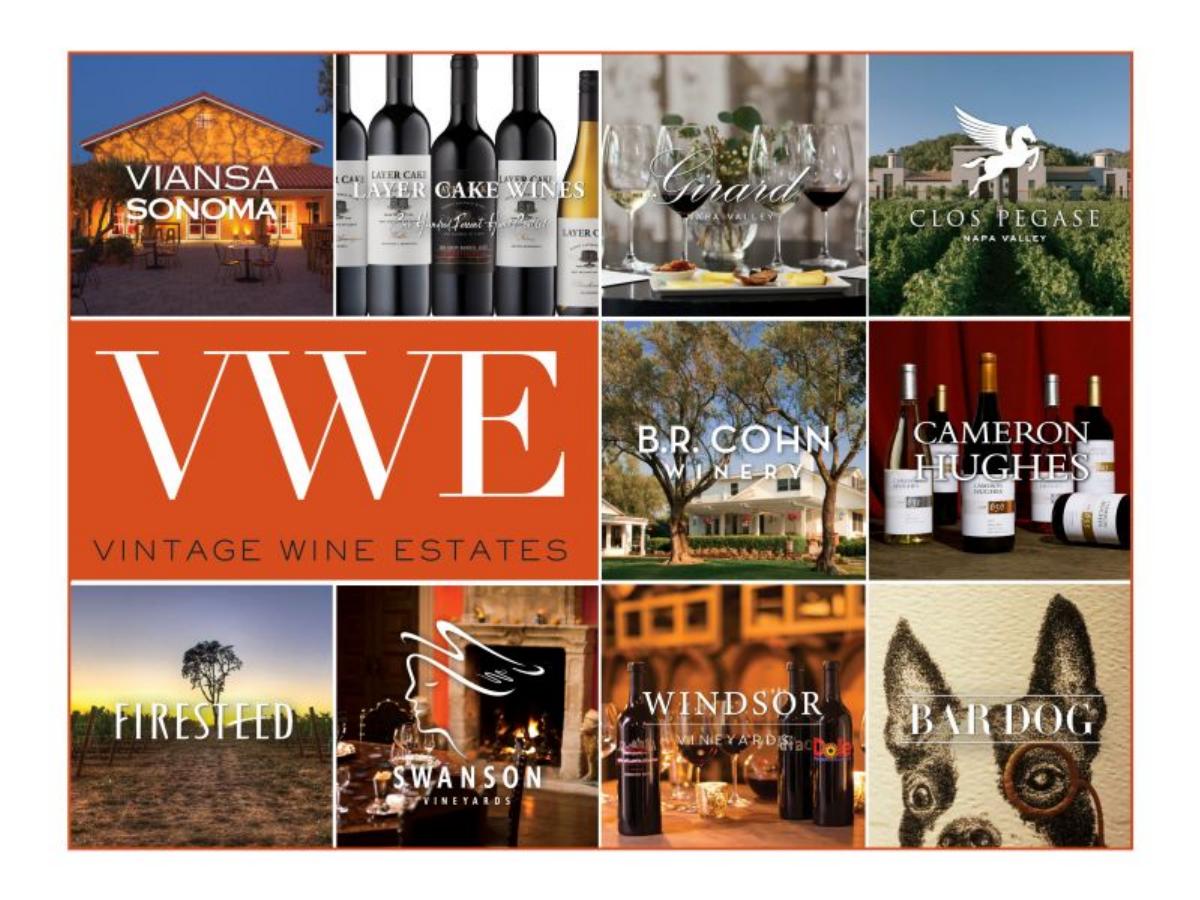
Slide 11 provides a visual timeline of the company’s 'Proven and Successful Track-Record.' It maps out acquisitions from Girard in 2000 through to Kunde in 2021. This isn't just a list; it’s a demonstration of a repeatable process. They show they can acquire legacy brands (B.R. Cohn), digital-first brands (Cameron Hughes), and production assets (Ray’s Station).
Slide 13 is perhaps the most important operational slide in the deck. It breaks down revenue into three nearly equal parts: Wholesale (41%), Direct-to-Consumer (30%), and B2B (29%) . Most wine companies are heavily weighted toward wholesale, which leaves them at the mercy of distributors. VWE’s 30% DTC contribution—fueled by 19 wine clubs and 36,000 members (Slide 17)—represents a high-margin, data-rich segment that investors prize.
Market Positioning and the Premium Pivot
Slide 15 defines the company’s market focus. They target the '$10 - $20 Premium Price Point,' noting that 99% of their case volume is in the >$10 segment. The data shows that while the 'Non-Premium' ( Slide 19 uses a 'wheel' graphic to show their distribution reach. It lists massive national accounts like Costco, Target, Kroger, and Safeway. The 'Significant Whitespace Opportunity' highlighted on the left of the wheel suggests that despite their current scale, they have only scratched the surface of national retail penetration.
Innovation and Category Adjacencies
Slide 21 addresses the future of the beverage industry. VWE isn't staying strictly within traditional wine. They showcase 'Doll Face' Hard Seltzer, 'Self' Hard Cider, and even a cannabis-infused beverage ('if you see kay'). By citing that California-only cannabis beverages are growing at 87%, they signal to investors that they are prepared for secular shifts in consumption habits beyond the vineyard.
Financial Performance and Projections
Slide 33 delivers the 'hockey stick' projections required of a public listing. They project Net Revenue to grow from $190 million (FY 2020A) to $308 million (FY 2023E). Crucially, they split these bars into 'Standalone' and 'Acquisitions,' showing that while organic growth is steady, the real leap comes from their M&A pipeline. The Adjusted EBITDA margin expansion from 14.5% to 25.9% is the core of the value creation story—it assumes that as they scale, they can strip out redundant costs from acquired wineries.
Slide 35 reinforces the balance sheet strength. With $190 million in appraised estate wineries/equipment and $200 million in book-value inventory, they claim the capacity for $1 billion+ in future acquisitions . This slide transforms the company from a wine producer into a well-capitalized financial vehicle.
Valuation Benchmarking
Slide 39 is the 'ask' in a public context. They compare their 14.9x - 16.3x EBITDA multiple against peers like Duckhorn (23.3x) and Boston Beer (22.0x). By showing a significant discount to the median, they are telling investors that VWE is 'on sale' relative to its growth profile. This is a classic SPAC tactic to encourage early investment before the 'pop' in share price.
What Vintage Wine Estates Does Well
Asset-Backed Narrative: Unlike tech startups, VWE anchors its valuation in $400 million of tangible assets. This provides a 'floor' for investor risk. · Omni-channel Proof: They don't just say they are diversified; they prove it with a 41/30/29 revenue split. This protects the business against shocks in any single channel (like restaurant closures during COVID-19). · M&A as a Core Competency: The timeline on Slide 11 and the case studies on Slide 29 demonstrate that they aren't just buying brands; they are improving them (e.g., increasing DTC focus for Kunde, discontinuing unprofitable wholesale for Cameron Hughes).
What is Missing from the Deck
Climate Risk: For a company with $190 million in California real estate and equipment, there is no mention of wildfire risk, water scarcity, or climate change mitigation strategies—factors that are increasingly relevant to ESG-conscious institutional investors. · Unit Economics by Brand: While they show aggregate margins, they don't disclose the unit economics of their 'Power Brands' versus their 'Lifestyle Brands.' This makes it hard to see which parts of the portfolio are truly driving the 45.1% projected gross margin. · Detailed Team Slide: While they highlight the BCAC chairman and mention '60+ years' of combined experience for the CEO and President (Slide 7), the deck lacks a traditional team slide showing the deep bench of operational talent required to manage 20+ disparate brands.
What Founders Should Copy
The 'Whitespace' Visual: Slide 19 is an excellent way to show market penetration. By putting your current customers in a circle and highlighting the empty 'wedge,' you visually communicate growth potential without needing a wall of text. · Acquisition Case Studies: If your business model involves M&A or partnerships, Slide 29 is a perfect template. It shows the 'Before' (Acquisition Date) and the 'After' (Value Creation Strategy/ROIC), proving that your strategy actually works. · Clear Benchmarking: Slide 39 shows how to handle valuation. Don't just pick one peer group; pick two (direct competitors and 'aspirational' high-growth companies) to bracket your valuation and make your 'ask' seem reasonable.
Frequently asked questions
- What is the core investment thesis for Vintage Wine Estates?
- The thesis rests on VWE acting as a primary consolidator in a fragmented market. They combine a proven M&A track record (20+ deals) with a diversified revenue model that isn't reliant on a single sales channel. By focusing on the high-growth 'premium' segment ($10-$20+ per bottle), they capture better margins than value-brand competitors while using their $400 million asset base to fuel further acquisitions.
- How does VWE handle its Direct-to-Consumer (DTC) sales?
- DTC accounts for 30% of net revenue and is a major growth engine. According to Slide 17, this includes 19 wine clubs with 36,000+ members, tasting rooms, and unique channels like QVC and telemarketing. They also own Cameron Hughes, which they claim is the largest e-commerce-only wine brand in the world, providing a robust digital-first footprint.
- What role does the SPAC sponsor (BCAC) play in the company?
- BCAC provides more than just capital; they provide institutional 'CPG' expertise. Slide 9 highlights Paul Walsh, the Executive Chairman of BCAC and former CEO of Diageo, who is credited with creating $80 billion in shareholder value. His involvement is intended to 'vault' VWE into the upper tier of U.S. vintners through his deep industry relationships and M&A expertise.
- What are the company's financial growth targets?
- VWE is aggressive in its projections. Slide 33 shows a target Net Revenue CAGR of 17.5%, moving from $190 million in FY 2020A to $308 million by FY 2023E. More significantly, they expect Adjusted EBITDA margins to expand from 14.5% to 25.9% in the same period, driven by acquisition synergies and a shift toward higher-margin DTC and private label channels.
- How does VWE compare itself to other public companies?
- VWE uses two peer groups for benchmarking: 'U.S. Growth Alcohol' (e.g., Boston Beer, Duckhorn) and 'High Growth Consumer Captains' (e.g., Fever-Tree, Monster). On Slide 39, they argue their valuation is attractive, showing a 2022E EBITDA multiple of 14.9x-16.3x, which is a significant discount compared to the peer medians of 22.0x and 22.2x.