Candidate.fyi secured $1.3M in Seed funding in 2024 by positioning itself as the 'hiring experience platform.' The deck focuses on a specific market shift: the transition of candidate priorities from 'possessions' to 'experiences.' By showcasing a high-fidelity candidate portal and listing notable early customers like Thrive Market and Synthesia, the founders demonstrated immediate market pull. The narrative centers on the failure of existing HR tools (ATS, CRM) to serve the candidate, proposing instead an 'intelligent layer' that sits between the interview and onboarding phases. While the de…
Key takeaways
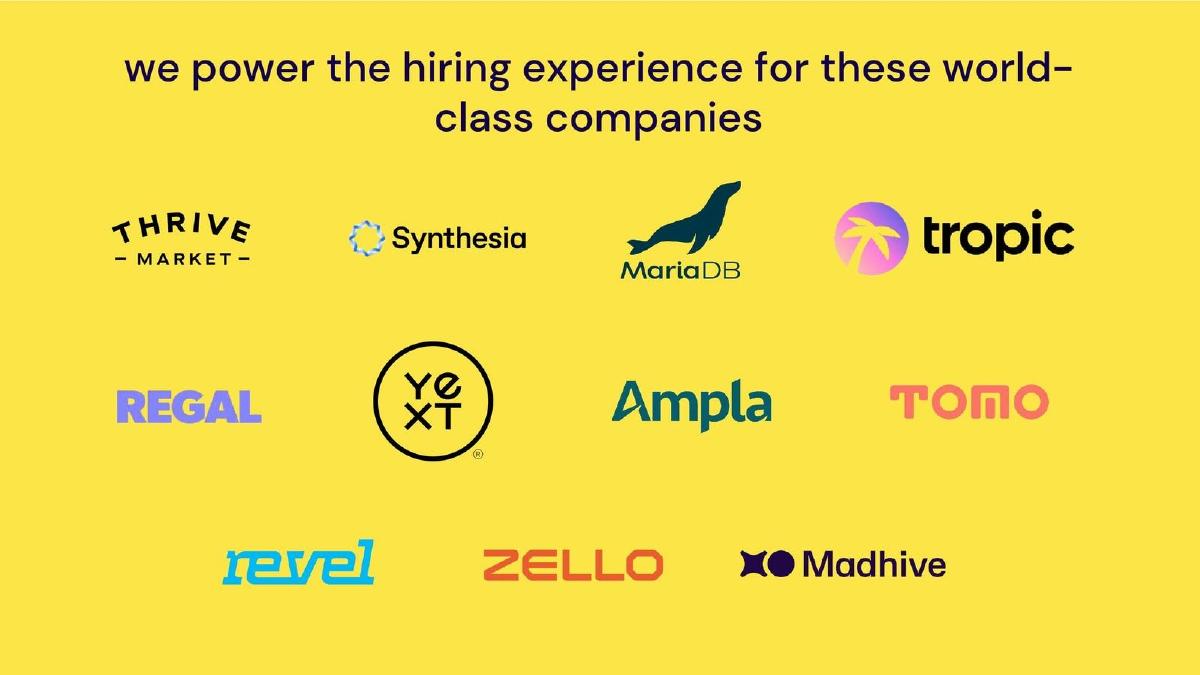
- The deck leads with significant social proof, listing 11 'world-class' customers including MariaDB and Yext on Slide 2.
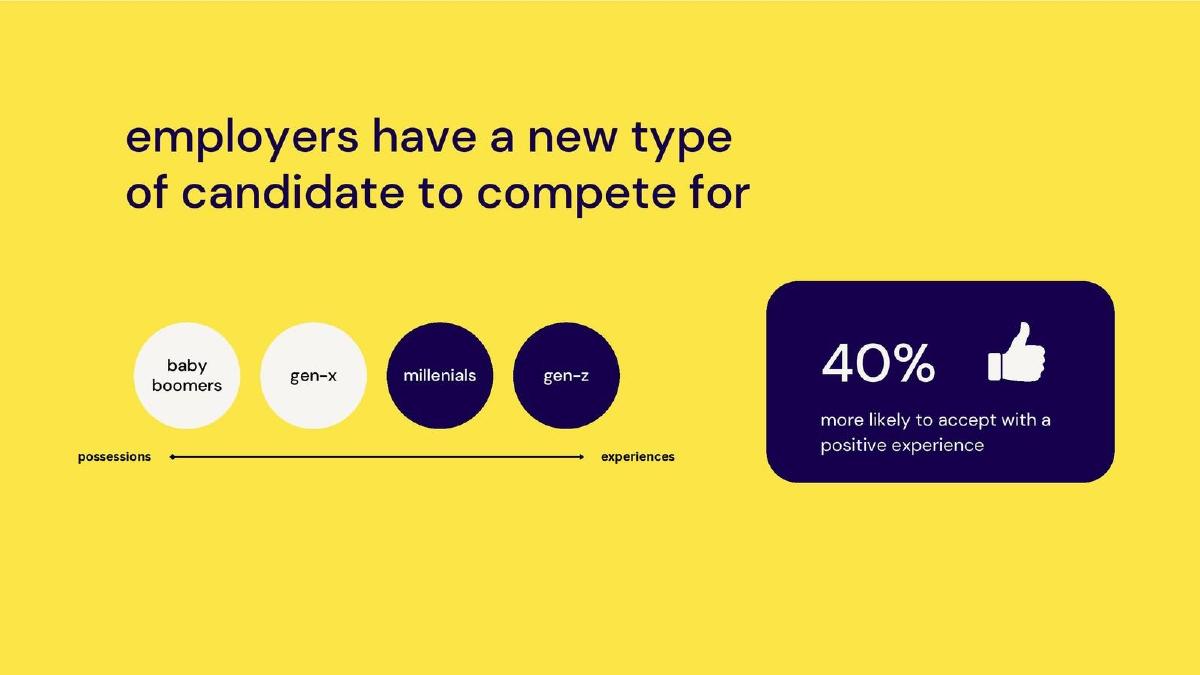
- A core psychological argument on Slide 3 claims candidates are 40% more likely to accept an offer with a positive experience.
- The problem is framed as a design failure, where existing tools like ATS and CRM are built for recruiters, not candidates (Slide 4).
- Product visualization is central, with Slide 5 detailing a 'candidate portal' featuring HR integrations and a 'Pulse Engine' for feedback.
- The company defines its market position as an 'intelligent layer' that bridges the gap between candidate and employee status (Slide 6).
- The deck lacks a formal 'Ask' slide or a breakdown of how the $1.3M in reported funding will be allocated.
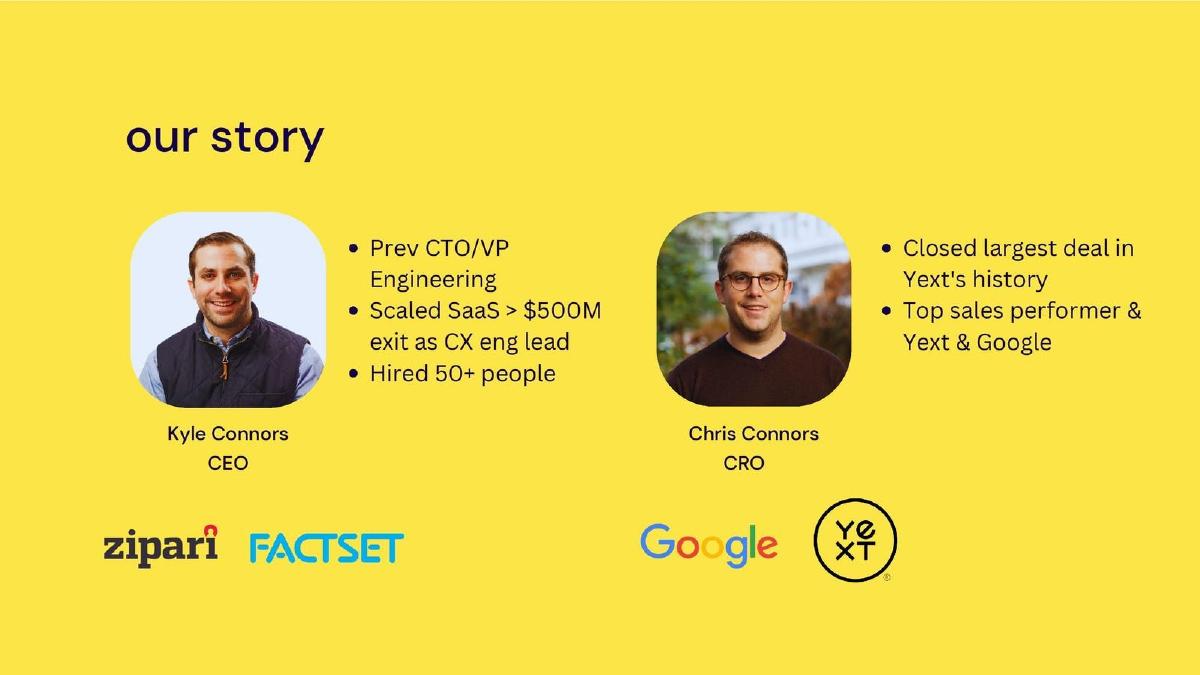
- There is no dedicated team slide in the provided sequence, omitting founder backgrounds and expertise.
- Financial projections and specific pricing models are entirely absent from the 12-slide presentation.
Introduction: The Experience Economy Hits HR
Candidate.fyi operates in a crowded HR technology market, but its Seed deck, which facilitated a reported $1.3M raise in 2024, takes a narrow and highly focused approach. Rather than attempting to replace the Applicant Tracking System (ATS), the company positions itself as a specialized layer designed to fix the 'candidate black hole.' The deck is visually driven, utilizing a high-contrast yellow and purple color palette and minimal text to convey a shift in candidate expectations.
Slide 1: Title and Branding
The deck opens with a simple title slide: 'candidate.fyi: the hiring experience platform.' The branding is modern and clean, establishing the company's identity immediately. There are no taglines about AI or revolutionary tech here; the focus is strictly on the 'hiring experience,' which sets the stage for the psychological argument that follows.
Slide 2: Social Proof and Early Traction
Unusually, the second slide is a 'logo wall.' It features 11 companies, including Thrive Market , Synthesia , MariaDB , Tropic , Regal , Yext , Ampla , Tomo , Revel , Zello , and Madhive . By placing this slide immediately after the title, the founders are signaling that their solution is already validated by 'world-class companies.' This is a high-conviction move that tells investors the product is already in the wild and generating utility for recognizable brands.
Slide 3: The Psychological Shift
Slide 3 attempts to define the 'Why Now?' by looking at generational shifts. It features a spectrum moving from 'possessions' to 'experiences,' placing Baby Boomers and Gen-X on the left and Millennials and Gen-Z on the right. The core metric presented is that candidates are 40% more likely to accept a position when they have a positive experience. This slide frames the product not as a 'nice-to-have' HR tool, but as a critical conversion tool for talent acquisition in a competitive market.
Slide 4: The Design Gap
This slide illustrates the 'Problem.' On the left, a recruiter is shown surrounded by tools: ATS, CRM, Sourcing, Assess, and Screening. The text notes these are 'existing tools not designed for the candidate.' On the right, a candidate is shown looking confused, surrounded by icons for emails and phone calls. This visualizes the fragmentation of the current hiring process, where the candidate is the last person to know what is happening, despite being the most important actor in the transaction.
Slide 5: The Solution (Candidate Portal)
Slide 5 is the 'How it Works' slide. It features a mockup of a MacBook Air displaying the 'candidate portal.' The portal is shown to be a branded experience (using the Tropic logo as an example) that includes:
Meet the Team: Profiles of interviewers like 'Sarah James.' · Hiring Timeline: A visual progress bar showing stages from 'Intro Call' to 'Offer.' · Interview Details: Specific times, dates, and integrated Zoom links. · Pulse Engine: A feedback widget asking 'Tell us about your experience in the Intro Call.'
The slide also notes that this system is powered by an 'Employer CMS' and 'HR Integrations,' suggesting it sits on top of existing workflows rather than requiring a total rip-and-replace of the ATS.
Slide 6: The Intelligent Layer and Moat
The final slide in the provided sequence defines the business strategy. It describes Candidate.fyi as 'owning a new, intelligent layer.' The slide breaks down the value into three pillars:
Unlocking new value: By owning the engagement touchpoint, they claim to impact 'quality of hire' and 'early stage attrition.' · Intelligence creates moat: The system supposedly gets smarter with every candidate, creating 'higher lock-in.' · Selling opportunities: The company plans to drive up ACVs (Annual Contract Values) by moving deeper into the 'onramp' with additional engagement modules.
A diagram shows the transition from 'Candidate' to 'Employee,' with the platform covering the gap between 'Interview,' 'Offer,' 'Preboard,' and 'Onboard.'
What Works in the Candidate.fyi Deck
Immediate Credibility: Leading with a logo wall of 11 mid-market and enterprise companies is a powerful way to bypass the 'does this work?' question. For a Seed round, this level of social proof is significant and suggests the founders have strong sales execution or a product that solves a very painful, immediate problem.
Narrow Focus: The deck does not try to be an all-in-one HRIS. It identifies a specific gap—the candidate's view of the process—and stays focused on that. This makes the value proposition easy for an investor to categorize and understand.
Visual Storytelling: The contrast between the 'Recruiter with tools' and the 'Confused Candidate' on Slide 4 is an effective way to illustrate a service gap. It turns an abstract workflow problem into a relatable human experience problem.
What is Missing from the Candidate.fyi Deck
The Team: There is no team slide in the provided 12-slide sequence. In a Seed round, the 'who' is often as important as the 'what.' Without knowing if the founders come from HR tech, engineering, or sales, an investor cannot assess the team's ability to scale this 'intelligent layer.'
Unit Economics and Financials: The deck mentions 'driving up ACVs' but provides no data on what current ACVs look like, what the pricing model is (per seat, per hire, or flat SaaS fee), or what the revenue growth has looked like since the customers on Slide 2 were onboarded.
Competitive Landscape: The HR tech space is notoriously crowded. While the deck argues that ATS and CRM tools aren't candidate-focused, many modern ATS platforms (like Greenhouse or Lever) are increasingly adding candidate experience features. The deck fails to address how Candidate.fyi maintains its 'moat' if an ATS decides to build a better native portal.
The Ask: While Business Insider reports a $1.3M raise, the deck itself does not state the funding goal, the valuation target, or the specific milestones the team intends to hit with the capital. This is a standard omission in 'public' versions of decks, but its absence in a teardown highlights a lack of transparency regarding the deal's mechanics.
Founder Takeaways: What to Copy
Quantify the Soft Value: If you are building a product that improves 'experience' or 'culture,' you must find a hard metric to attach it to. Candidate.fyi uses the '40% more likely to accept' figure (Slide 3). This turns a 'nice-to-have' experience into a 'must-have' ROI calculation for a Head of Talent.
Show, Don't Just Tell: The product slide (Slide 5) is excellent because it doesn't just list features; it shows a high-fidelity mockup that looks ready for enterprise deployment. It makes the 'intelligent layer' feel tangible.
Map the Journey: Slide 6 is a great example of how to show market expansion. By mapping the journey from 'Interview' to 'Onboard,' the founders show that while they are starting with a portal, their roadmap leads them toward becoming an onboarding and retention tool, which significantly increases their Total Addressable Market (TAM).
Focus on the Integration: By explicitly mentioning 'HR Integrations' on Slide 5, the founders proactively answer the technical hurdle question. They aren't asking recruiters to do more work; they are promising to automate the extraction of data from the tools the recruiters already use.
Frequently asked questions
- What is the primary problem Candidate.fyi is solving?
- According to Slide 4, the problem is that existing HR tools—such as Applicant Tracking Systems (ATS), CRMs, and screening tools—are designed for the employer's internal workflow rather than the candidate's experience. This creates a confusing and disconnected journey for the applicant, represented by a 'confused candidate' graphic surrounded by fragmented communication channels like email and phone calls.
- How does the product actually function for the end-user?
- Slide 5 illustrates the 'candidate portal,' which serves as a centralized hub for job seekers. It includes a 'Meet the Team' section, a visual hiring timeline, interview schedules with Zoom links, and a 'Pulse Engine' that collects real-time feedback after calls. The platform pulls data from an 'Employer CMS' and various 'HR Integrations' to keep the candidate informed throughout the process.
- What is the stated business impact of a better candidate experience?
- The deck quantifies the value on Slide 3, stating that candidates are 40% more likely to accept a job offer if they have a positive experience. Furthermore, Slide 6 suggests that by owning this 'engagement touchpoint,' the company can impact high-level business metrics such as quality of hire and early-stage attrition.
- What is the company's long-term competitive advantage?
- On Slide 6, Candidate.fyi claims that 'intelligence creates a moat.' The platform aims to get smarter with each candidate that passes through the system, creating higher lock-in for the employer. By positioning itself as an 'intelligent layer' between the interview and onboarding stages, they intend to become an essential piece of the HR tech stack that traditional systems of record cannot easily replicate.
- What key information is missing from this pitch deck?
- The deck is notably missing several standard venture components. There is no team slide to establish founder credibility, no competition slide to explain the landscape, and no financial slide detailing current revenue or growth projections. Additionally, the specific 'Ask' (the amount being raised and the terms) is not included in the slides, despite the reported $1.3M raise.