CampAssist is a social mobile app platform designed to connect students across universities and link them with potential employers. The deck identifies key pain points for students, such as limited budgets and a lack of career direction, and proposes a solution that includes mentorship, peer collaboration, and job opportunities. With a target market of 177 universities and over 5.2 million students in Pakistan, CampAssist demonstrates early traction through a 4,400+ member Facebook community and winning the Red Bull Basement University 2019 competition. The business model is diverse, featurin…
Key takeaways
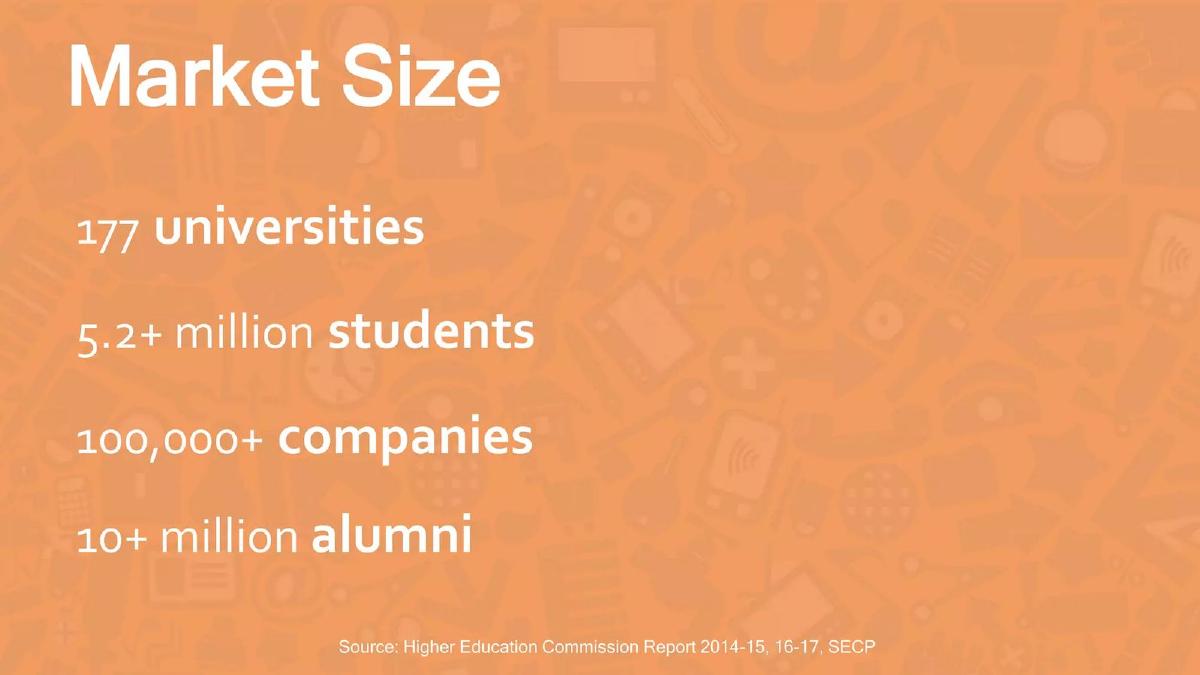
- The platform targets a market of 177 universities and 5.2+ million students in Pakistan (Slide 4).
- CampAssist won the Red Bull Basement University 2019 competition, providing significant early validation (Slide 7).
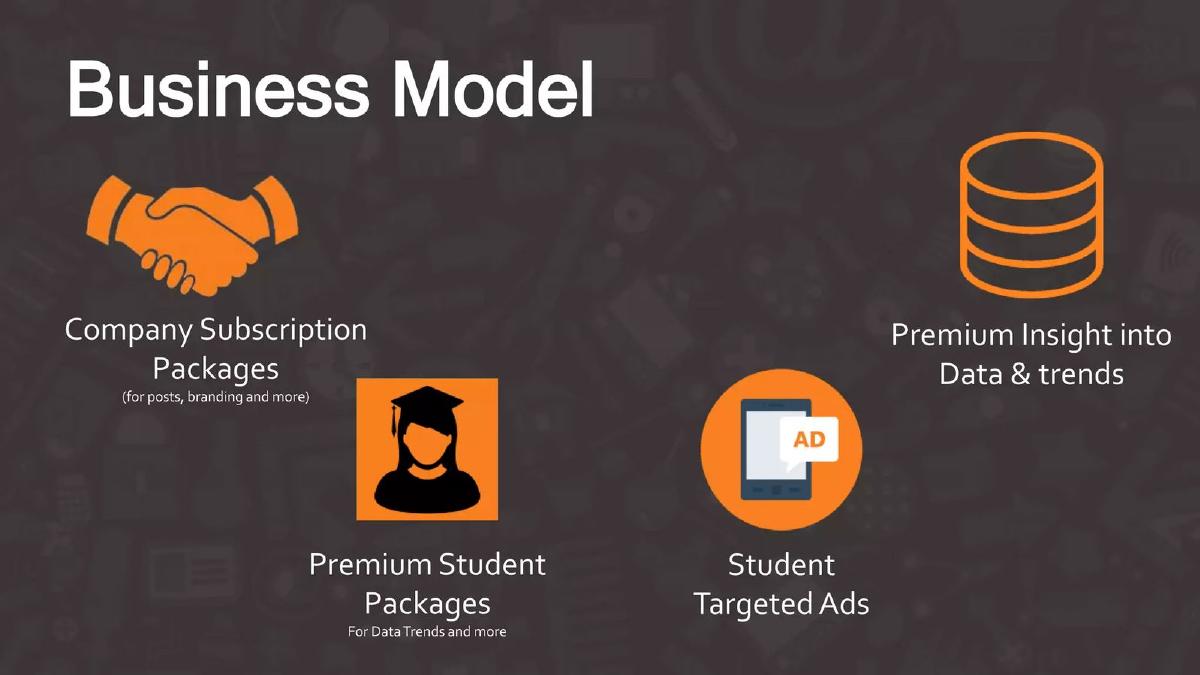
- The business model relies on four revenue streams: company subscriptions, premium student packages, targeted ads, and data insights (Slide 6).
- Early traction includes an active Facebook community of over 4,400 students from different Pakistani universities (Slide 7).
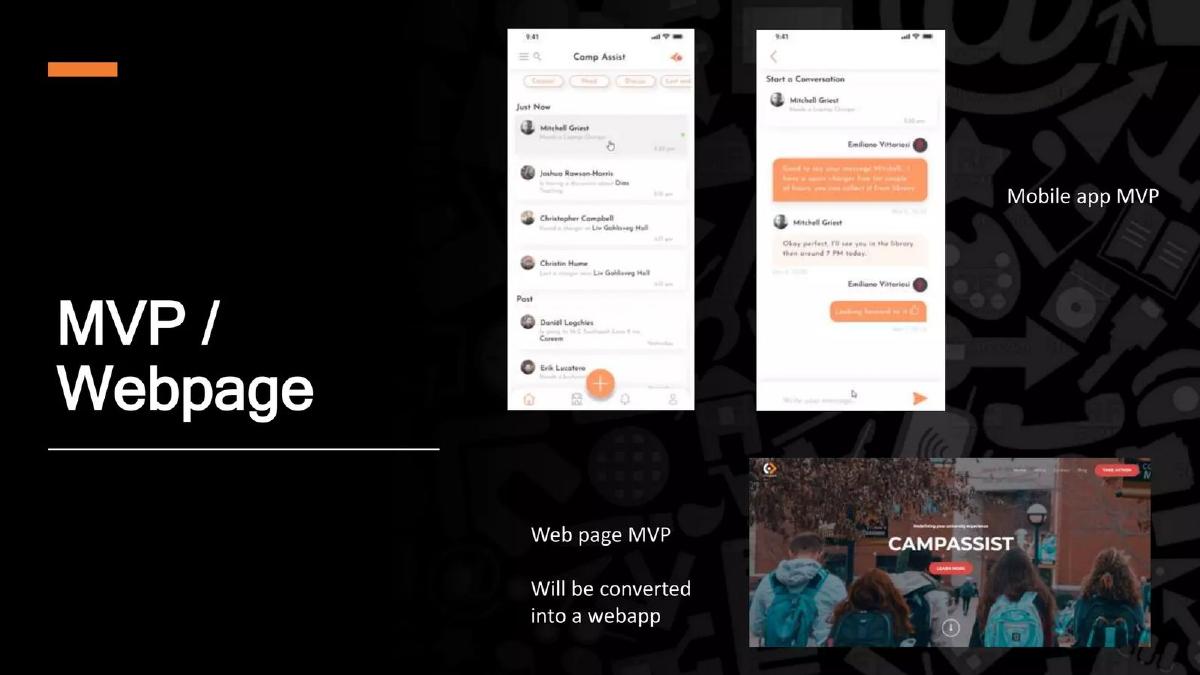
- The product exists as a mobile app MVP and a webpage that will be converted into a webapp (Slide 5).
- The vision includes expanding beyond Karachi to other regions and potentially amalgamating features of Glassdoor, LinkedIn, and EdTech (Slide 8).
- The deck completely omits a team slide, leaving the founders' backgrounds and expertise unknown.
- There is no specific financial ask or 'use of funds' slide, which is a major omission for a fundraising deck.
Slide-by-Slide Teardown
Slide 1: Title Slide
The cover slide introduces CampAssist with the tagline "Resourceful student-centered social platform." The branding uses a distinct orange and white logo. The background image features students on a campus setting, which aligns with the target demographic. It is a standard, clean opening slide that clearly states the company name and its primary function.
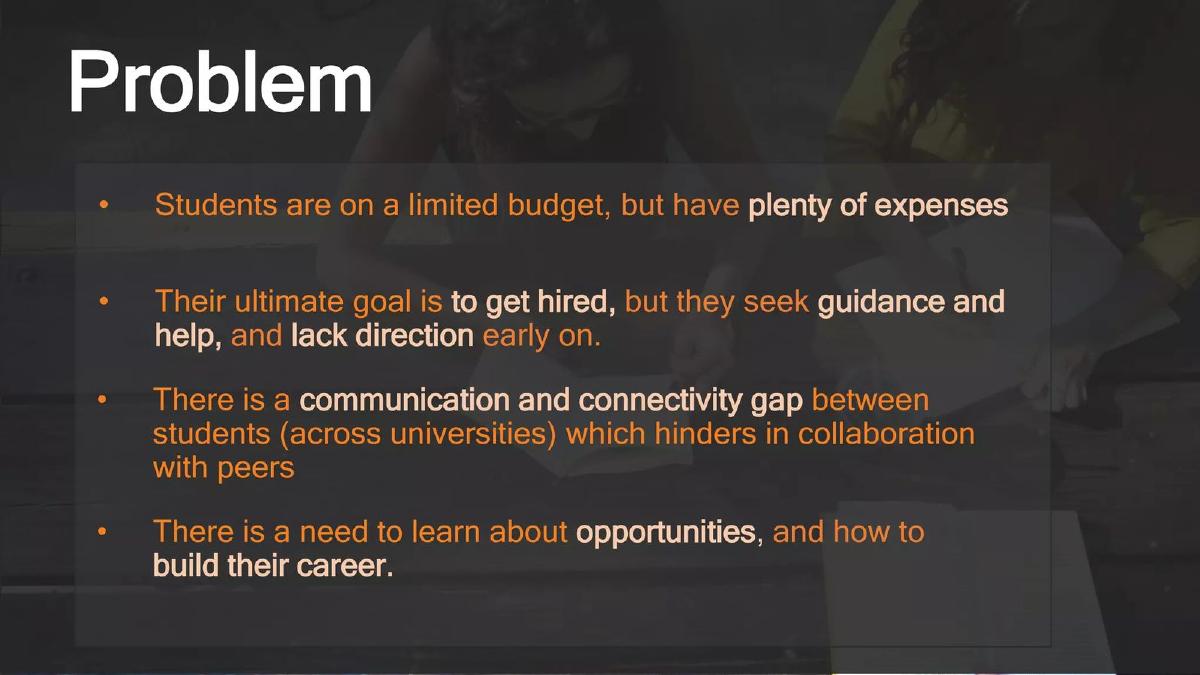
Slide 2: Problem
Slide 2 identifies four core pain points. First, it notes that students have "plenty of expenses" but are on a "limited budget." Second, it highlights a "lack [of] direction early on" regarding career goals. Third, it points to a "communication and connectivity gap" between students at different universities. Finally, it mentions the need for students to learn about "opportunities, and how to build their career." The slide uses bold text to emphasize key phrases, making the problems easy to scan.
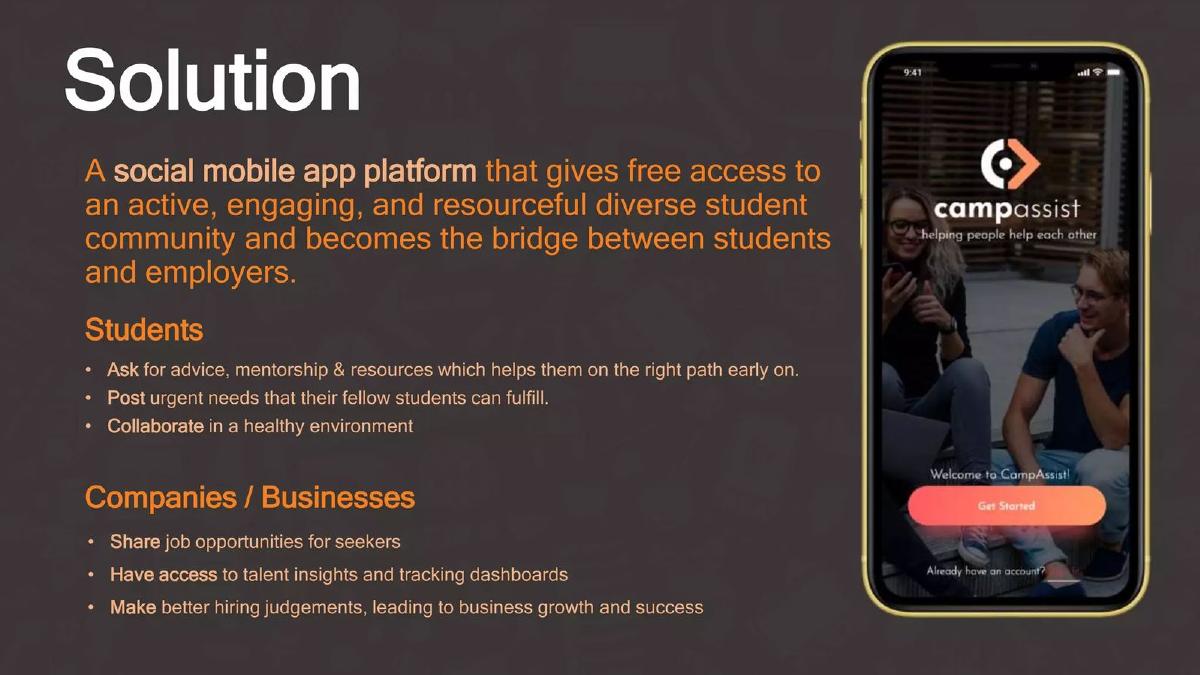
Slide 3: Solution
The solution is described as a "social mobile app platform" that acts as a bridge between students and employers. For students, the app offers a place to ask for advice, post urgent needs, and collaborate. For companies, it provides a way to share job opportunities and access "talent insights and tracking dashboards." A mobile mockup is included on the right side of the slide, showing the app's interface and the slogan "helping people help each other."
Slide 4: Market Size
This slide provides specific figures to quantify the opportunity in Pakistan. It lists "177 universities," "5.2+ million students," "100,000+ companies," and "10+ million alumni." The slide cites the "Higher Education Commission Report 2014-15, 16-17, SECP" as the source for these numbers. While these are large top-level numbers, the deck does not break them down into Serviceable Addressable Market (SAM) or Serviceable Obtainable Market (SOM).
Slide 5: MVP / Webpage
Slide 5 showcases the current state of the product. It displays screenshots of the "Mobile app MVP" showing a feed of student posts and a chat interface. It also mentions a "Web page MVP" that "will be converted into a webapp." This slide is useful for showing that the product is beyond the ideation phase and has functional components, though the visual design of the web page appears somewhat cluttered in the small screenshot provided.
Slide 6: Business Model
The revenue strategy is divided into four categories: "Company Subscription Packages" for branding and job posts, "Premium Student Packages" for data trends, "Student Targeted Ads," and "Premium Insight into Data & trends." This indicates a diversified approach to monetization, targeting both the B2B (employers) and B2C (students) sides of the marketplace. However, the slide lacks pricing details or projections.
Slide 7: Milestones
This is the strongest slide in the deck regarding validation. It highlights that CampAssist were "WINNERS Red Bull Basement University 2019." It also notes an "Active Facebook Community" of "4400+ students" from various universities in Pakistan. In a 30-day period, the community saw "100+ posts" and "30+ opportunities." It also mentions the launch of a landing page and blog with 500 social media followers. This provides concrete evidence of user engagement and external recognition.
Slide 8: Vision
The vision slide outlines the long-term goals of the company. It states a belief in the "power of our youth" and the goal of creating a "Single Intelligent Platform for Pakistani Students." Interestingly, it suggests the platform "could potentially be the amalgamation of Glassdoor, LinkedIn and EdTech." The slide also notes a phased rollout plan, starting in Karachi before expanding. At the bottom, it lists supporting organizations: The Nest i/o, Red Bull Basement University, and IBA.
Slide 9: Closing Slide
The final slide repeats the logo and the slogan "Revolutionizing Student Lives." It serves as a visual bookend to the presentation but lacks contact information or a call to action, which is a missed opportunity for a pitch deck.
What Works Well
Early Validation: Winning the Red Bull Basement University competition is a significant achievement that provides third-party credibility to the founders and the concept. · Community Traction: The mention of a 4,400+ member Facebook group demonstrates that there is a genuine demand for the service and that the founders know how to build a community before the full product is even launched. · Clear Problem/Solution Fit: The deck does a good job of identifying specific student needs (budget, career direction, connectivity) and showing how the app features directly address them. · Specific Market Data: Citing official reports for the number of students and universities in Pakistan gives the market size slide much-needed authority.
What Is Missing
Team Slide: This is the most glaring omission. Investors invest in people as much as ideas. There is no information about who is building CampAssist, their technical capabilities, or their previous experience. · The Ask: The deck does not state how much money the company is looking to raise, the valuation, or what the funds will be used for (e.g., hiring, marketing, product development). · Competitor Analysis: While the vision slide mentions Glassdoor and LinkedIn, there is no slide comparing CampAssist to existing local or international competitors. · Unit Economics: While the business model is listed, there is no mention of Customer Acquisition Cost (CAC), Lifetime Value (LTV), or even basic pricing tiers for the subscriptions. · Financial Projections: There are no charts or tables showing expected growth in users or revenue over the next 1-3 years.
What a Founder Should Copy
Use of Traction Metrics: Founders should follow CampAssist's lead in showing "pre-product" traction. If you don't have an app yet, show your Facebook group growth or waitlist numbers as seen on Slide 7. · Visualizing the MVP: Including screenshots of the actual app (Slide 5) helps investors visualize the product and proves that development work has actually occurred. · Segmented Business Model: Showing multiple revenue streams (Slide 6) can be attractive, as it suggests the business isn't reliant on a single, potentially volatile source of income. · Strategic Partnerships: Highlighting support from incubators or universities (Slide 8) helps build a "moat" around the business and shows that the founders are well-connected in their local ecosystem.
Frequently asked questions
- What is the primary problem CampAssist aims to solve?
- According to Slide 2, CampAssist addresses four main issues: students' limited budgets despite high expenses, their lack of career direction and guidance, a communication gap between students across different universities, and the need for better access to career building opportunities.
- How does CampAssist plan to generate revenue?
- Slide 6 outlines a multi-pronged business model. This includes subscription packages for companies to post jobs and build their brand, premium packages for students to access data trends, targeted advertising aimed at the student demographic, and selling premium insights into data and trends to third parties.
- What evidence of market demand does the deck provide?
- Slide 7 highlights several traction milestones, including a Facebook community with over 4,400 students, more than 100 posts and 30 opportunities shared within 30 days, and 500 social media followers across Facebook and Instagram. Winning the Red Bull Basement University 2019 competition also serves as a proof of concept.
- What is the scale of the target market mentioned in the deck?
- Slide 4 cites data from the Higher Education Commission Report (2014-15, 16-17) and SECP, identifying a market of 177 universities, 5.2+ million students, 100,000+ companies, and over 10 million alumni.
- What are the most significant missing elements in this pitch deck?
- The deck is missing two critical components for a professional fundraising round: a Team slide and an Ask slide. Without a team slide, investors cannot evaluate the founders' ability to execute. Without an Ask slide, the deck fails to communicate how much capital is needed and how it will be deployed to reach the next milestone.