Calpian’s June 2016 investor presentation for its MoneyOnMobile brand focuses on the massive opportunity to digitize cash in India. The company reports servicing over 170 million customers through a network of 315,000+ retail points, achieving a 210% growth in monthly processing volume over 12 months. The core value proposition lies in its 'lowest cost producer' status, claiming a profit of INR 1.56 per agent cash load compared to a loss of INR 0.40 for traditional banked wallets like Paytm. While the deck provides extensive market data and a robust competitive valuation table, it lacks a spe…
Key takeaways
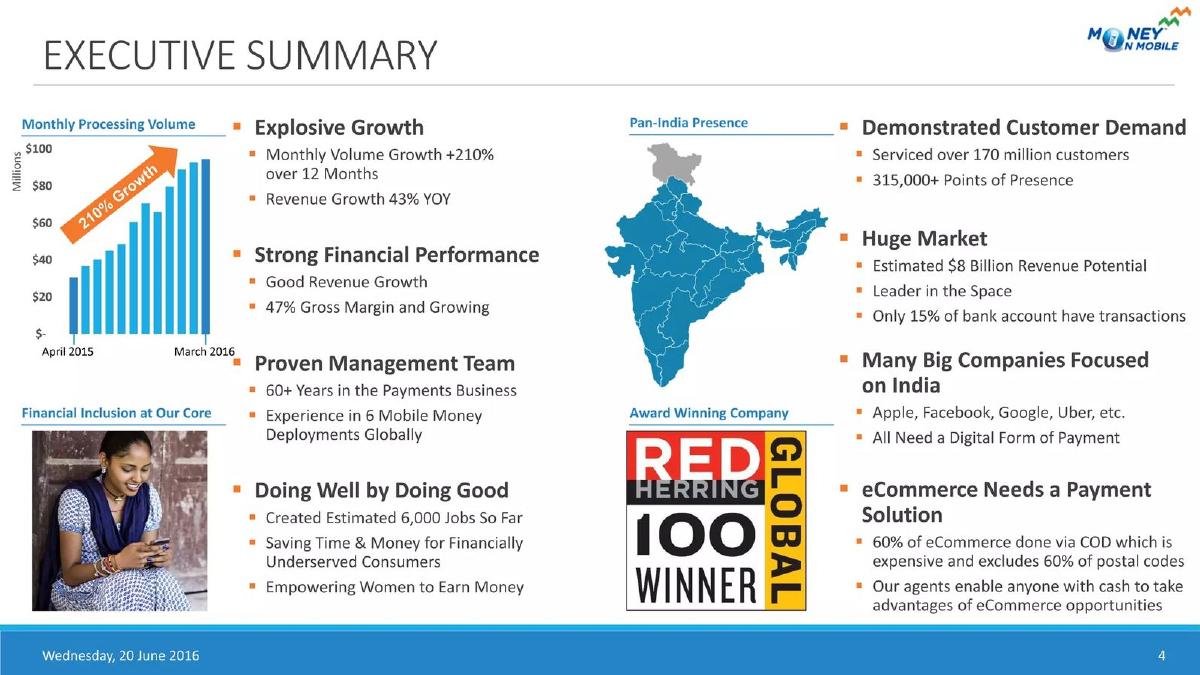
- Monthly processing volume grew by 210% between April 2015 and March 2016, reaching nearly $100 million (Slide 4).
- The business model relies on a network of 315,000+ retail stores that act as cash-to-digital conversion points (Slide 7).
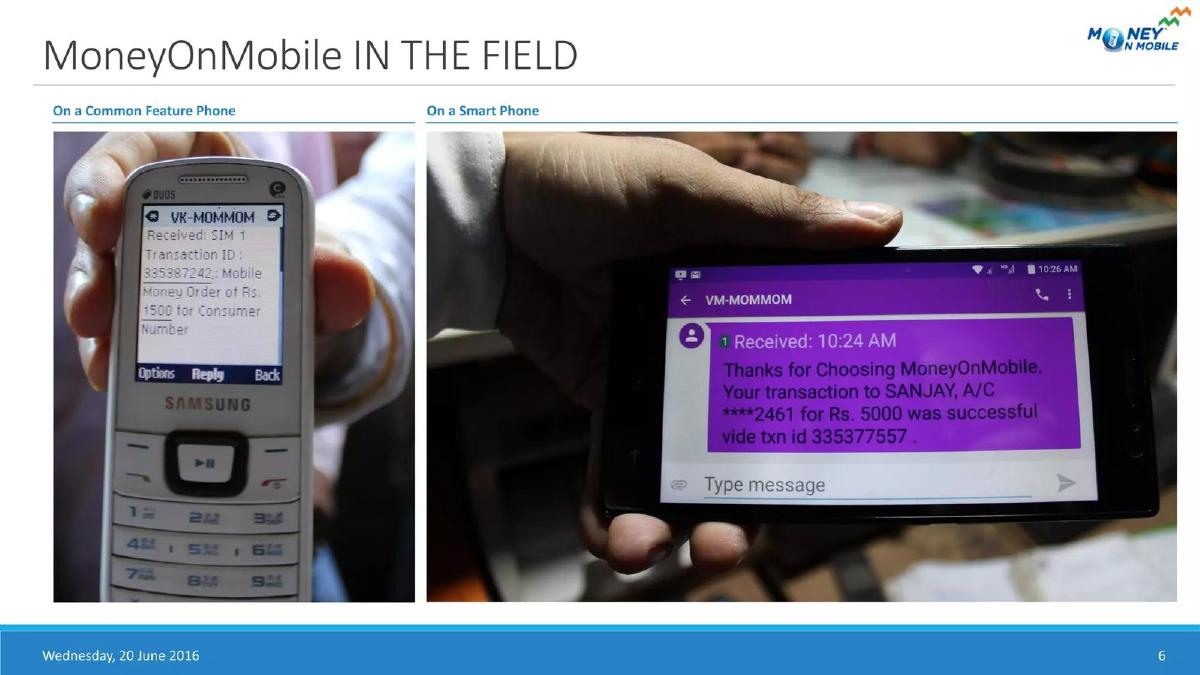
- SMS-based transactions account for 65% of the volume, while smartphones and PCs make up the remaining 35% (Slide 7).
- The company claims a significant unit economic advantage, earning INR 1.56 profit per transaction vs. a loss for competitors like Paytm (Slide 22).
- Strategic initiatives include changing the company name to MoneyOnMobile Inc. and adding Square co-founder Jim McKelvey to the board (Slide 16).
- Market projections estimate the Indian eCommerce market will reach $300 billion by 2030 (Slide 19).
- The platform supports 9 regional Indian languages to remove barriers for underserved consumers (Slide 13).
- A detailed valuation table compares Calpian's $41 million market cap against 25 global payment peers (Slide 25).
Executive Summary: The Scale of the Indian Opportunity
The Calpian (OTC:CLPI) deck, dated June 20, 2016, opens with a high-intensity executive summary on Slide 4 . The company positions its 'MoneyOnMobile' brand as the 'Payment Network of India.' The metrics presented are aggressive: a 210% growth in monthly processing volume over 12 months and a 43% year-over-year revenue growth. The slide successfully establishes the scale of the operation, citing 170 million customers and 315,000+ points of presence. By highlighting that only 15% of bank accounts in India have transactions, Calpian identifies a massive gap in the market that traditional banking has failed to fill.
The Solution: Bridging Cash and Digital
Slide 7 details the mechanics of the MoneyOnMobile solution. The core value proposition is the conversion of consumer cash into digital money through a retail agent network. This is a critical distinction from Western fintech models; it acknowledges that the target demographic is cash-reliant. The slide includes a breakdown of device usage, revealing that 65% of their transactions are still conducted via SMS on 'dumb phones,' while only 35% use smartphones or PCs. This data point validates their strategy of meeting the consumer where they are, rather than forcing a high-tech transition.
Visualizing the User Journey
Slide 10 uses simple illustrations to explain the use cases: sending money to family and recharging mobile data packs. The messaging is clear: 'Be it ₹500 or ₹50,000, you can send money to anyone with just a click.' This slide transitions the deck from hard metrics to the human element of 'doing well by doing good,' which was previously mentioned in the executive summary as a core value. Slide 13 reinforces this by addressing the linguistic diversity of India, stating that MoneyOnMobile supports 9 regional languages, effectively removing the literacy and language barriers that often hinder financial inclusion.
Strategic Roadmap and Governance
On Slide 16 , the company outlines its plan for 'Taking MoneyOnMobile to the Next Level.' This is a rare 'strategic initiative' slide that actually provides concrete actions rather than vague goals. Key initiatives include changing the corporate name to MoneyOnMobile Inc. to align with the brand, and the high-profile addition of Jim McKelvey (Square co-founder) to the board. The slide also mentions the intent to acquire smaller networks to add 100,000 locations and to consolidate ownership of the Indian operating company. This demonstrates a clear path toward corporate maturity and operational scaling.
Market Dynamics and Macro Trends
Slide 19 provides a comprehensive market overview using GSMA Intelligence and RBI data. It tracks the rapid growth of mobile internet penetration (projected at 44% for 2016) and smartphone connections. The most striking projection is the eCommerce market reaching $300 billion by 2030. By placing their current performance within these macro trends, Calpian makes the case that they are not just a successful company, but a company riding a generational wave of digital transformation in the world's second-most populous country.
The 'Lowest Cost Producer' Argument
One of the most effective slides in the deck is Slide 22 , which compares Calpian's unit economics against 'Banked Consumer Wallets' like Oxigen, Paytm, and MobiKwik. Calpian claims that while these competitors lose INR 0.40 per transaction due to high load costs (1% - 2.2% of PV) and heavy marketing spend (INR 7 billion on promotions), MoneyOnMobile generates a profit of INR 1.56 per transaction. They attribute this to having 'No Fraud Costs' and 'No Consumer Marketing,' as their agents act as the primary acquisition and verification channel. This is a powerful argument for sustainability in a sector known for 'burning' cash to acquire users.
Valuation and Peer Comparison
The deck concludes its data-heavy section with Slide 25 , a 'Trading comparables analysis for mobile payments.' This table is exhaustive, listing 25 companies including ACI Worldwide, Global Payments, and Euronet. It compares Calpian’s $41 million market cap and Enterprise Value (EV) against industry averages for Sales and EBITDA multiples. By showing that they trade at a 'n.m.' (not meaningful) or lower multiple compared to the high-quartile peers, they subtly suggest that the stock is undervalued relative to its growth and the massive Indian market opportunity.
What Calpian Does Well
The deck excels at comparative positioning . Slide 22, in particular, is a masterclass in identifying a competitor's weakness (high customer acquisition and loading costs) and framing it as a structural advantage for the presenter. The use of specific, localized data—such as the 9 regional languages and the 65% SMS transaction rate—proves that the company understands the nuances of the Indian market better than a generic global player might.
Furthermore, the strategic roadmap on Slide 16 is exceptionally clear. It breaks down initiatives into 'Category,' 'Initiative,' and 'Target Outcome,' which gives investors a checklist to measure management's performance in the coming quarters. The inclusion of a high-profile board member like Jim McKelvey adds significant institutional credibility to an OTC-listed company.
What is Missing from the Deck
The most glaring omission in the provided slides is a specific 'Ask' slide . While the deck is labeled an 'Investor Presentation,' it does not state how much capital is being raised, the terms of the offering, or the specific allocation of those funds. It functions more as a general corporate update or a 'buy the stock' pitch for the public markets than a traditional venture capital or private equity pitch deck.
Additionally, while the 'Proven Management Team' is mentioned on the executive summary, there are no individual bio slides for the key executives. Investors generally want to see the specific track records of the CEO, CTO, and COO, especially in a complex cross-border operation involving the US and India. The deck also lacks a detailed Risk Factors slide, which is standard for OTC-listed companies to address regulatory hurdles in India or currency fluctuation risks.
Founder Takeaways: Copy the Unit Economics Slide
Founders should study Slide 22 . In the current 'path to profitability' era of venture capital, showing exactly how your unit economics differ from the 'incumbent' or 'hyped' competitors is vital. Calpian didn't just say they were better; they broke down the 'Load Costs' and 'Marketing Spend' to show why they were profitable while others were losing money on every transaction. If you can prove that your business model has a structural cost advantage that competitors cannot easily replicate without changing their entire DNA, you have a winning pitch.
Another takeaway is the Market Overview (Slide 19) . Instead of just showing one giant 'TAM' circle, Calpian showed the convergence of three different trends: internet penetration, subscriber growth, and smartphone adoption. Showing the intersection of trends is much more persuasive than showing a single, static market size number.
Frequently asked questions
- What is the primary problem Calpian is solving?
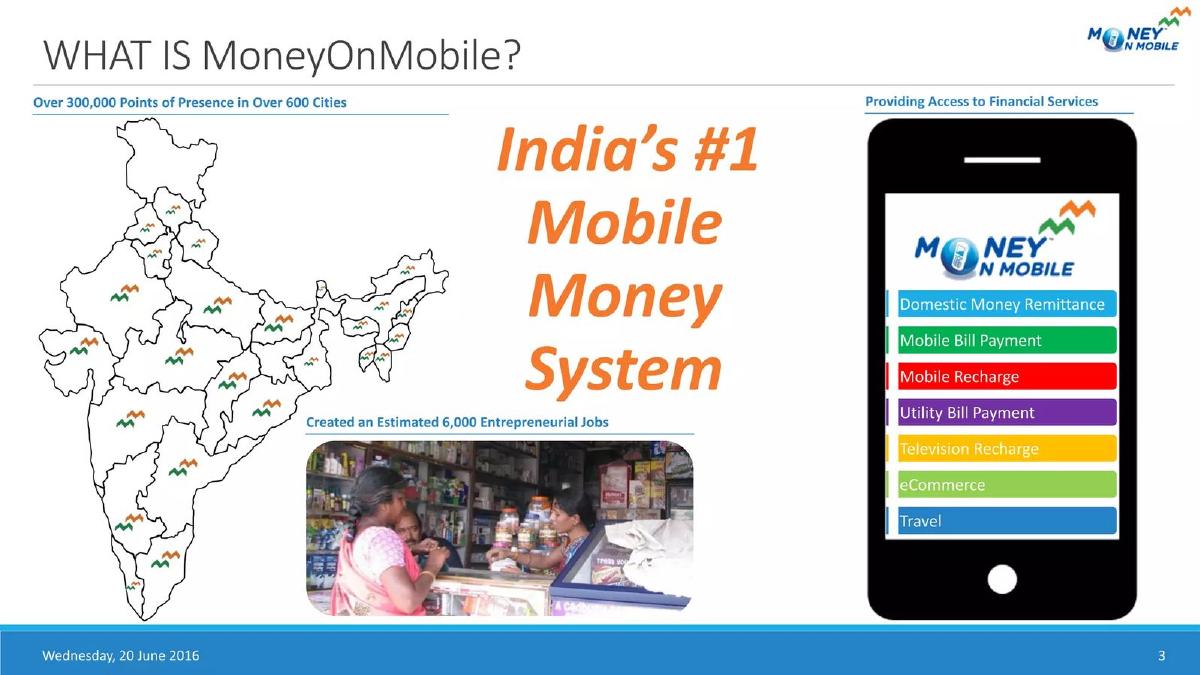
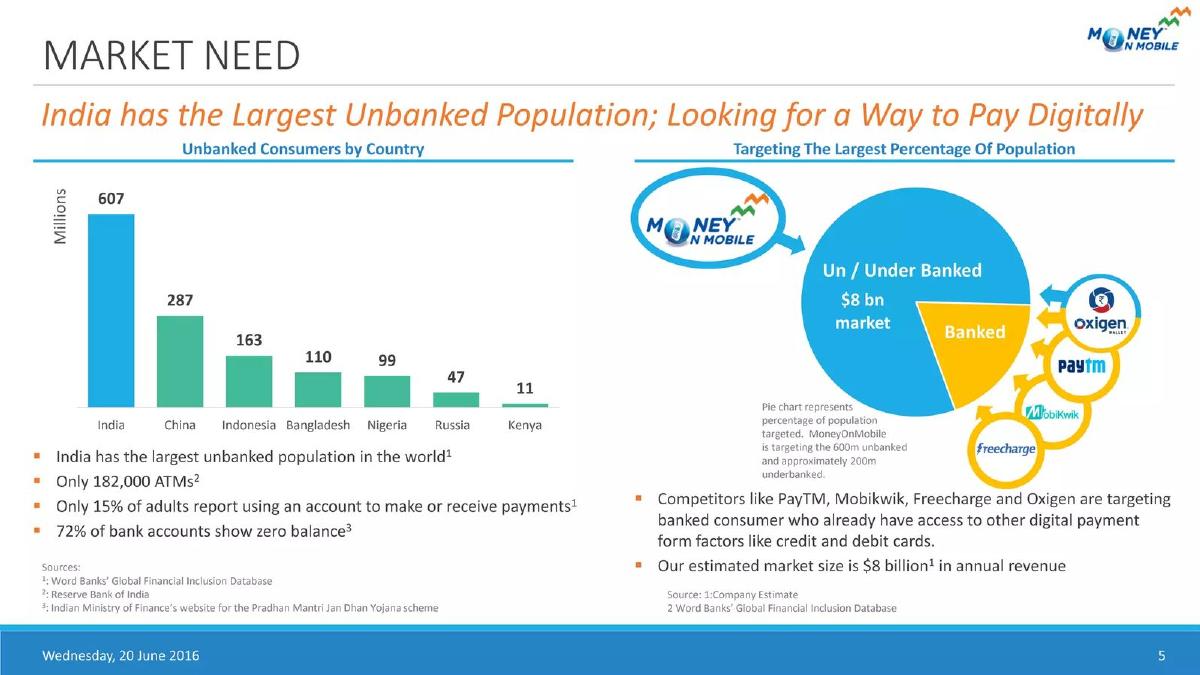
- Calpian addresses the financial exclusion of the Indian population, where only 15% of bank accounts have active transactions. By using a retail agent network, they allow cash-heavy consumers to perform digital tasks like domestic remittances, utility payments, and eCommerce purchases without needing a traditional bank-linked smartphone app.
- How does Calpian's unit economics compare to competitors like Paytm?
- According to slide 22, Calpian claims to be the 'lowest cost producer.' While competitors like Paytm lose money (INR 0.40 loss) on card-loaded wallet transactions due to high loading costs and promotions, Calpian earns a profit of INR 1.56 per transaction because they have no fraud costs or consumer marketing expenses.
- What is the significance of the retail agent network?
- The 315,000+ retail stores serve as the physical infrastructure for the digital service. These agents earn a commission for selling the service, while consumers use them to convert physical cash into digital money for remote transactions, effectively turning every small shop into a POS terminal.
- Who are the key people mentioned in the deck?
- While individual slides for the full team are missing from this selection, slide 16 highlights the addition of Jim McKelvey, a co-founder of Square, to the board. The management team is described collectively as having over 60 years of experience in the payments business and 6 global mobile money deployments.
- What are the company's future growth plans?
- The company plans to consolidate 100% ownership of its Indian operating company, acquire smaller agent networks to add 100,000 locations, and expand into B2B procurement payments for groups like taxi drivers. They also intend to up-list the stock to increase liquidity.