The Canada Jetlines October 2021 deck outlines a strategic entry into the C$48 billion Canadian air transport market, which the company describes as a duopoly where two airlines control 85% of the market. The pitch centers on a lean, high-density model using Airbus A320 aircraft to serve leisure destinations in the U.S., Mexico, and the Caribbean. A significant portion of the presentation is dedicated to the regulatory 'Air Operator Certificate' (AOC) process, reflecting the high barriers to entry in the aviation sector. While the deck provides a clear timeline for fleet growth—scaling from a…
Key takeaways
- The Canadian air transport industry is valued at C$48 billion, with two airlines controlling approximately 85% of the market (Slide 7).
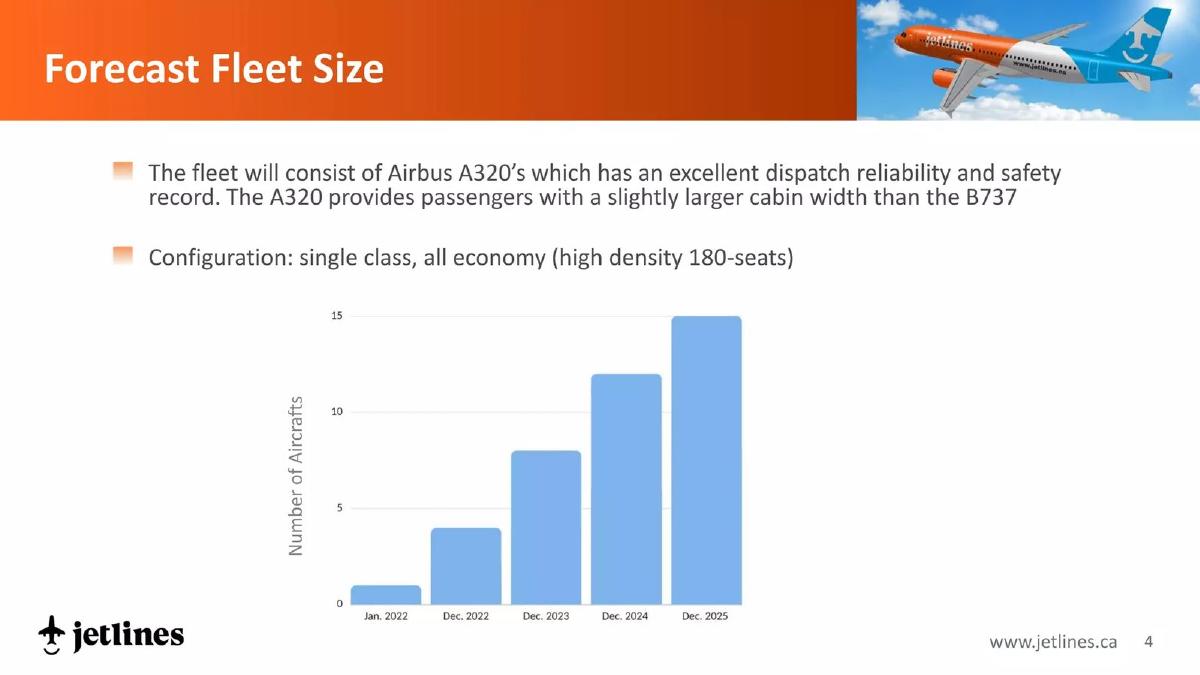
- Canada Jetlines plans to operate a single-class, all-economy fleet of Airbus A320s with a 180-seat high-density configuration (Slide 4).
- The company projects aggressive fleet growth, starting with one aircraft in January 2022 and reaching 15 aircraft by December 2025 (Slide 4).
- Initial flight operations were targeted for Spring 2022, focusing on Toronto-based routes to the U.S., Mexico, and the Caribbean (Slide 10).
- The distribution strategy relies heavily on indirect channels, aiming to reach 90% of Canada's travel agencies through platforms like Softvoyage (Slide 13).
- The regulatory roadmap for the Air Operator Certificate (AOC) was divided into five phases, with completion estimated for February 2022 (Slide 16).
- The Board of Directors includes high-profile figures such as the former Deputy Prime Minister of Canada and former executives from Amex Bank and Airbus (Slide 21).
- The deck omits a specific financial 'ask' or use of proceeds slide within the provided selection.
Executive Summary and Market Context
The Canada Jetlines October 2021 investor deck serves as a strategic roadmap for a startup airline attempting to break into a highly consolidated market. The presentation is structured to address the two biggest hurdles for any new airline: regulatory approval and market share acquisition against entrenched incumbents. By positioning themselves as a leisure-focused alternative in a C$48 billion industry, the company attempts to justify the capital-intensive nature of their business model.
Slide 1: Title Slide
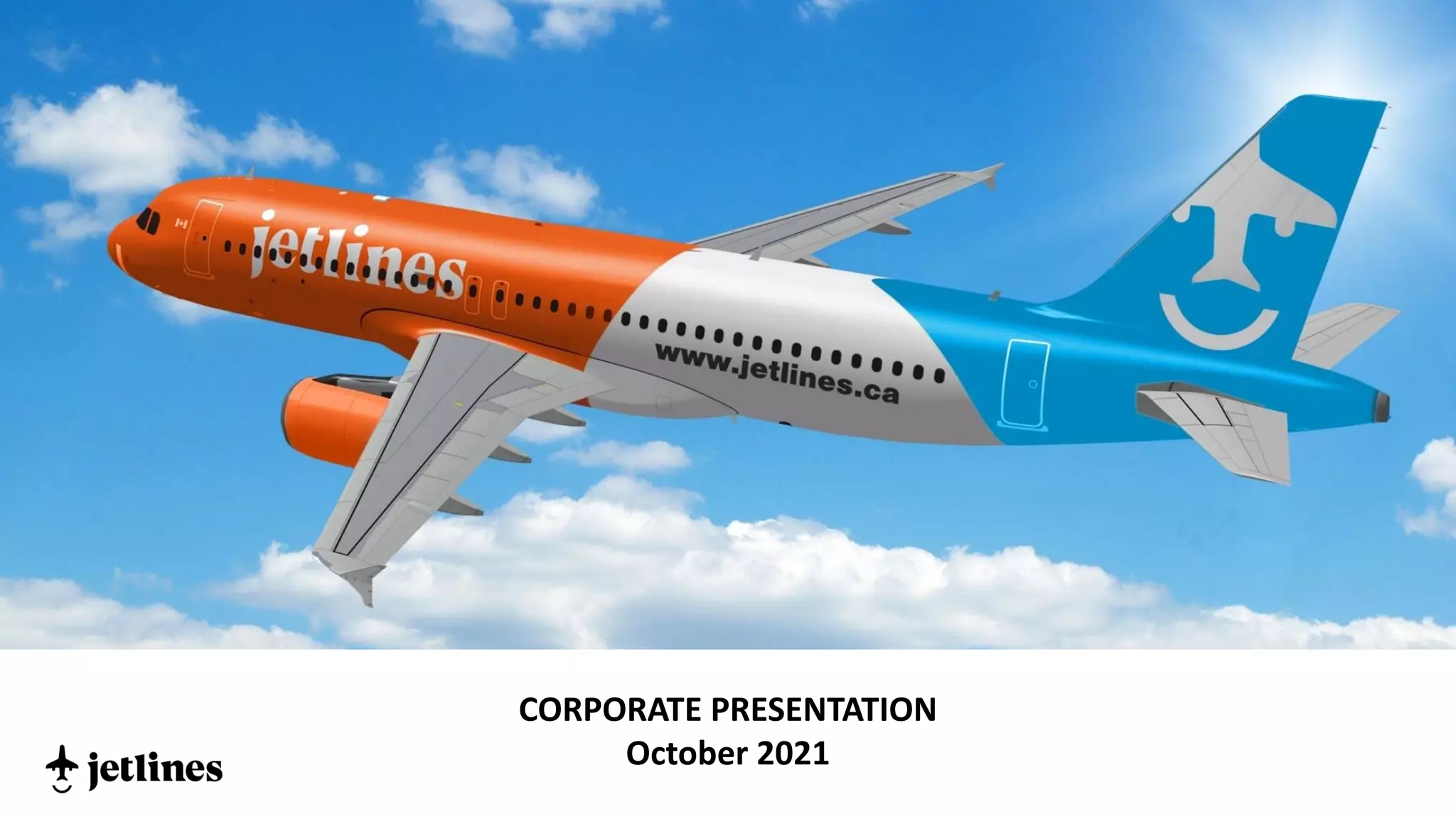
The cover slide features a high-resolution rendering of an Airbus A320 in the Canada Jetlines livery—a vibrant orange and blue design with a stylized 'smiley' aircraft tail logo. The text is minimal, identifying the document as a "CORPORATE PRESENTATION" dated "October 2021." The inclusion of the URL www.jetlines.ca and the company logo establishes the brand identity immediately. The imagery is aspirational, focusing on the physical asset (the plane) to signal to investors that the project is moving toward operational reality.
Slide 4: Forecast Fleet Size
This slide outlines the operational core of the business. Canada Jetlines specifies the use of Airbus A320s , citing "excellent dispatch reliability" and a "larger cabin width than the B737." The configuration is explicitly stated as "single class, all economy (high density 180-seats)." This is a standard tactic for Low-Cost Carriers (LCCs) to maximize seat-mile efficiency.
The bar chart on this slide provides a clear growth trajectory for the fleet:
Jan. 2022: 1 Aircraft · Dec. 2022: 4 Aircraft · Dec. 2023: 8 Aircraft · Dec. 2024: 12 Aircraft · Dec. 2025: 15 Aircraft
This aggressive scaling—growing 15x in four years—indicates a need for significant and continuous capital infusions, though the specific costs of these leases or purchases are not detailed on this slide.
Slide 7: The Canadian Marketplace
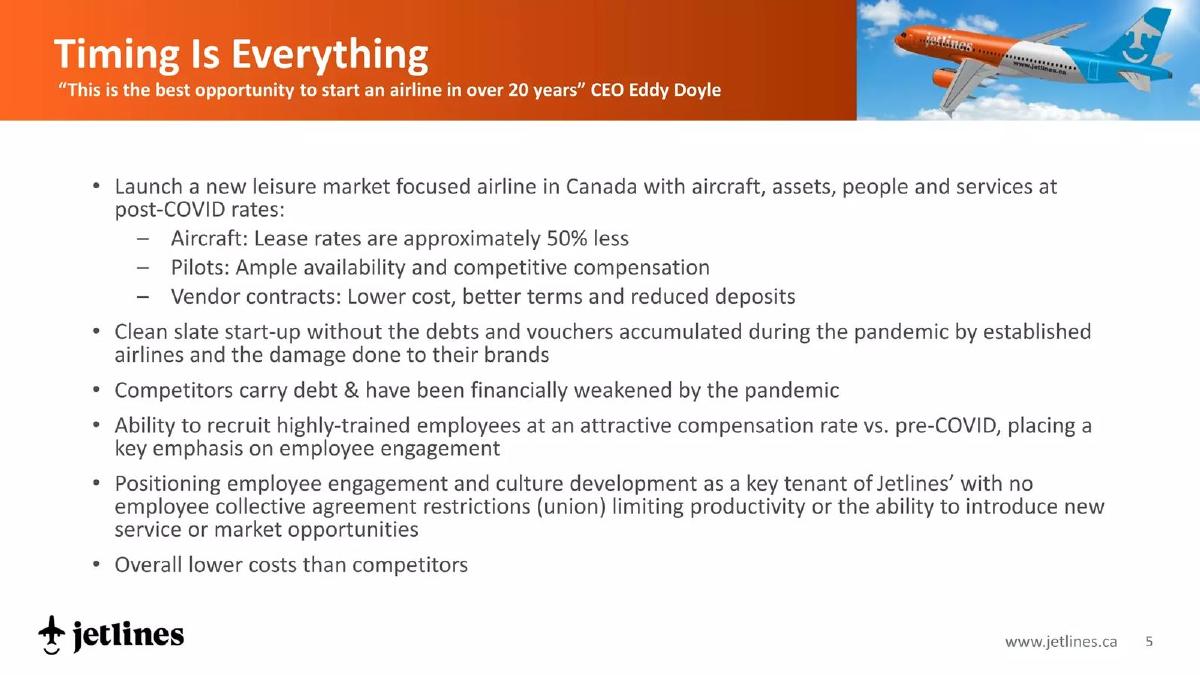
This is the "Problem" slide, framed through the lens of market opportunity. It states that the Canadian air transport industry is a C$48 billion industry according to IATA. The key argument is the "duopolistic nature" of the market, where two airlines (Air Canada and WestJet) control approximately 85% of the market , allowing them to control pricing.
The slide also highlights a specific competitive opening: the incumbents' low-cost brands, Swoop (WestJet) and Rouge (Air Canada), are allegedly "limited by employee contractual obligations" regarding fleet size and routes. Finally, it notes that Canadians are frequent travelers, averaging 1.79 trips per capita annually, compared to 1.88 for US travelers, despite significantly higher fares in Canada. This suggests a price-elastic market ready for a lower-cost entrant.
Slide 10: Targeted Markets
Spring 2022: Launch flights from Toronto (YYZ) focusing on U.S., Mexico, and Caribbean destinations. · 2023: Grow the Toronto schedule and introduce direct flights from other Canadian gateways to leisure destinations. · 2024 and Beyond: Continued growth from across Canada to leisure destinations.
By focusing on leisure destinations rather than domestic business hubs (like the Toronto-Montreal-Ottawa triangle), Jetlines is signaling a strategy to avoid direct, head-to-head competition with the primary business routes of Air Canada and WestJet.
Slide 13: Indirect Distribution
In a departure from many modern LCCs that prioritize direct web bookings to avoid commissions, Canada Jetlines places a heavy emphasis on the "Indirect Channel." The slide argues that the Canadian travel segment is still dominated by the travel trade, especially given the "complexity + general lack of consistency of COVID Protocol."
Strategic agency partnerships across North America. · Distribution via Softvoyage to reach 90% of Canada's travel agencies. · Partnerships with "Bed banks" including Booking.com, Hotel Beds, Dingas, HSBI, and Jumbo . · Direct deals with 10 hotels in each launch market to mitigate margin erosion.
This strategy suggests that Jetlines is positioning itself more as a vacation provider (Jetline Vacations) rather than just a seat-only airline.
Slide 16: Air Operator Certificate (AOC) Process and Timeline
For an airline, the AOC is the ultimate barrier to entry. This slide provides a status update on their regulatory journey with Transport Canada:
Phase 1 & 2: Completed (June/July 2021). · Phase 3: In progress (Design Assessment), with only one manual left to submit. · Phase 4: Performance Assessment estimated for Dec. 2021/Jan. 2022. · Phase 5: Final issuance of operating certificate and CTA license estimated for February 2022 .
This slide is crucial for de-risking the investment, as it shows the company is in the final stages of a multi-year regulatory process.
Slide 21: Board of Directors
The final slide in this selection showcases a board designed to project institutional stability and industry expertise. Notable members include:
Ryan Goepel (Chairman): 20 years in finance, LCC experience, and a role in the first Burger King IPO. · The Honourable Jean Charest: Former Deputy Prime Minister of Canada, providing significant political capital. · Beth S. Horowitz: Former President & CEO of Amex Bank of Canada. · Ken McKenzie: Former COO of Spirit Airlines and executive at Airbus Americas. · Peggy Gilmour: Audit and compliance expert. · Ravinder Minhas: Entrepreneurial representation (Minhas Craft Brewery).
The board composition is a mix of high-level political influence, deep aviation operational experience, and financial oversight, which is intended to reassure investors of the company's governance.
What Canada Jetlines Does Well
The deck excels at identifying a specific, structural market inefficiency—the Canadian aviation duopoly—and proposing a clear, asset-light (leased fleet) solution. By focusing on the Airbus A320, they benefit from a massive global supply chain and pilot pool. The regulatory timeline (Slide 16) is transparent and provides concrete milestones for investors to track progress. Furthermore, the Board of Directors is exceptionally strong for a startup, featuring names that carry weight in both Ottawa and the global aviation industry.
What is Missing from the Deck
The most glaring omission in the provided slides is a clear financial ask . There is no mention of how much capital is being raised in this round, the valuation, or the specific use of proceeds (e.g., how much goes to aircraft deposits vs. marketing vs. regulatory reserves). Additionally, the deck lacks Unit Economics . In the airline industry, investors look for CASM (Cost per Available Seat Mile) and RASM (Revenue per Available Seat Mile) projections. While they mention a 180-seat configuration, they do not provide the projected break-even load factors. There is also no mention of fuel hedging , which is one of the single largest risk factors for any airline's profitability.
Founder Takeaways
Leverage Market Structure: If you are entering a market dominated by a duopoly, your pitch should focus on the "incumbent's dilemma." Canada Jetlines does this well by pointing out that the big players are hamstrung by labor contracts that prevent them from competing effectively on price.
Regulatory Transparency: For companies in highly regulated sectors (fintech, medtech, aviation), a slide dedicated to the specific phases of government approval is mandatory. It shows you understand the complexity of the task and aren't just "hoping" for a license.
Distribution Realism: Don't assume "direct-to-consumer" is always the best path. Jetlines' recognition that the Canadian market still relies on travel agents for complex international trips shows a pragmatic understanding of their specific customer base, even if it means paying commissions.
Board as a Signal: When the business model is capital-intensive and risky, your board is your most important signal of credibility. Assembling a team with former Deputy Prime Ministers and C-suite executives from industry giants (Spirit, Airbus, Amex) tells investors that the "grown-ups" are in the room.
Frequently asked questions
- What is Canada Jetlines' primary competitive advantage according to the deck?
- The deck argues that the Canadian market is a duopoly where Air Canada and WestJet control 85% of the market, leading to high prices. Canada Jetlines intends to exploit this by offering lower-cost leisure travel. They also note that the incumbents' low-cost subsidiaries, Swoop and Rouge, are limited by employee contractual obligations regarding fleet size and routes, creating a gap for a new entrant.
- Which aircraft type does Canada Jetlines intend to use and why?
- The company has selected the Airbus A320. According to slide 4, they chose this model for its 'excellent dispatch reliability and safety record.' Additionally, they claim the A320 offers a slightly larger cabin width than the Boeing 737, which they intend to utilize in a high-density, 180-seat all-economy configuration to maximize revenue per flight.
- How does the company plan to handle ticket distribution?
- Unlike many modern ultra-low-cost carriers that focus exclusively on direct-to-consumer sales, Canada Jetlines emphasizes an 'Indirect Distribution' model on slide 13. They plan to partner with traditional and online travel agencies, tour operators, and bed banks (like Booking.com and Hotel Beds) to reach 90% of Canadian travel agents, citing the complexity of COVID-19 protocols as a reason travelers still prefer agents.
- What is the timeline for the airline becoming fully operational?
- Slide 16 details the Air Operator Certificate (AOC) process. As of the October 2021 deck, they had completed the formal application in July 2021. They estimated the performance assessment for late 2021 and the final issuance of the operating certificate and license for February 2022, coinciding with their Spring 2022 launch target for flights from Toronto.
- Who is leading the company's governance?
- The Board of Directors (Slide 21) is led by Chairman Ryan Goepel, who has experience in LCC (Low-Cost Carrier) finance. The board features significant political and industry weight, including the Honourable Jean Charest (former Deputy Prime Minister of Canada), Beth S. Horowitz (former CEO of Amex Bank of Canada), and Ken McKenzie (former COO of Spirit Airlines and EVP at Airbus).