The BrainRap Project, developed by Centiment Capital, is a specialized application of neuroscience and AI aimed at the hip-hop industry. The deck outlines a platform that uses a headset to help artists visualize lyrics, improve writing speeds, and optimize rap styles. A core component of the pitch is a 12-month study of 120 subjects claiming significant improvements in cognitive function and creative output. The business model is multifaceted, encompassing direct hardware sales, a studio-based service model, and SaaS licensing for brands and agencies. While the deck provides impressive study…
Key takeaways
- The project claims to increase writing speed by 80% and freestyle speed by 90% based on a 12-month study (Slide 11).
- BrainRap targets a wide market including brands ($218B marketing spend) and agencies ($54.7B annual spend) through emotional music analytics (Slide 13).
- The business model includes a 'Studio Model' featuring bookable time in a 'BrainRap Penthouse' (Slide 15).
- Unit economics for the agency model cite a $2,150 total profit per transaction based on a $4,000 session spend (Slide 15).
- The team is led by CEO Micah Brown, described as a two-time exit entrepreneur, and CTO CJ Carr (Slide 19).
- The deck features logos for Google, Spotify, and Time Life under 'Revenue + Partnerships' but does not specify the nature of these relationships (Slide 17).
- A 'Rationale Overview' uses a persona named Treyvon to illustrate how the software helps artists drive SEO and engagement (Slide 7).
- The deck omits a specific investment ask, use of funds, and detailed financial roadmap (Slide 1-19).
The BrainRap Project: A Deep Dive into Neuroscience-Driven Artistry
The BrainRap Project, presented under the Centiment Capital banner, represents an intersection of wearable technology, artificial intelligence, and music production. The deck, dated June 2019, positions the company not just as a tool for artists, but as a data-driven platform for the broader marketing and music industries. By leveraging neuroscience, the company aims to quantify and enhance the creative process of hip-hop artists.
Slide 1-3: Introduction and Vision
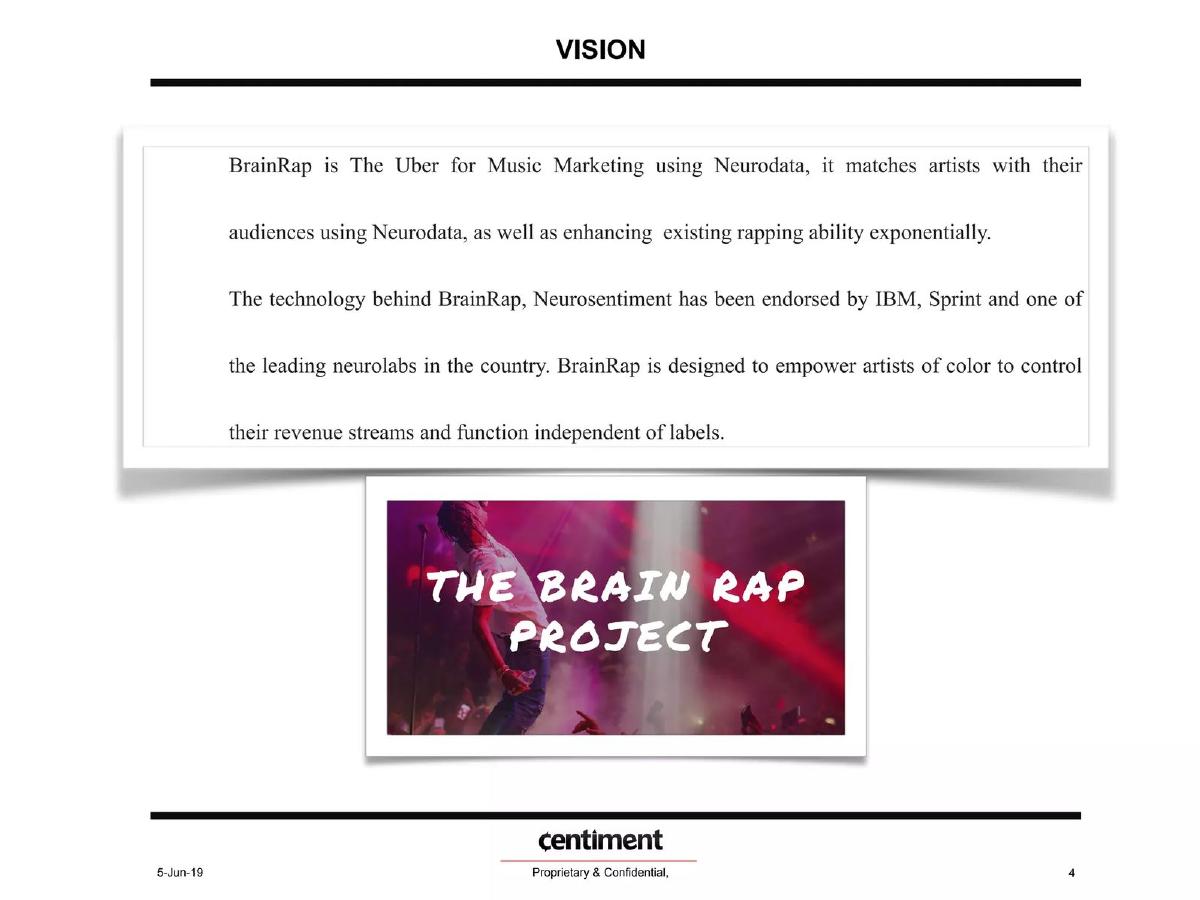
The deck opens with a title slide (Slide 1) branding the venture as 'The BrainRap Project' with the tagline 'Neuroscience Powered Rap.' It is presented by Centiment Capital. The subsequent slides for 'Vision' (Slide 2) and 'Pain Point + Target Buyer' (Slide 3) serve as section headers but, in this version of the deck, do not contain the descriptive text often found in these sections. This suggests a presentation style intended to be accompanied by a verbal narrative rather than a stand-alone document.
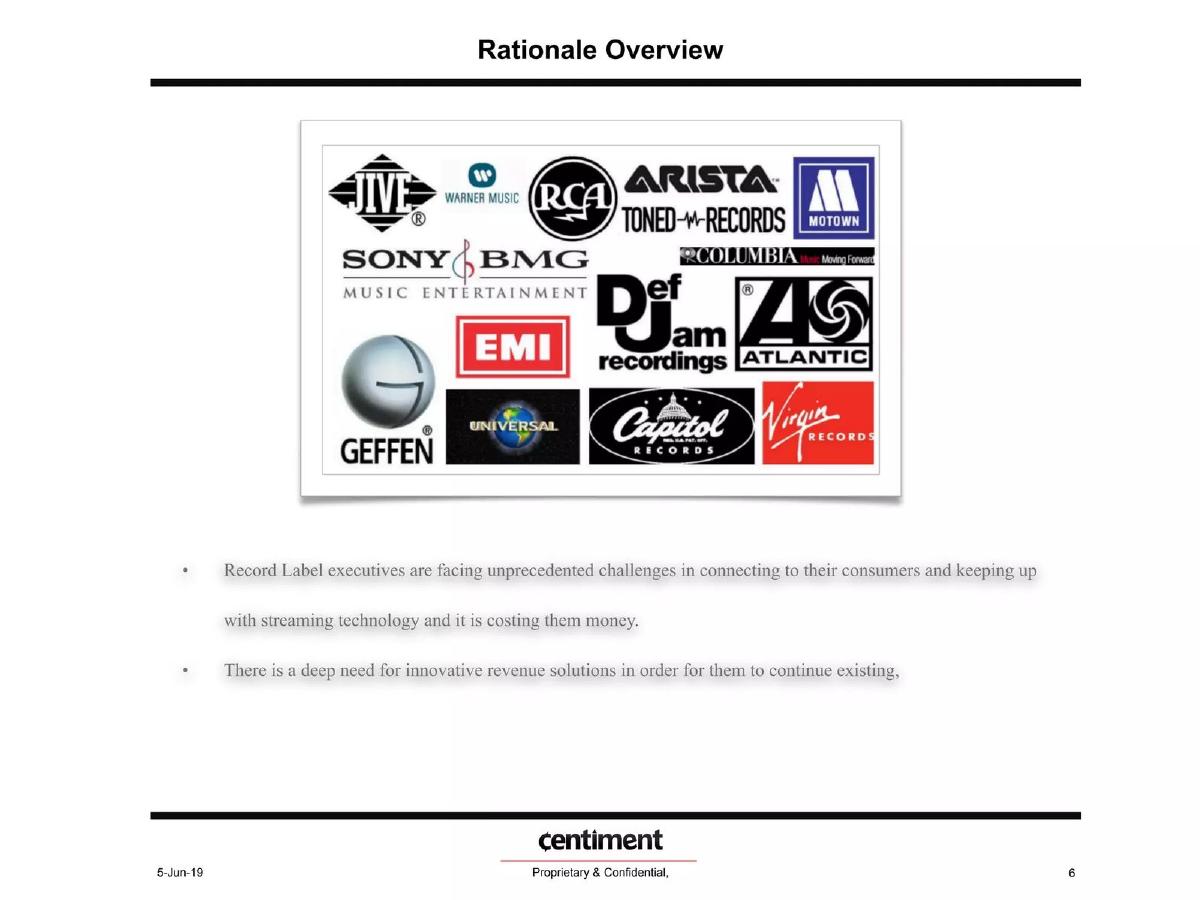
Slide 7: Rationale Overview
Slide 7 introduces a user persona, 'Treyvon,' an aspiring millennial rapper. The slide outlines the value proposition: despite having a following, Treyvon lacks high stream counts and revenue. BrainRap claims to solve this by allowing him to 'visually see the lyrics' required to drive SEO and engagement in real time. The slide explicitly states that the tool helps him 'rap better' and provides the data necessary to sell merch or get signed to a label. This slide is critical as it bridges the gap between high-level neuroscience and the practical needs of a working artist.
Slide 9: Solution + Science
This slide focuses on external validation through media coverage. It features a Fast Company headline from February 2019: 'BrainRap could change how we see hip-hop—and neuroscience.' It also mentions a partnership between Centiment and KU Med, originating from the Sprint Accelerator. The visuals show Micah Brown, the CEO, demonstrating the technology, which appears to involve a VR-style headset and a microphone setup. This slide serves to establish credibility by showing the founder in the field and highlighting third-party interest.
Slide 11: The BrainRap Study
Slide 11 is the most data-heavy portion of the deck, detailing a 12-month study involving 120 subjects. The metrics listed are exceptionally high: 80% faster writing speed, 90% faster freestyle speeds, and 80% increased cognitive function. Perhaps most notable is the claim that the software led to '50% higher streams.' The slide also references a specific subject, 'WB1,' who allegedly achieved a '90% higher cognitive function' and adapted to 30 new rap styles in a 30-day period. While these figures are impressive, the deck does not provide the methodology or the baseline metrics used to calculate these percentages.
Slide 13: Market Snapshot
The market analysis on Slide 13 divides the opportunity into 'Brands' and 'Agencies.' It cites a $218 Billion marketing spend for brands and $54.7 Billion annual spend for agencies in 2018. It also identifies a niche for 'Emotional Music Analytics' valued at $11.4 Billion. The slide includes market trends, noting that 60% of marketers struggle to personalize content in real time. This suggests that BrainRap intends to sell the data generated by its artists to brands looking for more authentic or 'emotionally resonant' marketing content.
Slide 15: Sales + Engagement Strategy
This slide outlines the business model. It proposes four distinct tracks:
Unit Sales: Selling the headset directly to record labels or music tech companies. · Agency Platform: A development model for artists. · Studio Model: Bookable time in a 'BrainRap Penthouse.' · SaaS + Licence: A software platform for advertising and licensing the underlying tech.
The slide provides a specific unit economic breakdown for the Agency/Studio model: a $4,000 average spend per session plus $150 in premium services, minus a $2,000 base cost, resulting in a '$2,150 total profit per transaction.'
Slide 17: Revenue + Partnerships
Slide 17 displays a collection of logos including Google, Spotify, Time Life, Genius, Beatdapp, and Cassandra Wealth. The slide is titled 'Revenue + Partnerships,' but it does not specify if these companies are paying customers, integration partners, or pilot participants. In a fundraising context, this lack of clarity can be a red flag, as investors cannot distinguish between a signed contract and a casual conversation.
Slide 19: The Team
The final slide introduces the leadership. Micah Brown (CEO) is described as a 'two time exit entrepreneur' and CJ Carr (CTO) is called one of the 'leading machine learning minds in the world.' The advisory board includes Allen Lee (Collab Asia), Robert Sanchez (True North Media Fund), Neal Conlon, and Emalik Njie, PhD. The slide claims the support of over twenty other advisors in neuroscience and hip-hop, though they are not named. This slide aims to demonstrate that the company has the necessary expertise in both the technical (ML/Neuroscience) and industry (Hip-Hop) domains.
What Works in This Deck
The BrainRap deck excels at creating a sense of 'frontier technology' applied to a culturally relevant space. The use of a specific study (Slide 11) provides a quantitative hook that most creative-tech decks lack. By presenting specific percentage improvements in artist performance, they move the conversation from subjective 'art' to objective 'optimization.' The inclusion of a Fast Company feature (Slide 9) also provides significant social proof for an early-stage venture. Furthermore, the hybrid business model (Slide 15) shows that the founders are thinking about multiple ways to monetize the technology beyond just selling hardware, which is notoriously difficult for startups.
What Is Missing
The most glaring omission is the lack of a clear 'Ask.' There is no slide indicating how much money the company is looking to raise, the valuation they are seeking, or what specific milestones the funding will help them achieve. Additionally, the deck lacks a technical deep dive. While 'neuroscience' is mentioned frequently, there is no explanation of what the headset actually measures (e.g., EEG, fMRI, etc.) or how the software translates brain waves into lyrical suggestions. The 'Revenue + Partnerships' slide (Slide 17) is also dangerously vague; without context, a logo wall can appear as 'logo soup' intended to mislead rather than inform. Finally, there are no financial projections or a roadmap showing when the 'BrainRap Penthouse' or SaaS platform will be fully operational.
Founder Takeaways
Founders should look at Slide 15 as a good example of how to break down unit economics for a service-based model. Providing a clear 'profit per transaction' figure helps investors understand the scalability of a physical location or agency model. However, founders should avoid the 'logo wall' trap seen on Slide 17. If you have partnerships, label them clearly as 'Pilot Program,' 'Integration,' or 'Paying Customer.' Transparency builds more trust than a collection of high-profile logos without context. Lastly, if you are presenting a study as core evidence of your product's value (as in Slide 11), be prepared to provide a white paper or a more detailed methodology slide in the appendix, as 90% improvement claims will naturally invite skepticism from sophisticated investors.
Frequently asked questions
- What is the core technology behind BrainRap?
- According to the deck, the technology involves a 'BrainRap headset' and software that allows artists to 'visually see the lyrics' they need to use to drive SEO and engagement in real time (Slide 7). The project is described as 'Neuroscience Powered Rap' and involves brain research to understand what makes rappers and fans 'tick' (Slide 9).
- What evidence does the company provide for its effectiveness?
- Slide 11 details 'The BrainRap Study,' which followed 120 subjects over 12 months. The company claims results such as 80% faster writing speed, 90% faster freestyle speeds, and 50% higher streams when using the software. It even claims one subject was able to 'relive drug addiction' and adapt to 30 new rap styles in 30 days.
- How does BrainRap intend to make money?
- The company proposes four revenue streams on Slide 15: Unit Sales of the headset to labels, an Agency Platform for artist development, a Studio Model for bookable recording time, and a SaaS + License model for advertising and underlying software usage.
- Who is the target audience for this product?
- The deck identifies two primary target groups on Slide 13. First, 'Brands' interested in marketing spend, research, and innovation. Second, 'Agencies' focused on marketing technology, social listening, and targeting analytics. It also targets individual 'aspiring Millennial Rappers' as the end-users (Slide 7).
- What is missing from this pitch deck?
- The deck is missing several standard venture components. There is no 'Ask' slide detailing how much capital is being raised, no slide for use of funds, no five-year financial projections, and no detailed competitive landscape analysis. It also lacks a clear explanation of the current stage of the hardware's manufacturing.