The Boxcryptor seed deck is a classic example of a 'market-first' pitch. By identifying security as the primary barrier to cloud adoption for CIOs (Slide 3), the founders positioned their encryption layer as the essential missing piece for platforms like Dropbox and Google Drive. The deck excels at showing immediate market pull, citing over 50,000 Windows downloads and 5,000 Android downloads within months of launch (Slide 9). While the financial projections are modest—targeting €1M in revenue by 2013—the clear freemium model and competitive positioning against enterprise giants like McAfee a…
Key takeaways
- The deck identifies 'Security' as the #1 success factor for cloud computing according to 46% of CIOs (Slide 3).
- Boxcryptor positioned itself as a cross-platform solution supporting Windows, Mac, Linux, Android, and iOS (Slide 4).
- Early validation is proven with over 50,000 Windows downloads and approximately 5,000 new installations per day (Slide 9).
- The revenue model is a clear freemium structure with 'Unlimited' licenses ranging from 4.99€ to 34.99€ (Slide 8).
- The competitive matrix places Boxcryptor in the 'Cloud Optimized' and 'Small Business/End Customer' quadrant, away from legacy enterprise players (Slide 7).
- The team slide emphasizes technical and legal expertise with backgrounds at IBM Research, Accenture, and SAP (Slide 2).
- The financial plan projected a team growth from 2 to 11 employees between 2011 and 2013 (Slide 10).
- The 'Ask' was specifically for a 500,000€ investment to fund team expansion, marketing, and product development (Slide 10).
The Market Context: 2012 Cloud Security
In 2012, cloud storage was exploding in popularity, led by Dropbox and Google Drive, but enterprise adoption was stalled by security fears. Boxcryptor (then operating under the company name Acomba UG) identified this friction point. This teardown examines the 12-slide deck that helped them raise $400k to become the encryption layer for the cloud.
Slides 1-2: Identity and Team
Slide 1: Title Slide The deck opens with the company name 'acomba' and the legal entity 'Acomba UG (haftungsbeschränkt)'. It is minimalist, using a green and white color scheme that persists throughout the presentation. There is no tagline or mission statement on the cover.
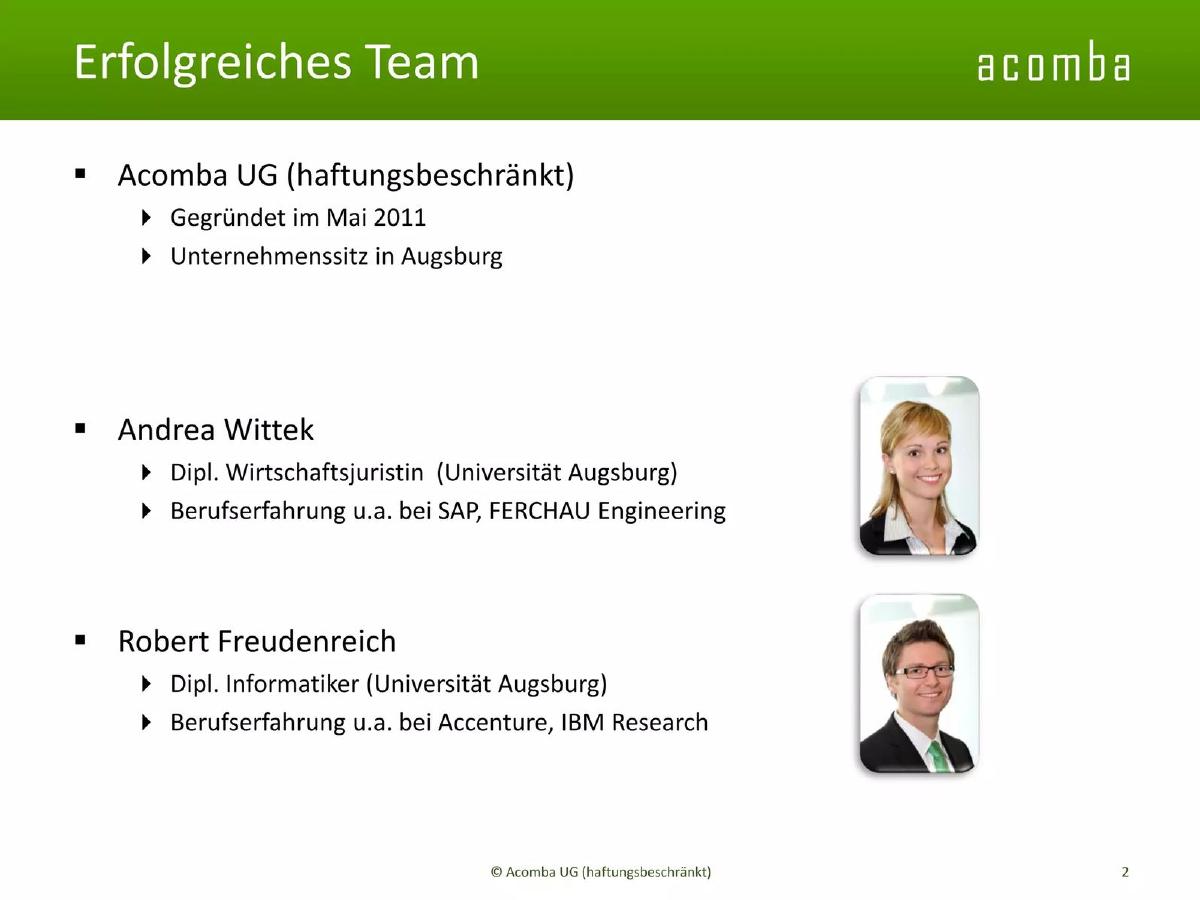
Slide 2: Successful Team (Erfolgreiches Team) The founders are introduced early, which is common for seed-stage companies where the 'who' is as important as the 'what.' Andrea Wittek is listed as a Dipl. Wirtschaftsjuristin (Business Lawyer) with experience at SAP and FERCHAU Engineering. Robert Freudenreich is listed as a Dipl. Informatiker (Computer Scientist) with a background at Accenture and IBM Research. The slide also notes the company was founded in May 2011 in Augsburg, Germany. This slide establishes a balance of technical execution and corporate/legal compliance expertise.
Slides 3-5: The Problem and Product Solution
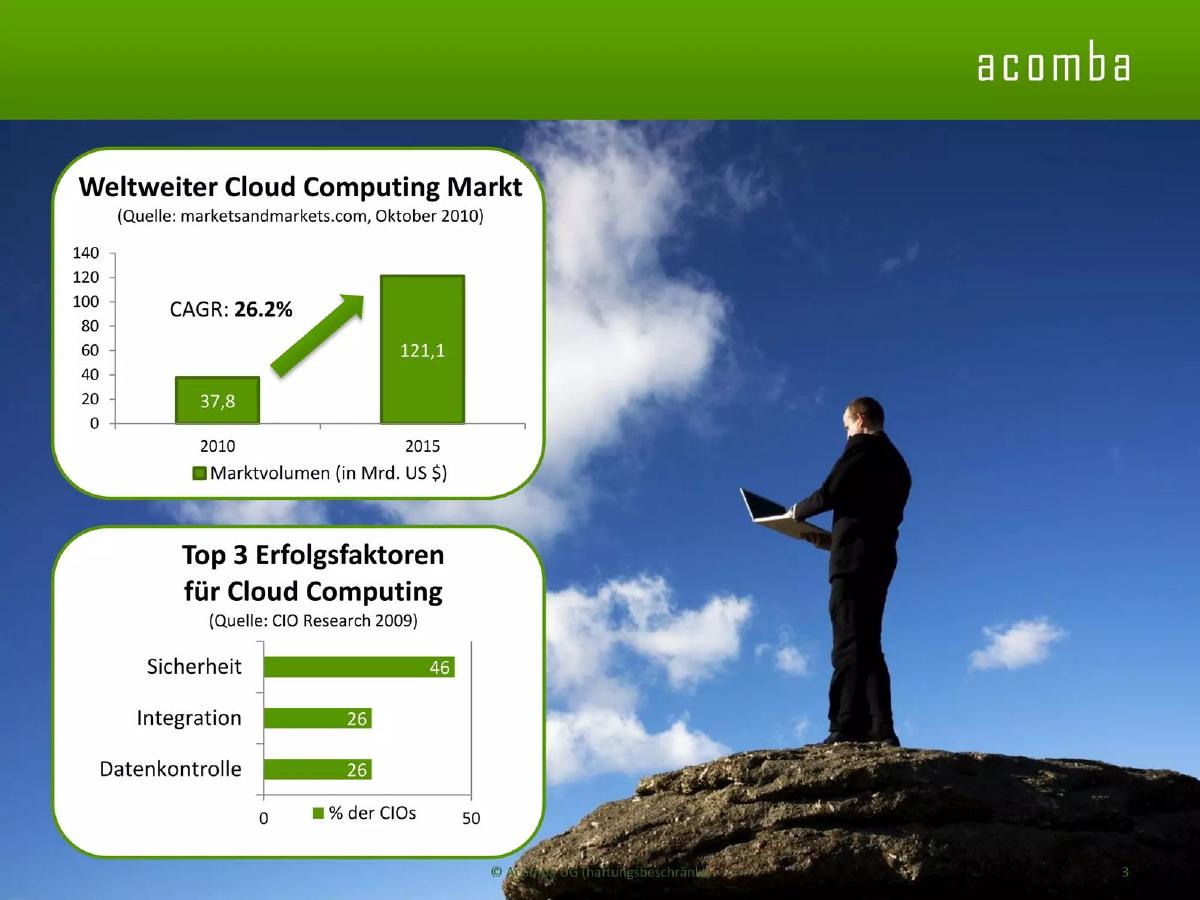
Slide 3: Worldwide Cloud Computing Market This slide uses external data from marketsandmarkets.com and CIO Research to justify the business. It highlights a CAGR of 26.2% for the cloud market, projected to reach $121.1 billion by 2015. Crucially, the bottom chart identifies 'Security' (Sicherheit) as the top success factor for 46% of CIOs, followed by integration and data control at 26% each. This creates an immediate 'why now' for a security product.
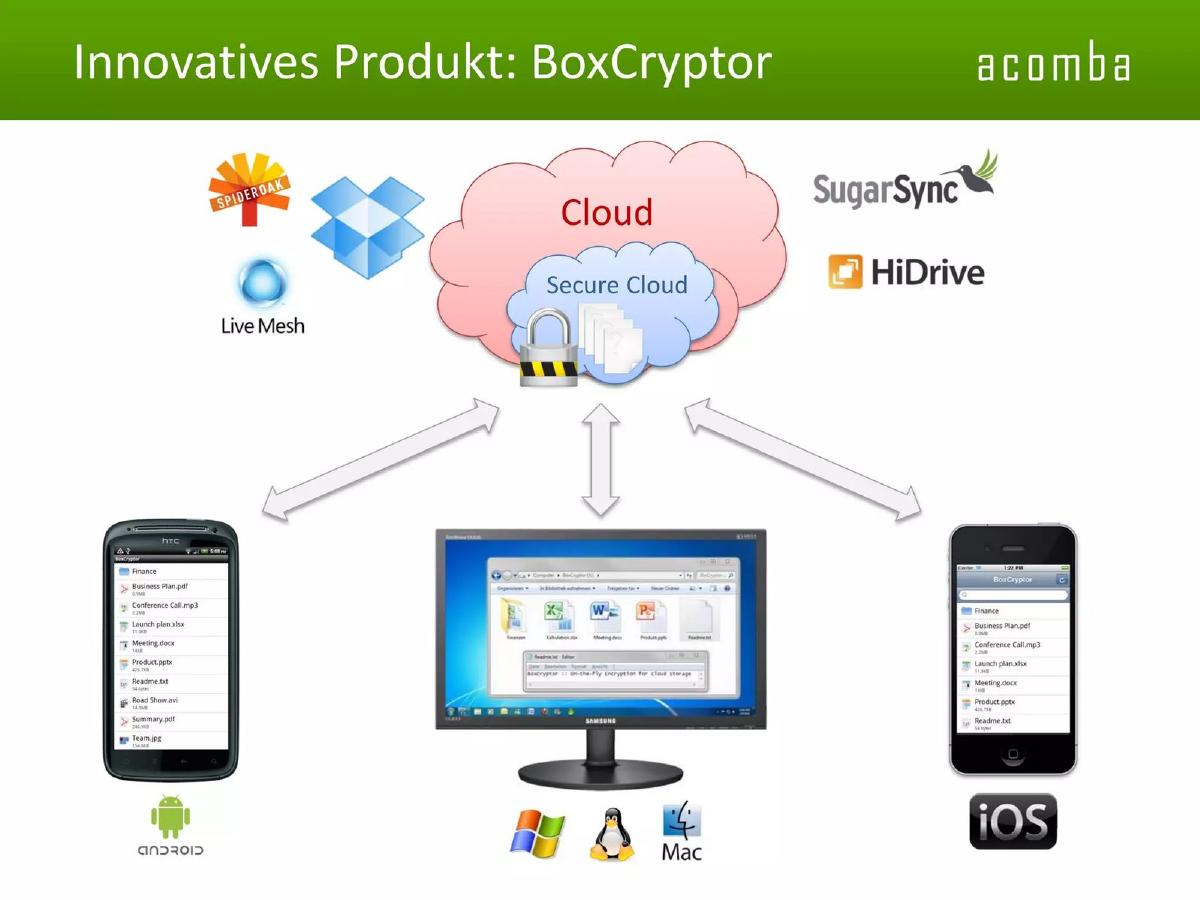
Slide 4: Innovative Product: BoxCryptor This is the primary product visualization slide. It shows BoxCryptor sitting as a 'Secure Cloud' layer between various cloud providers (Dropbox, Google Live Mesh, SpiderOak, SugarSync, HiDrive) and the user's devices. The slide emphasizes cross-platform availability, showing the software running on Windows, Mac, Linux, Android, and iOS. The visual metaphor of a padlock over the cloud icon clearly communicates the value proposition without needing deep technical text.
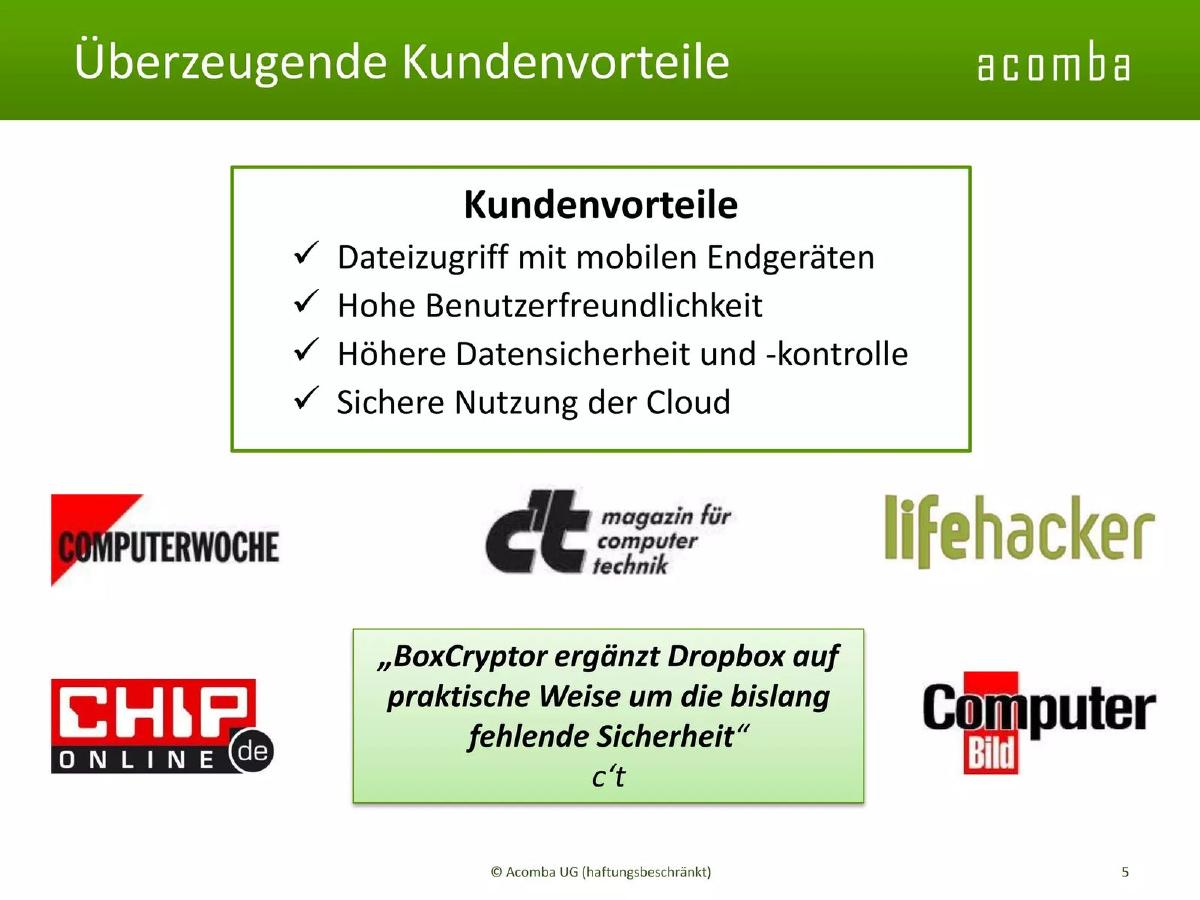
Slide 5: Convincing Customer Benefits (Überzeugende Kundenvorteile) The slide lists four key benefits: mobile data access, high user-friendliness, higher data security/control, and secure cloud usage. More importantly, the bottom half of the slide is dedicated to 'social proof' through press logos. It features Computerwoche, c't magazin, Lifehacker, Chip Online, and Computer Bild. A quote from c't magazin states: 'BoxCryptor complements Dropbox in a practical way by adding the previously missing security.' This third-party validation is a powerful trust signal for a security startup.
Slides 6-7: Market Opportunity and Competition
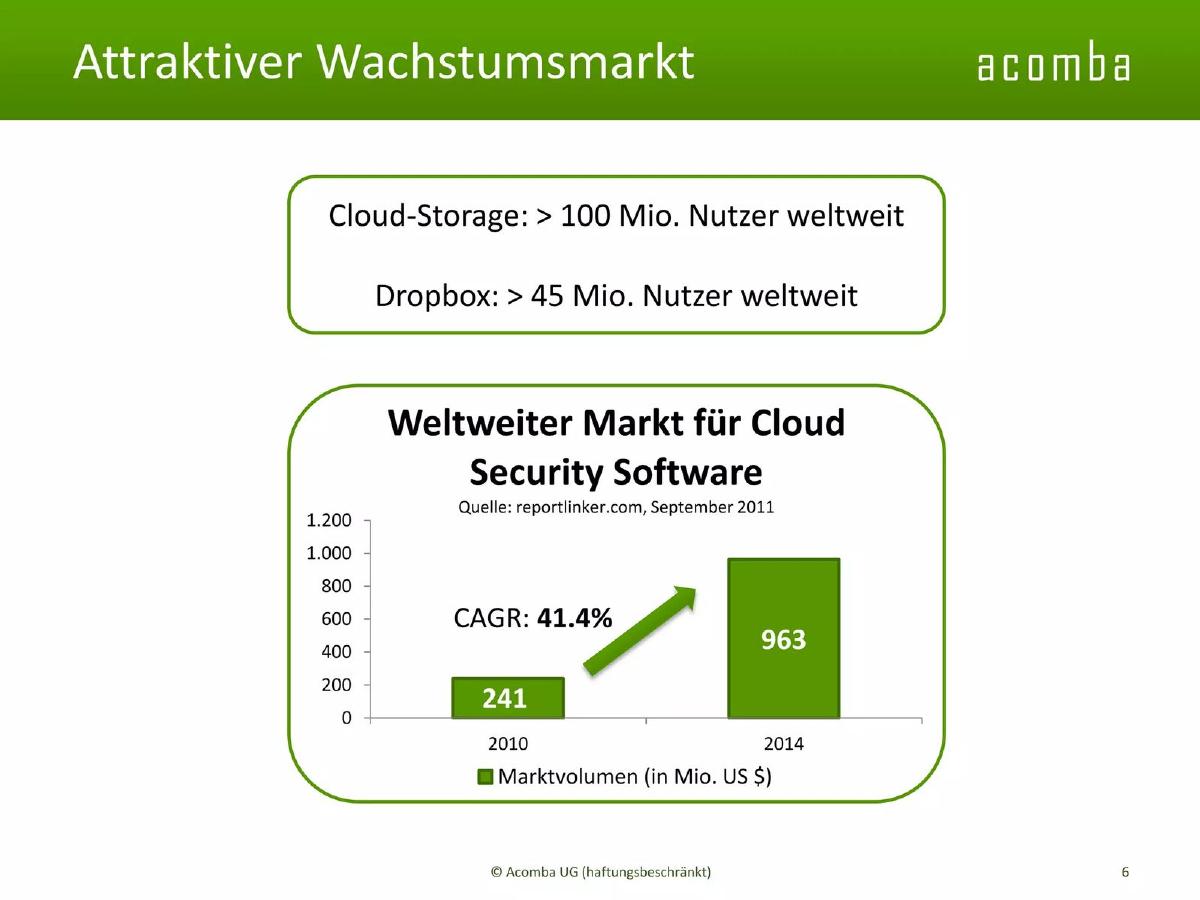
Slide 6: Attractive Growth Market The deck zooms in from the general cloud market to the specific niche of Cloud Security Software. It cites a CAGR of 41.4%, with the market expected to grow from $241 million in 2010 to $963 million in 2014. It also notes the massive user bases of potential partners/platforms: over 100 million cloud storage users and over 45 million Dropbox users. This suggests that even a small percentage of 'security-conscious' users represents a massive customer base.
Slide 7: Unique Competitive Position The competitive matrix uses two axes: 'Cloud Optimized' vs. 'Not Cloud Optimized' and 'Large Enterprise' vs. 'Small Business/End Customer.' Boxcryptor places itself in the top-right quadrant (Cloud Optimized + SMB/Consumer). It positions legacy giants like Sophos, Symantec, and McAfee in the 'Not Cloud Optimized' and 'Large Enterprise' quadrants. Smaller competitors like SecretSync and EncFS are shown as less cloud-optimized or less user-friendly. This slide effectively argues that the 'big guys' are too slow and the 'small guys' lack the polish or specific cloud focus of Boxcryptor.
Slides 8-9: Business Model and Traction
Slide 8: Scalable Business Model Boxcryptor utilizes a freemium model. The slide breaks down pricing by platform:
Windows: Free version; Unlimited Personal for 14.99€ (planned to increase to 29.99€); Unlimited Business for 34.99€ (planned to increase to 59.99€). · Android: Free version; Unlimited for 4.99€. · iOS: Free version; Unlimited for 6.99€.
The mention of 'tba' (to be announced) price increases suggests the founders believe they are currently underpricing relative to the value provided.
Slide 9: Strong Growth (Starkes Wachstum) This is the 'traction' slide. It reports over 50,000 downloads for Windows and over 5,000 for Android. It also claims approximately 5,000 new installations per day for the Windows version. A bar chart shows monthly revenue (Umsatz) from May 2011 to October 2011. While the absolute numbers are small (peaking at roughly 2,250€ in October), the month-over-month growth trend is clear and positive. This 'Proof of Concept' is vital for a seed round.
Slides 10-12: The Financials and The Ask
Slide 10: Future-Oriented Financing Concept The slide outlines the 'Ask' and the roadmap. They are seeking an investment of approximately 500,000€ (though the catalogue facts state they raised $400k). The funds are earmarked for team expansion, increased marketing, and development of further products. A financial table provides projections:
2011: 10k€ Revenue, 2 Employees, -36k€ EBIT. · 2012: 100k€ Revenue, 7 Employees, -400k€ EBIT. · 2013: 1,000k€ Revenue, 11 Employees, 200k€ EBIT.
The table explicitly shows the 500k€ capital requirement falling in 2012.
Slide 11: Why Invest? This serves as the summary slide, listing seven key points: Innovative product, international recognition, proof of concept achieved, large growth market, good exit possibilities, very good scalability, and a successful team. It is a standard 'recap' slide designed to leave the investor with the core highlights.
Slide 12: Thank You The final slide provides the company's contact address in Augsburg, Germany. It is functional but lacks a final 'call to action' or a repeat of the founders' direct email addresses.
What Works in This Deck
Specific Market Timing: The deck identifies a very specific window of time where cloud storage was ubiquitous but security was an afterthought. By citing that 46% of CIOs care about security (Slide 3), they turn a 'nice-to-have' tool into a 'must-have' infrastructure component.
Clear Traction: For a seed round, 50,000 downloads and 5,000 daily installs (Slide 9) are impressive metrics. It proves that the 'freemium' top-of-funnel is working, even if the initial revenue is low. It shifts the conversation from 'will people use this?' to 'how do we monetize this better?'
Platform Breadth: Showing support for Windows, Mac, Linux, iOS, and Android (Slide 4) is a significant technical moat for a small team. It demonstrates that the product is ready for a multi-device world, which was a key selling point for cloud users in 2012.
What Is Missing
Unit Economics: While the deck shows revenue growth and pricing, it does not mention Customer Acquisition Cost (CAC) or Lifetime Value (LTV). Since they are using a freemium model, understanding the conversion rate from free to paid is a critical omission that an investor would likely ask about immediately.
Technical Deep-Dive: For a security product, there is very little information about the actual encryption standards used (e.g., AES-256, RSA). While a pitch deck should stay high-level, a security-conscious investor would want to know if the architecture is truly 'zero-knowledge' or if the company holds the keys.
Detailed Exit Strategy: Slide 11 mentions 'Good exit possibilities,' but it does not list potential acquirers. In 2012, companies like Dropbox, Box, or even antivirus firms like Symantec would have been obvious candidates, and naming them could have strengthened the case.
What a Founder Should Copy
The 'Complementary' Positioning: Rather than trying to build a 'secure Dropbox' (which would require massive capital to compete on storage and sync), Boxcryptor built a layer on top of Dropbox. Founders should look for ways to 'piggyback' on the growth of existing giants rather than fighting them head-on.
The Press as Validation: Slide 5 is a masterclass in using press logos to build credibility. For a startup handling sensitive data, being featured in 'c't magazin' or 'Lifehacker' acts as a proxy for a security audit in the eyes of early-stage investors.
Simple Visual Metaphors: The cloud-with-a-lock graphic on Slide 4 is much more effective than a paragraph of text explaining end-to-end encryption. Founders should always aim for the 'one-glance' explanation of their product's core value.
Frequently asked questions
- What was Boxcryptor's primary value proposition in 2012?
- Boxcryptor's value proposition was providing an encryption layer for existing cloud storage providers. As shown on Slide 5, it aimed to 'complement Dropbox in a practical way by adding the previously missing security.' This allowed users to benefit from cloud convenience while maintaining data control and high security standards.
- How did the company demonstrate market demand?
- The deck uses a combination of macro market data and internal traction. Slide 6 notes that Dropbox had over 45 million users, while Slide 9 shows Boxcryptor's internal growth: 50,000+ Windows downloads and a revenue spike in October 2011, proving that a subset of cloud users were willing to pay for security.
- What was the competitive landscape according to the deck?
- Slide 7 categorizes competitors by target market (Enterprise vs. SMB/Consumer) and Cloud Optimization. Boxcryptor positioned itself against legacy encryption firms like Sophos, McAfee, and Symantec, arguing that those players were not 'cloud optimized,' while smaller rivals like SecretSync and EncFS lacked their specific market reach.
- What were the financial goals stated in the pitch?
- According to Slide 10, the company aimed to grow revenue from 10,000€ in 2011 to 1,000,000€ by 2013. They projected reaching profitability (EBIT of 200,000€) in 2013, supported by a total capital requirement of 500,000€.
- Is the team experienced enough for a cybersecurity startup?
- The deck highlights a balanced founding duo on Slide 2. Robert Freudenreich brought technical depth with a degree in Computer Science and experience at IBM Research, while Andrea Wittek provided legal and business expertise from SAP and her background as a business lawyer. This combination addressed both the 'how' and the 'legal compliance' aspects of data security.