Bouncehelp is a sales optimization tool designed to increase website conversion through instant call connections. The deck highlights a highly specific value proposition: a 9-second connection guarantee and a simple $1.99 per lead pricing model. With early traction showing 48 paid websites and $12,225 processed via Stripe within a month of launch, the company demonstrates immediate market fit for small-to-medium business websites. However, the deck lacks a specific financial ask, opting for vague requests for 'smart capital' and 'mentorship.' While the market sizing is ambitious, calculating…
Key takeaways
- The founders claim over 30 years of combined experience and have previously raised $1.5 million for other tech ventures (Slide 2).
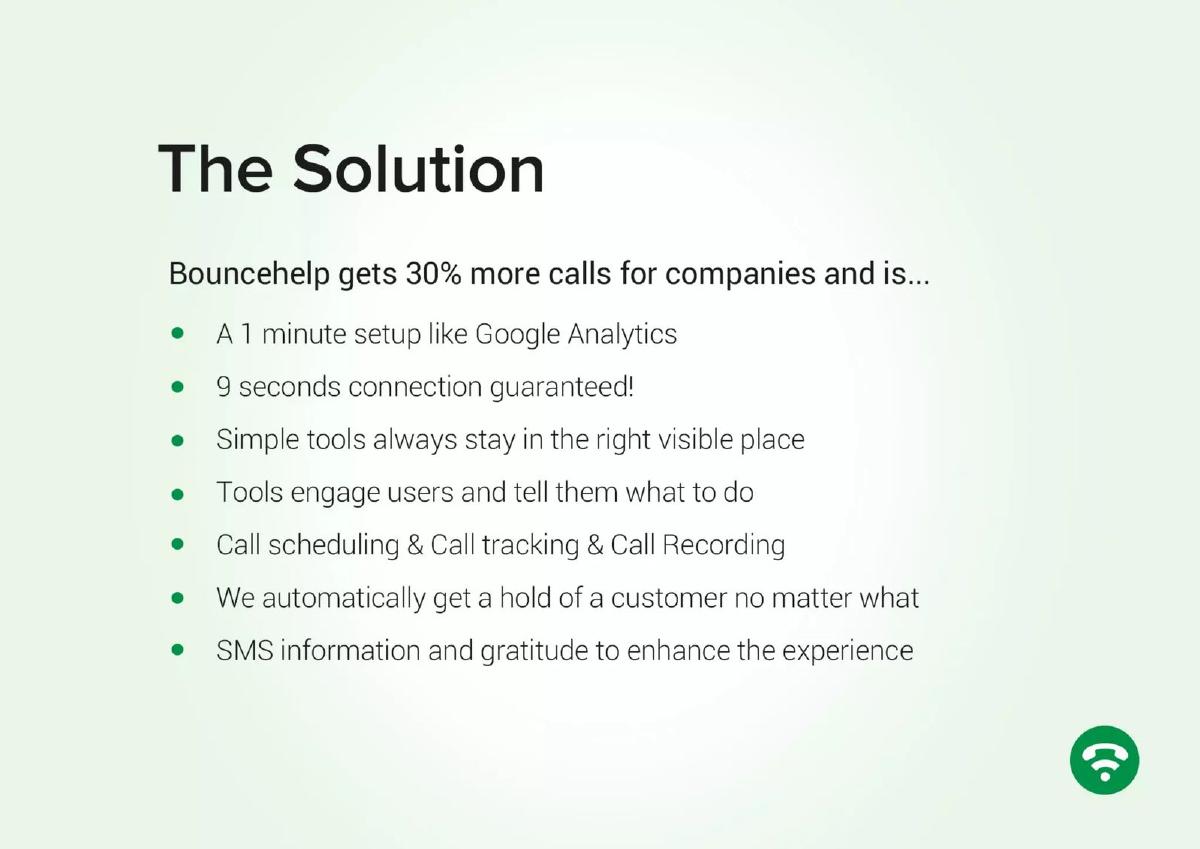
- The core product promise is a 9-second connection guarantee between a website visitor and a sales representative (Slide 4).
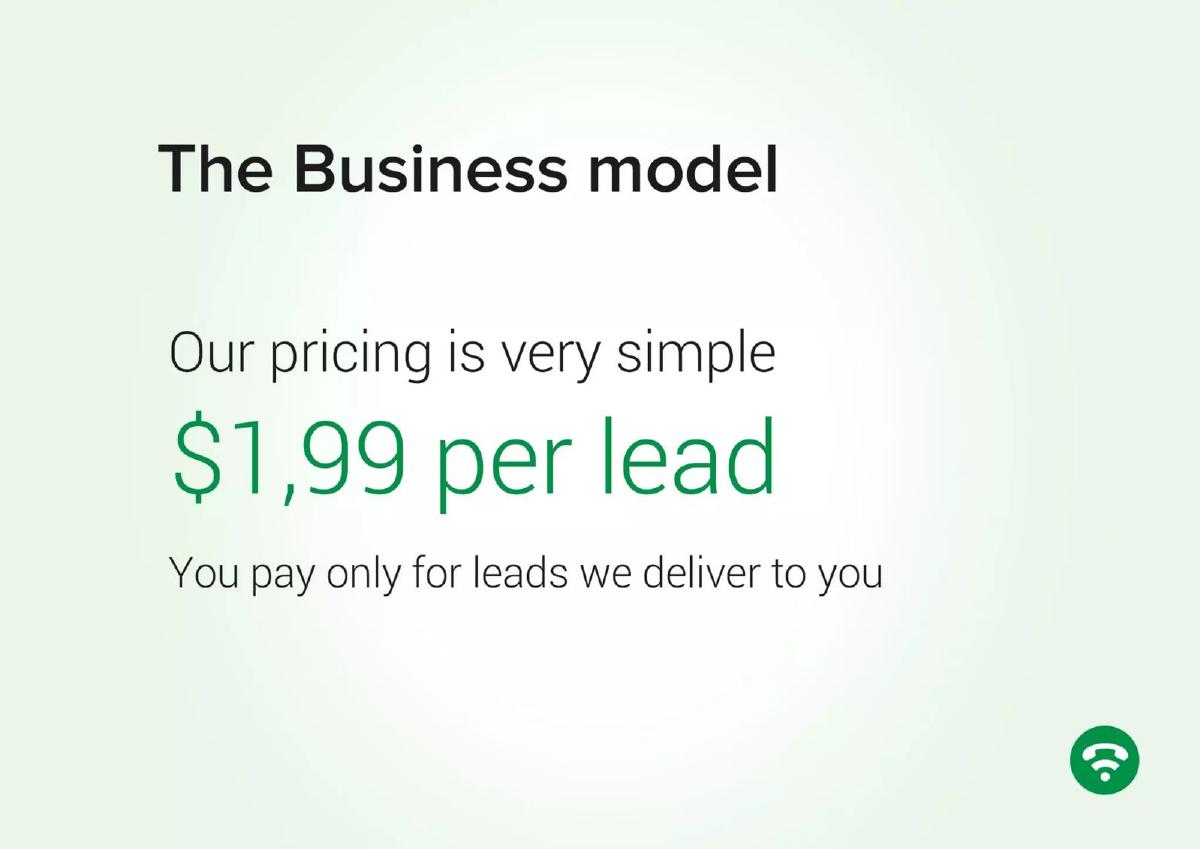
- The business model is strictly performance-based, charging customers exactly $1.99 per lead delivered (Slide 5).
- Market sizing assumes a 1.3% conversion rate across 78 billion annual visitors to 160,000 targeted US websites (Slide 6).
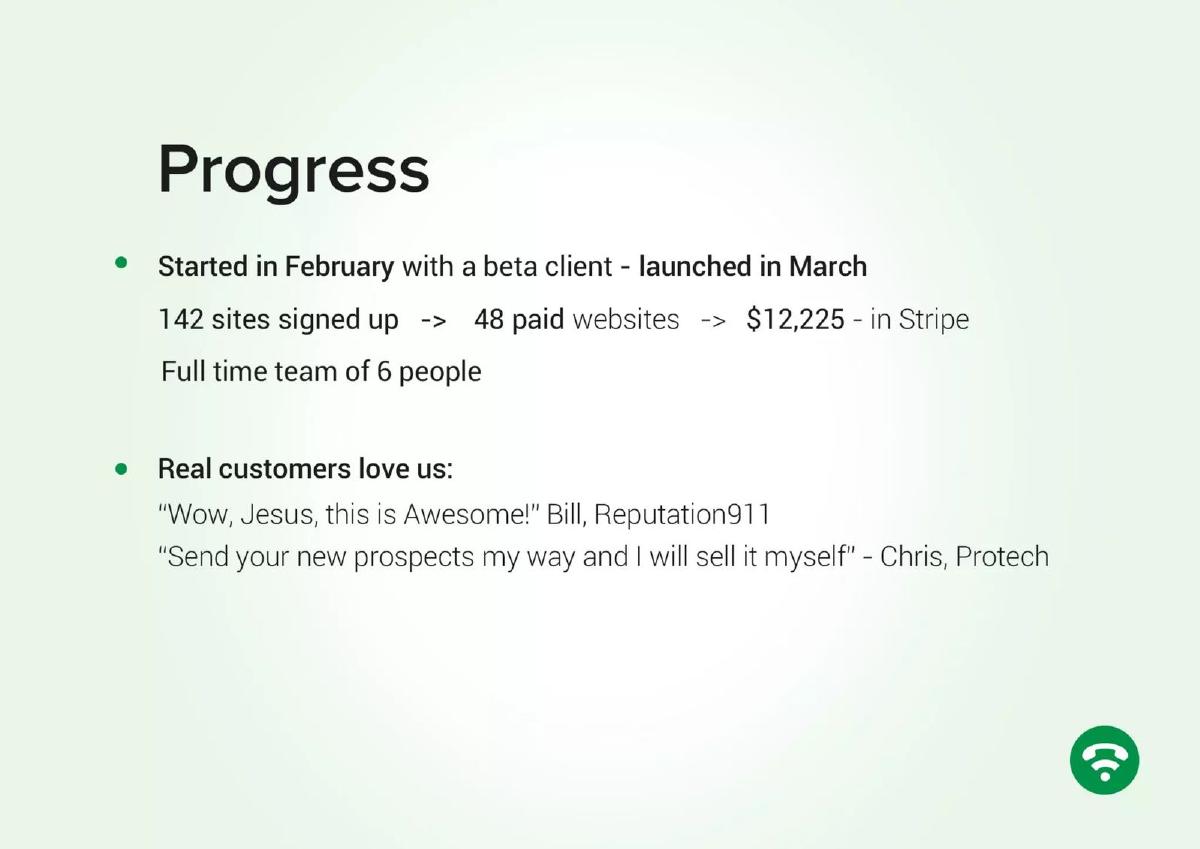
- Early traction metrics show a conversion from 142 sign-ups to 48 paid websites in the first month post-launch (Slide 8).
- The company reported $12,225 in revenue processed through Stripe at the time of the deck's creation (Slide 8).
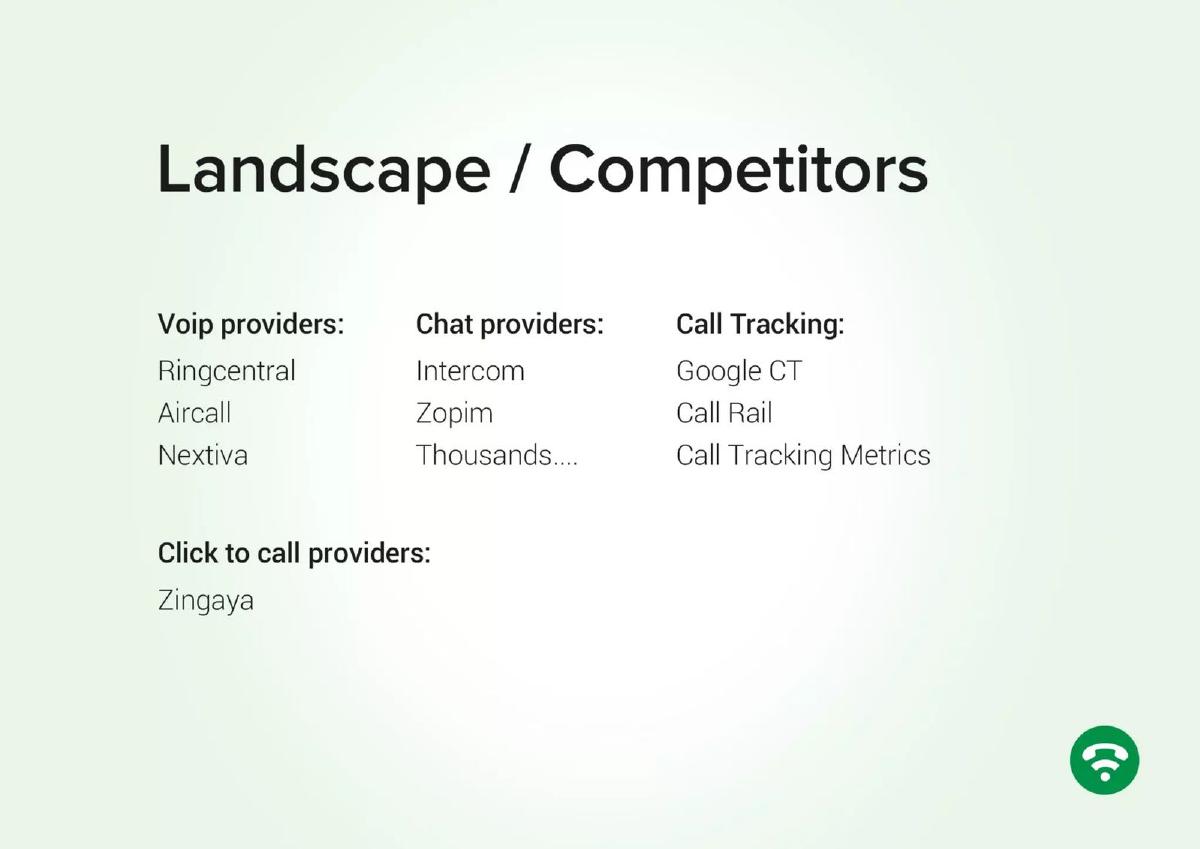
- The deck identifies four distinct competitor categories: VoIP, Chat, Call Tracking, and Click-to-call providers (Slide 7).
- The final slide omits a specific dollar amount for the funding round, requesting 'Smart capital' instead (Slide 10).
Bouncehelp Pitch Deck Analysis
Bouncehelp provides a 10-slide deck that follows a traditional, if somewhat minimalist, narrative structure. The deck is focused on a specific utility: converting website traffic into immediate phone calls. The visual style is clean, utilizing a consistent green and white color palette that matches their logo.
Slide 1: Title Slide
The cover slide introduces the company name, Bouncehelp, accompanied by the tagline: "Get More Sales Calls From Your Website." The logo features a green circle with a telephone handset and signal waves, clearly signaling the telecommunications nature of the product. It is a functional, no-frills entry point.
Slide 2: The Team
The team slide lists three key members: Dmitri Kozhevnikov (Co-founder & CEO), Denis Rodionov (Co-founder & CTO), and Aaron Moss (VP of Sales). The slide highlights their collective experience, claiming "30 years+ experience in web software design and development." Crucially, it mentions they have "Previously raised $1.5 million in total for tech companies" and lists past ventures such as Dayoga.ru and the Net Planet group of companies. This establishes founder-market fit and prior experience with investor capital.
Slide 3: The Problem
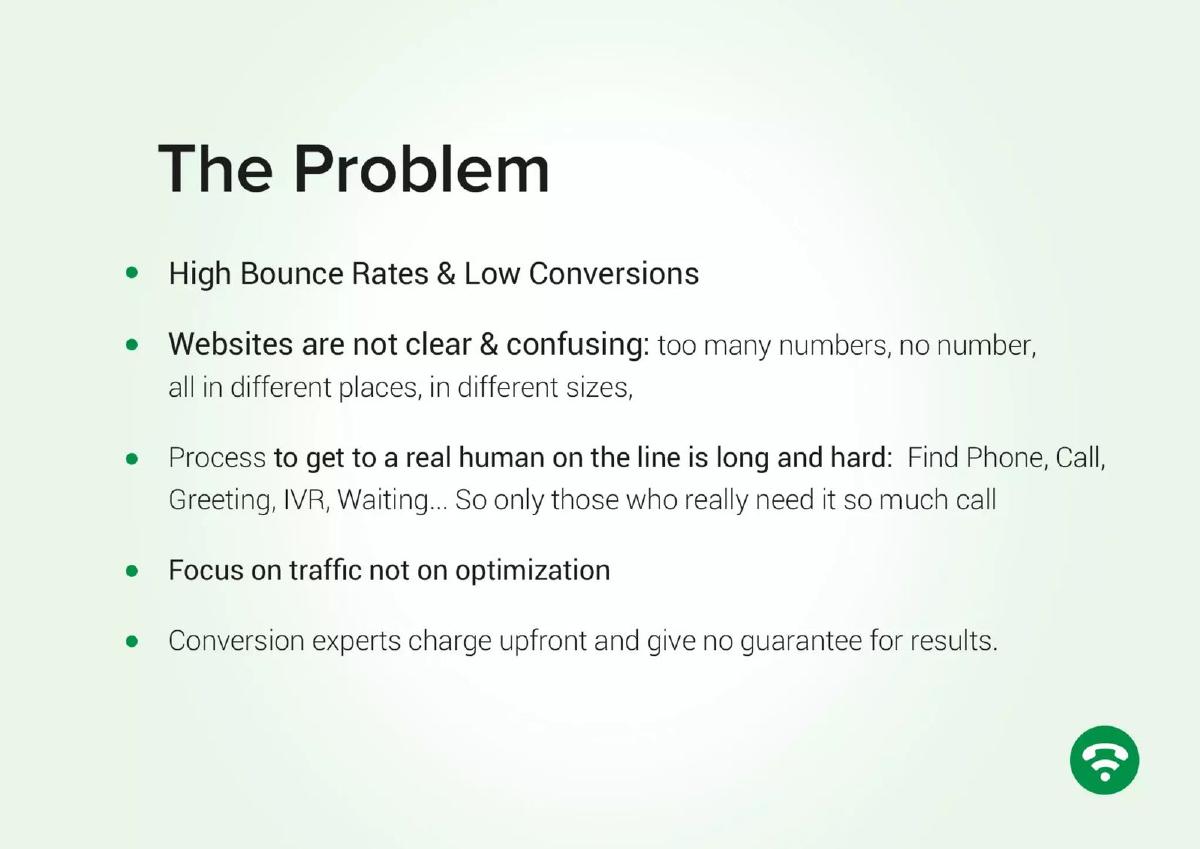
The problem is defined through five bullet points. It identifies "High Bounce Rates & Low Conversions" as the primary issue. It notes that websites are often "not clear & confusing" with too many or no phone numbers. A significant pain point mentioned is the "long and hard" process to reach a human, involving IVR and waiting. Finally, it critiques the current market by stating that conversion experts charge upfront with no guarantees.
Slide 4: The Solution
Bouncehelp positions itself as a solution that "gets 30% more calls for companies." The slide lists technical features including a "1 minute setup," a "9 seconds connection guaranteed," and integrated tools for call scheduling, tracking, and recording. The mention of "SMS information and gratitude" suggests a post-call engagement layer designed to enhance the user experience.
Slide 5: The Business Model
This is one of the strongest slides in the deck due to its simplicity. It states: "Our pricing is very simple: $1.99 per lead." By emphasizing "You pay only for leads we deliver to you," the company aligns its success directly with the customer's success, addressing the lack of guarantees mentioned in the problem slide.
Slide 6: The Market
The market slide uses a flow diagram to calculate a "$2 billion Market Opportunity." It starts with 160,000 US websites that have prominent phone numbers. It estimates these sites receive 78 billion annual visitors. Applying a 1.3% conversion rate leads to a projection of 1 billion "Bouncehelp calls." At the $1.99 price point, this results in the $2 billion figure. The slide adds a note that they intend to "triple it with new plans and features," though it does not specify what those are.
Slide 7: Landscape / Competitors
The landscape slide lists competitors across four categories. It acknowledges major players like Intercom and RingCentral. While it shows an awareness of the market, it lacks a comparison matrix or a "Why we win" section. It simply lists the names, leaving the investor to infer how Bouncehelp differentiates itself from a giant like Google CT or Aircall.
Slide 8: Progress
This slide provides the most compelling evidence for the business. It tracks progress from a February beta to a March launch. The metrics are specific: "142 sites signed up," "48 paid websites," and "$12,225 - in Stripe." It also mentions a "Full time team of 6 people." Two customer testimonials from "Reputation911" and "Protech" are included to provide social proof.
Slide 9: How to Sell
The go-to-market strategy is divided into three pillars: Direct Outbound (specifically "Cold calling 2.0" and email reach outs), Partnerships with agencies and freelancers, and Inbound Marketing. This suggests a multi-channel approach, though it lacks detail on the cost of acquisition (CAC) for these channels.
Slide 10: What we are looking for
The final slide is the "Ask." It is notably vague, listing "Mentorship," "Acceleration," and "Smart capital." It concludes with a simple "THANK YOU." The absence of a specific dollar amount or a breakdown of how the funds will be used is a missed opportunity to drive a concrete investment conversation.
What Works in the Bouncehelp Deck
Clarity of Value Proposition: The deck does an excellent job of explaining exactly what the product does and why it matters. The "9 seconds connection guaranteed" is a powerful, measurable hook that differentiates the service from standard contact forms.
Transparent Pricing: The $1.99 per lead model is easy to understand and reduces the barrier to entry for new customers. Investors generally appreciate performance-based revenue models in the early stages as they demonstrate a high level of confidence in the product's efficacy.
Real Traction: Slide 8 provides hard numbers. Showing five-figure revenue processed through Stripe within a month of launch is a strong signal of product-market fit. It proves that customers are not just signing up, but are willing to pay for the leads generated.
What is Missing from the Bouncehelp Deck
A Specific Financial Ask: The most glaring omission is the lack of a clear funding goal. Investors need to know how much capital is being raised to determine if the opportunity fits their mandate. "Smart capital" is a platitude rather than a business requirement.
Unit Economics: While the revenue is clear, the costs are not. There is no mention of the cost to generate a lead (telephony costs, SMS fees) or the cost to acquire a customer (CAC). Without these, it is impossible to judge the long-term profitability of the $1.99 price point.
Defensive Moat: The competitor slide lists many well-funded companies. The deck does not explain what prevents a competitor like Intercom or Aircall from simply adding a "9-second call" widget to their existing platforms. A discussion on proprietary technology or data moats is absent.
What a Founder Should Copy
The Problem/Solution Alignment: The way Slide 3 (Problem) and Slide 4 (Solution) mirror each other is a best practice. If the problem is "long and hard" processes, the solution is "1 minute setup." This direct addressing of pain points makes the pitch cohesive.
The Use of Specificity: Instead of saying "we are fast," they say "9 seconds." Instead of saying "we have revenue," they say "$12,225 - in Stripe." Specificity builds credibility. Founders should always opt for exact figures over generalizations whenever possible.
Simple Market Sizing: While the $2 billion figure is an estimate, the logic used on Slide 6 is easy to follow. It breaks down the TAM (Total Addressable Market) into a logical flow of websites -> visitors -> conversions -> revenue. This "bottom-up" style of calculation is often more believable than "top-down" industry reports.
Final Thoughts
The Bouncehelp deck is a strong example of a "traction-first" pitch. It relies heavily on the fact that the product is live and generating revenue. While it lacks the financial depth required for a late-stage round, its clarity and simplicity make it an effective tool for early-stage conversations, provided the founders are prepared to fill in the blanks regarding their specific funding needs and long-term defensibility.
Frequently asked questions
- What is the primary value proposition of Bouncehelp?
- Bouncehelp focuses on reducing friction in the sales process. According to Slide 4, the tool offers a '1 minute setup' and a '9 seconds connection guaranteed' between the user and the company. It aims to solve the problem of confusing websites and long IVR wait times by providing a visible, simple tool that automates customer contact and provides SMS follow-ups.
- How does Bouncehelp generate revenue?
- The company uses a pay-per-performance business model. As stated on Slide 5, they charge a flat fee of '$1.99 per lead.' The slide emphasizes that customers only pay for the leads actually delivered, which differentiates them from 'conversion experts' mentioned in the problem slide who charge upfront fees without guarantees.
- What early traction has the company achieved?
- Slide 8 details a launch timeline starting in February with a beta and a full launch in March. In that short window, they secured 142 sign-ups, resulting in 48 paid websites. This activity generated $12,225 in revenue, which the deck specifies was processed through Stripe.
- Who are the competitors listed in the deck?
- Slide 7 categorizes competitors into four groups: VoIP providers (RingCentral, Aircall, Nextiva), Chat providers (Intercom, Zopim), Call Tracking (Google CT, Call Rail, Call Tracking Metrics), and Click-to-call providers (Zingaya). The deck positions Bouncehelp as a specialized alternative to these broader communication suites.
- Is there a specific funding ask in this deck?
- No. Slide 10, titled 'What we are looking for,' lists 'Mentorship,' 'Acceleration,' and 'Smart capital.' It does not specify a target investment amount, a valuation cap, or a detailed use of funds, which is atypical for a formal seed or Series A pitch deck.