Brain Backups is developing AptaMark, a non-invasive, high-resolution brain imaging platform designed to provide objective diagnostics for Parkinson's Disease (PD). The deck identifies a significant gap in current PD diagnostics, which suffer from high false positive (24%) and false negative (20%) rates. By utilizing gold nanoparticles and D2-specific ligands, Brain Backups claims to achieve 1-micron resolution, significantly surpassing current MRI and CT capabilities. The company seeks $2.5 million for optimization and research deployment, with a long-term goal of an exit after proving safet…
Key takeaways
- Current Parkinson's diagnostics are imprecise, with a 24% false positive rate and 20% false negative rate (Slide 3).
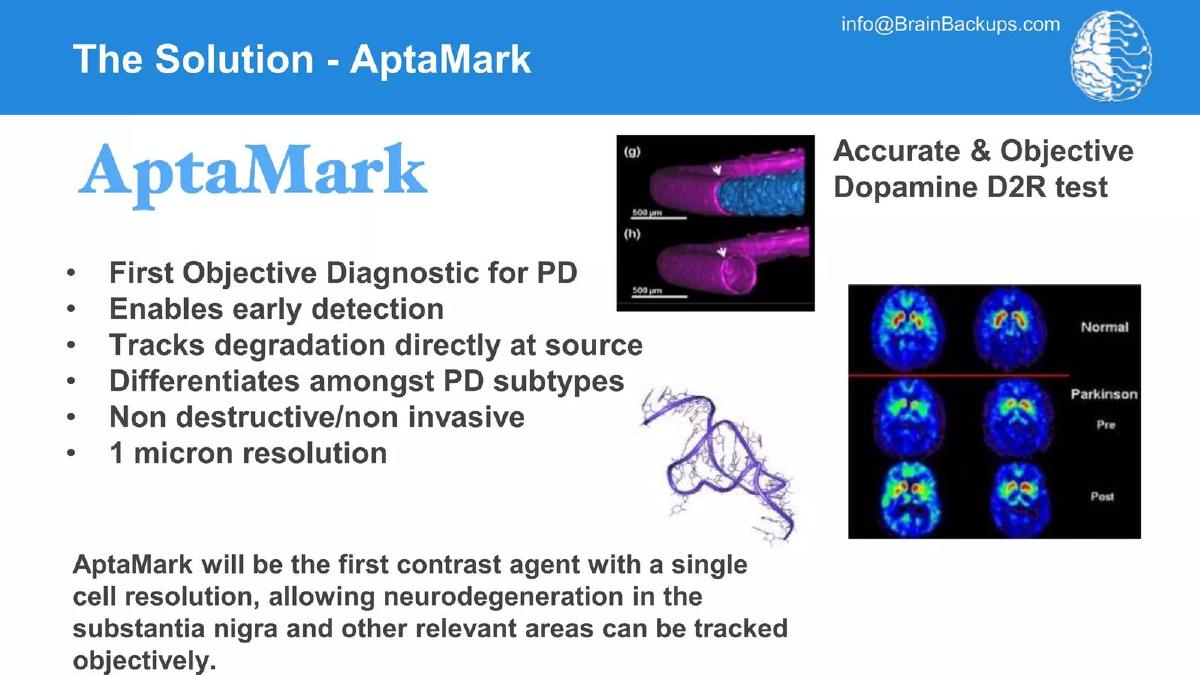
- The AptaMark solution offers 1-micron resolution, which the deck claims is 100x better than MRI (Slide 4, Slide 7).
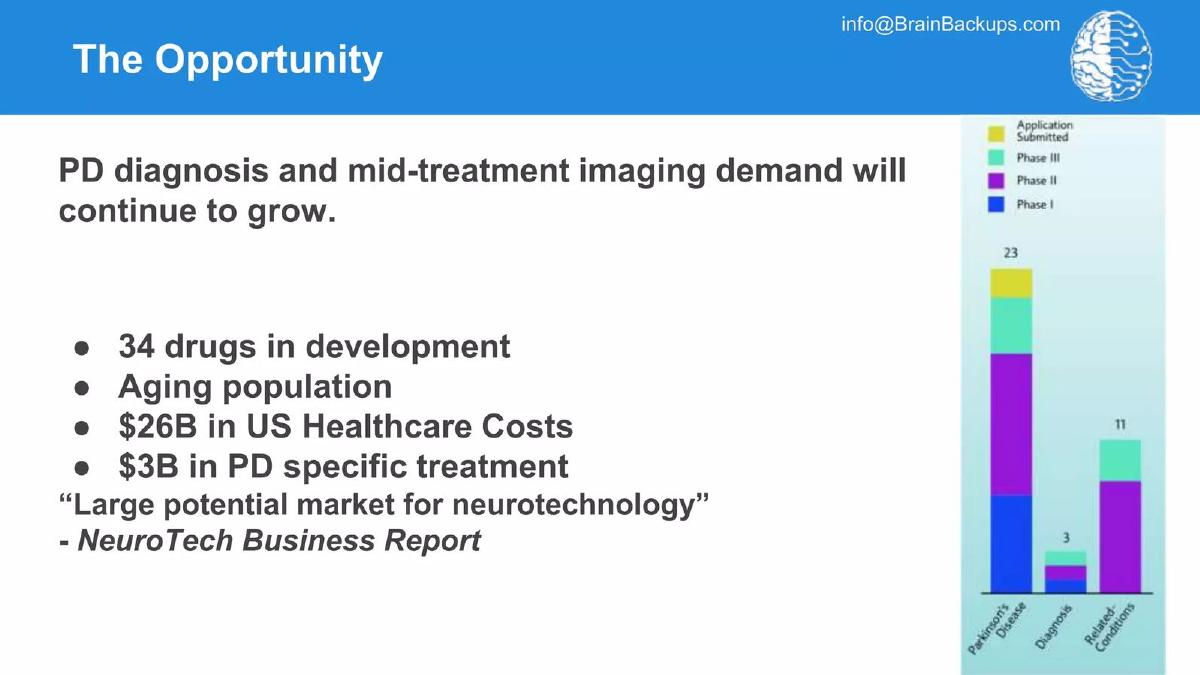
- The company targets a $26B US healthcare cost market related to Parkinson's, with $3B specifically in PD treatment (Slide 5).
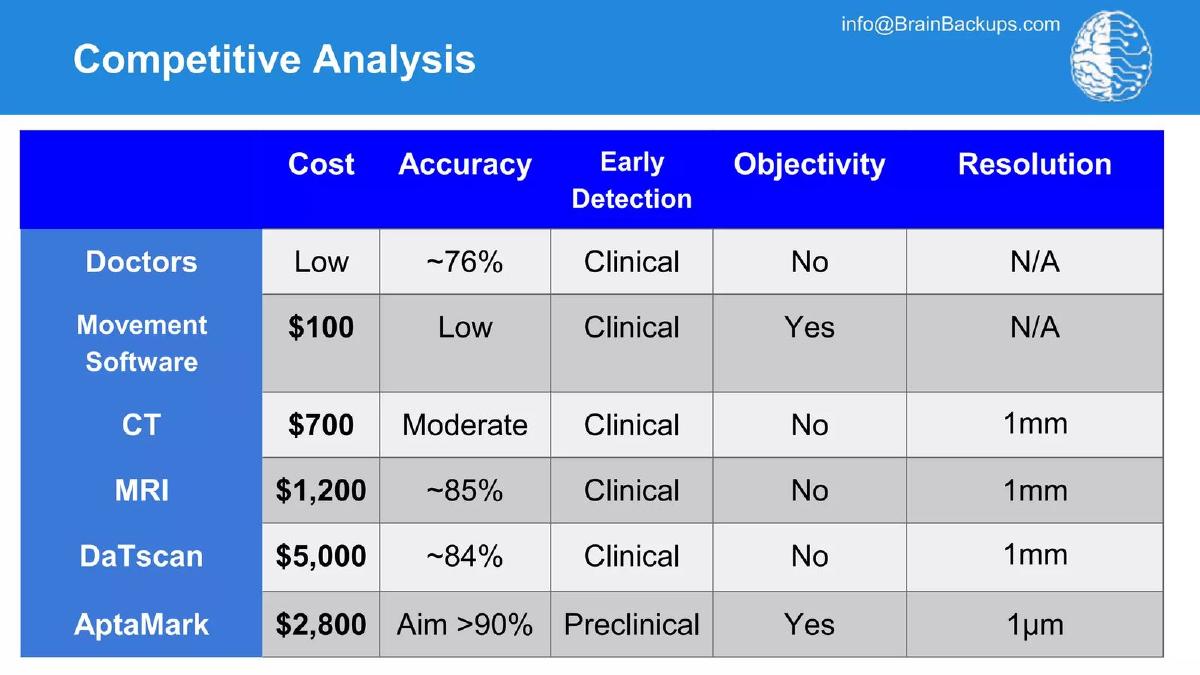
- Competitive analysis positions AptaMark at a $2,800 cost point with >90% aimed accuracy, compared to $5,000 for DaTscan (Slide 6).
- Revenue projections assume a 5% market share by Year 4, generating approximately $4M in initial diagnostic revenue (Slide 8).
- The initial funding ask is $2.5M for optimization, research deployment, and FDA 510K validation (Slide 11, Slide 12).
- The development timeline targets profitability by 2015 following the first deployment in research labs (Slide 15).
- The team includes individuals associated with Harvard, MIT, and Mount Sinai, though specific roles and bios are not detailed (Slide 10).
Brain Backups: The Quest for Objective Parkinson's Diagnostics
Brain Backups presents a technical pitch for a high-resolution imaging platform aimed at solving the diagnostic inaccuracies associated with Parkinson's Disease (PD). The deck transitions from a broad problem statement regarding the limitations of current imaging to a specific technical solution involving nanotechnology and aptamers. While the company name 'Brain Backups' suggests a broader transhumanist or data-storage goal, the deck focuses exclusively on medical diagnostics and research tools.
Slide 1: Title Slide
The title slide introduces the company name, Brain Backups , accompanied by a logo featuring a brain with circuit-like patterns. The subtitle clearly defines the deck's focus: Objective Diagnostics for Parkinson’s Disease .
Slide 2: Our Name - Brain Backups
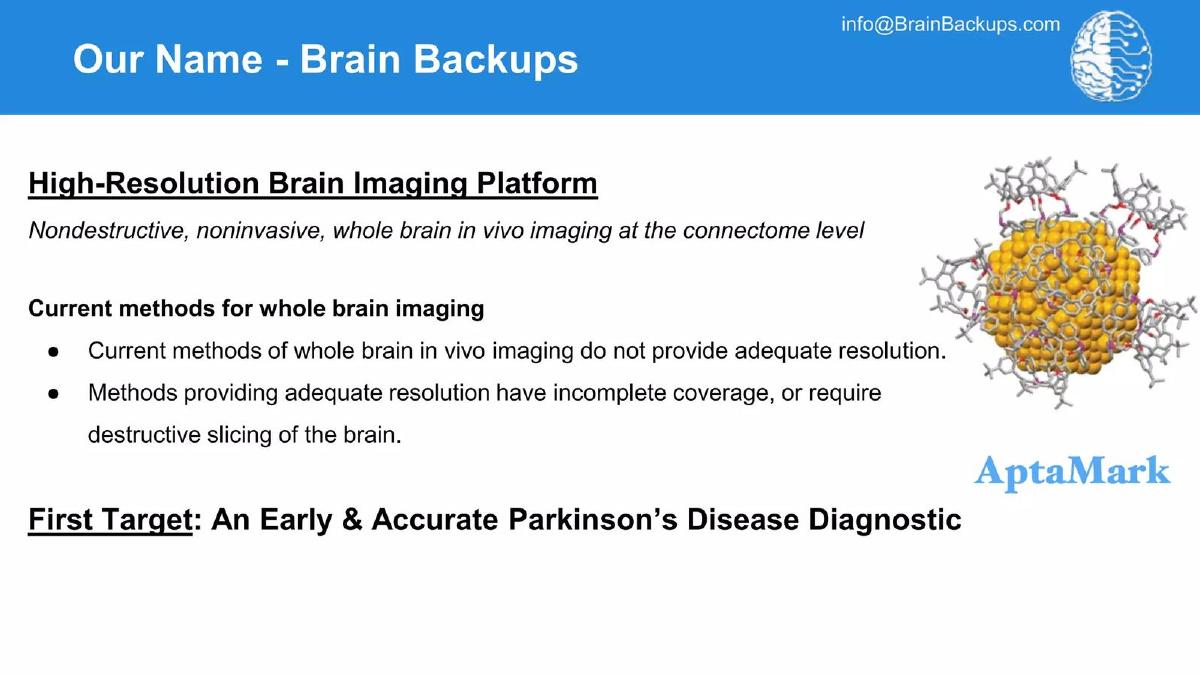
This slide attempts to bridge the gap between the company name and its current product. It describes a High-Resolution Brain Imaging Platform that is 'Nondestructive, noninvasive, whole brain in vivo imaging at the connectome level.' It identifies the 'First Target' as an 'Early & Accurate Parkinson’s Disease Diagnostic' and introduces the product name, AptaMark .
Slide 3: PD Diagnosis Today
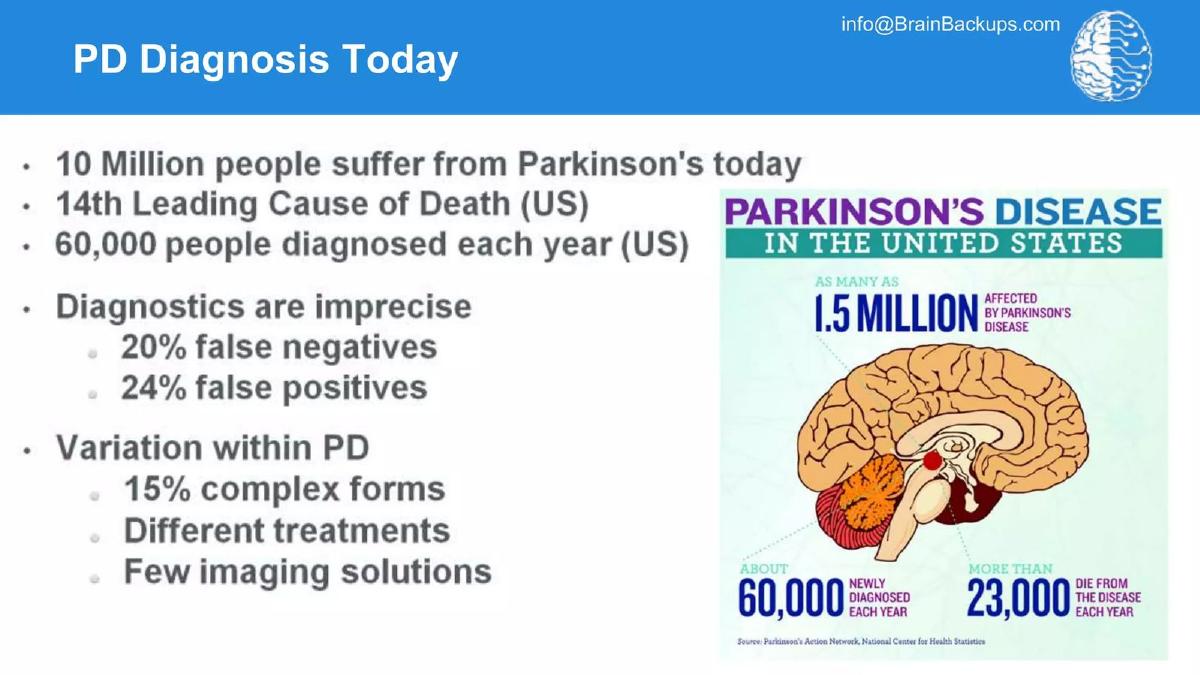
The problem slide highlights the scale of Parkinson's Disease. It notes that 10 million people suffer from PD globally and it is the 14th leading cause of death in the US. Crucially, it points out that current diagnostics are 'imprecise,' citing 20% false negatives and 24% false positives . It also mentions that there are 'few imaging solutions' for the 15% of patients with complex forms of the disease.
Slide 4: The Solution - AptaMark
Slide 4 introduces AptaMark as the solution. It is described as the 'First Objective Diagnostic for PD' that enables early detection and tracks degradation directly at the source. Technical claims include 1 micron resolution and the ability to differentiate among PD subtypes. A caption states that AptaMark will be the first contrast agent with single-cell resolution, allowing neurodegeneration in the substantia nigra to be tracked objectively.
Slide 5: The Opportunity
This slide quantifies the market opportunity. It cites 34 drugs in development , an aging population, and $26B in US Healthcare Costs . A bar chart illustrates the pipeline of drugs in various phases for Parkinson's Disease, Diagnosis, and Related Conditions, suggesting a growing demand for imaging during clinical trials.
Slide 6: Competitive Analysis
A table compares AptaMark to existing methods: Doctors, Movement Software, CT, MRI, and DaTscan. AptaMark is listed with a cost of $2,800 , an aim of >90% accuracy , and 1-micron resolution . Notably, it is the only method listed as 'Yes' for objectivity and 'Preclinical' for early detection, whereas others are limited to 'Clinical' stages.
Slide 7: The Competitors
This slide focuses on DaTscan , a SPECT iodine-123 contrast agent. Brain Backups claims AptaMark offers 100X better resolution than MRI and uses the same GE imaging hardware. Logos for Nanoprobes , Covidien , and Navidea Biopharmaceuticals are displayed as other entities developing contrast agents, though the slide claims they lack AptaMark's specificity.
Slide 8: Revenue Projections
The financial forecast assumes a 5% market share by Year 4 , leading to $4M in initial diagnostic revenue . The slide includes three charts: Market Share (growing to 5%), Cost per Test (decreasing from $3,000), and Revenue (scaling to $4M). It also claims that if used for treatment management, revenue could reach $100M by testing 40,000 patients twice a year.
Slide 9: Potential Partnerships
A 'logo soup' slide features companies Brain Backups aims to engage, including ThermoFisher Scientific , Sigma-Aldrich , GE , Siemens , BD , and CardinalHealth . The text notes an 'active outreach process to engage researchers and clinicians.'
Slide 10: The Team
The team slide features photos of five individuals: Russell Hanson , Jason Fuller , Mihai Dinulescu , Robert Cunningham , and Webster Heffernan . University and corporate logos are placed near the photos, including Harvard , MIT , Mount Sinai School of Medicine , UCLA , Reed College , Ginkgo Bioworks , and Ligon Discovery . No specific titles or biographies are provided on the slide.
Slide 11: What we are asking for...
The 'Ask' slide requests $2.5M for further optimization & research deployment . It mentions a potential for positive ROI from research revenue alone and suggests a future need for $30M+ for Phase I & Phase II toxicology trials . The stated goal is an 'Exit after proven safety & efficacy.'
Slide 12: Appendix: Financial I - $2.5M Series A Breakdown
This slide provides a granular budget for the $2.5M ask. The largest allocations are $1,100,000 for Personnel and marketing (44%) and $500,000 for In vivo validation FDA 510K (20%) . Other costs include $400,000 for real estate and $250,000 for laboratory equipment.
Slide 13: Appendix: Financial II - Research Revenue
Details the unit economics of the AptaMark consumable. The initial product cost is $1,300/test , dropping to $550/test at scale . The cost to the consumer is set at $2,800/test , with a break-even point of approximately 1,200 tests.
Slide 14: Appendix: Development Timeline
A timeline spanning from 2014 to an unspecified future date. It marks a 'Start' at ~$150k , moving to a Series A of $1.5M (note: this contradicts the $2.5M ask on Slide 11/12) in 2014. It predicts profitability in 2015 and a Series B of $10M for toxicology and PD research, eventually leading to an exit after $35M total investment.
Slide 15: Appendix: Financial III - Ancillary Markets
Lists other potential research products for conditions including Alzheimer’s , Autism , Huntington’s , Schizophrenia , and Obsessive Compulsive Disorder .
Slide 16: Appendix: Science I - About Aptamers
Explains the advantages of aptamers: they are very small (1 micron), chemically synthesized (no bioreactors), easy to ship, and can cross the blood-brain barrier without triggering neurons.
Slide 17: Appendix: Science II - Technology Details
Provides a visual of a gold nanoparticle with an attached D2-specific ligand . It also shows an image of a 'Rat knee imaged at 3 microns' and mentions nanoparticle uniformity validation using dynamic light scattering.
Slide 18: Appendix: Ultrahigh-resolution NanoCT
The final slide shows ultrahigh-resolution NanoCT images of a rodent, emphasizing the level of detail (down to 500 microns in these specific images) the technology aims to provide.
What Works in This Deck
Clear Problem Identification: The deck does an excellent job of quantifying the failure of current diagnostics (20-24% error rates), which creates a compelling 'why now' for the technology. · Granular Use of Funds: Slide 12 provides a specific breakdown of how the $2.5M will be spent, which builds trust with investors regarding fiscal responsibility. · Dual-Track Revenue Model: By targeting the research market first, the company shows a path to early revenue and validation while navigating the longer, more expensive FDA clinical trial process. · Technical Specificity: The inclusion of specific resolution metrics (1 micron) and the chemistry of the contrast agent (gold nanoparticles + D2 ligands) provides a level of technical depth necessary for med-tech investors.
What Is Missing or Needs Improvement
Conflicting Figures: Slide 11 and 12 ask for $2.5M, but the timeline on Slide 14 lists a Series A of $1.5M. This discrepancy can be a red flag during due diligence. · Team Roles: While the team slide lists impressive institutions, it fails to state the actual roles (CEO, CTO, etc.) or the specific experience of the founders. Investors need to know who is running the business versus who is providing scientific advisory. · Regulatory Roadmap: While 'FDA 510K' is mentioned in the budget, a more detailed regulatory strategy would be beneficial, especially given the claim that this is a 'first' of its kind diagnostic. · Company Identity: The name 'Brain Backups' and the logo suggest a very different company (perhaps digital consciousness or data storage) than what is presented (a Parkinson's diagnostic). This branding mismatch could be confusing to investors.
Founder Takeaways
Cite Your Sources: Brain Backups cites the 'NeuroTech Business Report' and 'National Center for Health Statistics.' Providing these references adds significant weight to market claims. · Use a Competitive Matrix: The table on Slide 6 is a classic and effective way to show how a new technology outperforms incumbents on key metrics like cost, resolution, and objectivity. · Include Unit Economics: Slide 13's breakdown of cost-per-test versus price-to-consumer is vital for any hardware or consumable-based startup. It proves the founder understands the margins of their business. · Visual Proof: Including actual scans (even if they are rat knees or rodent skeletons) helps move the technology from 'theoretical' to 'functional' in the mind of the investor.
Frequently asked questions
- What is the core technology behind Brain Backups?
- The core technology is AptaMark, a high-resolution brain imaging platform. According to Slide 17, it uses gold nanoparticles with attached D2-specific ligands. These aptamers are chemically synthesized, small enough to cross the blood-brain barrier, and designed to bind to specific neurons without triggering them, allowing for non-destructive, 1-micron resolution imaging.
- How does Brain Backups plan to generate revenue in the short term?
- The company plans to generate 'research revenue' before full clinical approval. Slide 11 and Slide 15 indicate that the first deployment of AptaMark will be in research laboratories. Slide 14 notes that even with an 80% production profit margin, the product is intended to be more cost-effective than current destructive research methods.
- What are the primary financial requirements stated in the deck?
- Brain Backups is asking for $2.5 million for 'further optimization & research deployment.' Slide 12 provides a breakdown of this spend, including $1.1 million for personnel and marketing, $500,000 for in vivo validation (FDA 510K), and $400,000 for laboratory and office space.
- What is the exit strategy for investors?
- The deck explicitly states an 'Exit after proven safety & efficacy' on Slide 11. The development timeline on Slide 15 further clarifies this, suggesting an exit via a 'Full partnership with therapeutic partner' following human testing and the development of further AptaMark products for both research and diagnostic use.
- How does AptaMark compare to existing Parkinson's diagnostic tools?
- Slide 6 compares AptaMark to CT, MRI, and DaTscan. While DaTscan costs $5,000 with ~84% accuracy and 1mm resolution, AptaMark aims for >90% accuracy and 1-micron resolution at a cost of $2,800. Unlike most current methods, AptaMark is described as both objective and capable of early (preclinical) detection.