BrandBoards is a marketplace connecting media buyers with owners of digital signage in live event venues, such as stadiums and arenas. The deck identifies a significant inefficiency in the market: while marquee TV spots like the Super Bowl sell out at $1.5 million, live venues routinely carry 15-35% unsold digital inventory. By positioning themselves as the 'Google AdWords for live events,' the company aims to capture a share of a $9 billion global opportunity. The strength of this pitch lies almost entirely in its team, featuring a former Anheuser-Busch Executive VP who managed $200 million…
Key takeaways
- The company identifies a specific market gap where 15-35% of live event digital inventory remains unsold despite high demand for TV spots (Slide 4).
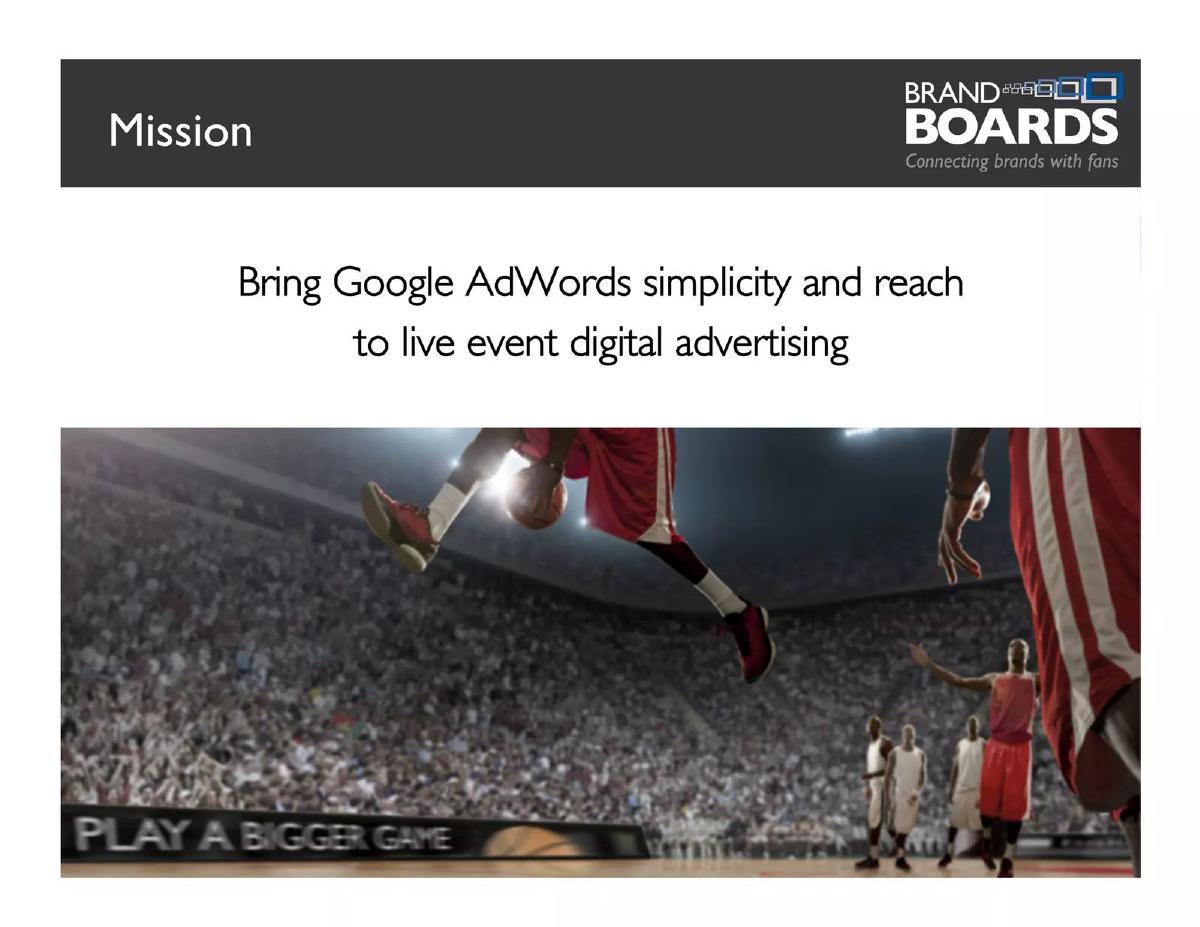
- The mission is framed as a direct analogy to a known success: bringing 'Google AdWords simplicity' to live event advertising (Slide 2).
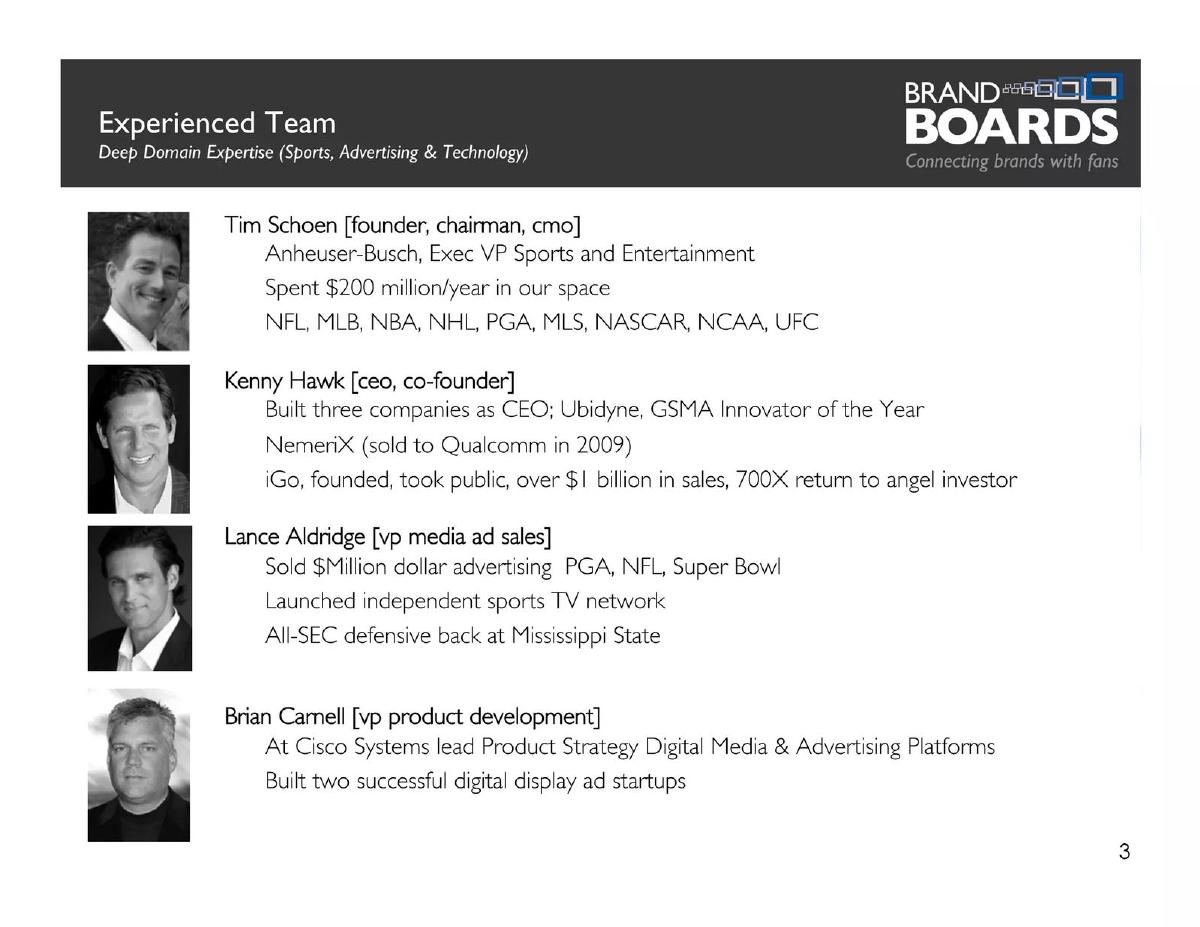
- The team slide is exceptionally strong, citing a founder who managed $200 million in annual spend across major leagues including the NFL, NBA, and MLB (Slide 3).
- CEO Kenny Hawk highlights a track record of building three companies, including one that achieved over $1 billion in sales and a 700X return for angel investors (Slide 3).
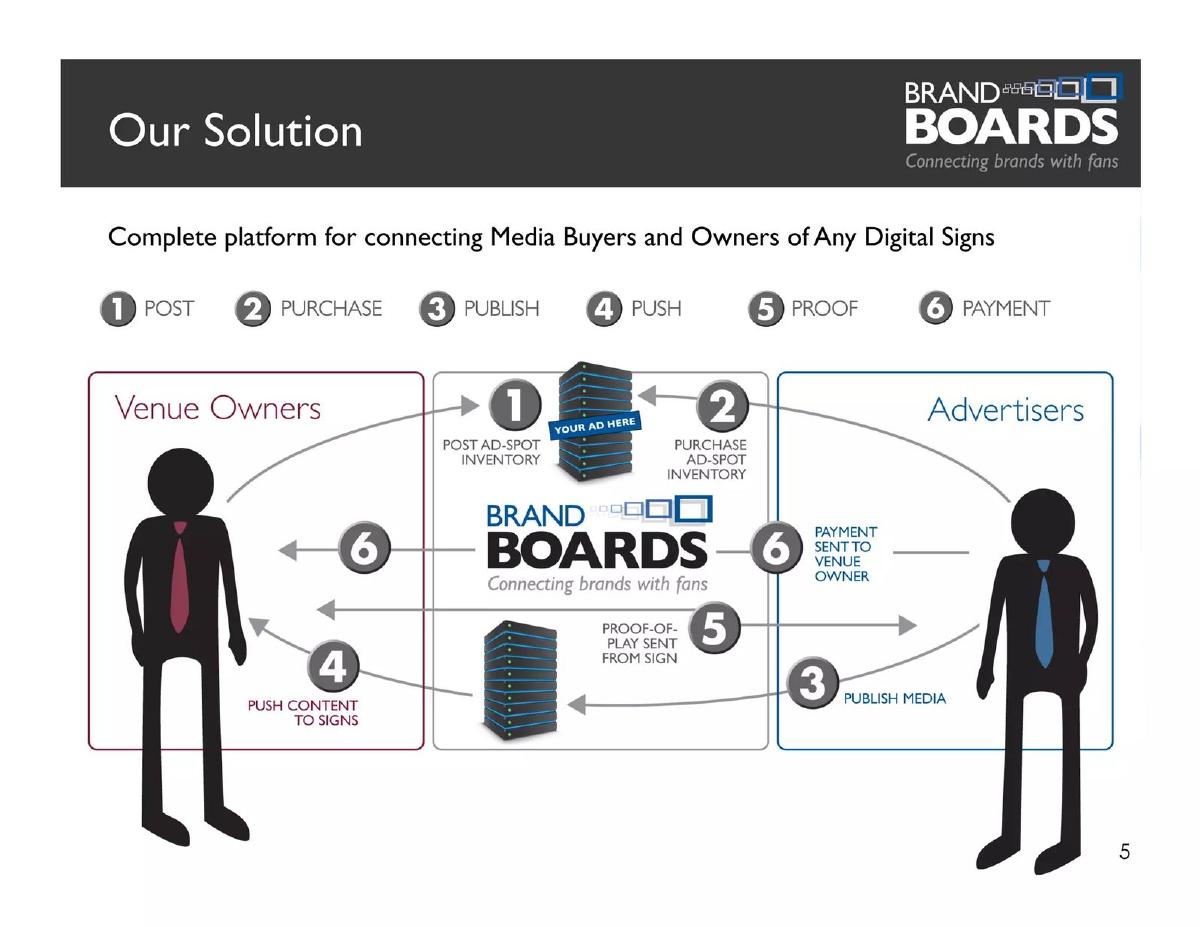
- The solution is visualized as a six-step circular marketplace involving posting, purchasing, publishing, pushing, proof, and payment (Slide 5).
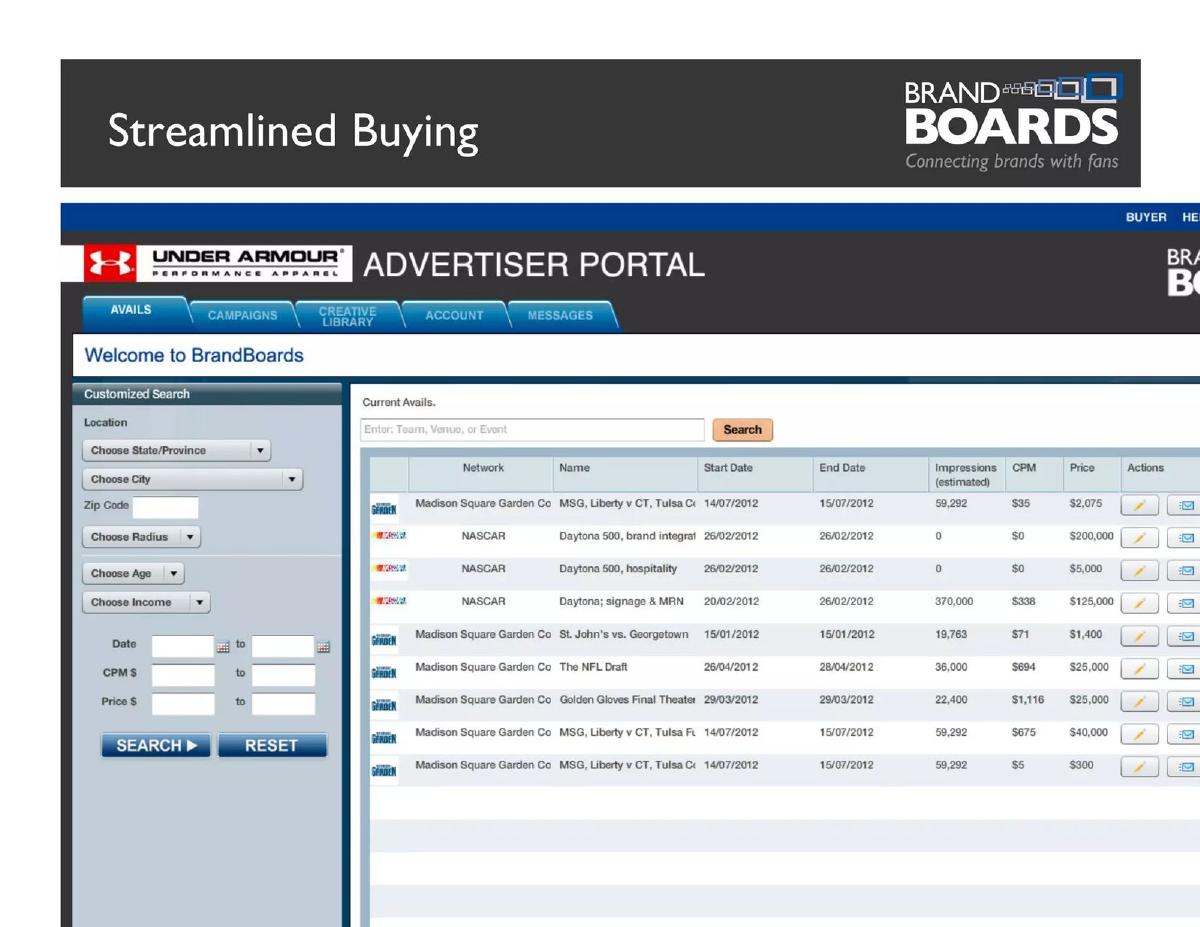
- A product screenshot demonstrates a functional advertiser portal with granular search filters for location, age, and income (Slide 6).
- Traction is validated by $1 million in advertising commitments and ongoing contract phases with major sports franchises like the Golden State Warriors and Dallas Cowboys (Slide 7).
- The financial ask is a modest $750,000, though the deck omits the specific use of funds or a timeline for this capital (Slide 8).
BrandBoards Pitch Deck Analysis
The BrandBoards deck is a concise, 8-slide presentation that focuses heavily on team pedigree and market opportunity. It targets a specific niche within the AdTech space: the digital signage inside live sports and entertainment venues. By framing the problem as a lack of accessibility to 'unsold inventory,' the company positions itself as a necessary bridge between major brands and premium sports audiences.
Slide 1: Title Slide
The title slide is minimalist, featuring the BrandBoards logo and the tagline 'Connecting brands with fans.' It identifies Kenny Hawk as the Co-Founder. The branding is professional but dated, consistent with the era of the listed product screenshots. There is no specific date or round designation on the cover.
Slide 2: Mission
BrandBoards uses a classic 'X for Y' mission statement: 'Bring Google AdWords simplicity and reach to live event digital advertising.' This is an effective way to communicate a complex marketplace solution by anchoring it to a platform that every investor understands. The imagery of a basketball game reinforces the sector focus.
Slide 3: Experienced Team
This is arguably the strongest slide in the deck. The founders have significant 'Deep Domain Expertise.' Tim Schoen brings the buyer's perspective, having spent $200 million per year at Anheuser-Busch across every major US sports league. Kenny Hawk provides the entrepreneurial credibility, citing a 700X return for angel investors and a public exit with $1 billion in sales. Lance Aldridge and Brian Carnell round out the sales and product functions with experience at Cisco and in Super Bowl ad sales. For a $750K raise, this team appears overqualified, which is a strong signal to investors.
Slide 4: The Problem and Opportunity
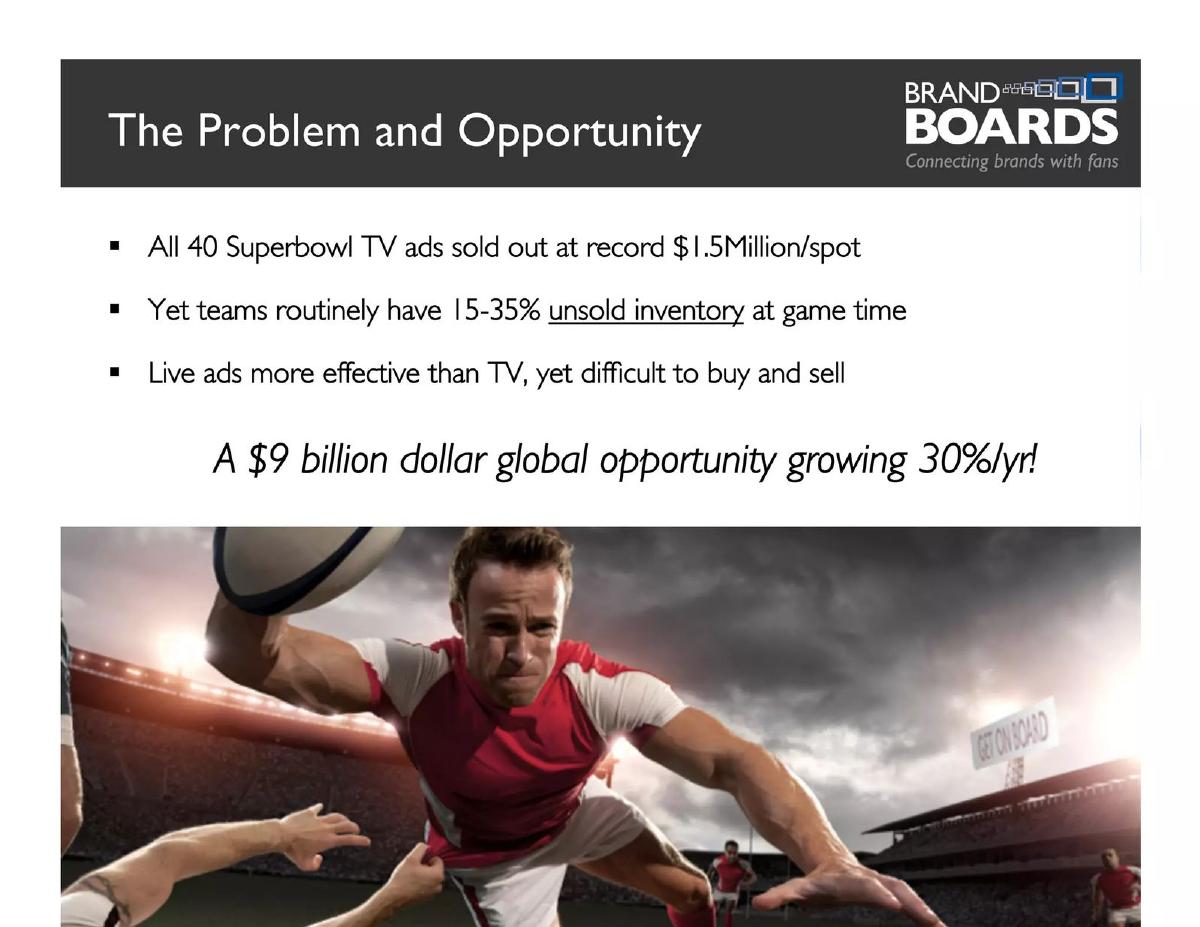
The deck quantifies the inefficiency in the market. It notes that while Super Bowl ads sell for $1.5 million per spot, teams have 15-35% unsold inventory at game time. It values the global opportunity at $9 billion with a 30% annual growth rate. This slide successfully creates a sense of urgency by highlighting 'wasted' inventory that could be monetized through better technology.
Slide 5: Our Solution
Slide 5 provides a workflow diagram of the marketplace. It outlines a six-step process: 1. Post, 2. Purchase, 3. Publish, 4. Push, 5. Proof, and 6. Payment. The diagram shows BrandBoards sitting in the center, handling the servers and the flow of data between Venue Owners and Advertisers. It clarifies that the platform handles the 'Proof-of-Play'—a critical requirement for advertisers to verify their ads actually ran.
Slide 6: Streamlined Buying
This slide shows a screenshot of the 'Advertiser Portal.' It features Under Armour as a placeholder client. The UI allows for 'Customized Search' based on location, age, and income. The 'Current Avails' table lists specific events like 'MSG, Liberty v CT' and 'NASCAR Daytona 500.' It includes metrics like estimated impressions, CPM (ranging from $5 to $1,116 on the slide), and total price. This proves the product is more than a concept; it is a functional tool with granular data.
Slide 7: Accelerating Traction
Traction is presented through two lenses: hard dollars and brand partnerships. The slide claims $1 million in signed advertising commitments. Below this, it displays logos for 12 major sports entities, including the Golden State Warriors, Dallas Cowboys, and New York Knicks, stating they are in the 'contract phase.' This demonstrates that the team's connections (from Slide 3) are translating into actual business development pipeline.
Slide 8: Investment Opportunity
The final slide is the ask: $750,000. It provides a direct email for Kenny Hawk. Notably, this slide lacks any detail on the terms of the round (equity vs. note) or what the capital will be used for (hiring, scaling, or hardware integration).
What BrandBoards Does Well
The deck is exceptionally focused. It does not waste time on tangential markets or overly technical explanations of their 'push' technology. By focusing on the 'unsold inventory' problem, they present a clear value proposition for venue owners: 'We will help you make money on screens that are currently empty.'
The use of the 'Google AdWords' analogy is a powerful shortcut. It tells the investor that the goal is self-service, scale, and data-driven buying, which are the hallmarks of high-margin AdTech businesses. The team slide is the 'closer' here; investors are often willing to overlook missing financial projections if the founders have already delivered billion-dollar outcomes and managed nine-figure budgets in the exact industry they are disrupting.
What is Missing
Unit Economics: The deck never explains how BrandBoards makes money. Is it a percentage of the media buy? A SaaS fee for the venue owners? Without a 'Business Model' slide, the $1 million in commitments is hard to value—is that $1 million in gross merchandise value (GMV) or $1 million in revenue for the startup?
Competition: There is no mention of existing competitors or how venues currently manage this inventory. Are they using legacy systems, or is the competition simply 'doing nothing'?
Use of Funds: A $750,000 raise is relatively small for a marketplace that requires integration with physical venue hardware. The deck fails to explain how this specific amount of capital gets them to the next milestone or profitability.
Founder Takeaways
Leverage your 'unfair advantage': If your team has managed $200M in spend, make that the centerpiece of your pitch. It validates the problem better than any chart could. · Show, don't just tell: The screenshot in Slide 6 is vital. It moves the conversation from 'we want to build a portal' to 'here is the portal we built.' · Quantify the 'Waste': Every marketplace solves an inefficiency. By stating that 15-35% of inventory is unsold, BrandBoards gives a clear reason for the marketplace to exist. · Keep it brief: 8 slides is enough to get a first meeting if the traction and team are high-caliber. You don't need 20 slides to ask for $750K.
Frequently asked questions
- What is the core problem BrandBoards is solving?
- BrandBoards addresses the inefficiency in selling digital signage at live sports and entertainment venues. While major television events sell out, venue owners typically have 15-35% of their digital inventory left unsold at game time. The deck notes that while live ads are effective, they are currently difficult to buy and sell, representing a $9 billion global opportunity.
- How does the platform actually work for an advertiser?
- The platform functions as a streamlined buying portal. Advertisers can search for inventory by location, zip code, radius, and even target demographics like age and income. The deck shows a UI where buyers can see 'Current Avails' for venues like Madison Square Garden, including estimated impressions, CPM, and total price, allowing for immediate purchase and media publishing.
- Who are the key members of the leadership team?
- The team includes Tim Schoen (Founder/CMO), a former Anheuser-Busch EVP who oversaw sports spending for the NFL and MLB; Kenny Hawk (CEO), who led iGo to a public offering and $1 billion in sales; Lance Aldridge (VP Media Ad Sales), who sold Super Bowl ads; and Brian Carnell (VP Product), a former Cisco lead.
- What level of traction has the company achieved?
- At the time of the deck, BrandBoards had signed its first $1 million in advertising commitments. They also listed 12 major sports brands in the 'contract phase,' including the New York Knicks, Cleveland Cavaliers, NASCAR, and the Oakland Athletics, indicating significant top-of-funnel interest from premium venue owners.
- What is missing from this pitch deck?
- The deck is missing several standard components: a detailed breakdown of unit economics (take rates), a competitive landscape analysis, a roadmap for product development, and a 'Use of Funds' slide. It relies heavily on the 'who' (the team) and the 'what' (the $1M traction) rather than the 'how' of the business model.