Canexxia’s presentation is less a product pitch and more a macroeconomic thesis for a healthcare roll-up. The company identifies a significant gap in the senior care market, where medical costs are rising at 6.2% annually while GDP and wages lag behind. Their proposed solution is a 'value-based home health ecosystem' built through aggressive M&A, targeting fragmented local operators who lack scale. While the deck provides strong context on the 'why'—specifically citing the cost-savings of managing diabetes at home (ranging from $589 to $4,641 per member per month)—it is notably light on opera…
Key takeaways
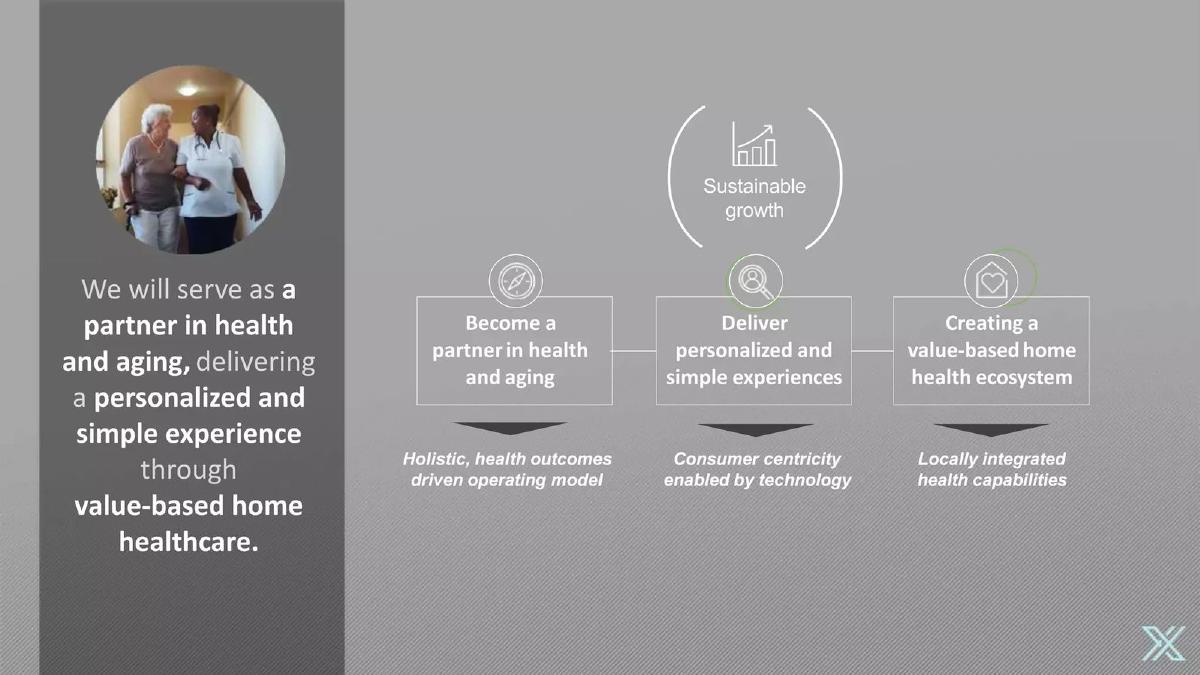
- The company positions itself as a partner in health and aging through a value-based home healthcare model (Slide 2).
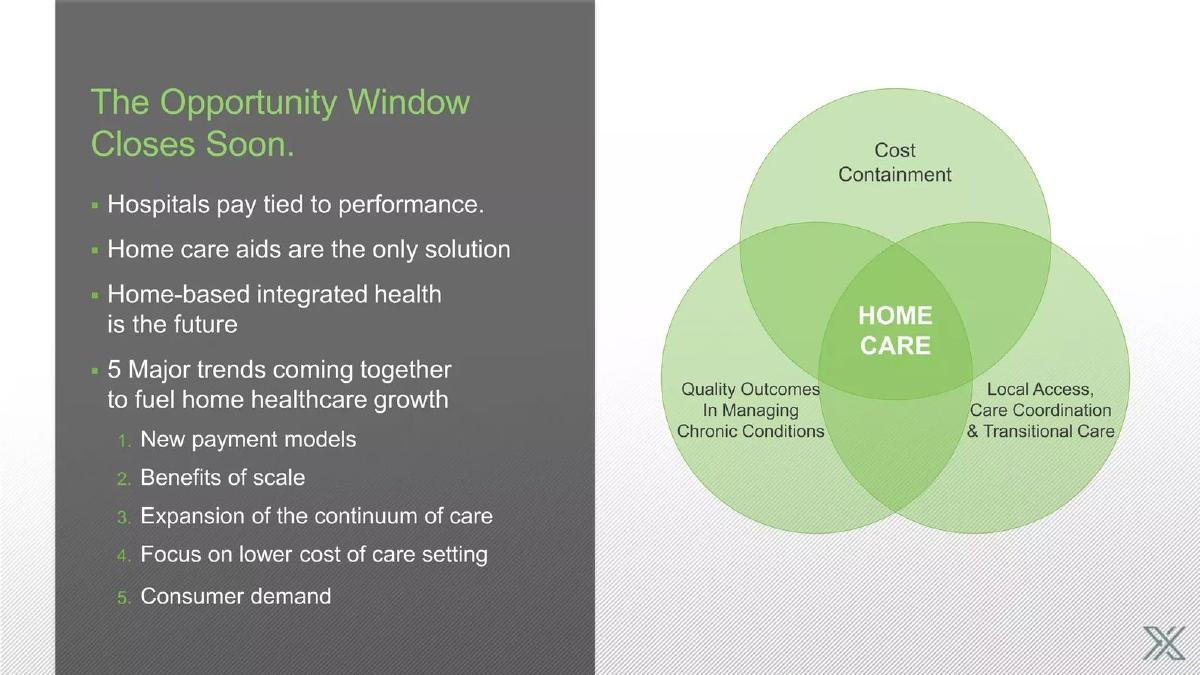
- Canexxia identifies a closing 'Opportunity Window' driven by five trends, including new payment models and consumer demand (Slide 3).
- Medical costs are rising at 6.2% CAGR, significantly outpacing wage growth of 1.3% and GDP growth of 1.1% (Slide 4).
- The core growth strategy is explicitly stated as M&A, targeting 'Mom and Pop' operators who cannot scale (Slide 5).
- The deck quantifies the value of home care through diabetes management, showing costs rising from $589 for low severity to $4,641 for high severity (Slide 6).
- Co-founder Jim Toner brings a background in real estate investment with over 10,000 transactions valued at $2 billion (Slide 8).
- The senior population is projected to grow by as much as 30% in some urban centers (Slide 4).
- The deck mentions 'consumer centricity enabled by technology' but provides no details on the actual software or platform (Slide 2).
Executive Summary: The Macro Thesis for Home Health Consolidation
Canexxia’s investor presentation is a classic example of a thesis-driven pitch. Rather than leading with a specific product or a proprietary medical breakthrough, the deck leads with a massive, unavoidable macroeconomic problem: the unsustainable rise of healthcare costs for an aging population. The company positions itself as the solution to this problem through a strategy of consolidation and value-based care. By acquiring fragmented local home health providers and applying a standardized, technology-enabled operating model, Canexxia aims to capture the margin created by keeping seniors out of high-cost hospital environments.
Slide 1: Title and Branding
The cover slide is minimalist, featuring the company name 'CANEXXIA' and the subtitle 'Investor Presentation.' The background image of a sunset or sunrise through clouds suggests a 'new dawn' or a broad, visionary scope, though it provides no immediate context regarding the industry. The branding is clean, using a modern sans-serif font and a stylized 'X' logo that reappears as a watermark throughout the deck.
Slide 2: The Mission and Operating Model
Slide 2 serves as the executive summary. It defines the company’s goal: to serve as a 'partner in health and aging' through 'value-based home healthcare.' The slide introduces a three-pillar strategy: Become a partner in health and aging (Holistic, outcomes-driven model), Deliver personalized and simple experiences (Consumer centricity enabled by technology), and Creating a value-based home health ecosystem (Locally integrated health capabilities). A circular graphic at the top emphasizes 'Sustainable growth.' The mention of technology here is important, but notably, the deck does not elaborate on what this technology actually is.
Slide 3: The Opportunity Window
This slide creates a sense of urgency, stating 'The Opportunity Window Closes Soon.' It lists five major trends fueling home healthcare growth: new payment models, benefits of scale, expansion of the continuum of care, focus on lower-cost care settings, and consumer demand. A Venn diagram illustrates the intersection of 'Cost Containment,' 'Quality Outcomes,' and 'Local Access' as the sweet spot for 'HOME CARE.' This slide is designed to convince investors that the market is shifting toward Canexxia’s model right now, making it a timely investment.
Slide 4: The Economic Reality of Aging
Slide 4 provides the quantitative 'Why.' It notes that seniors in America have an average of three chronic conditions. A line graph shows the percentage of the US population aged 65 and older rising from 12% in 2010 to an estimated 20% by 2025. The most compelling data point is the 'sustainability gap': Medical costs are growing at a 6.2% CAGR, while wages (1.3%) and GDP (1.1%) are stagnant by comparison. The slide concludes that the senior population will grow by as much as 30% in some urban centers, representing a massive, growing market that the current economic structure cannot afford to support without innovation.
Slide 5: The M&A Strategy
This is the most revealing slide regarding Canexxia’s actual operations. It explicitly states that 'M&A is the best tool to capitalize on the dominant trends.' The company identifies 'Mom and Pop' operators as having 'no ability to scale.' The strategy is to focus on acquisition as the 'fastest way to geometric growth.' This suggests that Canexxia is essentially a private equity-style roll-up play. They are looking for investors to fund the purchase of existing cash-flowing businesses that can be optimized under a single brand and technology stack.
Slide 6: The Diabetes Case Study
To prove the value of home care, Slide 6 looks at 'Diabetes Disease Progression.' It maps the cost of care against the severity of the disease. According to data attributed to Humana (2018), the cost 'Per Member Per Month' (PMPM) for a well-managed (low severity) diabetic is $589. As the disease progresses to renal complications, vision loss, and eventually amputations, the cost skyrockets to $4,641 PMPM. The argument is simple: by providing quality care in the home, Canexxia can keep patients in the 'low severity' category, saving the healthcare system thousands of dollars per patient per month.
Slide 7: Leadership Transition
Slide 7 is a simple transition slide titled 'Canexia Leadership' (note the slight spelling variation from the cover slide). It uses the same cloud imagery as the cover, maintaining visual consistency but offering no new information.
Slide 8: Co-Founder Profile
The final slide in this set profiles Co-Founder Jim Toner. His biography is heavily weighted toward real estate investment rather than clinical healthcare. He is described as a 'Nationally recognized real estate investment specialist' with a 30-year career involving 10,000 transactions valued at over $2 billion. His previous company had an estimated market cap of $176 million. This profile is critical because it explains the M&A focus of the deck. Toner is an expert in acquiring and managing physical assets and scaling operations through transactions. For a roll-up strategy, this is a strong pedigree, though clinical investors might look for a medical counterpart in the full leadership team.
What Works in the Canexxia Deck
The deck excels at establishing a clear 'Problem/Solution' dynamic based on macroeconomic data. By highlighting the 6.2% growth in medical costs versus the 1.1% growth in GDP, Canexxia makes the need for their service feel inevitable. The use of the diabetes cost-progression chart (Slide 6) is a masterclass in demonstrating value. It moves the conversation from abstract 'better care' to concrete 'dollars saved,' which is exactly what value-based care investors want to see. The focus on M&A as a growth lever is also refreshingly honest; it tells the investor exactly how their money will be used—to buy market share and scale.
What is Missing from the Canexxia Deck
The most glaring omission in these slides is the 'How.' While Slide 2 mentions 'technology' and Slide 5 mentions 'scale,' there is no description of the proprietary systems Canexxia uses to manage these disparate 'Mom and Pop' acquisitions. Investors need to see the 'secret sauce' that makes Canexxia better at running a home health agency than the original owners. Furthermore, there is no 'Ask' slide or financial history. We don't know if they have already acquired ten agencies or zero. Without a track record of successful integration, the M&A strategy is just a theory. Finally, the lack of a clinical lead in the provided slides is a potential red flag for a healthcare play; real estate expertise is great for acquisition, but healthcare outcomes require medical expertise.
Founder Takeaways: Lessons from Canexxia
Quantify the Value Gap: If your business saves money for a third party (like an insurance company or the government), show the exact dollar amount of that saving, as Canexxia did with the PMPM diabetes costs on Slide 6. · Align Team Background with Strategy: If your strategy is M&A, your team slide should highlight transaction volume and capital management. Canexxia does this well by showcasing Jim Toner’s $2 billion transaction history. · Use Macro Trends to Create Urgency: Slide 4 uses demographic shifts and economic stagnation to show that the current system is at a breaking point. This makes the 'Opportunity Window' feel real and immediate. · Be Explicit About Growth Levers: Don't hide behind vague 'marketing' plans. If you are going to grow by buying competitors, say so. It shows a level of operational maturity and a clear understanding of your path to scale.
Frequently asked questions
- What is Canexxia's primary business model?
- Canexxia operates as a consolidator in the home healthcare space. According to Slide 5, their strategy is 'Growth Through Acquisition,' focusing on acquiring small, local 'Mom and Pop' operators to achieve geometric growth. They aim to integrate these acquisitions into a 'value-based home health ecosystem' that leverages scale to improve outcomes and contain costs for seniors with chronic conditions.
- How does Canexxia justify the move to home-based care?
- The justification is purely economic. Slide 6 uses diabetes as a case study, showing that poorly managed conditions lead to high-cost interventions like amputations. By managing these conditions at a 'Low Severity' level in the home, costs are kept at $589 per member per month (PMPM), compared to $4,641 PMPM for high-severity cases. This delta represents the 'value' they aim to capture.
- What is the background of the leadership team?
- The only leader detailed in the provided slides is Co-Founder Jim Toner (Slide 8). His background is not in clinical healthcare, but in real estate investment. He is described as a specialist who has been involved in over $2 billion worth of transactions. This reinforces the idea that Canexxia is a financial roll-up play focused on acquiring and scaling physical service locations.
- What are the key market drivers identified in the deck?
- Slide 3 and Slide 4 outline the drivers: an aging population (30% growth in urban centers), the prevalence of chronic diseases (seniors average 3 conditions), and a shift in hospital payment models toward performance-based metrics. The deck argues that home care is the only viable solution for cost containment as medical costs (6.2% growth) outpace the broader economy.
- What information is missing from this pitch deck?
- The deck is missing several critical components for a late-stage or M&A-focused investment. There is no 'Ask' slide detailing how much capital is being raised. There are no financial projections, no list of current assets or previously acquired companies, and no specific details on the 'technology' mentioned as a growth enabler. It functions more as a high-level strategic overview than a complete investment memorandum.