Canix, a YC S'19 alum, utilizes this 13-slide deck to showcase a highly efficient growth engine within the cannabis ERP space. The company reported reaching $123K in Monthly Recurring Revenue (MRR) by September 2020, representing 12% monthly growth since its June 2019 launch. What makes the deck stand out is the explicit transparency regarding their unit economics and capital efficiency: they spent only $750K over 16 months to reach a $1.5M ARR run rate. The deck focuses heavily on the 'compliance burden' as a primary pain point, positioning their software and hardware integration as the esse…
Key takeaways
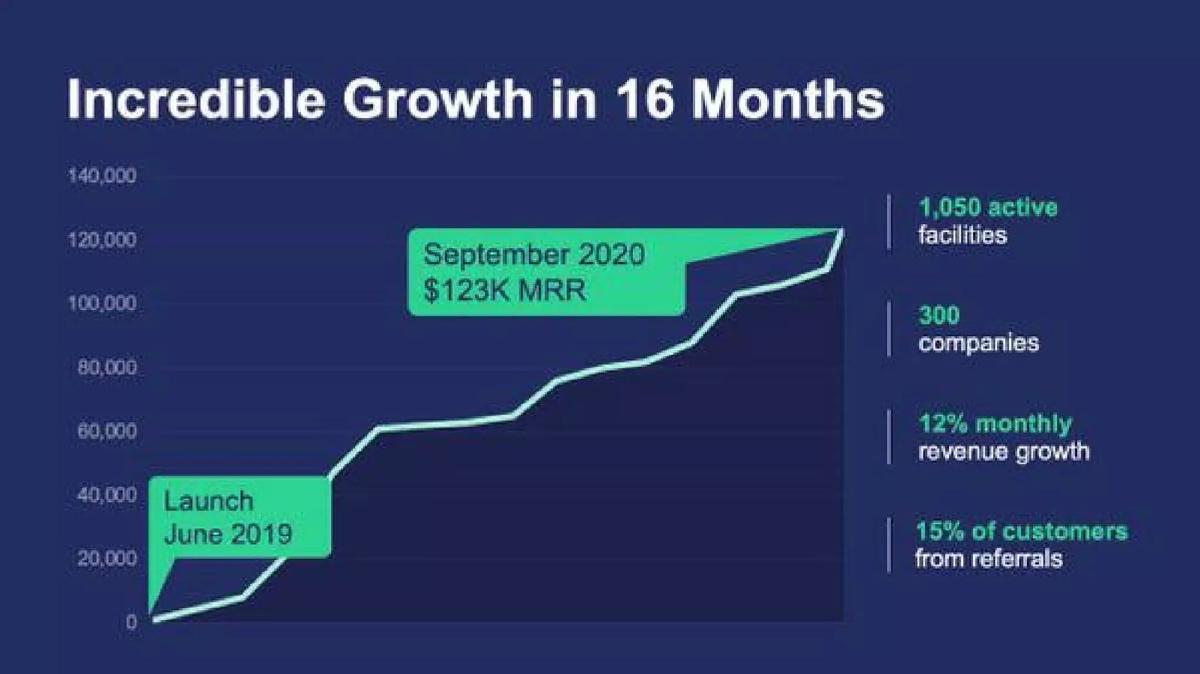
- The company reached $123K MRR in September 2020, just 16 months after launching in June 2019 (Slide 4).
- Canix demonstrates extreme capital efficiency, having spent only $750K to reach a $1.5M ARR (Slide 8).
- The platform manages 1,050 active facilities across 300 companies with a 12% monthly revenue growth rate (Slide 4).
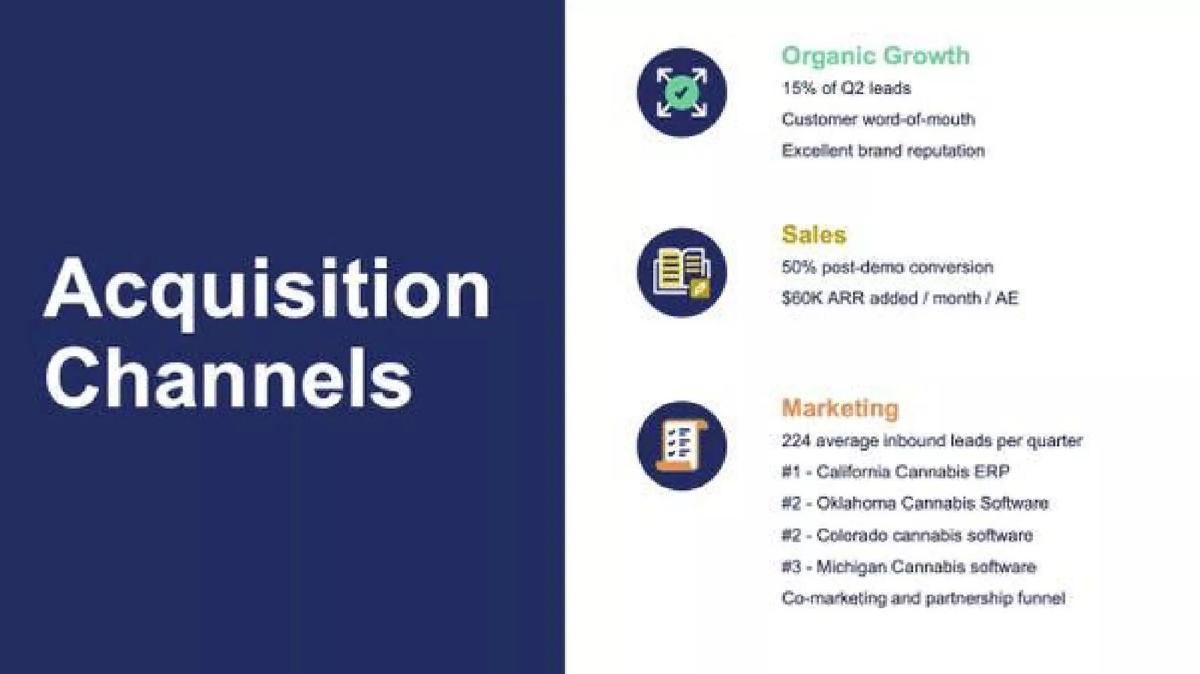
- Acquisition is highly efficient, with 15% of leads coming from organic word-of-mouth and a 50% post-demo conversion rate (Slide 6).
- The team leverages deep technical roots, citing an engineering team with backgrounds from Facebook, Coinbase, MIT, and Uber (Slide 7).
- The market size is segmented into a $25.8B global cannabis market, with an $800M immediate ERP addressable market in legalized states (Slide 10).
- The requested investment of $1.5M - $2.0M is intended to provide 18-24 months of runway (Slide 12).
- The product roadmap includes aggressive international expansion into markets like Canada, Thailand, and South Africa by Q4 2021 (Slide 9).
Executive Summary: The Vertical ERP Playbook
Canix provides a textbook example of how to pitch a vertical SaaS solution in a complex, regulated industry. By focusing on the 'unsexy' back-office operations of cannabis cultivation and distribution, they have built a high-retention product that serves as the system of record for its users. The deck is characterized by its brevity and its heavy reliance on hard data over visionary fluff.
Slides 1-3: The Foundation and the Product
Slide 1: Title The deck opens with a simple, dark blue brand identity. The tagline is direct: "An ERP for Cannabis Companies." There is no ambiguity about what the company does or who it serves.
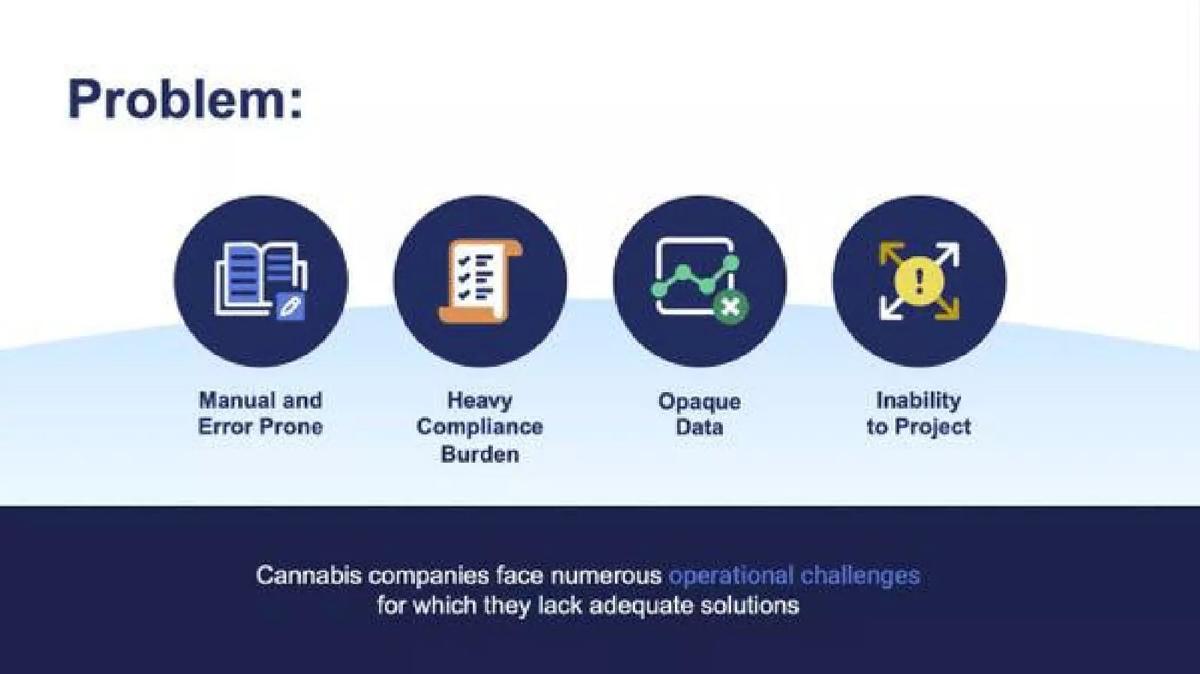
Slide 2: Problem The problem slide identifies four pillars: Manual and Error Prone , Heavy Compliance Burden , Opaque Data , and Inability to Project . By highlighting the "Heavy Compliance Burden," Canix taps into the greatest fear of cannabis operators—losing their license due to regulatory infractions. This makes the software a 'must-have' rather than a 'nice-to-have.'
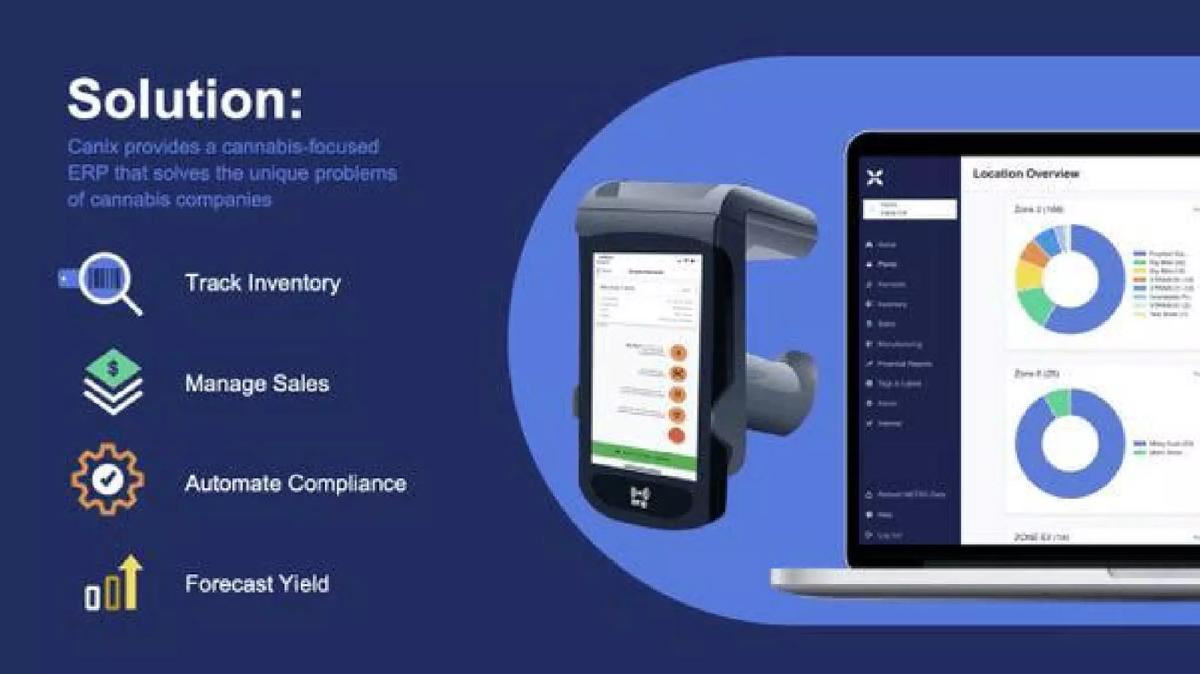
Slide 3: Solution The solution slide introduces the hardware-software hybrid approach. It lists four key capabilities: Track Inventory, Manage Sales, Automate Compliance, and Forecast Yield. The visual includes a ruggedized handheld scanner and a laptop dashboard, signaling that the software is designed for the 'muddy boots' environment of a cultivation facility, not just an office.
Slides 4-6: Traction and Market Validation
Slide 4: Incredible Growth in 16 Months This is the 'money slide.' It features a steep revenue graph showing a climb from launch in June 2019 to $123K MRR in September 2020 . Key stats on the right reinforce the scale: 1,050 active facilities , 300 companies , and 12% monthly revenue growth . Most impressively, they note that 15% of customers come from referrals, which indicates high product satisfaction in a tight-knit industry.
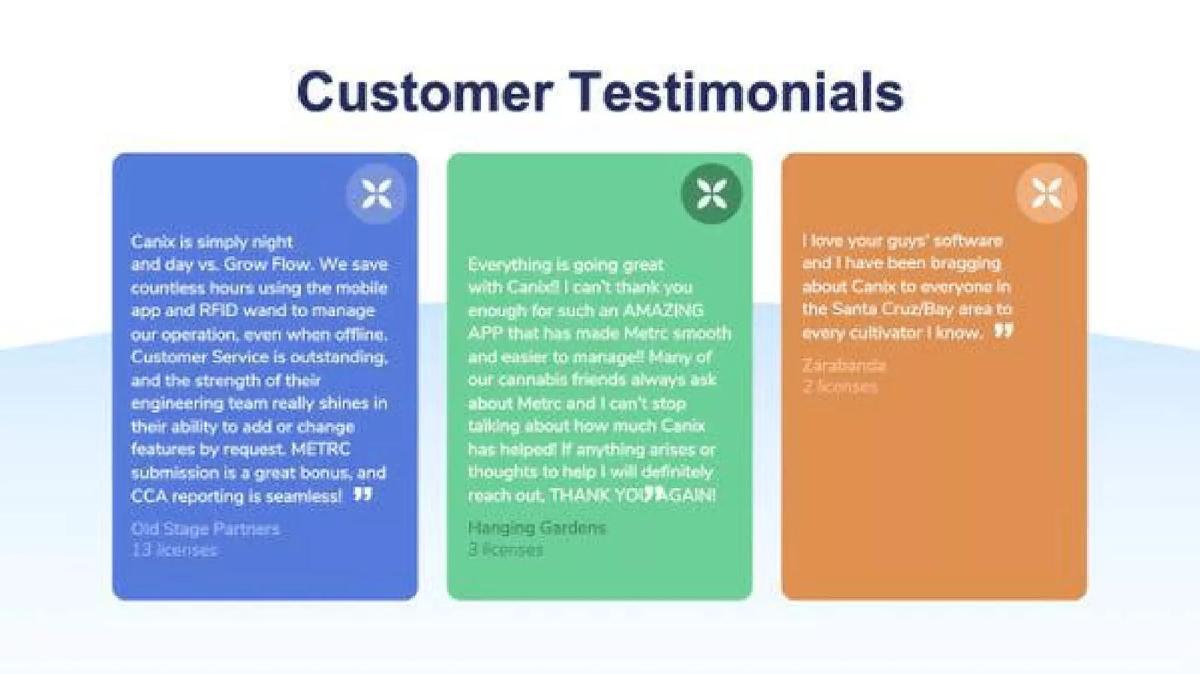
Slide 5: Customer Testimonials Three testimonials from companies like Old Stage Partners (13 licenses) and Hanging Gardens (3 licenses) emphasize the time saved and the strength of the engineering team. One quote specifically mentions that Canix is "night and day vs. Grow Flow," naming a competitor and claiming superiority in mobile app and RFID functionality.
Slide 6: Acquisition Channels This slide breaks down the efficiency of their go-to-market strategy. They report a 50% post-demo conversion rate , which is exceptionally high for B2B SaaS. They also claim to add $60K ARR per month per AE (Account Executive). The marketing section highlights their dominant SEO position in key states like California and Oklahoma.
Slides 7-9: The Team and Efficiency
Slide 7: Canix Team The team slide features Co-founders Stacey Hronowski (CEO) and Artem Pasyechnyk (CTO). The logos for Cowen, HIG Capital, and PagerDuty provide institutional credibility. They also boast an engineering team from Facebook, Coinbase, MIT, and Uber , suggesting they have the technical chops to handle the complex data integrations required for an ERP.
Slide 8: Capital Efficiency This is a rare and powerful slide in a pitch deck. Canix explicitly states they spent $750K in 16 months to reach $1.5M in ARR . This 2x return on capital spent is a massive signal of a healthy business model. They disclose $700K remaining from their seed round and a $75K monthly burn , with a projection to be profitable in 6 months . This transparency reduces perceived risk for investors.
Slide 9: Product Roadmap The roadmap is divided into Geographic Expansion, Marketplace, and Adjacent Verticals. By Q4 2021 , they planned to expand into international markets including Thailand, Columbia, Portugal, and South Africa . This shows the ambition to move beyond the US state-by-state patchwork into a global player.
Slides 10-13: Market Size and The Ask
Slide 10: Market Size Canix uses a concentric circle diagram to define their TAM, SAM, and SOM. The $25.8B represents the global cannabis market, while the $800M figure is the specific ERP market size within existing legalized states. This is a realistic and grounded approach to market sizing that avoids the 'trillion-dollar' hyperbole often seen in decks.
Slide 11: Vision The vision slide moves the company from a tool to a platform. They envision a marketplace where cultivators, manufacturers, and distributors trade seamlessly. They argue that as the "largest source of cannabis production data," they are uniquely positioned to facilitate these transactions.
Slide 12: Investment Opportunity The ask is for $1.5M - $2.0M to provide 18-24 months of runway . The use of proceeds is clearly allocated: 44% Engineering , 25% G&A , 18% Sales , and 13% Marketing . This allocation suggests a continued focus on product development and infrastructure over pure aggressive marketing spend.
Slide 13: Closing Visual The final slide is a simple graphic of cannabis plants with RFID tags, reinforcing the core product utility of tracking and compliance.
What Works in This Deck
Extreme Capital Efficiency: Showing that you can generate $1.5M in ARR on $750K of spend is the ultimate proof of a scalable business. · Transparency: Disclosing burn rate, cash on hand, and time to profitability builds immediate trust with sophisticated investors. · Specific Traction: Using MRR, facility counts, and referral percentages provides a multi-dimensional view of growth. · Focus on Compliance: By positioning themselves as a solution to a regulatory burden, they move the product from a luxury to a necessity.
What Is Missing
Churn and Retention Metrics: While they mention growth and referrals, they do not explicitly state their Net Revenue Retention (NRR) or logo churn. In an ERP play, high retention is the key metric. · Competitive Landscape: Aside from a brief mention in a testimonial, there is no dedicated slide comparing Canix to other incumbents like Metrc or MJ Freeway. · Pricing Model: The deck does not explain how they charge (e.g., per facility, per user, or based on volume).
What a Founder Should Copy
The 'Capital Efficient' Slide: If your metrics are good, be as transparent as Slide 8. It proves you are a responsible steward of capital. · The Acquisition Breakdown: Don't just say you have a sales team. Show the conversion rates and the ARR generated per AE as seen on Slide 6. · The Realistic TAM: Use data-backed figures for your specific niche (like the $800M ERP market on Slide 10) rather than just the total industry spend.
Frequently asked questions
- What is the primary problem Canix is solving?
- According to Slide 2, Canix addresses four core operational challenges for cannabis companies: manual and error-prone processes, a heavy compliance burden, opaque data, and an inability to project business outcomes. They specifically target the 'compliance burden' as a key driver for software adoption in this highly regulated industry.
- How does Canix acquire customers?
- Slide 6 outlines three main channels: Organic Growth (15% of Q2 leads via word-of-mouth), Sales (50% post-demo conversion and $60K ARR added per month per Account Executive), and Marketing (224 average inbound leads per quarter). They also claim the #1 SEO/ranking position for 'California Cannabis ERP'.
- What are the financial milestones disclosed in the deck?
- The deck is very transparent about finances. Slide 4 shows a jump from $0 to $123K MRR in 16 months. Slide 8 reveals they have $700K left from their seed round, a monthly burn of $75K, and an expectation to be profitable within 6 months.
- Who is the team behind Canix?
- The leadership includes CEO Stacey Hronowski (formerly Cowen and HIG Capital) and CTO Artem Pasyechnyk (formerly PagerDuty). Slide 7 also highlights a 'Head of Growth' and an engineering team with experience at major tech firms like Facebook and Uber.
- What is the long-term vision for the company?
- Slide 11 describes a vision to move beyond ERP into a marketplace. They aim to create a platform where cultivators, manufacturers, and distributors can source and sell products seamlessly, leveraging their position as the largest source of production data.