Can-Fite BioPharma presents a highly technical, data-driven investor deck typical of a publicly traded clinical-stage biotechnology firm. The company focuses on its A3 adenosine receptor (A3AR) platform, which utilizes small molecule, orally bioavailable drugs. The deck highlights significant progress in late-stage clinical trials, specifically Piclidenoson for Psoriasis and Namodenoson for Liver Cancer and NASH. A key strength of the presentation is the validation provided by ~$18 million in upfront and milestone payments from global partners like Cipher and CMS. While the deck lacks a tradi…
Key takeaways
- The company is dual-listed on the NYSE American (CANF) and Tel-Aviv Stock Exchange (CFBI) with ~15.4 M ADRs outstanding as of slide 3.
- Can-Fite has secured ~$18 million in upfront and milestone payments from out-licensing deals across Canada, Europe, and Asia (slide 7).
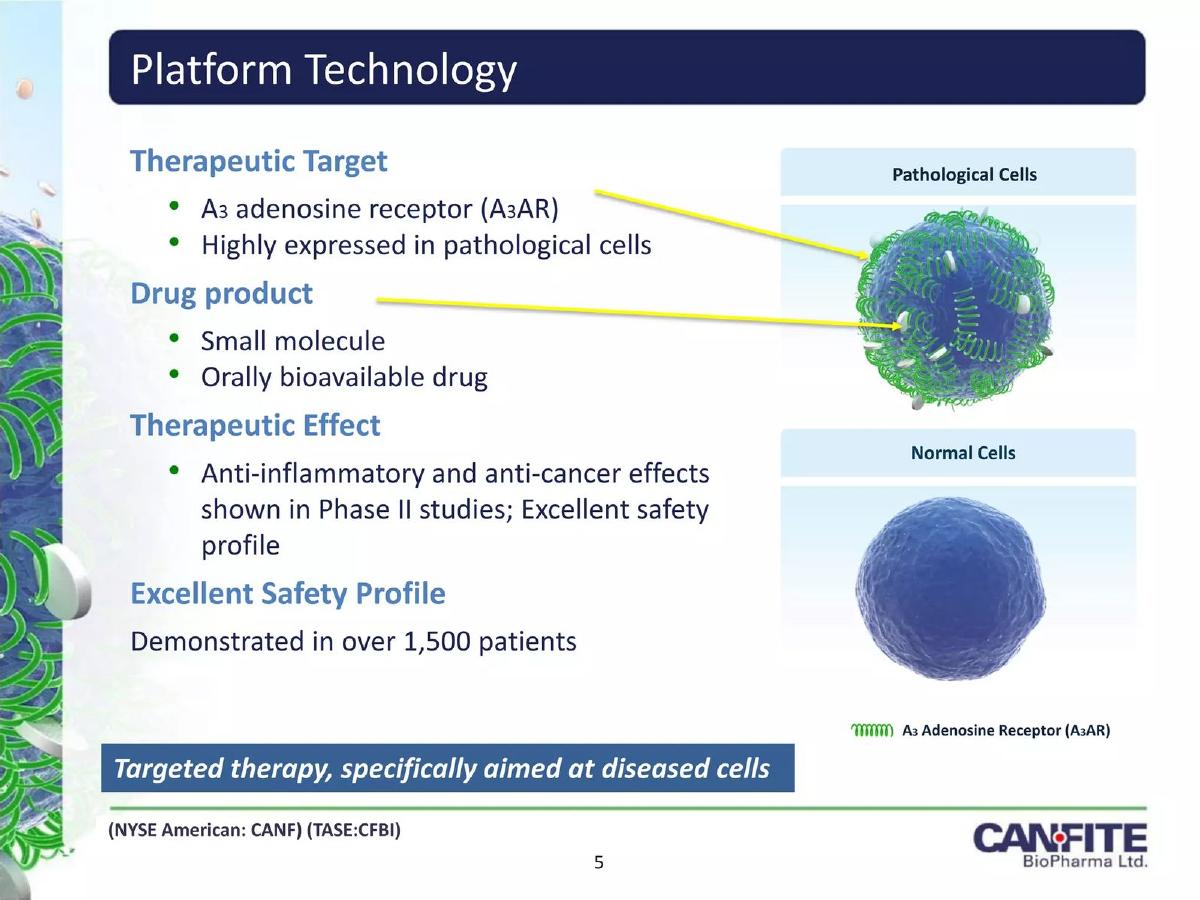
- The platform technology targets the A3 adenosine receptor (A3AR), which is highly expressed in pathological cells but not normal cells (slide 5).
- Piclidenoson is positioned as a cost-effective oral alternative to $2,000-$5,000/month biologics for psoriasis, targeting a ~$750/month price point (slide 9).
- The company pivoted to include a COVID-19 Phase II study for moderate disease, leveraging the anti-inflammatory and anti-viral effects of Piclidenoson (slide 11).
- Namodenoson has received both Orphan Drug and Fast Track status from the FDA for the treatment of liver cancer (slide 13).
- Phase II NASH results showed a significant decrease in liver enzymes ALT and AST, alongside reduced liver fat content (slide 15).
- The company claims to be financially positioned to conduct all clinical programs and G&A for more than one year as of December 2020 (slide 17).
Can-Fite BioPharma: Clinical Maturity and Market Positioning
The December 2020 investor presentation for Can-Fite BioPharma (NYSE American: CANF) represents a transition from early-stage R&D to a late-stage clinical powerhouse. The deck is structured to satisfy the rigorous due diligence of institutional investors, focusing heavily on clinical data, regulatory milestones, and existing commercial validation through licensing deals. Unlike early-stage startup decks that sell a vision, this deck sells a pipeline of de-risked assets targeting multi-billion dollar markets.
Slide 1: Title and Identity
The cover slide establishes the company's identity as a developer of 'Small Molecules For Big Clinical Needs.' It clearly displays its dual-listing status on the NYSE American (CANF) and the Tel-Aviv Stock Exchange (CFBI). The visual of a cell being targeted by pills reinforces the mechanism of action—oral small molecule therapy—which is a recurring competitive advantage throughout the deck.
Slide 3: Company Profile
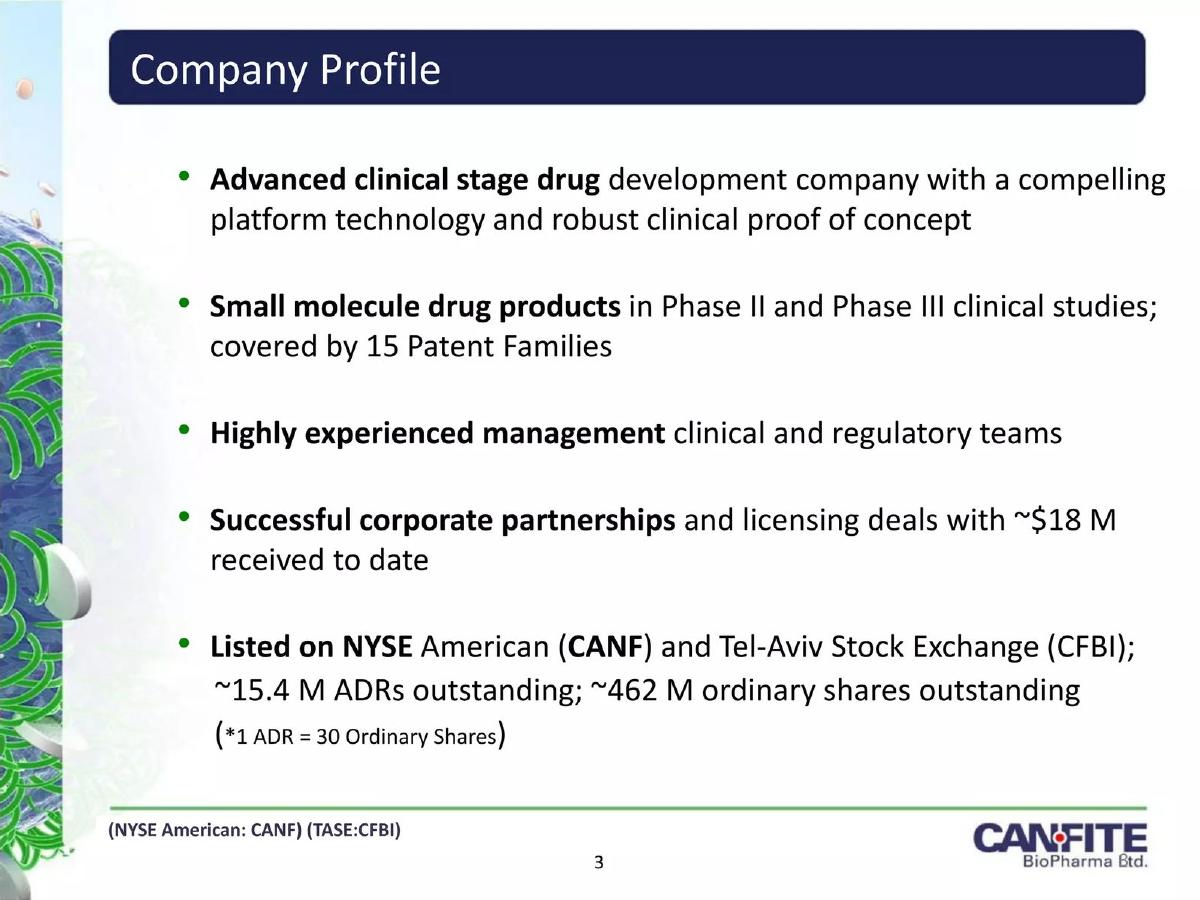
This slide serves as the 'Executive Summary.' It defines Can-Fite as an 'advanced clinical stage drug development company.' Key highlights include:
Small molecule products in Phase II and Phase III clinical studies. · A portfolio covered by 15 Patent Families. · ~$18 million received to date from corporate partnerships and licensing. · Capital structure details: ~15.4 M ADRs and ~462 M ordinary shares outstanding.
This slide is effective because it immediately quantifies the company's progress and financial validation.
Slide 5: Platform Technology
The technical foundation of the company is the A3 adenosine receptor (A3AR). The slide uses a simple visual comparison between 'Pathological Cells' (high A3AR expression) and 'Normal Cells' (low expression). This explains the 'Targeted therapy' approach. The safety profile is emphasized with the fact that the technology has been 'Demonstrated in over 1,500 patients,' a significant number for a clinical-stage biotech.
Slide 7: Corporate Partnerships and Out-licensing
This is arguably the most important slide for demonstrating market validation. It lists five major licensing partners across diverse geographies including Canada, Europe, China, and South Korea. The table specifies the drug (Piclidenoson or Namodenoson), the indication (Psoriasis, Liver Cancer, or NASH), and the region. A footnote mentions that $8.5M was previously received from a Japanese partner (SKK) before a strategic change, showing a history of high-value engagement even when trials are ongoing.
Slide 9: Psoriasis Competitive Landscape
Can-Fite positions Piclidenoson against heavyweights like Humira, Enbrel, and Otezla. The slide makes a 'pharmaco-economic' argument:
Biologics: Cost $2,000-$5,000/month, require injections, and carry 'Black Box' warnings. · Otezla: An oral drug costing $750-$3,500/month with a 5% market share. · Piclidenoson: An oral drug targeting a ~$750/month price point with an 'excellent safety profile.'
By framing the drug as a cost-effective, safer oral alternative, Can-Fite defines a clear path to market share in a field dominated by expensive biologics.
Slide 11: COVID-19 Strategic Pivot
Reflecting the 2020 timeframe, this slide details a Phase II study for treating moderate COVID-19. It leverages Piclidenoson’s anti-inflammatory and anti-viral effects. The study design is a randomized, double-blind, placebo-controlled trial of 40 patients. This slide demonstrates the platform's versatility and the company's ability to respond to urgent global health needs.
Slide 13: Liver Cancer - Pivotal Phase III
This slide focuses on Namodenoson. It highlights that an agreement has been reached with the FDA and EMA on the design of a pivotal Phase III trial involving 450 patients worldwide. The regulatory 'wins' are prominent: Orphan Drug Status (FDA/EMA) and Fast Track Status (FDA). It also mentions a 'Compassionate Use Program' in Israel, which provides real-world evidence of the drug's utility while formal trials continue.
Slide 15: NASH Phase II Results
Non-alcoholic steatohepatitis (NASH) is a massive unmet medical need. The slide lists several clinical successes:
Significant decrease in liver enzymes (ALT and AST). · Significant reduction in liver fat volume assessed by MRI-PDFF. · Decrease in body weight in the Namodenoson groups. · Confirmation of the 25mg dose for future studies.
The data-heavy nature of this slide is intended to prove that the drug is not just safe, but highly efficacious in improving liver health markers.
Slide 17: Summary and Financial Position
The final slide summarizes the investment thesis: novel technology, Phase III assets, a strong IP portfolio, and established partnerships. Crucially, it addresses the 'runway' question, stating the company is 'well positioned to conduct all its clinical development programs and G&A for > 1 year.' This provides a clear window for investors regarding the next potential capital raise or milestone event.
What Can-Fite Does Well
The deck excels at regulatory and commercial validation . By listing specific FDA statuses (Orphan, Fast Track) and naming global licensing partners, Can-Fite moves beyond the 'trust us' phase of many biotech pitches. The economic comparison on slide 9 is also a masterclass in positioning; it doesn't just say the drug works, it explains why an insurance provider or a patient would choose it over the current standard of care based on price and delivery method (oral vs. injection).
What is Missing
In this 9-slide selection, there is no dedicated team slide . While 'Highly experienced management' is mentioned on slide 3, the specific pedigrees of the scientists and executives are not detailed. Furthermore, while the deck mentions being funded for 'more than 1 year,' it lacks a detailed use of proceeds or a specific 'ask' for new capital, which is common for public companies providing general updates rather than a specific private placement round. There is also no detailed financial breakdown of the $18M in licensing—specifically how much is upfront cash versus future milestones.
Founder Takeaways
Quantify your de-risking: If you have patents, state the number of families (Can-Fite has 15). If you have patients in trials, state the total number (Can-Fite has 1,500+). These numbers build a wall of credibility that qualitative descriptions cannot match. Address the 'So What?' of your market: Don't just list competitors; explain the economic incentive for your solution. Can-Fite’s comparison of a $750 oral drug vs. a $5,000 injection is a compelling reason for a clinician to switch. Regulatory milestones are currency: For any health-tech or biotech founder, designations like 'Fast Track' or 'Orphan Drug' are major value inflection points that should be highlighted as primary achievements.
Frequently asked questions
- What is the core technology behind Can-Fite's drug pipeline?
- Can-Fite’s platform is based on small molecule drugs that target the A3 adenosine receptor (A3AR). According to slide 5, this receptor is highly expressed in pathological cells (diseased cells) but has low expression in normal cells. This allows for a targeted therapeutic effect with an excellent safety profile, as demonstrated in over 1,500 patients.
- How does Can-Fite generate revenue before drug commercialization?
- The company utilizes an out-licensing model. Slide 7 details that they have received ~$18 million in upfront and milestone payments to date. Partners include Cipher Pharmaceuticals (Canada), Gebro Pharma (Spain, Austria, Switzerland), China Medical System (China, Hong Kong, Macau, Taiwan), Chong Kun Dang Pharm (South Korea), and Kyongbo Pharm (South Korea).
- What are the primary clinical indications being pursued?
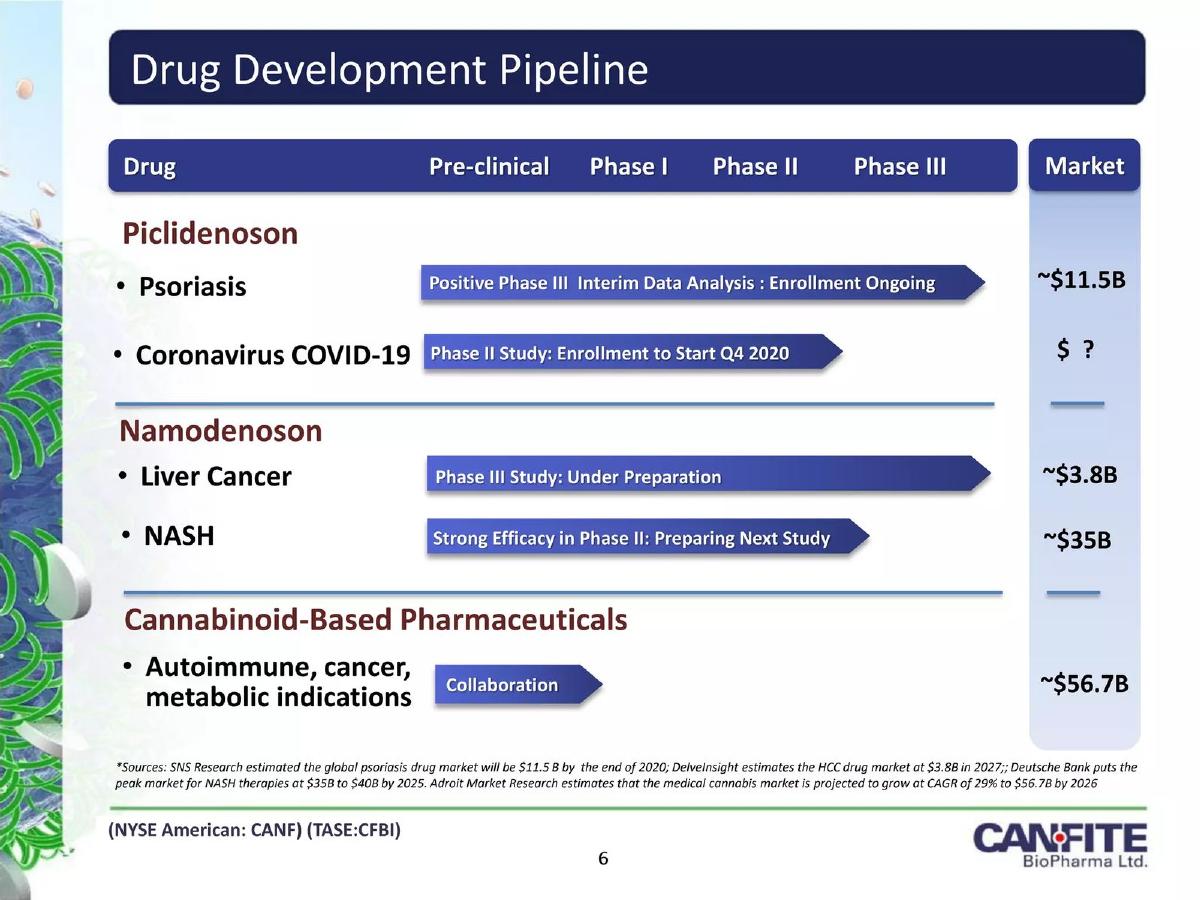
- Can-Fite is targeting three major areas: Psoriasis (Piclidenoson), Liver Cancer (Namodenoson), and NASH (Namodenoson). Slide 13 notes that the liver cancer program is entering a pivotal Phase III trial, while slide 15 highlights successful Phase II results for NASH, including reduced liver fat volume.
- How does Piclidenoson compare to existing psoriasis treatments?
- Slide 9 highlights a 'strong pharmaco-economic incentive.' While biologics like Humira and Enbrel cost between $2,000 and $5,000 per month and require injections, Piclidenoson is an oral drug with a target cost of ~$750 per month. It aims to compete with Otezla by offering a better safety profile and lower cost than high-risk biologics.
- What is the current regulatory status of their lead assets?
- As of slide 13, Namodenoson has been granted Orphan Drug Status by both the FDA and EMA, as well as Fast Track Status by the FDA for liver cancer. For psoriasis, Piclidenoson is in Phase III trials, and a Phase II study for COVID-19 was approved by the FDA in 2020 (slide 11).