Canadian Overseas Petroleum Limited (COPL) utilizes this October 2022 investor presentation to articulate a transition from asset acquisition to operational scaling in the Wyoming Powder River Basin. The narrative centers on two primary pillars: the US$19.15 million acquisition of Cuda Energy LLC assets, which nearly doubled the company's 2P Net Asset Value, and a comprehensive refinancing strategy to replace high-cost credit fund debt with conventional bank lending. Technically dense, the deck relies heavily on Ryder Scott reserve reports and detailed geological mapping of the Barron Flats a…
Key takeaways
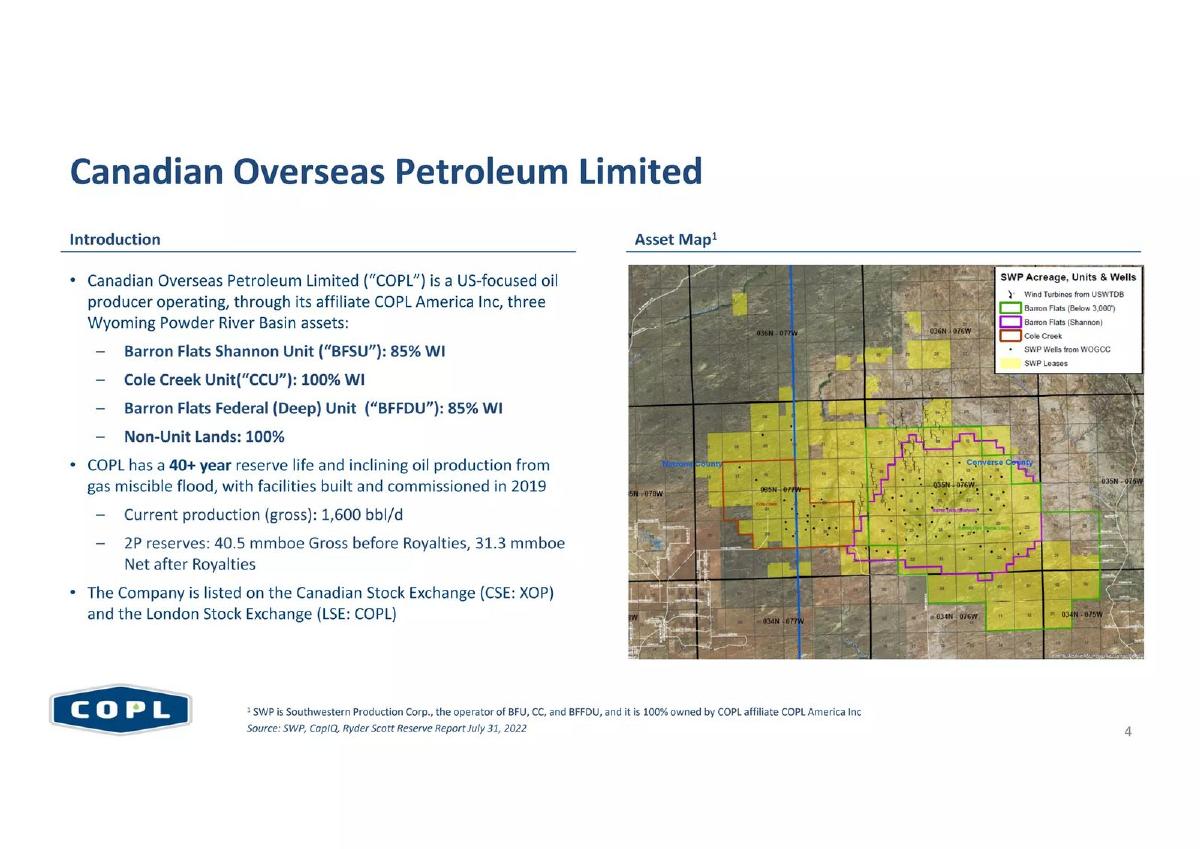
- The company operates three primary Wyoming Powder River Basin assets: Barron Flats Shannon Unit, Cole Creek Unit, and Barron Flats Federal (Deep) Unit (Slide 4).
- COPL reports a 40+ year reserve life with current gross production of 1,600 bbl/d as of the presentation date (Slide 4).
- The acquisition of Cuda Energy LLC for US$19.15 million on July 25, 2022, increased the 2P NPV at 10% DCF from US$258M to US$492M (Slide 7).
- A core strategic objective is refinancing a US$42M credit facility to reduce the cost of debt and increase operating flexibility (Slide 10).
- Production forecasts by Ryder Scott suggest a peak total proved oil production potential exceeding 10,000 bbl/d by 2026 (Slide 13).
- The development plan includes drilling 9 additional BFSU production wells and 15 CCU PUD horizontal wells in the Frontier 2 formation (Slide 13).
- Operational ESG goals focus on minimal gas flaring and utilizing wind-driven electricity for field operations (Slide 25).
- The deck provides rigorous technical definitions for reserve categories, including Proved, Probable, and Possible (Slide 28).
Executive Summary and Asset Overview
Slide 1: Title Slide
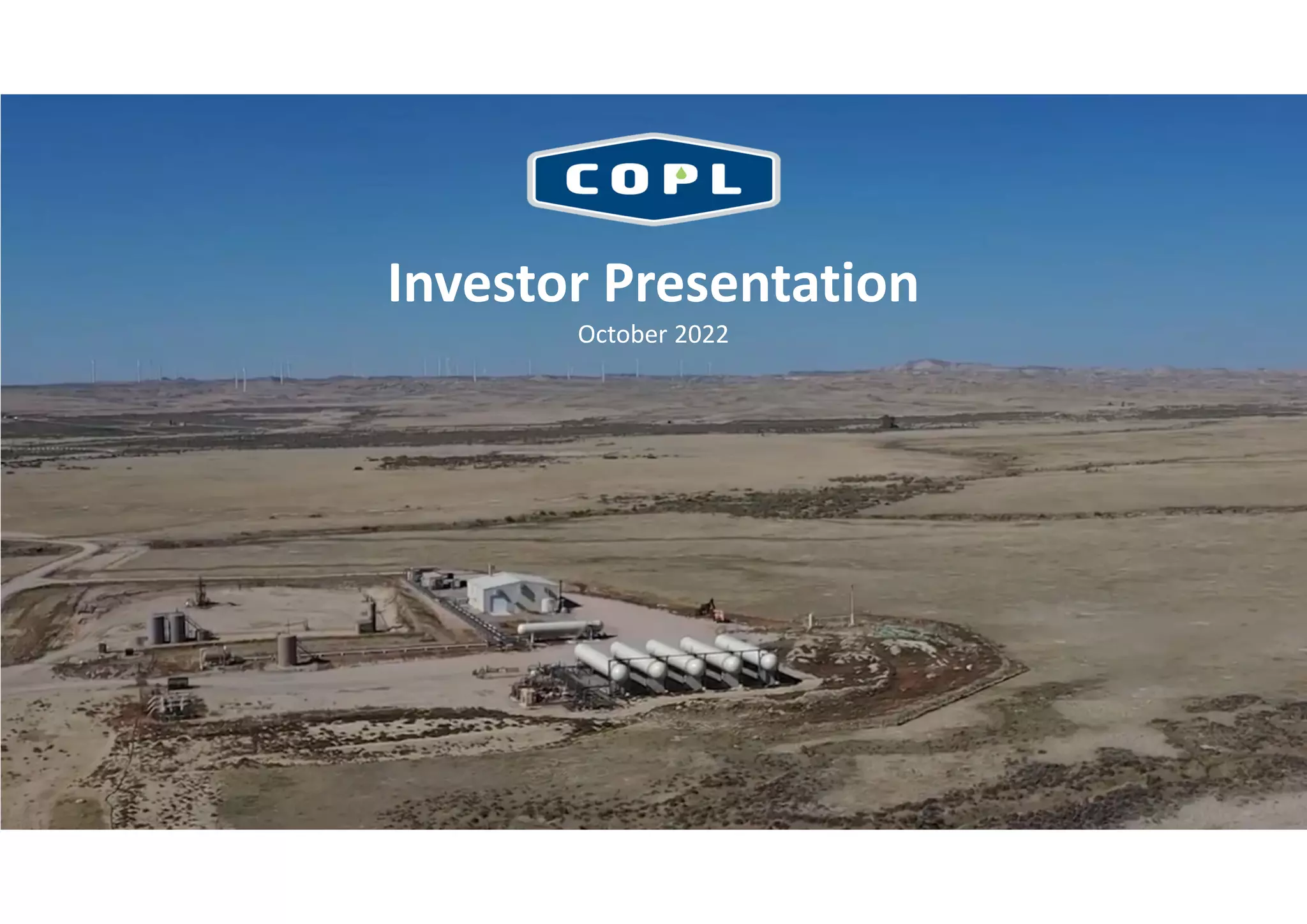
The presentation opens with the COPL logo and the title 'Investor Presentation - October 2022.' The background image features an aerial view of an oil and gas facility in a semi-arid landscape, establishing the industrial and operational focus of the company. The date indicates this deck was produced shortly after a major acquisition period.
Slide 4: Introduction and Asset Map
This slide introduces Canadian Overseas Petroleum Limited as a US-focused oil producer operating through its affiliate, COPL America Inc. It identifies three key assets in the Wyoming Powder River Basin: the Barron Flats Shannon Unit (85% Working Interest), the Cole Creek Unit (100% WI), and the Barron Flats Federal (Deep) Unit (85% WI). The slide highlights a 40+ year reserve life and current gross production of 1,600 bbl/d. Crucially, it notes that 2P reserves are valued at 40.5 mmboe Gross and 31.3 mmboe Net after royalties. The accompanying Asset Map provides a geographical layout of the acreage, units, and wells, including wind turbines from the USWTDB, which hints at the company's ESG integration.
Financial Strategy and Acquisitions
Slide 7: Consolidation of Wyoming Assets
Slide 7 focuses on the acquisition of Cuda Energy LLC, which closed on July 25, 2022. COPL acquired non-operating interests (27% in BFSU and 27.5-33.33% in other units) for US$19.15 million. The impact on Net Asset Value (NAV) is presented via a bar chart, showing a jump from US$258M (pre-acquisition) to US$492M (post-acquisition) based on 2P NPV at 10% DCF. The slide also mentions that the acquisition was financed with a US$25M Convertible Bond backed by a cornerstone institutional shareholder.
Slide 10: Refinancing of Credit Facility
This slide addresses the company's capital structure. COPL currently has a US$42M drawn credit facility with a 'large US Credit Fund' characterized by a high cost of debt. The stated objective for Q4 2022 is to refinance this into a conventional Senior Loan or Reserve Based Lending (RBL) facility with US banks. The goal is to lower the cost of debt and provide a Junior Facility to fund capital expenditures for converting Proved Undeveloped (PUD) reserves to Proved Developed Producing (PDP) reserves.
Operational Roadmap and Technical Data
Slide 13: Junior Facility and Production Forecast
Slide 13 details the 'Acceleration to Total Proved Forecast.' It lists specific operational steps: de-bottlenecking the gas gathering system, adding compression at the BFSU Gas Plant, and drilling 9 additional BFSU production wells. A detailed production history and forecast chart from Ryder Scott (effective December 31, 2021) shows a projected climb in oil production, targeting a peak of over 10,000 bbl/d by 2026. The chart distinguishes between 'Proved Producing Oil,' 'Total Proved Oil,' and 'Proved Plus Probable Oil.'
Slide 16: Cole Creek Unit and Non-Unit Lands
This slide provides a technical drilling map for the Cole Creek Unit, specifically the Frontier 2 Formation. It identifies PUD (Proved Undeveloped), Probable, and Contingent resource drilling locations. The map uses a color-coded grid to show company land and various resource categories (P1, P2, C1, C2, C3). This level of detail is intended for technical investors to verify the scale of the untapped resource base.
Slide 19: Barron Flats Shannon Unit Infrastructure
Focusing on infrastructure, this slide maps the gas and oil gathering systems and the processing plant at Barron Flats. It distinguishes between existing gas lines, future oil gathering systems, and new high-pressure gas gathering lines. This infrastructure is vital for the 'de-bottlenecking' strategy mentioned earlier in the deck, ensuring that increased production can be processed and transported efficiently.
Slide 22: Condensate Treatment: Pumping Well Schematic
Slide 22 is a highly technical operational slide. It explains how COPL manages paraffin deposits, which occur between 1,400 and 4,000 feet. The schematic shows a pumping well configuration and describes a process where 200 barrels of condensate are pumped down the casing to dissolve paraffin. This technical transparency demonstrates the company's hands-on management of common field-level production challenges.
ESG and Regulatory Framework
Slide 25: ESG Operating Credentials
This slide highlights COPL's commitment to Environmental, Social, and Governance (ESG) standards. The primary claims are 'minimal gas flaring' and 'sourcing wind driven electricity for operations.' The visual uses standard ESG iconography but lacks specific metrics or third-party certifications, serving more as a statement of intent and current operational practice.
Slide 28: Technical Definitions
The final slide in the analyzed set provides a glossary of terms. It defines Gross vs. Net Reserves and provides the industry-standard criteria for Proved, Probable, Possible, Developed, and Undeveloped reserves. This is a standard requirement for oil and gas investor presentations to ensure compliance with reporting regulations (such as NI 51-101 in Canada).
What COPL Does Well
The deck is exceptionally strong in technical validation. By including third-party data from Ryder Scott and detailed geological and infrastructure maps, COPL provides the 'proof of work' necessary for institutional energy investors. The clear 'Before and After' comparison of the Cuda acquisition (Slide 7) effectively communicates value creation in a single glance. Furthermore, the deck does not shy away from operational realities, such as the paraffin treatment schematic on Slide 22, which suggests a high level of operational competence.
What is Missing from the Deck
Despite the technical depth, there are significant omissions typical of a startup or growth-stage pitch deck. First, there is no Management Team slide in the provided sequence. For a public company, the experience of the CEO, CFO, and lead geologists is paramount. Second, there is no Financial Financials slide beyond the NPV and debt figures; there is no mention of current revenue, EBITDA, or burn rate. Third, the ESG slide (Slide 25) is purely qualitative; it lacks data on carbon intensity or specific safety records. Finally, there is no clear Ask—while the deck mentions refinancing, it does not explicitly state if they are seeking new equity investors or what the terms of such an investment might be.
Founder Takeaways
Use Third-Party Validation: COPL’s reliance on Ryder Scott reports is a masterclass in building credibility. If your industry has gold-standard auditors or research firms, use their logos and data to back your claims. Visualize the Value Add: The bar chart on Slide 7 is the most effective slide in the deck because it shows exactly how a US$19M spend resulted in a US$234M increase in asset value. Founders should always look for ways to visualize ROI so clearly. Address the 'How': Many decks focus only on the 'What' (we will produce more oil). COPL explains the 'How' (de-bottlenecking, paraffin treatment, refinancing). This level of detail reduces the perceived risk for sophisticated investors who understand the operational hurdles of the industry.
Frequently asked questions
- What was the primary driver for the increase in Net Asset Value in 2022?
- The primary driver was the consolidation of Wyoming assets through the acquisition of Cuda Energy LLC. By purchasing non-operating interests (ranging from 27% to 33.33%) for US$19.15 million, COPL increased its 2P Net Present Value (NPV) at a 10% discount rate from US$258 million in late 2021 to US$492 million by July 2022, as shown on slide 7.
- How does COPL plan to manage its current debt obligations?
- Slide 10 outlines a plan to move away from a high-cost US Credit Fund facility. The company intends to enter into a conventional Senior Loan or Reserve Based Lending (RBL) arrangement with US banks. This move aims to retire the existing US$42M facility, lower the cost of debt, and provide a Junior facility for capital expenditures to convert proved undeveloped (PUD) reserves to proved developed producing (PDP) reserves.
- What are the specific production targets for the Wyoming assets?
- According to the Ryder Scott forecast on slide 13, the company aims to significantly scale production from its current 1,600 bbl/d. The chart indicates a target for 'Total Proved Oil' to reach approximately 10,000 bbl/d by the 2025-2026 period, supported by new drilling in the Barron Flats and Cole Creek units.
- What technical methods are being used to maintain well productivity?
- Slide 22 details a specific 'Condensate Treatment' for pumping wells to manage paraffin deposits. This involves pumping approximately 200 barrels of condensate down the casing annulus to the fluid level to dissolve paraffin, which otherwise accumulates between 1,400 and 4,000 feet. This preventative maintenance is designed to clean flow lines and tubing strings.
- Where are COPL's primary operations located and how are they listed?
- COPL is a US-focused producer with assets in the Wyoming Powder River Basin. The company is publicly traded, with listings on the Canadian Stock Exchange (CSE: XOP) and the London Stock Exchange (LSE: COPL), as noted on slide 4.