CalypsoAI’s November 2022 deck is a strategic blueprint for a company moving from specialized government work to broad enterprise application. By positioning themselves as the 'Cybersecurity for AI' leader, they utilize a proprietary threat library developed through work with the US Department of Homeland Security and the Air Force to validate their technology. The deck effectively uses a 'land and expand' narrative, showing how their presence in high-risk government sites provides the 'rich insights' necessary to build a commercial product suite. While the provided slides lack specific finan…
Key takeaways
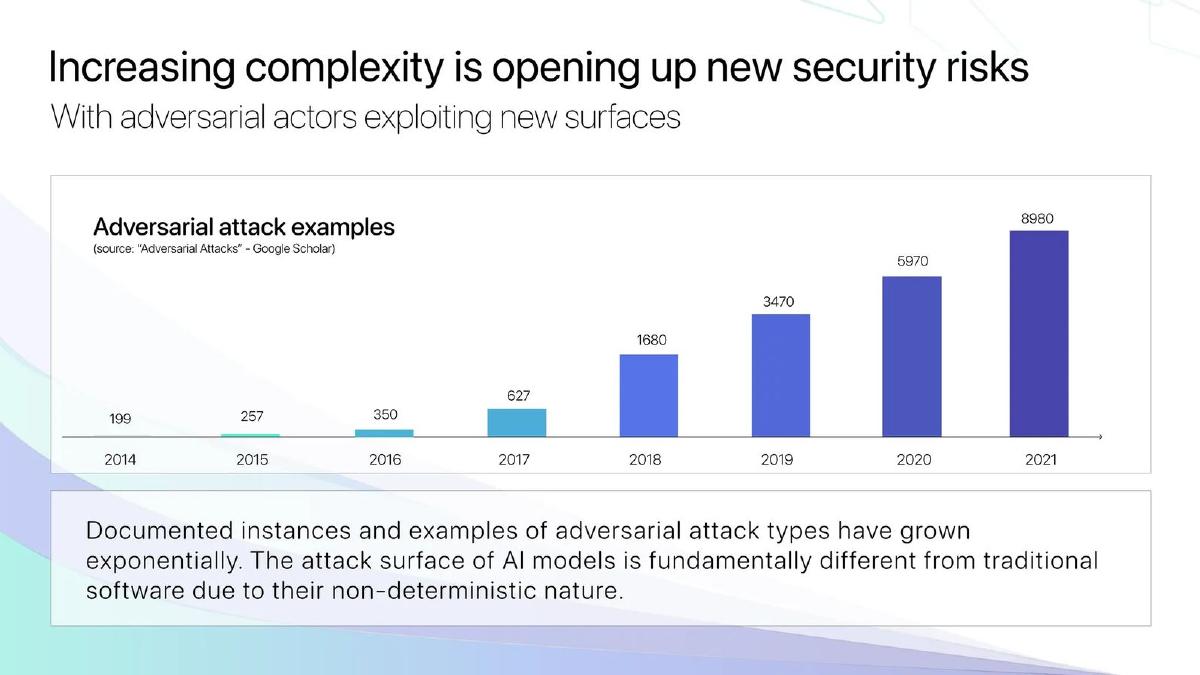
- Adversarial attacks on AI models grew from 199 instances in 2014 to 8,980 in 2021, according to Slide 2.
- The company positions its proprietary threat library as the market leader, citing active on-prem deployments in critical government sites as the source of its insights on Slide 4.
- CalypsoAI is part of a $249 million JAIC contract and has a program of record with the Department of Homeland Security, as stated on Slide 5.
- The product roadmap transitions from 'Available Today' penetration testing to an ML Firewall in Q1 2023 and Edge Detection by Q4 2024 on Slide 6.
- The sales strategy mirrors the evolution of Dev-Sec-Ops, aiming to establish the 'ML-Sec-Ops' category for CISOs and CDOs on Slide 7.
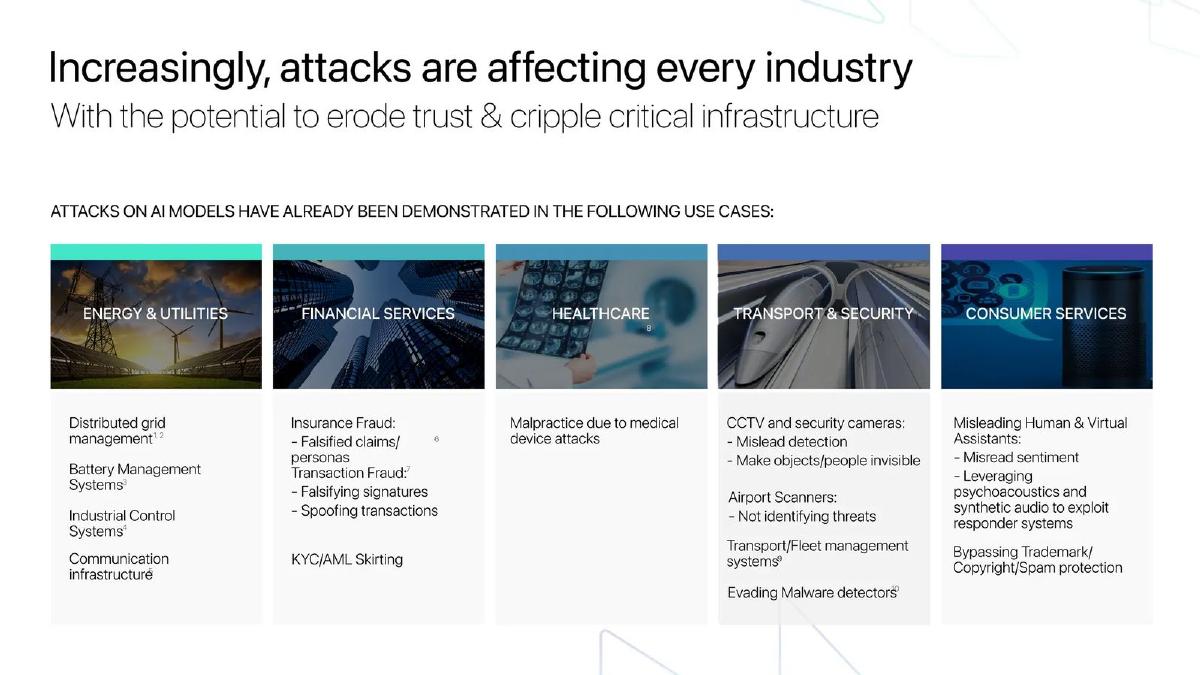
- The deck identifies five key industry verticals for AI attacks: Energy & Utilities, Financial Services, Healthcare, Transport & Security, and Consumer Services on Slide 3.
- CalypsoAI claims to have helped shape the NIST trustworthy AI standards and was selected as a Gartner 'Cool AI Vendor' on Slide 5.
- The deck lacks a team slide, specific revenue figures, or a clear investment 'ask' in the provided 7-slide sample.
CalypsoAI: Securing the Machine Learning Frontier
The CalypsoAI deck from November 2022 is a prime example of a 'credibility-first' pitch. In a sector as technical and emerging as AI security, the founders chose to lead with the magnitude of the problem and the weight of their existing partnerships. By the time an investor reaches the product roadmap, the company has already established itself as a trusted partner of the US military and intelligence communities. This teardown examines how they structured this narrative and where the gaps remain.
Slide 1: Title Slide
The title slide is minimalist, featuring the logo and the tagline 'Cybersecurity for AI.' The date 'November 2022' is clearly marked. This is a standard, professional opening that immediately defines the category the company intends to own. The background pattern suggests a mesh or shield, subtly reinforcing the security theme without being distracting.
Slide 2: The Problem - Exponential Threat Growth
Slide 2 focuses on the 'Increasing complexity' and 'new security risks' associated with AI. It features a bar chart showing 'Adversarial attack examples' sourced from Google Scholar. The data shows a clear upward trend: from 199 in 2014 to 8,980 in 2021. Crucially, the slide notes that AI models are 'non-deterministic,' which serves as the technical justification for why traditional cybersecurity tools are insufficient. This slide does the heavy lifting of proving that the problem is both real and growing at an exponential rate.
Slide 3: Industry Impact
This slide expands the problem from a technical niche to a broad economic threat. It lists five verticals: Energy & Utilities, Financial Services, Healthcare, Transport & Security, and Consumer Services. For each, it provides specific examples of demonstrated attacks, such as 'Insurance Fraud: Falsified claims/personas' and 'Malpractice due to medical device attacks.' By citing specific use cases (and using footnotes for sources), CalypsoAI demonstrates that their market is not just government, but every major industry adopting AI.
Slide 4: The Competitive Moat
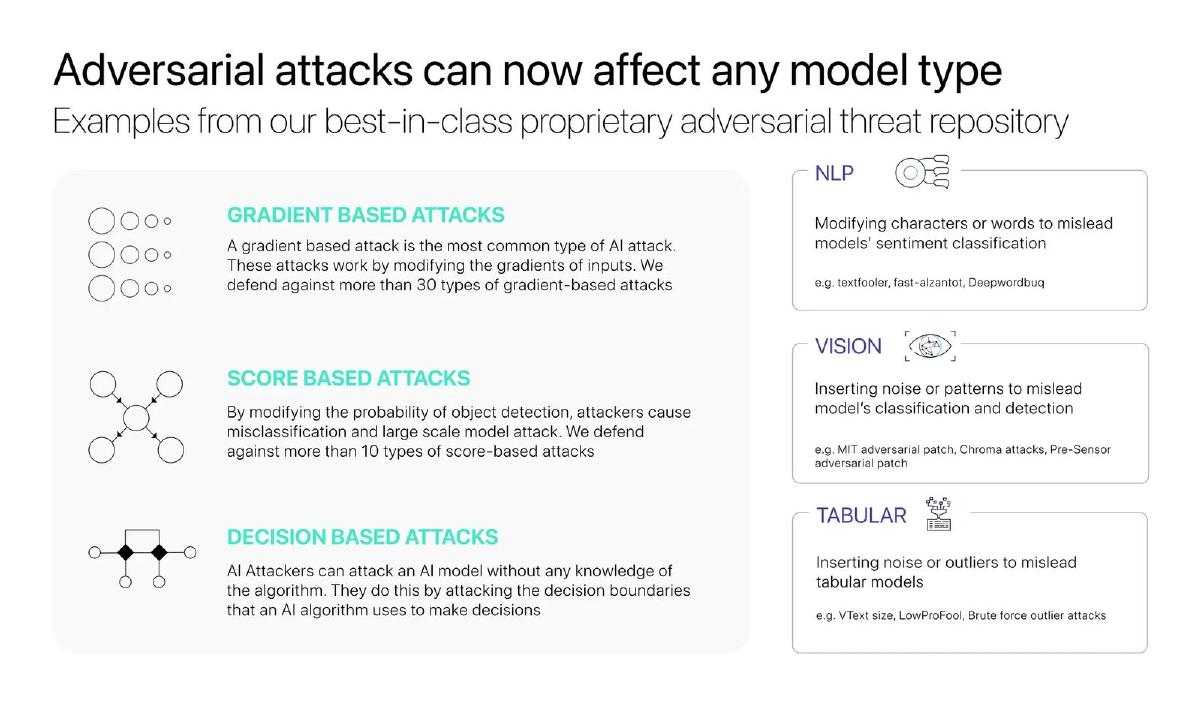
Slide 4 introduces the 'Proprietary library of AI attacks & defenses.' The company claims to be the 'market leader' based on three pillars: the largest threat library, the most critical customers (US Government), and on-prem insights. The phrase 'developed from the most high-risk, most active sites' is a powerful way to describe their R&D process. It tells investors that their product isn't just theoretical; it's being forged in the most demanding environments on earth.
Slide 5: Battle-Tested Validation
This is the 'social proof' slide, and it is exceptionally strong. It is divided into three sections: 'Currently Protecting,' 'Partnered With,' and 'Industry Accolades.' The mention of a 'Program of record with Department of Homeland Security' and being 'Part of $249m JAIC contract' provides immense valuation support. The logos of PwC, Microsoft, AWS, and Dell further suggest a robust ecosystem of partners. This slide effectively removes 'technology risk' from the investor's mind.
Slide 6: Product Roadmap and Strategy
Slide 6 outlines the transition from a service-heavy government provider to a scalable product company. The timeline shows a shift from 'R&D' in 2019 to 'Expansion into Financial Services' in 2023 and 'Healthcare' in 2024. The product breakdown is clear: Penetration Testing is the current offering, with an ML Firewall, Threat Intelligence, and Edge Detection coming in 2023 and 2024. This gives investors a clear view of how the company intends to capture the enterprise market over time.
Slide 7: The Sales Strategy (ML-Sec-Ops)
The final slide in this sample explains the 'ML-Sec-Ops' concept. It maps the company's sales strategy to the historical evolution of DevOps. By targeting Data Scientists, CDOs, and CISOs with specific value propositions, CalypsoAI shows they understand the enterprise buying committee. This slide is critical because it explains how they will sell a complex technical product to large organizations.
What CalypsoAI Does Well
The deck excels at Category Creation . By repeatedly using the term 'Cybersecurity for AI' and 'ML-Sec-Ops,' they are positioning themselves as the inevitable leader of a new, necessary vertical. Their use of government contracts as a 'moat' is also brilliant; it suggests a level of technical sophistication and 'security clearance' that competitors would find difficult to replicate quickly. The visual design is clean, data-driven, and avoids the 'hype' often associated with AI startups.
What is Missing from the Deck
While the narrative is strong, the provided slides leave several critical questions unanswered. There is no Team Slide in this 7-slide sample, which is a major omission for a technical teardown. Investors need to see the pedigree of the engineers and researchers building this 'largest threat library.' Furthermore, there are no financial metrics . While they mention being part of a $249m contract, they don't state their specific share of that revenue or their current ARR from enterprise clients. Finally, the 'Ask' is missing . We don't know how much they are raising or what the specific milestones for that capital are, other than the general product roadmap.
Founder Takeaways: What to Copy
Leverage High-Stakes Validation: If you have government or enterprise pilots, frame them as 'battle-testing' your tech for the broader market. · Define the Category: Use consistent terminology (like ML-Sec-Ops) to own a specific space in the investor's mind. · Map to Historical Success: Comparing your sector's growth to a known quantity (like the rise of DevOps) helps investors understand the potential trajectory and exit opportunities. · Use Specific Use Cases: Don't just say 'AI is dangerous.' List specific ways it can be exploited in healthcare, finance, and infrastructure to make the threat feel tangible.
Frequently asked questions
- What is CalypsoAI's primary value proposition?
- CalypsoAI positions itself as the provider of 'Cybersecurity for AI.' Their core value lies in a proprietary library of adversarial attacks and defenses. They argue that because AI models are non-deterministic, they require a fundamentally different security approach than traditional software. They leverage their experience with high-risk government clients to provide 'battle-tested' security for machine learning models in the enterprise sector.
- How does CalypsoAI validate its market leadership?
- The company uses high-level government partnerships and industry accolades for validation. Slide 5 lists a program of record with the DHS, a role in a $249m JAIC contract, and partnerships with major firms like PwC and Microsoft. They also cite being a Gartner 'Cool AI Vendor' and their involvement in shaping NIST standards as proof of their standing in the AI security market.
- What does the product roadmap look like?
- As of November 2022, the roadmap shows a transition from testing to active defense. Their penetration testing platform was 'Available Today,' with an ML Firewall (Security Gateway) scheduled for Q1 2023. Further down the line, they planned to release Threat Intelligence in Q1 2024 and Edge Detection in Q4 2024, aiming for an end-to-end security solution across the risk stack.
- What is the 'ML-Sec-Ops' strategy mentioned in the deck?
- CalypsoAI draws a parallel between the 2010s evolution of DevOps into Dev-Sec-Ops and the current 2020s evolution of ML into ML-Sec-Ops. Their strategy is to target different stakeholders within an organization: Data Scientists for model robustness, CDOs for critical vulnerability management, and CISOs for organizational-wide AI security and infrastructure protection.
- What critical information is missing from this pitch deck?
- Based on the 7 slides provided, the deck is missing a team slide, which is crucial for assessing technical expertise. It also lacks any mention of current revenue, burn rate, or specific unit economics. Most importantly, there is no 'Ask' slide detailing how much capital they are raising or how those funds will be allocated to achieve the stated roadmap.