Capacity's 16-slide deck for its Series B round is notable for what it chooses to emphasize: vision, integration, and social proof. Rather than leading with a dense spreadsheet of unit economics, the company focuses on the 'wasted time' inherent in enterprise knowledge management (Slide 3) and its solution's ability to integrate with over 40 apps (Slide 5). The deck relies heavily on third-party validation, dedicating entire slides to industry awards (Slide 12) and market growth projections from firms like Tractica (Slide 8). While the lack of a traditional team slide or specific revenue numb…
Key takeaways
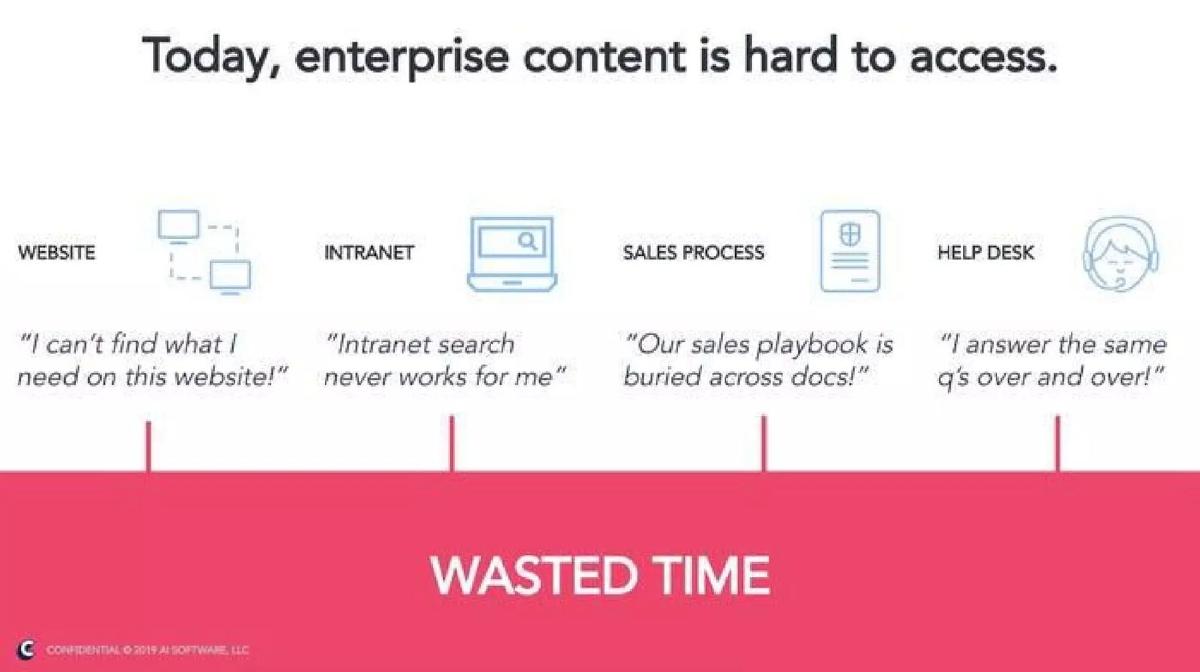
- The deck identifies 'Wasted Time' as the core enterprise problem, citing broken intranet searches and repetitive help desk queries (Slide 3).
- Capacity positions itself as an 'enterprise AI platform' that integrates with 40+ apps to mine business intelligence (Slide 5).
- The business model is built on multiyear contracts and predictable, recurring SaaS revenue (Slide 9).
- Market validation is sourced from Business Insider, Forbes, and ZDNet to prove that 80% of businesses want chatbots by 2020 (Slide 7).
- The company highlights a successful track record of hitting goals, including achieving bookings targets in both 2017 and 2018 (Slide 13).
- The deck explicitly states the company's funding history: $1.6m Seed, $8.4m Series A, and an ongoing $10m+ Series B (Slide 14).
- A 'Near Term Focus' slide outlines the transition from building the product to developing a 'world class sales & marketing machine' (Slide 10).
- The deck lacks a dedicated team slide, choosing instead to list founders David Karandish and Chris Sims on a general profile slide (Slide 14).
Introduction
Capacity, formerly known as Jane.ai, is a support automation platform that leverages artificial intelligence to streamline how employees and customers access information. This 16-slide Series B deck was used to secure a round that ultimately totaled $13.2 million (with the deck itself noting an ongoing $10m+ target). The deck is a prime example of a 'narrative-first' presentation, focusing on the macro problem of enterprise inefficiency and the company's proven ability to execute against its roadmap.
The Hook and the Problem (Slides 1-3)
The deck opens with a minimalist title slide (Slide 1) featuring only the company logo on a deep blue background. This is followed by a standard legal disclaimer (Slide 2), which is common in later-stage rounds to protect the company regarding forward-looking statements. The narrative truly begins on Slide 3, titled 'Today, enterprise content is hard to access.' This slide is effective because it categorizes the pain points into four distinct buckets: Website, Intranet, Sales Process, and Help Desk. By using relatable quotes like 'I answer the same q’s over and over!' the company grounds its technical AI solution in a very human problem: Wasted Time .
The Solution and Product Architecture (Slides 4-6)
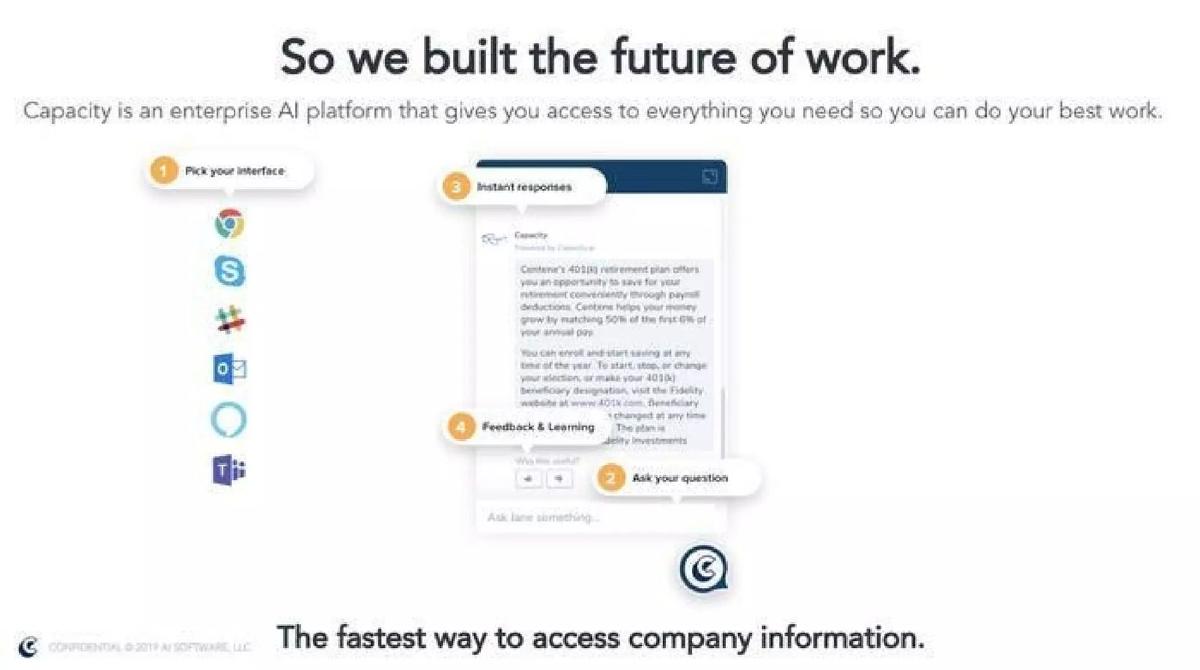
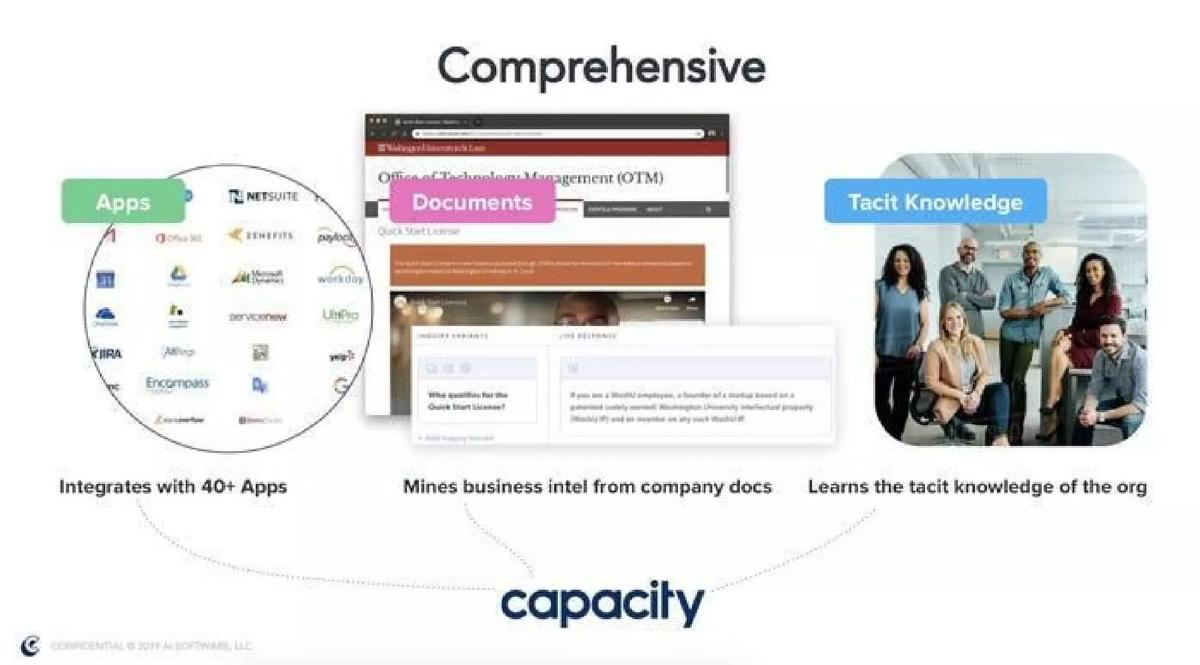
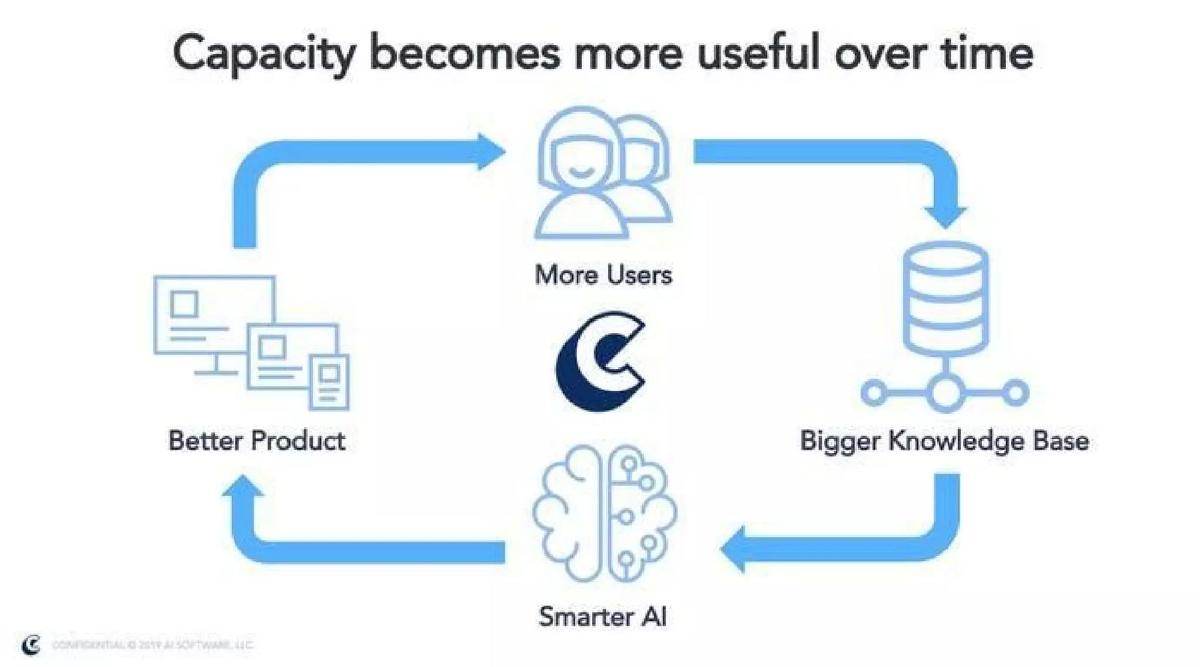
Slide 4 introduces the solution as 'the future of work,' describing Capacity as an enterprise AI platform. It uses a simple four-step visual to explain the user experience: pick an interface, ask a question, get an instant response, and provide feedback. Slide 5, titled 'Comprehensive,' is perhaps the most important technical slide in the deck. It shows that Capacity isn't just a layer on top of a single database; it integrates with over 40 apps (NetSuite, Salesforce, Workday, etc.), mines documents, and captures 'Tacit Knowledge.' This last point is a sophisticated value prop, suggesting the AI learns things that aren't even written down. Slide 6 illustrates the 'flywheel effect,' showing how more users lead to a bigger knowledge base, which creates a smarter AI and a better product, theoretically creating a defensive moat.
Market Validation and TAM (Slides 7-8)
Capacity leans heavily on external authority to justify its existence. Slide 7, 'The Workplace needs AI,' uses logos from Business Insider, Forbes, and ZDNet to provide social proof. It cites a specific statistic: '80% of businesses want chatbots by 2020.' This creates a temporal urgency for investors. Slide 8 addresses the Total Addressable Market (TAM) using a chart from Tractica. The chart shows AI software revenue exploding from near-zero in 2017 to over $100 billion by 2025. By showing a rainbow of industries in the bar chart, Capacity signals that they are not limited to a single vertical like Finance or HR, but are a horizontal platform play.
Business Model and Strategic Focus (Slides 9-11)
Slide 9 outlines a standard but attractive SaaS business model: multiyear contracts, predictable recurring revenue, and scalable deployment. The mention of 'Upselling & cross-selling' indicates that their strategy involves a 'land and expand' approach within large enterprises. Slide 10, 'Near Term Focus,' is a transition slide. It tells investors exactly what the Series B capital will be used for: moving from product development ('Build the Category Killer') to commercialization ('Develop a world class sales & marketing machine'). Slide 11 is a placeholder for a 'Demo,' which suggests this deck was intended to be presented live rather than just sent as a PDF.
Traction and Social Proof (Slides 12-13)
To de-risk the investment, Capacity showcases its trophy cabinet on Slide 12. They list awards from 'InVest,' 'Unleash,' and 'Digital Mortgage 2018.' This proves that industry experts have already vetted the technology. Slide 13, 'We Hit Our Goals,' is the 'execution' slide. It features a checklist of eight milestones achieved between 2017 and 2018. Crucially, it mentions hitting bookings targets for two consecutive years. For a Series B investor, this checklist is a signal that the management team is disciplined and capable of hitting the numbers they promise.
Company Profile and The Ask (Slides 14-16)
Slide 14 provides a 'Company Profile' that acts as a summary. It lists the founders, David Karandish and Chris Sims, and the funding history: $1.6m Seed, $8.4m Series A, and the current $10m+ Series B. Interestingly, there is no slide detailing the founders' backgrounds or previous exits, which is a notable omission unless the founders are already well-known to the target investors. Slide 15 is a 'Raising our Series B' slide featuring a classic 'J-curve' or hockey stick growth chart. It marks their current position at the base of the curve, just before the projected exponential spike. The deck concludes on Slide 16 with a repeat of the logo slide.
What Works
Clear Problem Definition: Slide 3 does an excellent job of taking a complex technical problem (knowledge management) and making it visceral through user quotes. · Integration Focus: By highlighting '40+ Apps' on Slide 5, Capacity addresses the biggest hurdle in enterprise software: the siloed nature of data. Investors see this as a sign of high switching costs and deep stickiness. · Execution History: The checklist on Slide 13 is a powerful way to build trust. It shows the company isn't just dreaming; they are delivering on a schedule. · Third-Party Validation: The use of recognized media logos and industry awards throughout the deck helps to overcome the skepticism often associated with 'AI' startups.
What is Missing
Granular Financials: There is a total lack of revenue figures, burn rate, or unit economics. While this might be in the data room, a Series B deck usually benefits from showing the scale of the current ARR (Annual Recurring Revenue). · Team Bios: The deck assumes the investors know who David Karandish and Chris Sims are. For a cold pitch, the lack of a team slide with past successes is a significant gap. · Competitive Landscape: There is no slide addressing competitors. In the crowded 'AI Help Desk' and 'Enterprise Search' space, failing to differentiate from players like Zendesk, ServiceNow, or Glean is a missed opportunity. · Use of Funds: While Slide 10 mentions a 'sales & marketing machine,' there is no specific breakdown of how the $10m+ will be allocated (e.g., headcount, R&D, geographic expansion).
What a Founder Should Copy
The 'Near Term Focus' Slide: Slide 10 is a great way to signal a shift in company maturity. It tells investors, 'We've built the tech, now we're building the business.' · The Goal Checklist: Every founder should have a slide like Slide 13. It proves you are a 'say-do' company. Even if the goals are modest, the act of hitting them consistently is highly attractive to VCs. · Visualizing the Flywheel: Slide 6's circular diagram is a standard but effective way to explain how your product gets better with scale. It helps investors visualize the long-term value of the data being collected. · High-Level Category Positioning: Capacity doesn't call itself a 'chatbot.' It calls itself an 'Enterprise AI Platform.' Founders should copy this 'category-up' positioning to justify higher valuations.
Frequently asked questions
- How does Capacity define its market opportunity?
- Capacity uses a top-down approach to market sizing. On Slide 8, they include a Tractica chart showing AI software revenue growing toward $100 billion by 2025 across dozens of industries. They supplement this with qualitative data on Slide 7, noting that 84% of enterprises believe AI provides a competitive advantage. This frames the company as a horizontal solution capable of capturing value across the entire enterprise landscape rather than a niche tool.
- What is unique about Capacity's product positioning in this deck?
- The deck positions Capacity as more than just a chatbot. Slide 5 emphasizes three pillars: Apps (40+ integrations), Documents (mining intel from company docs), and Tacit Knowledge (learning from the organization). By including 'Tacit Knowledge,' they are signaling that the AI captures the unwritten expertise of employees, which is a significant step up from standard keyword-based help desk software.
- Why is the 'We Hit Our Goals' slide important for a Series B?
- Slide 13 is critical because Series B investors are looking for execution consistency. By listing specific achievements like 'Achieve Bookings Target 2017' and '2018,' along with 'Land our first clients outside of St. Louis,' Capacity proves they can set a roadmap and follow it. It transforms the pitch from a set of promises into a demonstration of a repeatable process.
- What information is missing from the Capacity pitch deck?
- The deck is remarkably light on specific financial metrics. There are no mentions of Monthly Recurring Revenue (MRR), Customer Acquisition Cost (CAC), or Churn rates. Additionally, there is no traditional team slide featuring headshots and bios; the founders are simply listed by name on Slide 14. This suggests the deck was likely used as a high-level visual aid for a conversation where the data room was already accessible.
- How does Capacity handle the 'Why Now' question?
- Capacity addresses 'Why Now' through the lens of enterprise readiness. Slide 7 quotes a 2016 Business Insider report stating 80% of businesses want chatbots by 2020. Since the deck was produced around 2019, it creates a sense of urgency—positioning Capacity as the solution for a demand wave that is currently cresting. It suggests that the market has moved past the 'curiosity' phase into the 'adoption' phase.