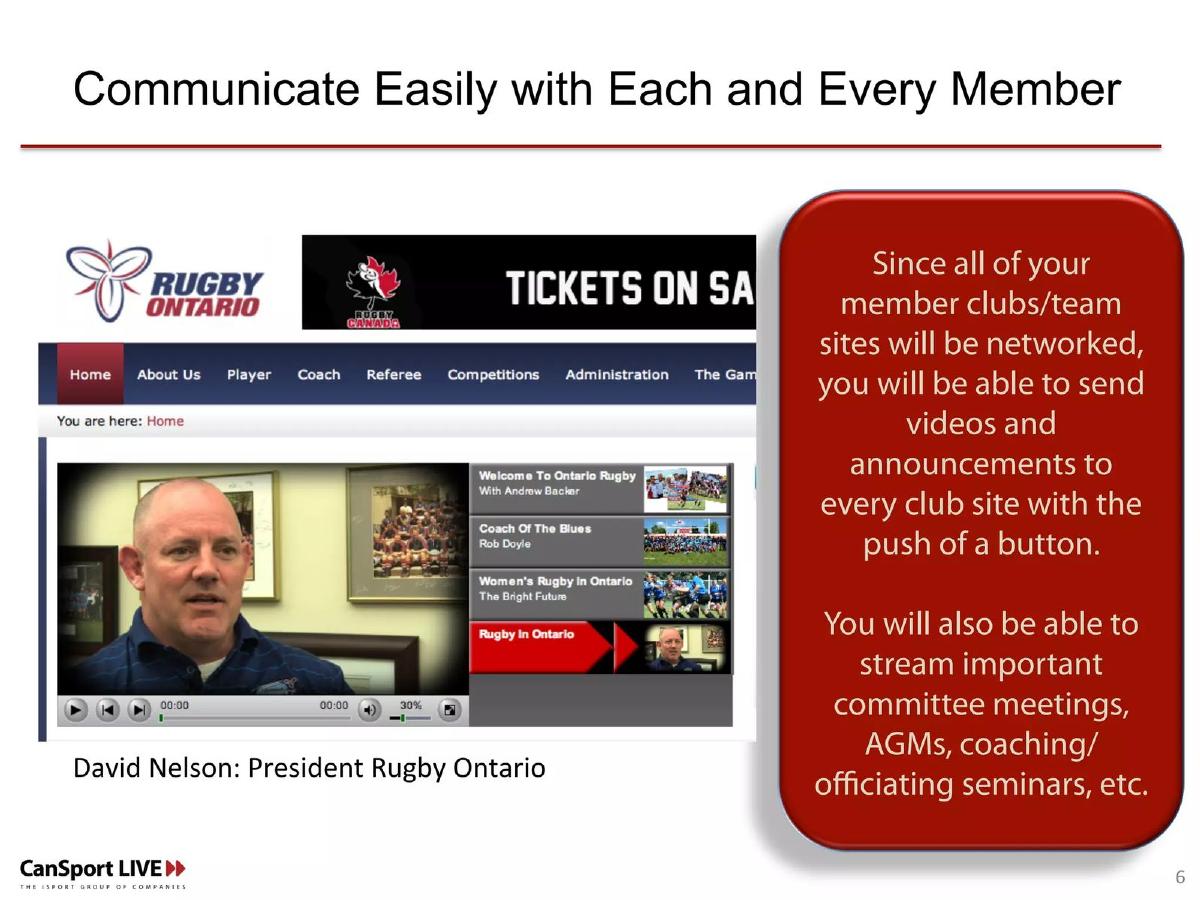
The CanSport LIVE deck, dating from 2011, functions more as a B2B sales presentation for sports federations than a traditional venture capital pitch. The core value proposition is the 'CanSport LIVE Network,' which aims to aggregate fragmented amateur sports websites into a single entity capable of attracting national advertisers like Ford and Capital One. By providing a full-service CMS, video streaming, and e-commerce tools to clubs that previously relied on rudimentary web designs, the company sought to build a top 5 digital property in Canada. While the deck excels at demonstrating produc…
Key takeaways
- The company positions itself as Canada's first full-service digital solutions provider for amateur sports federations, teams, and clubs (Slide 1).
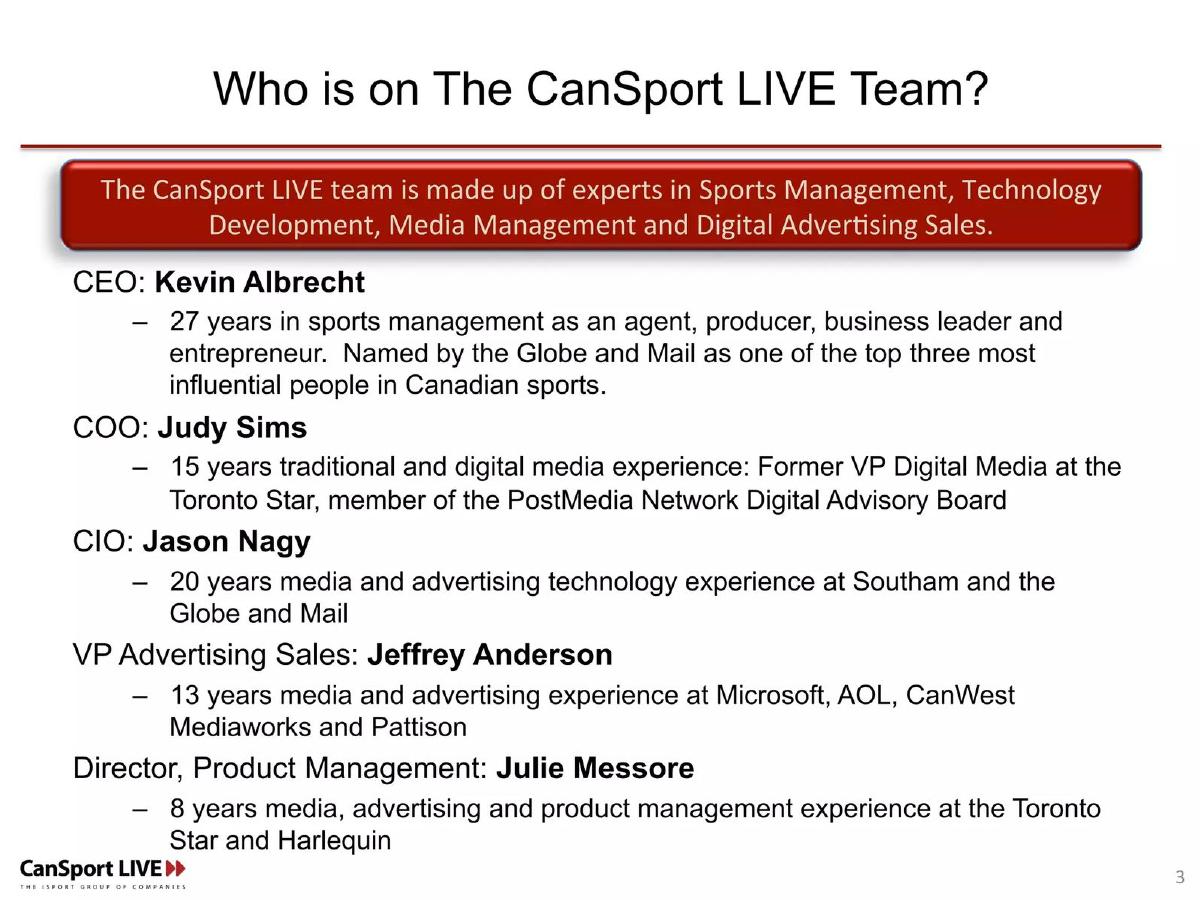
- The leadership team boasts significant tenure, including a CEO with 27 years in sports management and a COO with 15 years in digital media (Slide 3).
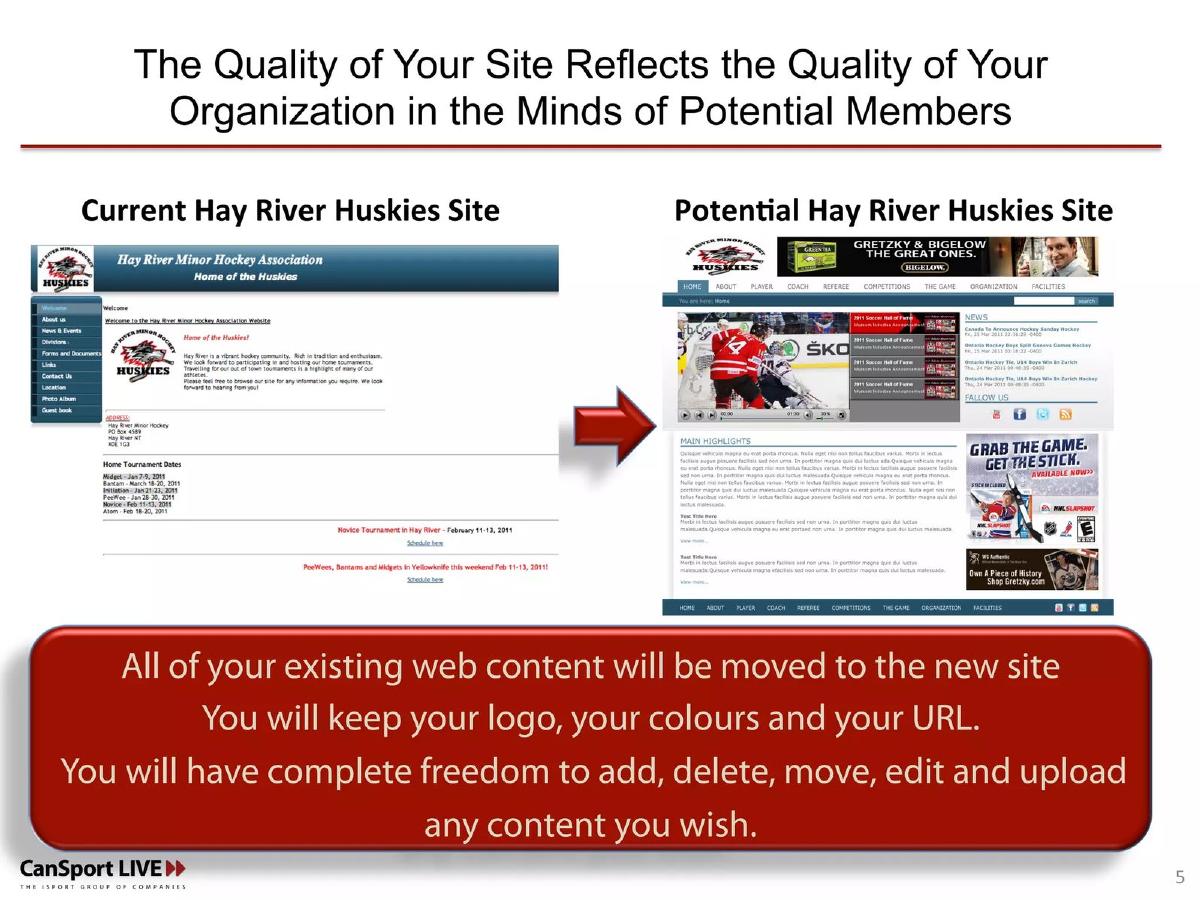
- A 'before and after' comparison of the Hay River Huskies site illustrates the visual and functional upgrade the platform provides (Slide 5).
- The platform includes a specialized Video eCommerce Player supporting rentals, subscriptions, and pre/mid/post-roll advertising (Slide 9).
- The primary business strategy is traffic aggregation, aiming to combine small sites to become one of the top 5 digital properties in Canada (Slide 11).
- The deck lists high-profile potential or existing advertising partners including Banana Boat, Intact Insurance, Ford, and Capital One (Slide 13).
- Technical features highlighted include a role-based permission system and a dedicated support desk for complex issues (Slides 17 and 19).
- The deck lacks essential fundraising metrics such as current revenue, user growth rates, or a specific capital requirement.
The CanSport LIVE Pitch Deck: Aggregating the Amateur Sports Long Tail
The CanSport LIVE deck from 2011 represents a specific era of the web where 'aggregation' was the dominant strategy for monetizing niche content. By offering a professional-grade Content Management System (CMS) to amateur sports organizations, CanSport LIVE aimed to capture the high-intent traffic of parents, players, and fans, packaging it for national advertisers who would otherwise never buy space on a local hockey team's website.
Slide 1: The Introduction
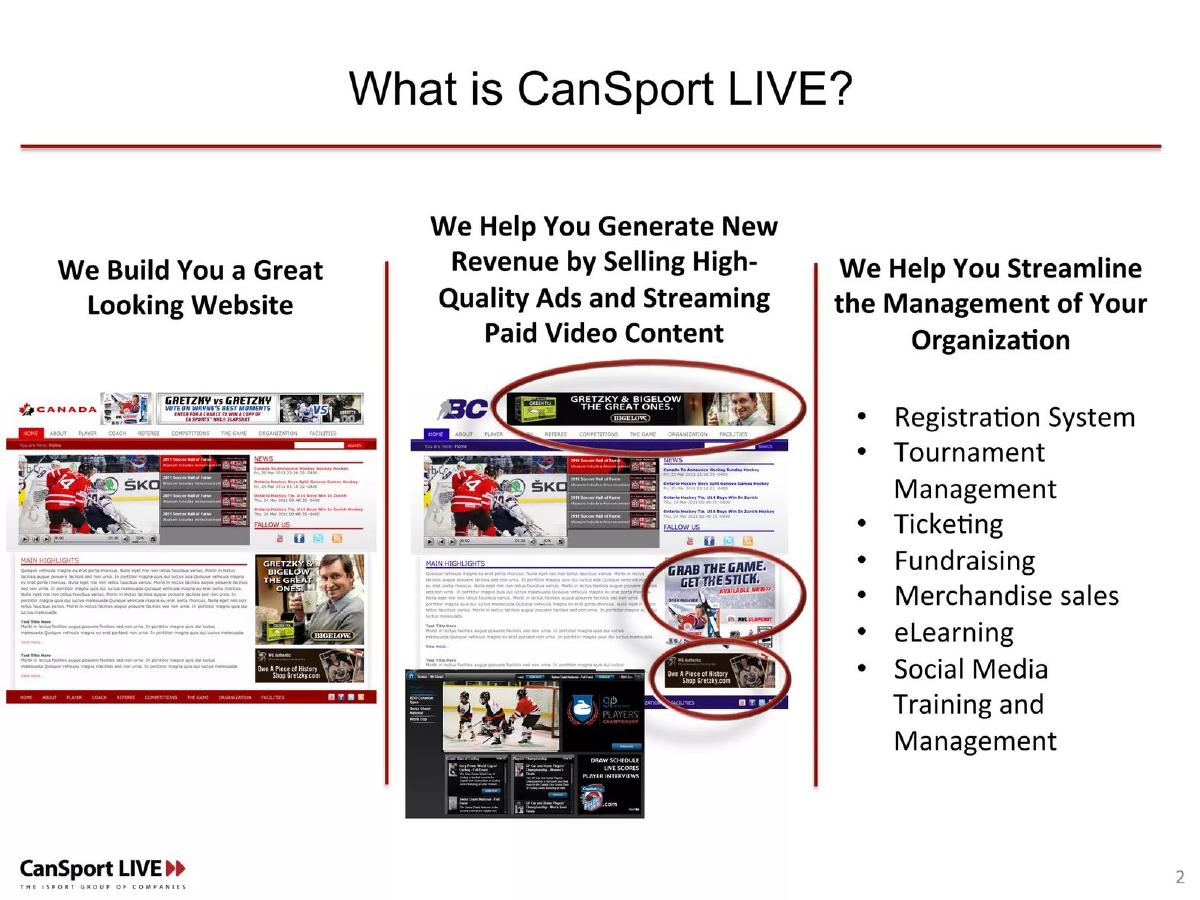
The cover slide establishes CanSport LIVE as a subsidiary of 'The iSport Group of Companies.' It defines the company as Canada’s first full-service digital solutions provider for amateur sports federations, teams, and clubs. The branding is professional, utilizing a red and black color scheme that evokes a sports broadcast feel. The value proposition is clear: digital transformation for a traditionally underserved market.
Slide 3: The Leadership Team
This is a strong 'Experience' slide. It lists five key executives, emphasizing their years in the industry. CEO Kevin Albrecht is the anchor, with 27 years in sports management and a notable accolade from the Globe and Mail. The inclusion of leaders from the Toronto Star and Globe and Mail (Judy Sims and Jason Nagy) signals that the company views itself as a media and advertising play as much as a technology provider. The combined 83 years of experience listed across the team provides significant credibility for a startup in the sports niche.
Slide 5: The Visual Transformation
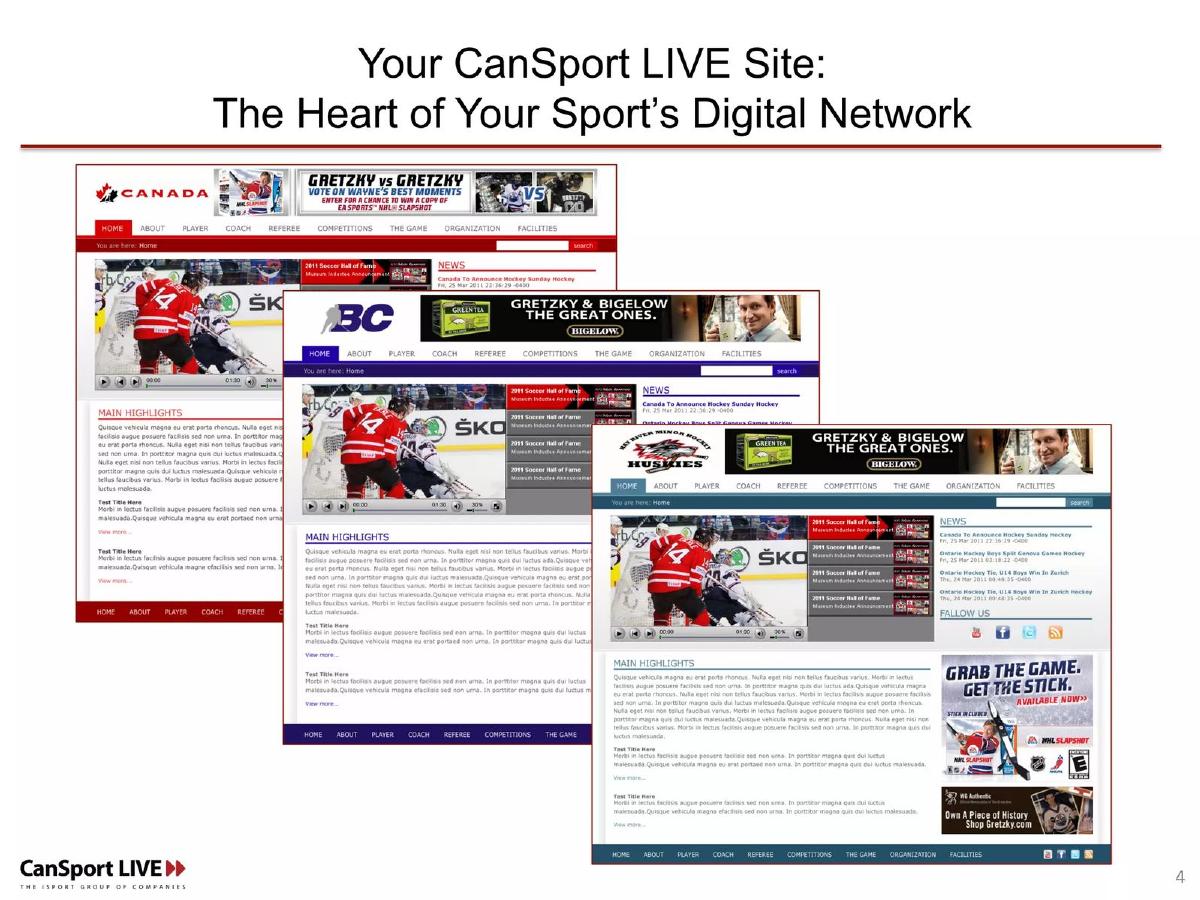
Slide 5 uses a classic 'Before and After' comparison. On the left is the 'Current Hay River Huskies Site,' which appears to be a basic, text-heavy HTML page from the early 2000s. On the right is the 'Potential Hay River Huskies Site,' featuring a modern (for 2011) layout with high-resolution imagery, organized navigation, and prominent advertising slots for brands like Gretzky & Bigelow. The text at the bottom promises a seamless migration: 'All of your existing web content will be moved to the new site.' This addresses a major pain point for non-technical club administrators: the fear of losing data during an upgrade.
Slide 7: Customization and Features
Titled 'Make it Work for You,' this slide lists the functional modules available to clubs. It highlights calendars, skating schedules, news feeds, and photo galleries. The screenshots show the platform's ability to handle specific sports data, which is a key differentiator from generic website builders like WordPress or Wix. The emphasis is on 'easily customize,' reinforcing the user-friendly nature of the CMS.
Slide 9: The Video Strategy
Video is a central pillar of the CanSport LIVE offering. Slide 9 distinguishes between a 'Standard Video Player' for live events and a 'Video eCommerce Player.' The latter is particularly interesting as it mentions 'rentals, subscriptions, purchases as well as pre, mid and post-roll advertising.' In 2011, providing a turnkey solution for pay-per-view amateur sports was a sophisticated offering, allowing small clubs to monetize their games similarly to professional leagues.
Slide 11: The Network Effect
This is the 'Business Model' slide. It uses a map of Canada populated with red circles of varying sizes to represent National Sports Federations (NSF), Provincial Sports Organizations (PSO), and small leagues. The text states that while individual sites are too small for national advertisers, together they have the potential to become one of the 'top 5 digital properties in the country.' This is the core pitch to both the clubs (who get better ads) and potential investors (who see the scale).
Slide 13: Advertising Partners
Slide 13 displays logos for Banana Boat, Intact Insurance, Royal Canadian Mint, Ford, and Capital One. The slide promises that by joining the network, clubs don't need to worry about 'junky' or questionable ads. This 'High-Quality' promise is a direct response to the low-quality programmatic ads that often plagued small websites in the early 2010s. It positions CanSport LIVE as a premium gatekeeper.
Slide 15: Platform Usability
This slide provides a look 'under the hood' of the CMS. It shows a dashboard with modules for site settings, skins, security roles, and newsletters. The inclusion of 'Google Analytics Pro' suggests a focus on data-driven management. By showing the actual interface, the deck attempts to prove that the product is built and functional, rather than just a concept.
Slide 17: Security and Control
Slide 17 focuses on 'Roles and Permissions.' For large organizations like a National Sports Federation, controlling who can edit content is critical. The slide shows a granular matrix where administrators can assign 'View, Add, Content, Copy, Delete' rights to different user groups. This feature is essential for B2B enterprise sales, ensuring that a volunteer coach doesn't accidentally delete the federation's homepage.
Slide 19: Support Infrastructure
The final slide in this set addresses post-launch concerns. It features a screenshot of a support portal with a knowledge base, news, and a live chat option. The 'Support Email address' is prominently displayed. For a service-based technology company, showing that there is a human element to the support (the 'support desk') is a key closer for sales to non-technical organizations.
What CanSport LIVE Does Well
The deck is exceptionally good at identifying its target audience's pain points. Amateur sports clubs are often run by volunteers who lack technical skills and have no way to monetize their traffic. CanSport LIVE offers a 'done-for-you' solution that includes migration, hosting, and a revenue stream. The 'Before and After' slide (Slide 5) is a powerful psychological tool that makes the value of the service immediately obvious. Furthermore, the team slide (Slide 3) is top-tier, showing a group of people who clearly understand both the Canadian sports landscape and the digital media industry.
What Is Missing from the Deck
As a fundraising document, this deck has several glaring omissions. First, there is no Financial Ask . We do not know how much money the company is seeking or what the valuation is. Second, there are no Unit Economics . While they mention advertising revenue, they don't explain the split between the company and the clubs, nor do they provide a Customer Acquisition Cost (CAC) or Lifetime Value (LTV) for the federations. Third, there is no Competition Slide . In 2011, other platforms were beginning to eye the amateur sports space; failing to acknowledge them is a missed opportunity to define their unique edge. Finally, there is no Traction Slide . While they show a 'potential' site for the Hay River Huskies, they don't state how many clubs are currently signed up or what the total network traffic looks like.
Lessons for Founders
Founders can learn two major lessons from this deck. The first is the power of Visual Proof . If you are selling a transformation, show the 'before' and 'after.' It removes the need for long paragraphs of text. The second lesson is Aggregation Strategy . If your individual customers are small, your pitch must be about the power of the collective. CanSport LIVE correctly identified that their value wasn't just in the software, but in the 'Network' (Slide 11) that the software created. However, founders should be careful not to confuse a sales deck with an investor deck. If you are pitching for capital, you must include the 'Ask' and the 'Math'—two things this deck ignores in favor of product features.
Frequently asked questions
- Is this a fundraising deck or a sales deck?
- Based on the content, this functions primarily as a sales deck targeted at sports federations. It focuses heavily on 'what you get' as a partner—such as a new website, video players, and support—rather than 'what the investor gets.' It lacks a slide for the 'Ask,' financial forecasts, or an exit strategy, which are standard in investor-facing materials.
- What is the core revenue model described in the slides?
- The model is built on advertising and sponsorship aggregation. Slide 11 explains that individual amateur sites are too small for national advertisers, but the CanSport LIVE Network pools them to attract major brands. Slide 9 also mentions video-specific revenue through rentals, subscriptions, and ad rolls.
- How does the company address the technical limitations of its target audience?
- The deck emphasizes ease of use and support. Slide 15 shows a CMS interface for managing pages and modules, while Slide 19 highlights a dedicated helpdesk and knowledge base. This suggests the target customers are non-technical volunteers or staff at local sports clubs.
- What specific technology features are highlighted?
- The deck showcases a custom CMS, a standard video player for live events, a specialized eCommerce video player, and a granular roles and permissions system (Slides 7, 9, and 17). It also mentions the ability to move existing content to new URLs while keeping original branding.
- Who are the key people behind CanSport LIVE?
- The team is led by CEO Kevin Albrecht, who was named one of the top three most influential people in Canadian sports by the Globe and Mail. He is supported by COO Judy Sims (formerly of Toronto Star) and CIO Jason Nagy (formerly of Globe and Mail), providing a mix of sports and media expertise (Slide 3).