Visiblee’s 2014 seed deck is exceptionally lean, consisting of only eight slides. It bypasses traditional filler, moving immediately from a stark problem statement (low website conversion) to a high-traction proof point ($42K MRR with 46% MoM growth). The deck relies on 'big data' and 'machine learning' as its technical moat, though it remains light on architectural specifics. Its strength lies in its clarity of purpose: identifying anonymous B2B visitors to boost conversion by a claimed 300%. With a team that boasts four previous startups and two exits, the deck leverages founder credibility…
Key takeaways
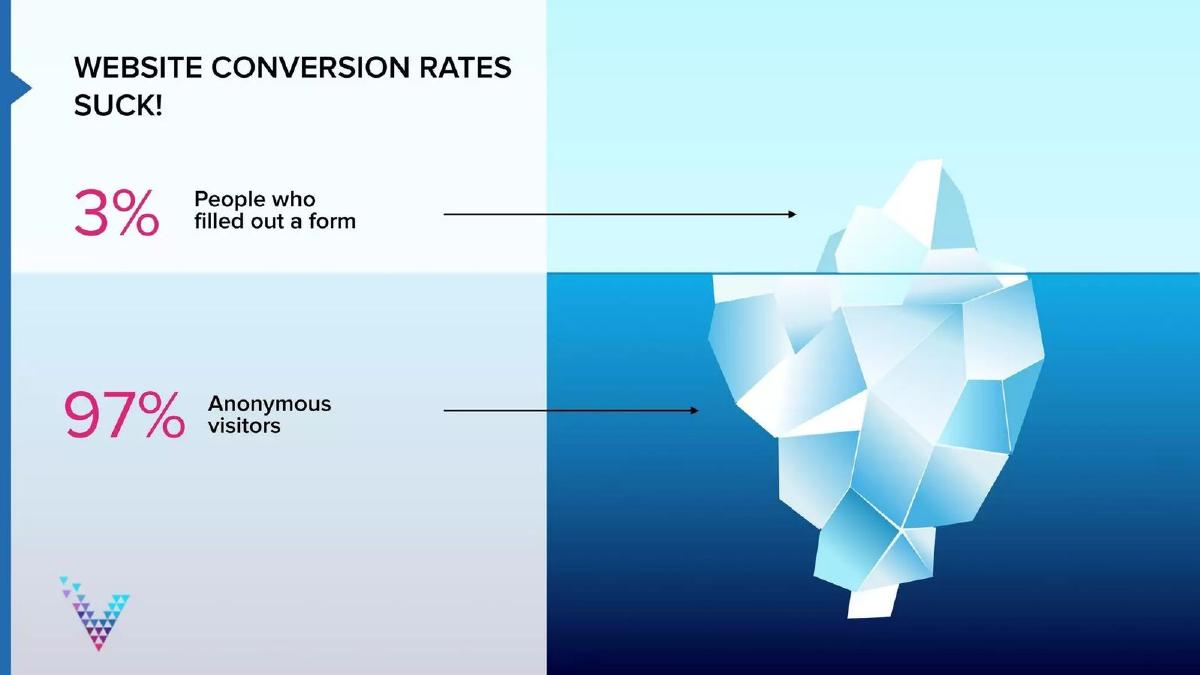
- The deck identifies a specific market inefficiency: 97% of website visitors are anonymous and do not fill out forms (Slide 2).
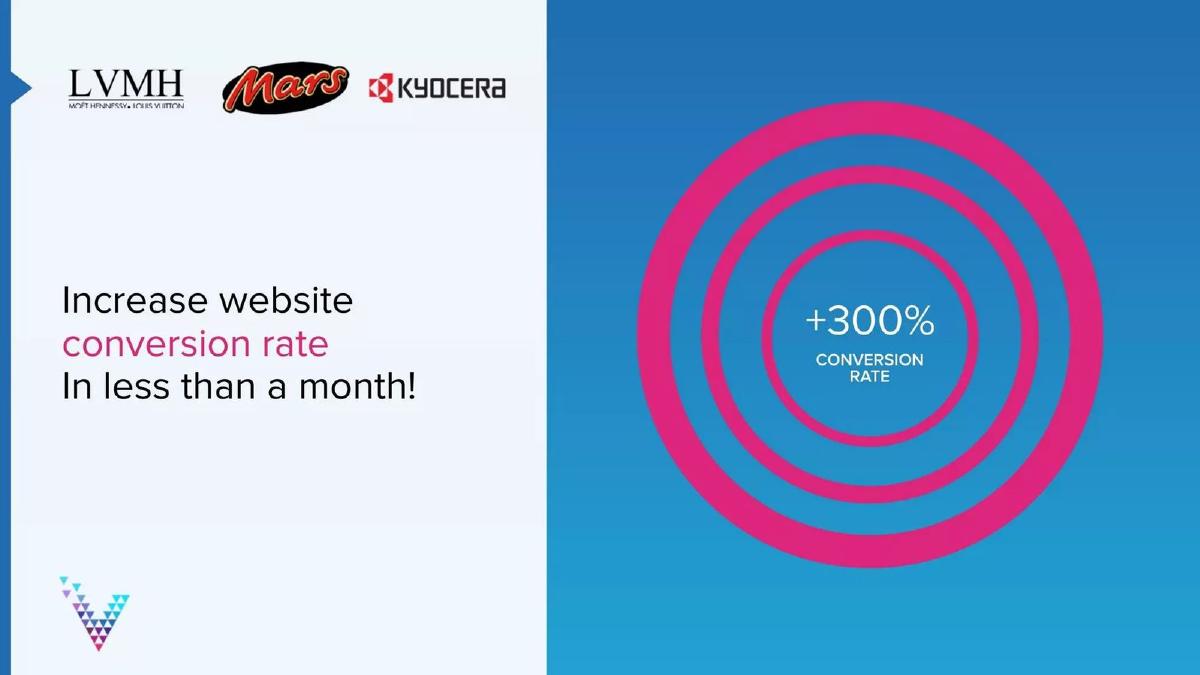
- Visiblee claims to increase website conversion rates by 300% in less than a month (Slide 3).
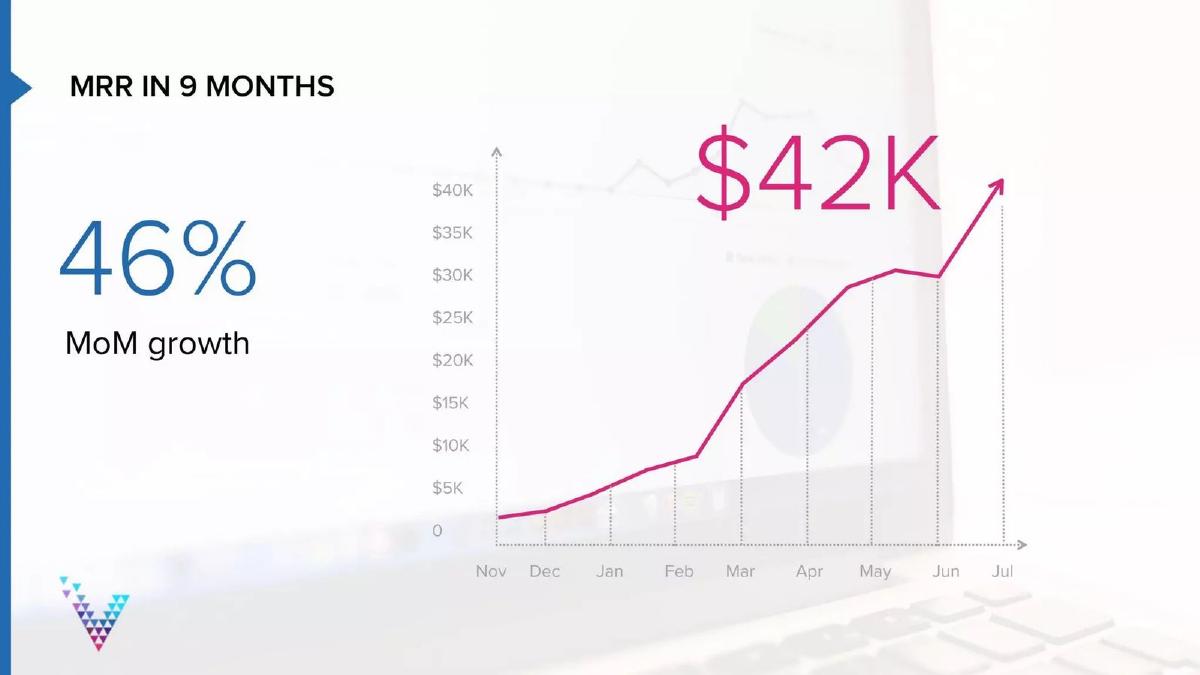
- The company demonstrates significant early traction, reaching $42K MRR within 9 months of operation (Slide 4).
- Growth is accelerating at a 46% month-over-month rate as of the July data point (Slide 4).
- The technical solution involves combining IP address analysis and cookies with machine learning to identify visitors in real time (Slide 6).
- The founding team has high pedigree, citing 4 previous startups created and 2 sold (Slide 7).
- The deck uses logos from LVMH, Mars, and Kyocera to establish enterprise-level social proof (Slide 3).
- There is a total absence of a 'The Ask' slide, financial forecasts, or a detailed competitive landscape within the 8-slide deck.
The 8-Slide Sprint: How Visiblee Raised $4M
In the world of venture capital, there is a persistent myth that a pitch deck must be a 20-page exhaustive document covering every possible contingency. Visiblee’s 2014 seed deck is a direct rebuttal to that notion. At just eight slides, it is one of the leanest decks to successfully secure a multi-million dollar round. The company, developed by Salezeo, focused on a singular B2B pain point: the 'invisible' website visitor. By the time this deck was circulating, Visiblee was already generating $42,000 in monthly recurring revenue, a figure that often does the heavy lifting in any fundraising conversation.
The Hook: Problem and Promise (Slides 1-3)
Slide 1: Title The deck opens with a high-contrast cover slide featuring a blurred crowd on a crosswalk. The tagline is bold and quantitative: "We help B2B websites to become 300% more effective." This sets an immediate expectation for a performance-driven product. Contact info for the founders and their AngelList profile are clearly visible at the top, signaling transparency.
Slide 2: The Iceberg Problem Visiblee uses a classic 'iceberg' visualization to illustrate market inefficiency. They state that "Website conversion rates suck!" and back it up with a simple split: 3% of people fill out a form (the tip of the iceberg), while 97% remain "Anonymous visitors" (the submerged bulk). This slide is effective because it identifies a massive, untapped opportunity that every B2B marketer recognizes. It frames the 'anonymous visitor' not just as a missed connection, but as a systemic failure of current web tech.
Slide 3: The Bold Claim Slide 3 doubles down on the value proposition. It promises to "Increase website conversion rate in less than a month!" with a graphic indicating a "+300%" improvement. To mitigate the skepticism such a high number usually invites, the slide features the logos of LVMH, Mars, and Kyocera. This is a high-level use of social proof; if these global giants are using the tool to find leads, the 300% figure gains instant credibility.
The Proof: Traction and Product (Slides 4-6)
Slide 4: The 'Money' Slide This is arguably the most important slide in the deck. Titled "MRR IN 9 MONTHS," it shows a revenue graph climbing from near-zero in November to $42,000 in July. The headline metric is "46% MoM growth." For a seed-stage company in 2014, $42K MRR with nearly 50% monthly growth is an exceptional signal. It tells investors that the product-market fit has already been established and the capital being raised will be used to pour gasoline on an already burning fire.
Slide 5: The Solution After showing the growth, Visiblee finally explains what the product does. "With Visiblee... You can identify your anonymous visitors & You can engage them automatically." The imagery of a satellite dish suggests a 'scanning' or 'tracking' capability. This slide is light on details but heavy on the 'what' and 'why.' It positions the software as an automated bridge between the anonymous 97% and the sales team.
Slide 6: The Moat To answer the inevitable "How?" question, Slide 6 addresses their uniqueness. They claim to combine "big data and machine learning" to analyze IP addresses and cookies. The goal is real-time identification. While 'machine learning' was a buzzword even in 2014, the specific mention of IP and cookie analysis provides a hint at the technical implementation. The visual of a red apple among green apples reinforces the 'unique' theme, though it adds little technical value.
The Pedigree: Team and Summary (Slides 7-8)
Slide 7: The Team The team slide is a masterclass in 'founder-market fit.' The headline is "TEAM: 4 STARTUPS CREATED, 2 SOLD." This immediately de-risks the investment for a VC. The slide features a photo of the four leads (CFO, CMO, CEO, CTO) surrounded by logos of prestigious institutions and former employers: 500 Startups, HEC Paris, Uppsala Universitet, Orange, Credit Agricole, and SoftBank Group (via Aldebaran). This isn't a team of first-time founders learning on the job; it's a group of veterans who have successfully exited before.
Slide 8: The Closing Argument The final slide summarizes the "3 Success Factors": an experienced team with exits, unique big data technology, and a 46% MoM growth rate. It repeats the contact information and website URL. Notably, there is no 'Ask' slide. There is no mention of how much they are raising or what the valuation is. This suggests the deck was used to generate inbound interest and 'fear of missing out' (FOMO) rather than as a formal proposal.
What Works in This Deck
Extreme Brevity: By sticking to 8 slides, the founders ensure that every slide is viewed. There is no room for the 'boring' middle section that plagues most decks. · Traction First: Placing the $42K MRR and 46% growth on Slide 4—before even explaining the technology—forces the investor to pay attention. It is much harder to dismiss a product's 'how' when the 'results' are already proven. · Social Proof: The use of enterprise logos (LVMH, Mars) and previous exit history (2 startups sold) creates a narrative of inevitable success. It suggests that the 'smart money' and 'big clients' are already in the building. · Clear Problem Statement: The 97% vs 3% iceberg analogy is a perfect visual shorthand for a complex marketing problem. It is easily understood and impossible to argue with.
What is Missing
The Ask: The most glaring omission is the lack of a funding goal. While this can be a strategic choice to remain flexible during negotiations, it leaves the viewer wondering what the next step is. · Business Model: There is no explanation of how Visiblee makes money. Is it a $50/month SaaS or a $50,000/year enterprise contract? Without understanding the pricing tiers or the Sales/Marketing spend (CAC), it's hard to judge the sustainability of the 46% growth. · Competitive Landscape: The 'visitor identification' space was becoming crowded in 2014 with players like Leadfeeder, WhoisVisits, and others. Visiblee ignores them entirely, which might lead a diligent investor to question their awareness of the market. · Financial Projections: There is no 'where we are going' slide. Investors typically want to see a 3-year or 5-year vision of how this $42K MRR scales into a $100M+ business.
What a Founder Should Copy
The Traction Slide: If you have 40%+ MoM growth, make it the centerpiece of your deck. Use a clean line graph and bold text for the percentage. Do not bury your best metric on Slide 12. · The '3 Success Factors' Summary: Ending with a bulleted list of why you are a winning bet is a great way to leave a lasting impression. It gives the investor the exact talking points they need to sell the deal to their partners. · Pedigree Logos: If your team has worked at impressive companies or attended top schools, use the logos. They are processed faster than text and carry significant psychological weight in the early stages of fundraising. · Quantitative Taglines: Instead of saying "We help websites grow," say "We help B2B websites to become 300% more effective." Specificity creates curiosity.
Frequently asked questions
- How does Visiblee justify its 300% conversion increase claim?
- The deck presents this figure on Slide 3 as a primary value proposition. It is positioned alongside logos of major corporations like LVMH and Mars, implying that these results are achievable for enterprise clients. However, the deck does not provide a case study or a breakdown of the 'before and after' metrics to explain exactly how the 300% is calculated, relying instead on the strength of the $42K MRR growth curve to validate the product's efficacy.
- What is the 'secret sauce' behind their visitor identification technology?
- According to Slide 6, the 'uniqueness' of the platform stems from the combination of big data and machine learning. Specifically, they analyze every visitor's IP address and cookies to identify them in real time. While this was a common pitch in 2014, the deck suggests their competitive advantage is the speed of identification and the ability to trigger 'automatic engagement' based on that data.
- Is there any information on the company's business model or pricing?
- No. The 8-slide deck completely omits a business model slide. While Slide 4 shows Monthly Recurring Revenue (MRR), it does not specify if this is a seat-based SaaS model, a lead-based commission model, or a tiered subscription. The focus is entirely on the aggregate revenue growth ($42K) rather than the unit economics or customer acquisition costs.
- Who are the competitors mentioned in the deck?
- The deck does not mention a single competitor. There is no 'Magic Quadrant' or feature comparison table. By omitting competitors, Visiblee frames the problem (97% anonymous visitors) as an unsolved void that only they are currently addressing. This strategy places the burden of market research on the investor but keeps the pitch focused on Visiblee's internal momentum.
- What was the purpose of this deck if it lacks an 'Ask' slide?
- Given the high-level nature and the focus on traction, this functions as a 'teaser' or 'intro' deck. It is designed to secure a meeting by proving three things: the problem is huge, the team is experienced, and the growth is undeniable. The specific terms of the $4M seed round were likely handled in follow-up documentation or data rooms rather than this initial presentation.