BabySparks presents a compelling case for the 'expert in your pocket' model within the EdTech and parenting sectors. The deck is structured as a narrative journey, beginning with the founder's personal struggle and transitioning into a massive global market opportunity of 400 million children under three. The company demonstrates significant traction, citing a $1.4 million annual sales run rate and 185% year-over-year subscription growth. While the deck excels at establishing the emotional 'why' and the technical 'how' through app screenshots, it lacks traditional financial projections, a det…
Key takeaways
- The company reports a $1.4 million annual sales run rate on slide 7.
- Subscription growth is stated at 185% year-over-year on slide 7.
- The platform has achieved over 2.5 million parent downloads as shown on slide 7.
- User engagement is high, with an average subscriber session lasting 18 minutes on slide 7.
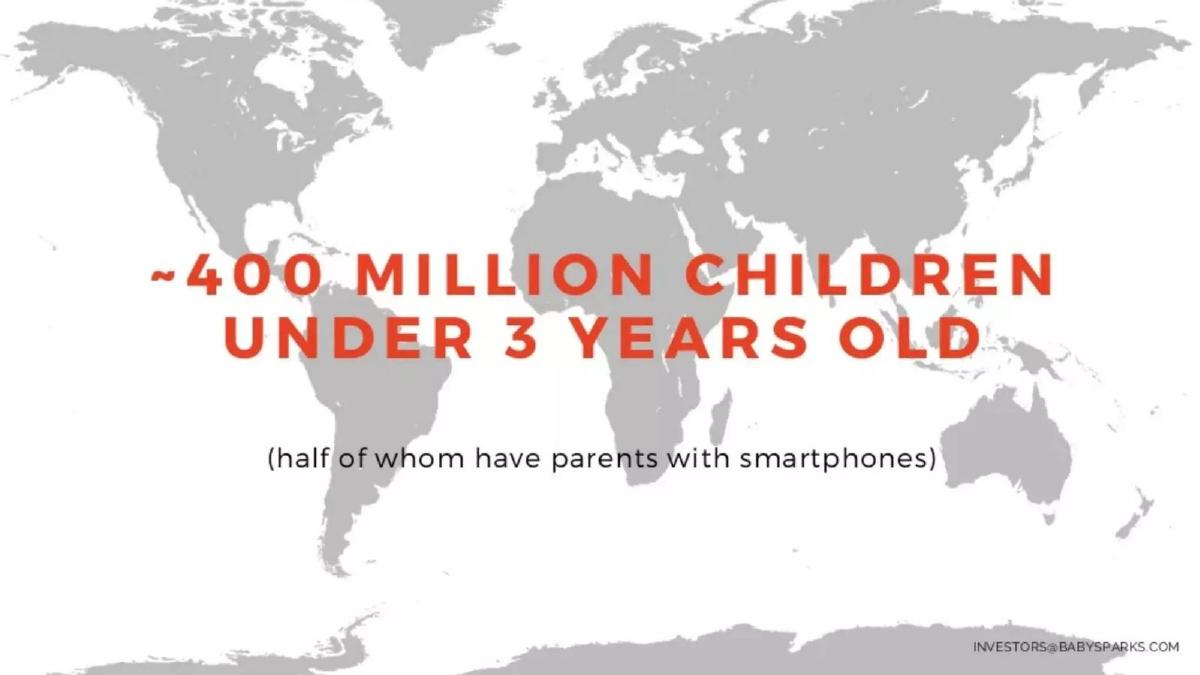
- The total addressable market is defined as ~400 million children under 3 years old on slide 4.
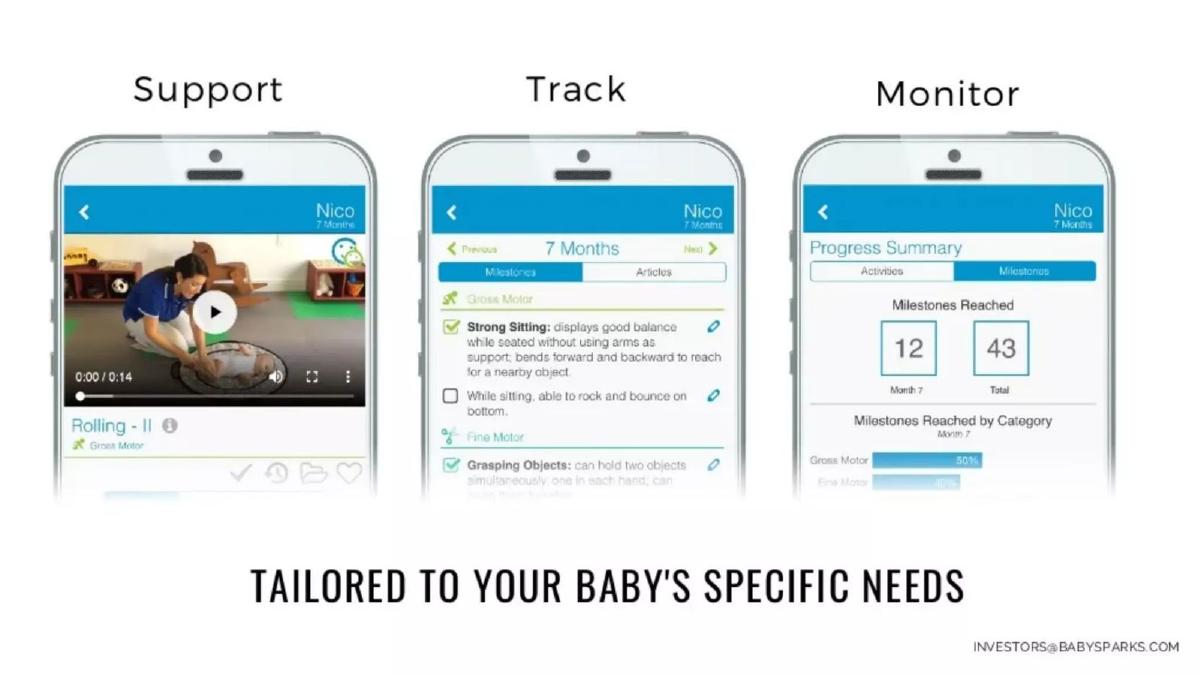
- The product uses a 'Support, Track, Monitor' framework to tailor activities to a baby's specific needs on slide 6.
- The founding team brings significant experience, including 12 years in investment banking and 18 years in startups with 3 successful exits on slide 9.
- The deck emphasizes the biological urgency of the product, noting that 85% of brain development occurs by age 3 on slide 13.
The Narrative Arc: From Personal Pain to Global Scale
The BabySparks pitch deck is a classic example of a Demo Day presentation designed for a fast-paced environment. It prioritizes high-impact visuals and emotional resonance over dense data tables. The deck follows a 'Hero's Journey' structure: the founder identifies a personal problem, realizes it is a universal struggle, and builds a data-driven solution that is already showing massive commercial traction.
Slides 1-4: The Problem and Market Opportunity
Slide 1 serves as the title card, identifying the presenter as Gustavo Rodriguez and the venue as 500 Startups Demo Day. The imagery of a baby's hand in an adult's hand immediately sets the emotional tone.
Slide 2 and Slide 3 establish the personal 'why.' The text 'MY WIFE AND I WERE BUSY (AND TIRED)' on slide 2 uses a relatable image of a parent working while wearing a baby carrier. Slide 3, 'TURNS OUT I WASN'T ALONE,' acts as the bridge from personal anecdote to market validation.
Slide 4 quantifies the opportunity. It states there are '~400 MILLION CHILDREN UNDER 3 YEARS OLD' globally. Crucially, it adds that 'half of whom have parents with smartphones,' narrowing the focus to a digital-first audience of 200 million potential users. This slide effectively moves the conversation from a 'niche parenting app' to a 'global scale platform.'
Slides 5-6: The Product Solution
Slide 5 introduces the brand promise: 'AN EXPERT IN YOUR POCKET.' It shows three smartphone mockups displaying the app interface, which includes video content, milestone tracking, and progress summaries. This visualizes the 'developer of tools and programs' mentioned in the company's self-description.
Slide 6 breaks down the product functionality into three pillars: Support (instructional videos), Track (milestone checklists), and Monitor (data-driven progress summaries). The tagline 'TAILORED TO YOUR BABY'S SPECIFIC NEEDS' emphasizes the personalization aspect of their algorithm.
Slides 7-8: Traction and Efficiency
Slide 7 is the 'money slide.' It presents four key metrics in high-contrast black boxes:
2.5+ MILLION Parent downloads · $1.4 MILLION Annual sales run rate · 185% YOY Subscription growth · 18 MINUTES Average subscriber session
These figures provide a comprehensive view of the business: reach (downloads), revenue (run rate), momentum (growth), and stickiness (session length).
Slide 8 is a bold transparency play. It overlays the 'TOTAL INVESTED $25K' stamp over the previous traction slide. This is intended to show extreme capital efficiency—achieving a $1.4M run rate on a nominal amount of external capital. Note: This $25k likely refers to the initial accelerator check, as the catalogue indicates a total raise of $3.8M later on.
Slides 9-10: Team and Vision
Slide 9 introduces the founders: Gustavo Rodriguez (CEO), Juan Pablo Mejia (CTO), and Jose Bernal (COO). Instead of corporate headshots, they use baby photos of themselves, maintaining the deck's theme. The credentials are impressive: 12 years of Investment Banking ($20+ bn in M&A) for the CEO, 16 years of product building for the CTO, and 18 years of startup experience with 3 exits for the COO.
Slide 10 pivots back to the emotional and social impact, stating: 'IN JUST A FEW MINUTES A DAY WE CAN GIVE EACH CHILD A GIFT WITH LIFELONG BENEFITS.'
Slides 11-15: The 'Why Now' and Biological Urgency
Slides 11 through 15 appear to be a deeper dive into the problem, perhaps used as backup slides or as part of a longer version of the pitch. Slide 11 and Slide 12 revisit the founder's personal anxiety. Slide 13 provides the scientific 'Why Now': it shows brain development percentages, noting that 85% of brain development occurs by age 3. This creates a sense of urgency for parents and investors alike.
Slide 14 mocks the current alternative: Google. It shows a search bar with queries like 'how to make my baby a genius,' suggesting that parents are searching for guidance but finding unorganized or unreliable results. Slide 15 concludes with the phrase 'EVERY CHILD IS UNIQUE,' reinforcing the need for the personalized, algorithmic approach BabySparks provides.
What Works in This Deck
Capital Efficiency Narrative: Slide 8 is the strongest part of the pitch. By showing a $1.4M run rate against only $25k invested, the founders prove they can build a real business without burning through massive amounts of cash. This is a high-signal indicator for Series A investors.
Engagement Metrics: An 18-minute average session (Slide 7) is exceptionally high for a mobile app. This suggests that the content is not just being downloaded, but actively consumed, which is the primary driver for long-term subscription retention.
Team Pedigree: The team slide (Slide 9) balances technical skill (CTO), operational experience (COO with 3 exits), and financial/strategic depth (CEO with M&A background). This reduces 'execution risk' in the eyes of an investor.
What Is Missing
The Ask: There is no slide stating how much money they are currently raising, the valuation they are seeking, or what they intend to do with the capital. While common in Demo Day decks to keep the 'ask' for private conversations, its absence makes the deck feel incomplete as a standalone fundraising tool.
Competitive Landscape: The deck implies that Google is the only competitor. In reality, the EdTech and 'ParentTech' space is crowded with both legacy players and other startups. Omitting a 'Competitor Matrix' or 'Our Edge' slide is a missed opportunity to define their moat.
Financial Projections: While current traction is excellent, there is no roadmap showing how they get from a $1.4M run rate to $10M or $100M. Investors need to see the 'path to scale' beyond just the current growth percentage.
What a Founder Should Copy
The 'Expert in Your Pocket' Framing: This is a perfect high-concept pitch. It immediately explains the value proposition in four words. Founders should strive for this level of clarity in their own product descriptions.
Visualizing the Product Pillars: Slide 6 is a masterclass in explaining a complex app. By categorizing features into 'Support, Track, Monitor,' they make the product's utility easy to digest without needing a live demo.
Using Science to Create Urgency: Slide 13 (brain development) turns a 'nice-to-have' parenting app into a 'must-have' developmental tool. If your product addresses a biological or economic window of opportunity, visualize that window clearly to create a 'fear of missing out' (FOMO) for the user and the investor.
Frequently asked questions
- How much did BabySparks raise with this deck?
- According to the catalogue data, BabySparks raised $3,800,000 in a Series A round. While slide 8 mentions a 'Total Invested' of $25k, this likely refers to initial seed or accelerator capital (such as from 500 Startups) rather than the total Series A round.
- What is the core value proposition of the BabySparks app?
- The deck positions the app as an 'expert in your pocket' (slide 5). It provides a personalized program that learns a child's unique profile to support, track, and monitor development through video-based activities and milestone tracking (slide 6).
- Who are the founders of BabySparks?
- The team consists of Gustavo Rodriguez (CEO), who has 12 years of investment banking experience; Juan Pablo Mejia (CTO), with 16 years in web and mobile product development; and Jose Bernal (COO), who has 18 years of startup experience and three successful exits (slide 9).
- What market size does BabySparks target?
- Slide 4 identifies a global market of approximately 400 million children under the age of three. The slide further notes that half of these children have parents who own smartphones, suggesting a reachable market of 200 million users.
- Is there a competitive analysis in the deck?
- No. The deck completely omits a competitive landscape slide. It focuses entirely on the internal metrics and the general problem of parents using Google (slide 14) rather than naming specific direct competitors in the EdTech or parenting app space.