Ayekart presents a multi-layered platform designed to organize India's traditional food and agriculture sectors. The deck emphasizes a 'techno-functional' stack that integrates digital profiling, B2B marketplaces, and supply chain finance (SCF). By the time of this 2022 presentation, Ayekart had already achieved significant traction, reporting a Gross Transaction Value (GTV) of INR 300 Crores and turning EBITDA positive within a short operational window. The narrative focuses heavily on the 'multiplier effect' of being present at every touchpoint of the value chain—from farmers and FPOs to mi…
Key takeaways
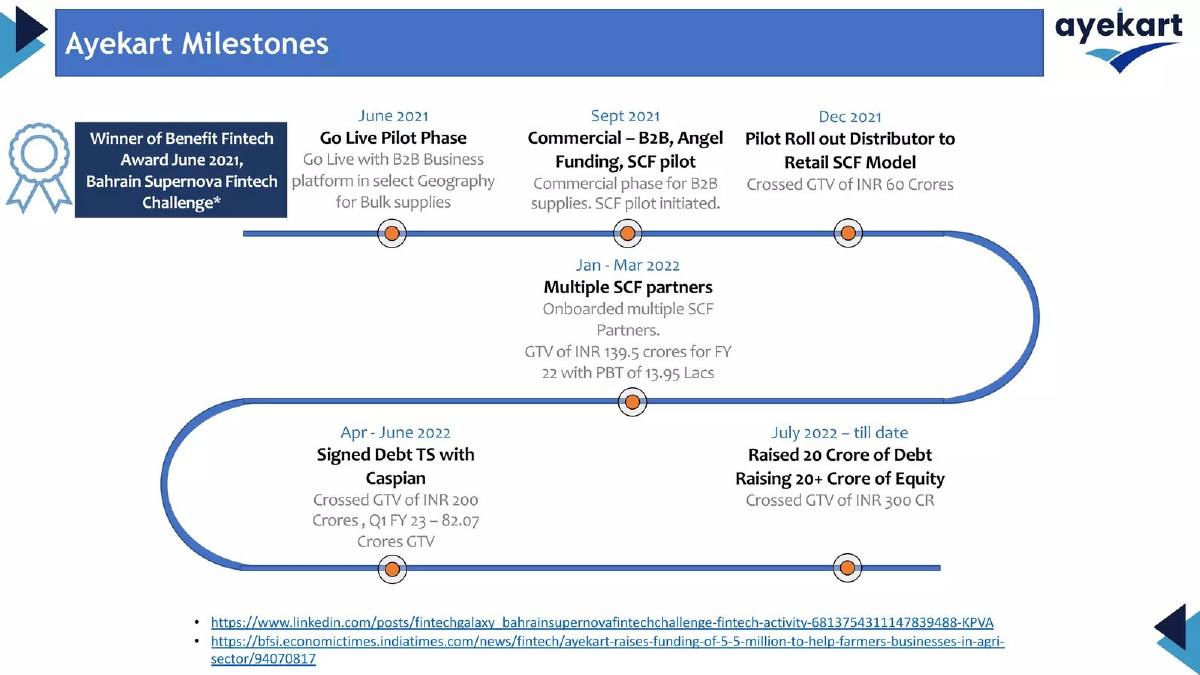
- The company achieved a GTV of INR 300 Crores by July 2022, representing rapid scaling from its June 2021 pilot (Slide 4).
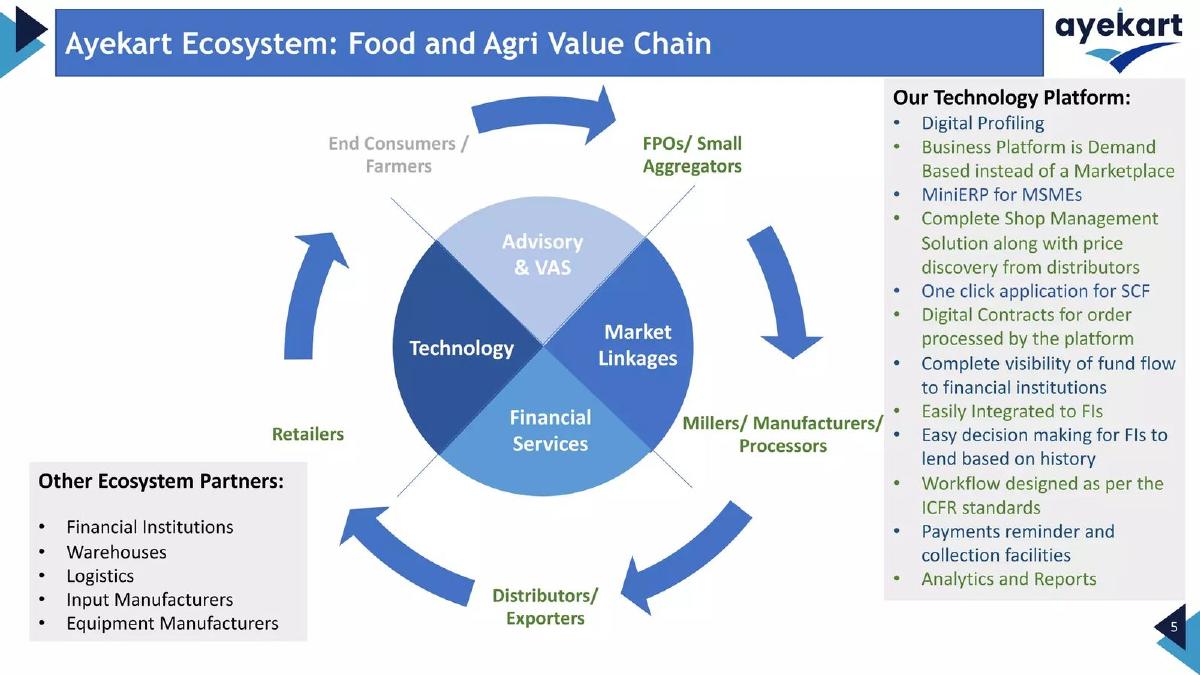
- Ayekart operates a 'demand-based' platform rather than a simple marketplace, integrating a MiniERP for MSMEs to ensure customer stickiness (Slide 5).
- The business model relies on a 'multiplier effect' by enabling transactions at every phase of the value chain, including B2B and B2C (Slide 11).
- Financial performance shows a month-on-month sales CAGR of 69% between April 2021 and March 2022 (Slide 15).
- The platform has successfully transitioned to being EBITDA positive, a rare milestone for early-stage agri-tech startups (Slide 15).
- Ayekart's ecosystem includes a proposed NBFC arm (Ayekart Capital) to serve its own customer book, slated for Q3 FY 2024 (Slide 13).
- The total addressable market is defined by a US$ 500 BN Agri & Processing industry and 63 million MSMEs in India (Slide 12).
- The technology stack utilizes blockchain and machine learning for product traceability and order management (Slide 18).
Executive Summary and Team
Slide 1: Title and Vision
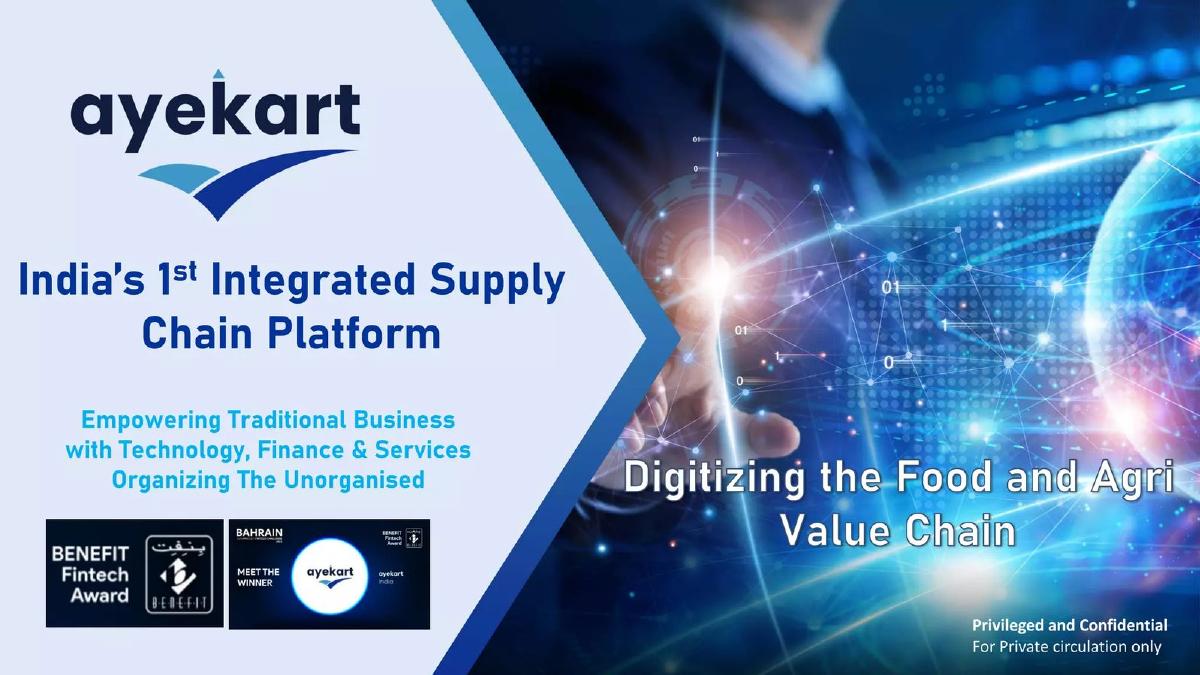
The deck opens with a clear positioning statement: "India's 1st Integrated Supply Chain Platform." It highlights three pillars of their value proposition: Technology, Finance, and Services. The slide also features awards, specifically the Benefit Fintech Award and the Bahrain Supernova Fintech Challenge, establishing immediate credibility. The subtitle "Organizing The Unorganized" defines the mission statement for the food and agri value chain.
Slide 2: Leadership Team
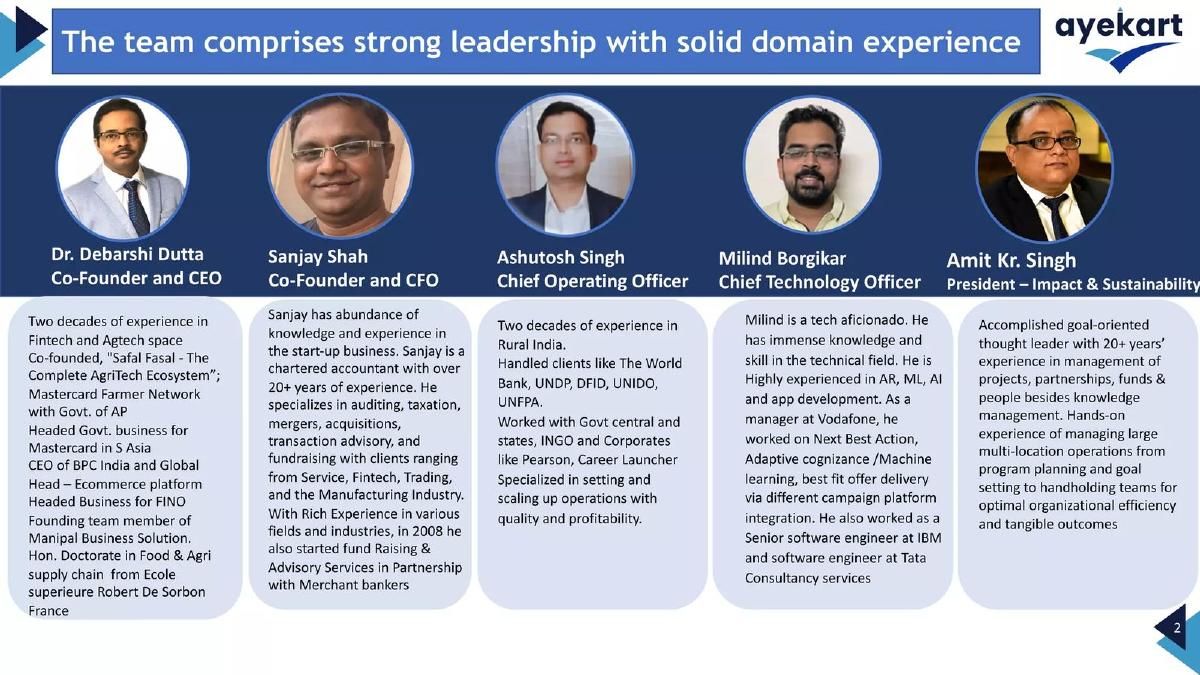
The team slide emphasizes deep domain expertise. Dr. Debarshi Dutta (CEO) is credited with two decades in Fintech/Agtech, including leadership roles at Mastercard and BPC India. Sanjay Shah (CFO) is a Chartered Accountant with 20+ years in startup advisory and fundraising. The C-suite is rounded out by Ashutosh Singh (COO), Milind Borgikar (CTO), and Amit Kr. Singh (President – Impact & Sustainability), all claiming 20+ years of experience. This is a high-seniority team, which is a strong signal for a complex sector like agriculture.
Slide 3: Advisory Board
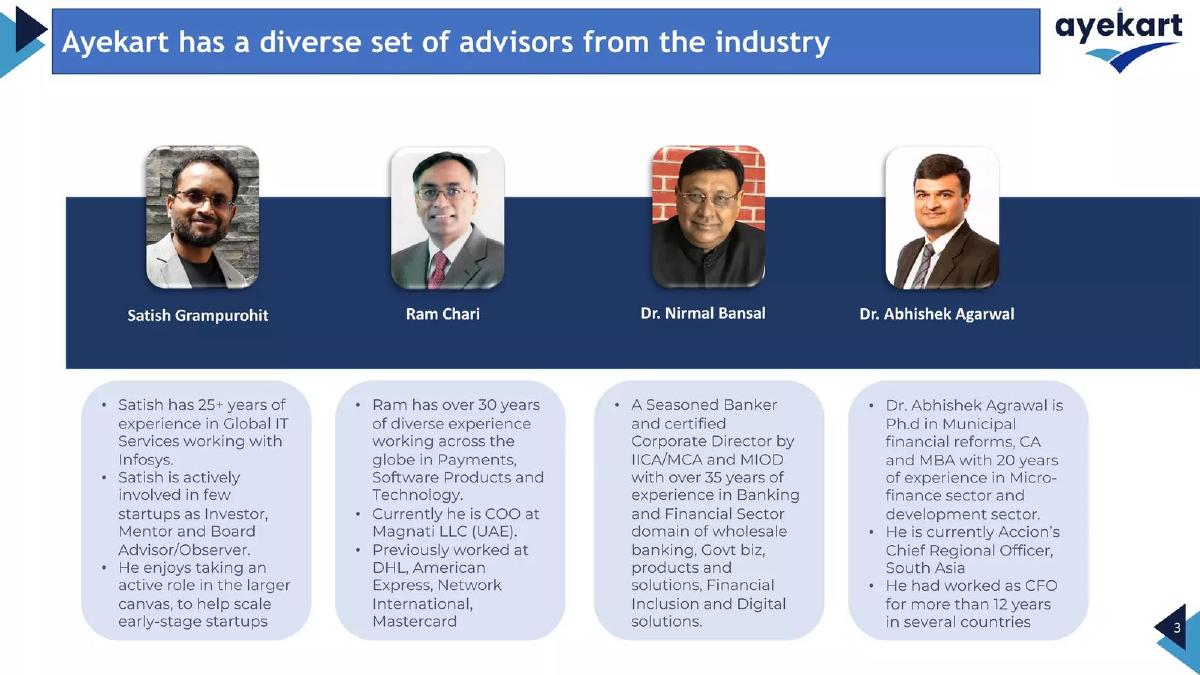
The advisors bring institutional weight, featuring individuals with backgrounds at Infosys, DHL, American Express, and Accion. Notably, Dr. Abhishek Agarwal is Accion’s Chief Regional Officer for South Asia, suggesting strong ties to the micro-finance and development sectors.
Traction and Milestones
Slide 4: Ayekart Milestones
This timeline tracks the company from its June 2021 pilot to July 2022. Key data points include:
Sept 2021: Angel funding and SCF pilot initiated. · Dec 2021: GTV crossed INR 60 Crores. · FY 22: GTV of INR 139.5 Crores with a Profit Before Tax (PBT) of 13.95 Lacs. · July 2022: Raised 20 Crore INR in debt and reached a GTV run rate of INR 300 Crores.
The rapid growth from 60 to 300 Crore GTV in seven months is the central hook of the deck.
Product and Ecosystem
Slide 5: The Ecosystem Map
This slide illustrates the circular nature of their platform, connecting Farmers/FPOs, Millers/Processors, Distributors/Exporters, and Retailers. The core of the circle is divided into Technology, Financial Services, Market Linkages, and Advisory. A bulleted list on the right details the tech platform features, such as "MiniERP for MSMEs" and "One click application for SCF."
Slide 6: Ayekart Perspective
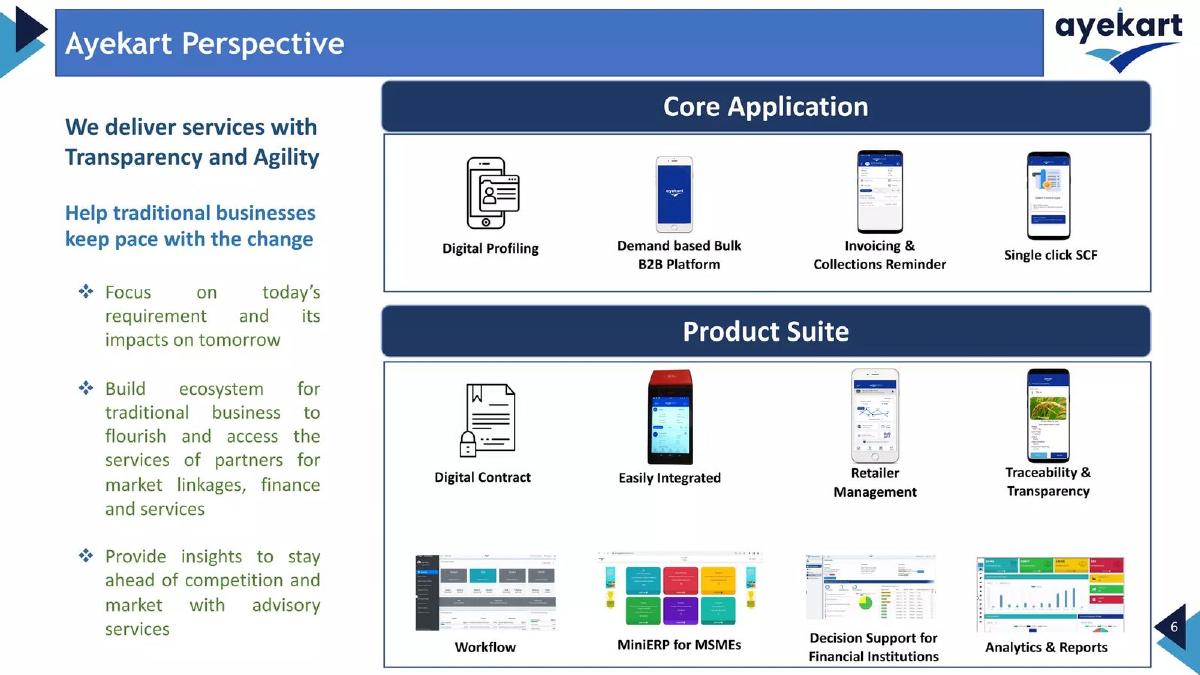
This slide breaks down the product into two categories: the "Core Application" (Profiling, B2B Platform, Invoicing, SCF) and the "Product Suite" (Digital Contracts, Retailer Management, Traceability, and Analytics). It emphasizes transparency and agility as the primary service delivery values.
Slide 7: Platform Integration
A simple additive formula is presented: Core Application + Product Suite + Partnership = Ayekart Platform. This slide serves to reiterate that they are a "single platform to cater to all needs of the traditional businesses," focusing on digital profiling, market linkages, and embedded finance.
Slide 8: Key Partners
This is a dense list of collaborators categorized into Development Agencies, Financial Agencies, Incubators, and B2B customers. Active financial partners include Caspian Debt and Axis Bank, while the "In Pipeline" list includes names like Lending Kart and Poonawalla Fincorp. This slide demonstrates significant ecosystem buy-in.
Operational Mechanics
Slide 9: B2B Bulk Business Flow
This flowchart explains the wholesale model. The buyer generates demand, Ayekart processes it to suppliers, quotes are returned inclusive of Ayekart's margin, and the order is fulfilled. Crucially, it notes that "All products are billed by Ayekart to Buyers," indicating they take principal position or at least control the billing flow.
Slide 10: B2B Retail Business Flow
In the retail model, Ayekart acts as the "originator of SCF" (Supply Chain Finance). The flow shows retailers ordering from distributors with an SCF request. Ayekart handles the documentation for Financial Institutions, who then pay the distributors. Ayekart earns platform and processing charges here.
Slide 11: The Multiplier Effect
Using an isometric graphic, this slide shows how Ayekart enables transactions at every phase of the value chain. By being the digital layer between FPOs, Manufacturers, Distributors, and Retailers, they create "ripple effects" that increase their total addressable touchpoints within a single supply chain.
Market Opportunity and Structure
Slide 12: The India Opportunity
Market sizing is presented through several large figures: a US$ 1000 BN Retail Industry by 2025, a US$ 500 BN Agri & Processing industry, and 63 million MSMEs. It also notes that 92% of retailers are unorganized and 86% of farmers (144 million) are marginal, highlighting the vastness of the "unorganized" segment they aim to digitize.
Slide 13: Corporate Structure
Ayekart Fintech acts as the holding company and technology hub. The structure includes:
Ayekart Foundation: Focused on FPOs and grants. · Ayekart Agro: Operationalized in Oct 2022 for bulk business and exports. · Ayekart Capital (Proposed): An NBFC arm planned for Q3 FY 2024 to serve the internal customer book.
This indicates a long-term strategy to move from a facilitator to a direct lender.
Financial Performance
Slide 14: Growth Story
This slide provides three charts showing quarterly progress from July 2021 to June 2022. Sales growth went from 10.02 Cr to 82.07 Cr per quarter. Gross margins, EBITDA, and Net Margins are shown as positive and trending upward, though the absolute figures for net margin remain slim (0.09 Cr in the latest quarter).
Slide 15: Financial Validation
This slide is the most data-rich in the deck. It claims a "Sales CAGR 69% month on month" and highlights that they "Turned EBITDA (+)ve in short span." The bar charts show monthly sales peaking at nearly 3000 lakhs (30 Cr) in March 2022. The EBITDA margin appears to have stabilized around the 2-3% range.
Slide 16: Geographic Presence
Two maps of India show "Business Presence" in 13 states and "Team Presence" in 8 base locations. Andhra Pradesh, Maharashtra, and Uttar Pradesh appear to be their primary hubs.
Technology and Product Deep Dive
Slide 17: Mobile Offerings
This slide showcases the UI for two apps: "Ayekart Business" (B2B) and "Hisab" (MSME management). Features for Hisab include an invoice generator, auto-reminders, and attendance/salary tracking, which are designed to ensure the merchant uses the app daily.
Slide 18: Technical Stack
A comprehensive diagram of their "Techno Functional stack." It includes an API Gateway, Blockchain for traceability, Machine Learning for recommendation engines, and Middleware AES encryption. This slide is intended to satisfy technical due diligence by showing a modern, scalable architecture.
Slide 19: Robust Offerings
This slide summarizes the "stickiness" factors. For the B2B ecosystem, it's SCF and loyalty rewards. For the hyperlocal segment, it's store management, online catalogues, and inventory tracking. It frames the product as a comprehensive tool for business growth, not just a transaction platform.
Slide 20: Summary of Digitization
A summary slide using a circular "Scope of Operations" chart and a 3D "Ayekart Advantage" graphic. It reiterates the six ways they create opportunities: profiling, merchant acquiring, customer stickiness, finance access, market access, and transaction acquiring.
Slide 21: Future Ecosystem
The final content slide depicts the future "Ayekart MSME Neobank" model. It shows how they will sit between business/retail customers and multiple banks, acting as the integrated marketplace and workflow manager. The bottom of the slide features a row of logos from "Partners in the Journey," including Mastercard and various Indian banks.
Slide 22: Conclusion
A standard "Thank You" slide with contact information for Milind Borgikar (CTO & Co-Founder).
What Works Well
1. Strong Traction Data: The deck does not hide behind vague percentages. Citing a GTV of INR 300 Crores and specific monthly revenue figures (Slide 15) provides concrete evidence of product-market fit. 2. Clear Operational Flows: Slides 9 and 10 are excellent examples of how to explain a complex B2B2B business model. By separating the "Bulk" and "Retail" flows, the founders clarify how they make money and where they add value in each scenario. 3. Experienced Team: The leadership slide (Slide 2) is exceptionally strong for an early-stage company. The combined decades of experience in fintech and agriculture reduce the perceived execution risk.
What Is Missing
1. Unit Economics: While the deck mentions being EBITDA positive, it lacks a detailed breakdown of unit economics (e.g., CAC, LTV, or the specific take-rate per transaction). Investors would want to see how profitable each transaction is before accounting for overhead. 2. Competitive Landscape: There is no mention of competitors. In the crowded Indian agri-tech space (with players like DeHaat, Ninjacart, or WayCool), failing to address how Ayekart differs from these incumbents is a notable omission. 3. The "Ask": The deck mentions they are "Raising 20+ Crore of Equity" on Slide 4, but it does not specify the use of funds, the target valuation, or the specific milestones that the new capital will unlock.
Founder Takeaways
1. Visualize the Value Chain: Founders in complex industries should copy Slide 11. It clearly shows how one platform can extract value from multiple points in a single supply chain, justifying a higher valuation through the "multiplier effect." 2. Use Real Financials: Ayekart’s use of monthly bar charts for sales and EBITDA (Slide 15) is far more convincing than a single "up and to the right" arrow. If you have the data, show it month-by-month. 3. Bridge the Gap Between Tech and Reality: The deck successfully balances high-level tech talk (Blockchain/ML on Slide 18) with gritty operational reality (Order flows on Slide 9). This balance is crucial for startups that operate in the physical world but sell a digital solution.
Frequently asked questions
- What is Ayekart's primary revenue model?
- Based on Slide 13, Ayekart generates revenue through transaction processing charges on its platform, cross-selling financial products, and data monetization. They also plan to introduce a premium subscription version for their technology tools. In their B2B bulk business, they earn a margin on products billed to buyers (Slide 9), while in the retail segment, they act as an originator for Supply Chain Finance (SCF), earning platform and processing fees (Slide 10).
- How does Ayekart integrate finance into the supply chain?
- Ayekart uses a 'Single Click SCF' (Supply Chain Finance) model. As shown on Slide 10, when a retailer places an order, the platform shares the request and necessary documentation with Financial Institutions (FIs). The FIs then pay the distributors directly. Ayekart facilitates this by providing FIs with visibility into fund flows and decision-making data based on transaction history (Slide 5).
- What specific technology tools does Ayekart provide to small businesses?
- The platform offers a 'MiniERP' for MSMEs, which includes features like digital profiling, invoicing, collection reminders, and stock management (Slide 6). They also offer two specific mobile applications: 'Ayekart Business' for B2B experiences and 'Hisab' for simplifying day-to-day business tasks like invoice generation, payment requests, and attendance tracking (Slide 17).
- Who are Ayekart's key partners in the financial sector?
- Slide 8 lists several active financial partners, including Caspian Debt, FINO Payments Bank, Drip Capital, and Axis Bank. They also mention 'in pipeline' or 'discussion' phases with major institutions like Yes Bank, ICICI Bank, and Kotak Mahindra Bank. These partnerships are critical for their embedded finance and SCF offerings.
- What is the scale of Ayekart's operations as of mid-2022?
- By July 2022, Ayekart had raised 20 Crore INR in debt and was in the process of raising 20+ Crore INR in equity (Slide 4). Their GTV had reached INR 300 Crores, up from INR 139.5 Crores in the 2022 fiscal year. Operationally, they reported a presence in 13 states across India, including Bihar, Delhi, Karnataka, and West Bengal (Slide 16).