Axcess Instruments presents a medical device play targeting the high-volume laparoscopic surgery market, specifically gallbladder procedures and tubal ligations. The core value proposition centers on a disposable 4K imaging system that eliminates the need for costly instrument reprocessing and prevents common surgical delays like lens fogging and scratching. With 13 utility patents and a working prototype manufactured by Synectic, the company is seeking $2.2 million for a 20% equity stake. The funding is primarily allocated toward FDA testing and application ($700,000) and prototype refinemen…
Key takeaways
- The company is seeking a $2.2 million pre-seed investment in exchange for a 20% equity position as stated on slide 12.
- The product addresses seven specific laparoscopic problems including fogging, lens cleaning, and pixelated images (slide 4).
- Axcess Instruments claims 13 utility patents and a working contract with the Texas Heart Institute (slide 8).
- The financial model projects a jump from $0 revenue in Year 1 to $55,200,000 in Year 5, selling 36,000 units (slide 11).
- A significant portion of the value prop is economic, claiming a $100-$120 saving per procedure by eliminating reprocessing (slides 7 and 15).
- The market opportunity focuses on the $8.3 billion global laparoscopic market, with a specific target of 1 million U.S. gallbladder surgeries annually (slides 3 and 10).
- The team slide features two primary members: a CEO with 32 years of surgery experience and a VP with a background in oilfield development (slide 13).
- Manufacturing and development are outsourced to partners including Synectic, FortyAU, and Huck Medical (slide 14).
Executive Summary and Vision
Axcess Instruments enters the medical technology space with a clear, surgical focus: improving the efficiency of laparoscopic procedures. The deck, presented at the Newport Beach Investor Conference, centers on the AxcessPort, a single-use 4K imaging system. The narrative is built on the frustration of surgeons dealing with antiquated, reusable hardware that fogs, scratches, and requires expensive sterilization cycles. By moving to a disposable model with integrated AI and superior optics, the company aims to capture a significant slice of the $8.3 billion global laparoscopic market.
Slide 1: Title Slide
The opening slide establishes the brand and the core product definition: "First palm-sized, AI-enabled, single-use laparoscopic imaging system." It identifies Michael J. Norton, MD, FACS, as the President and Founder. The imagery of a surgical team in a dark blue hue sets a professional, clinical tone immediately.
Slide 2: Product Visualization
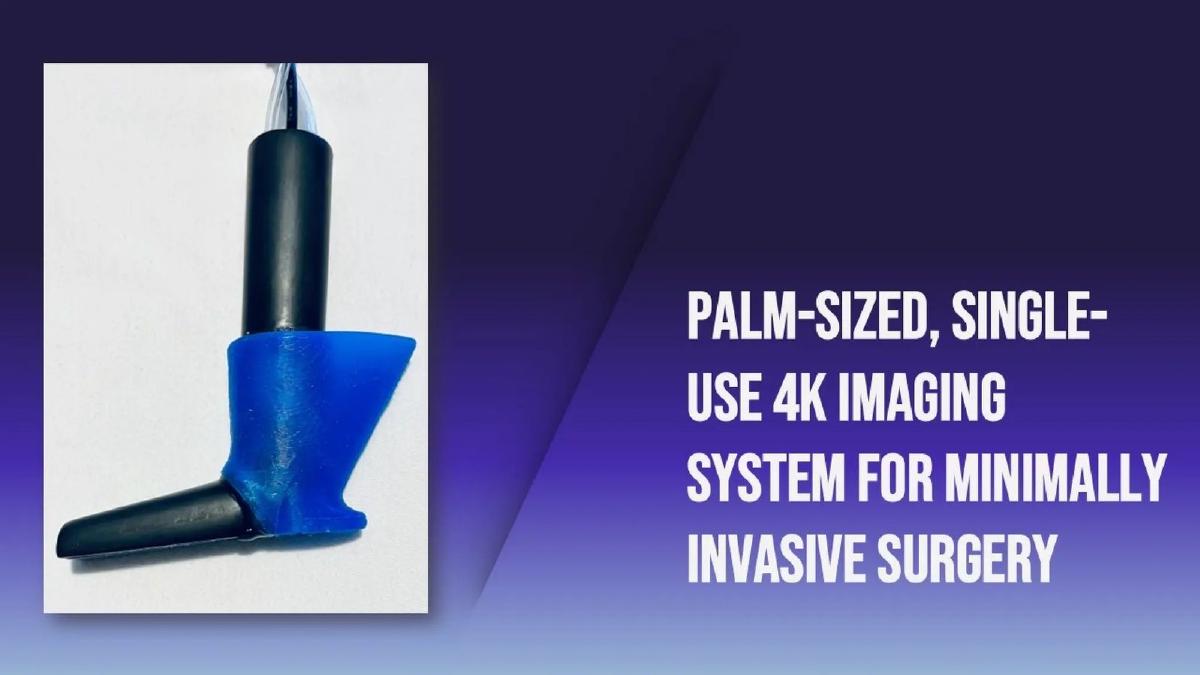
Slide 2 provides a high-contrast photo of a prototype or 3D-printed model of the device. The text reinforces the "palm-sized" and "single-use 4K" aspects. The visual shows a black cylindrical component attached to a blue, ergonomic-looking base, emphasizing the compact nature of the hardware compared to traditional bulky towers.
Slide 3: Market Volume
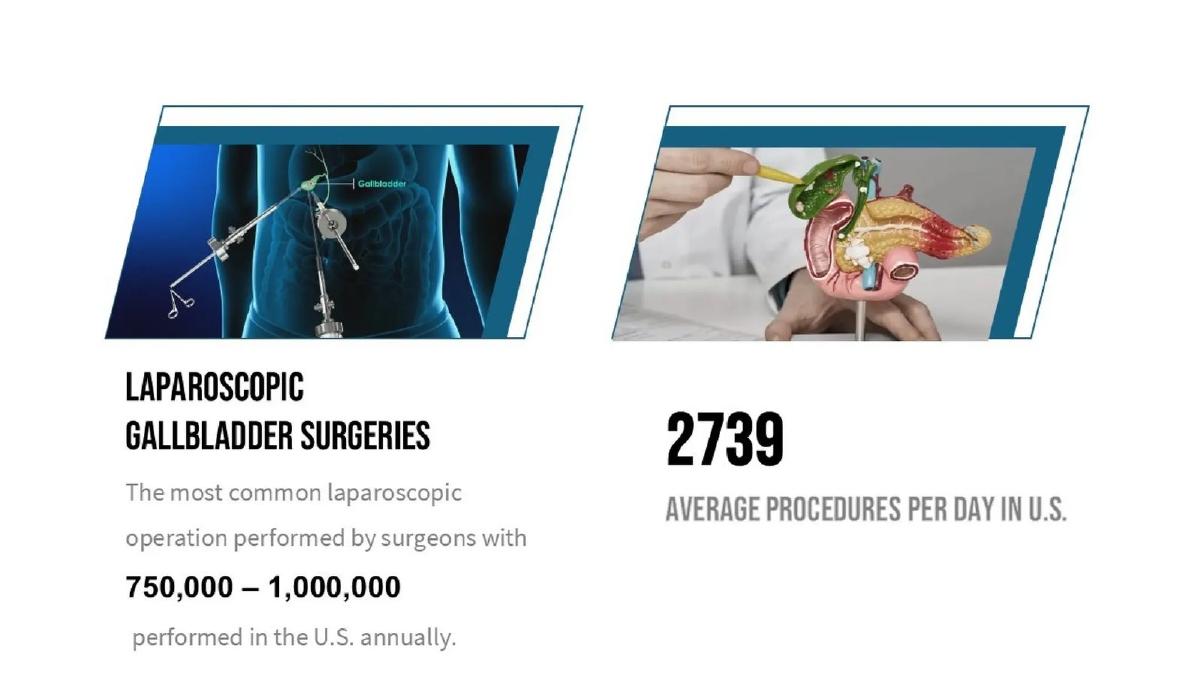
This slide focuses on the sheer volume of procedures. It cites 750,000 to 1,000,000 laparoscopic gallbladder surgeries performed annually in the U.S., averaging 2,739 procedures per day. This establishes the "bread and butter" application for the device, grounding the investment opportunity in high-frequency medical necessity.
Slide 4: The Problem Statement
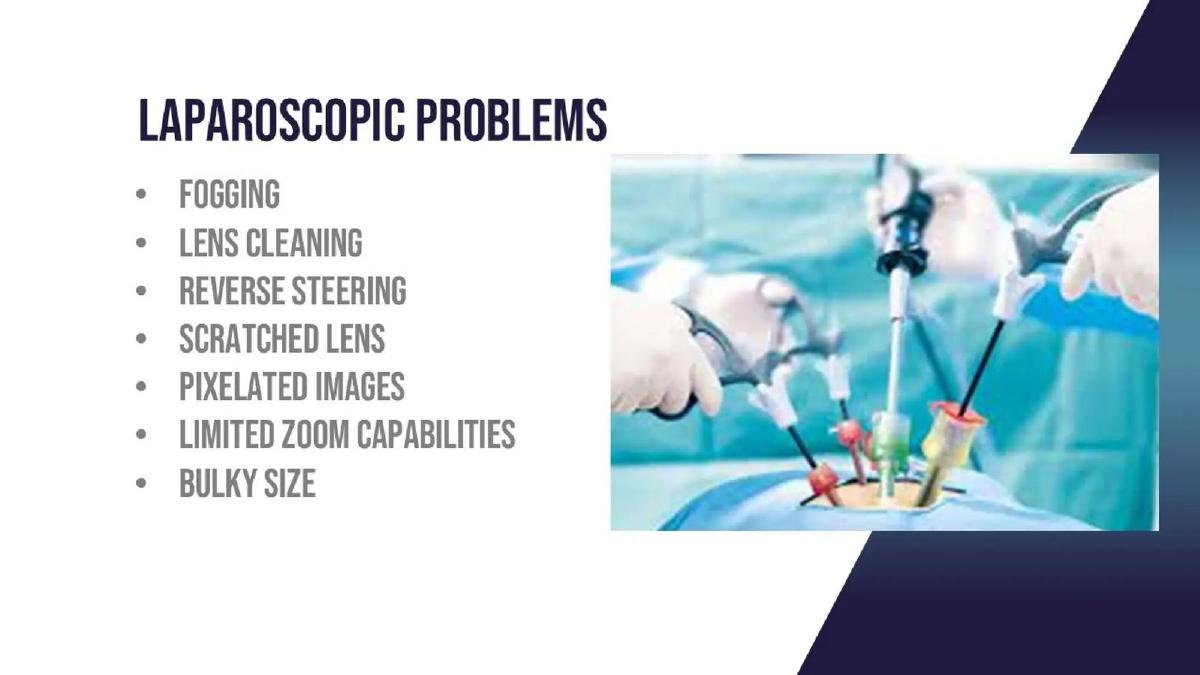
The deck lists seven specific "Laparoscopic Problems": fogging, lens cleaning, reverse steering, scratched lens, pixelated images, limited zoom capabilities, and bulky size. By listing these, the company is speaking directly to the daily annoyances of surgeons, positioning their solution as a comprehensive fix for existing hardware limitations.
Slide 5: Visual Proof of Problem
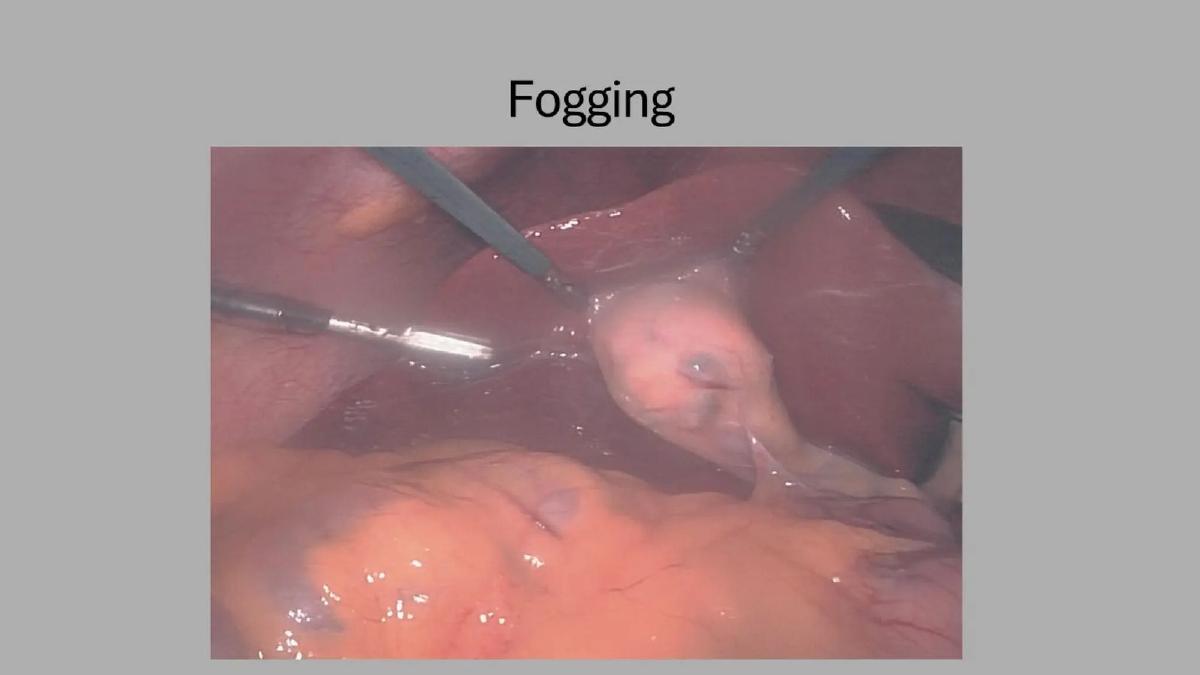
Slide 5 is a single-word slide: "Fogging." It features an actual endoscopic image where the view is obscured by condensation. This is a classic "show, don't just tell" tactic in medtech pitching, illustrating the danger and delay caused by current technology.
Slide 6: Visual Proof of Solution
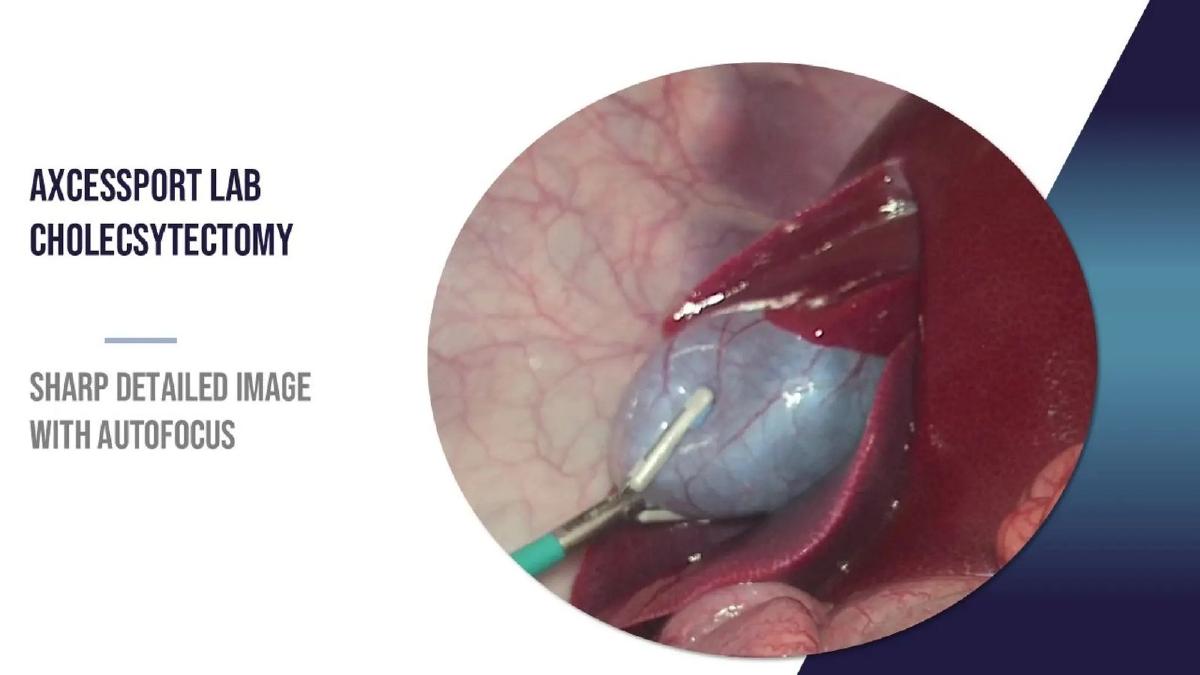
Contrasting the previous slide, Slide 6 shows an "AxcessPort Lab Cholecystectomy." The image is significantly clearer, showing a "sharp detailed image with autofocus." The visual comparison between Slide 5 and Slide 6 is the core technical validation of the pitch.
Slide 7: The Axcess Instruments Solution
This slide breaks down the benefits into four quadrants: Faster Procedure, Surgeon Friendly, No Facility Limitations, and Facility Velocity. Key technical details include a "jet wash proprietary lens cleaning system," "natural camera steering," and a claim that facility turnover increases by 10-20%. Crucially, it notes that no reprocessing is needed, saving approximately $100 per procedure.
Slide 8: Traction and Milestones
Traction is quantified through intellectual property and partnerships. The company claims 13 utility patents, a working prototype manufactured by Synectic, and a working contract with the Texas Heart Institute. The "Next Steps" are clearly defined as FDA application and approval, which sets the stage for the funding ask.
Slide 9: Competitive Landscape
A standard comparison grid pits AxcessPort against Stryker, Olympus, and New View. Axcess claims to be the only one offering AI camera technology and surgeon-friendly steering. It acknowledges that New View offers single-use disposables but suggests Axcess is the only "universal" solution suitable for all facility types, including austere locations.
Slide 10: Market Opportunity
Slide 10 uses a concentric circle diagram to visualize the market. It starts with the $8.3 billion global laparoscopic market, narrows to the $2.8 billion U.S. market, then the $700 million U.S. trocar market, and finally the Axcess Instruments target. It also notes a CAGR of 7-8%, indicating a growing sector.
Slide 11: Financial Projections
The financial slide shows a five-year projection. Year 1 has $0 revenue and a $200,000 loss. Year 2 projects $3.3 million in revenue from 3,000 units. By Year 5, the company projects $55.2 million in revenue and $14.8 million in EBITDA from 36,000 units sold. The growth curve is aggressive, assuming rapid market adoption post-FDA approval.
Slide 12: The Ask (Pre-Seed Round)
The company is seeking $2.2 million for a 20% equity position. The use of funds is detailed in a donut chart: $700,000 (32%) for FDA testing and application, $600,000 (27%) for marketing and manufacturing in Year 2, $400,000 (18%) for operational costs, $300,000 (14%) for the FDA prototype, and $200,000 (9%) for materials.
Slide 13: The Team
The team slide features two individuals. Michael J. Norton, MD, FACS (CEO), brings 32 years of surgery experience and 13 patents. Noel Ischy (VP) has a background in finance and oilfield development. While the CEO has deep domain expertise, the core team appears small for a company aiming for $55 million in revenue within five years.
Slide 14: Strategic Partners
To compensate for the small internal team, Slide 14 highlights four partners: Troutman Pepper Locke (IP/M&A), Synectic (Product development/manufacturing), FortyAU (Software/Firmware), and Huck Medical (Device development). This indicates an outsourced development model common in early-stage medtech.
Slide 15: Investor Summary
This is a "one-pager" style slide that summarizes the entire deck. It introduces a new metric: "$120 per minute savings per procedure by eliminating reprocessing." It also mentions a future SaaS model for AI-assisted positioning, suggesting a recurring revenue stream beyond hardware sales.
Slide 16: Contact Slide
The final slide repeats the contact information for Dr. Norton, including his email and cell phone number, over the company logo and website.
What Works Well
The deck excels at identifying a visceral pain point for surgeons. By using actual surgical imagery to contrast the "fogging" problem with their "4K autofocus" solution, the founders make a compelling case for the product's utility. The focus on the economic benefit to the hospital—specifically the $100-$120 saved per procedure by eliminating sterilization—provides a clear ROI for the end customer, which is often more important than clinical outcomes in hospital procurement. The inclusion of 13 utility patents provides a necessary "moat" for a hardware play.
What Is Missing or Weak
The most significant weakness is the team's breadth. While Dr. Norton has impressive clinical and inventive credentials, the deck lacks a dedicated Chief Operating Officer or a regulatory expert as a core team member, which is critical for a company whose next major milestone is FDA approval. The transition from $0 to $55 million in revenue is also extremely steep; the deck does not detail the sales strategy or the size of the sales force required to hit 36,000 units per year. Furthermore, while "AI-enabled" is mentioned frequently, the specific function of the AI (other than a brief mention of "assisted positioning" on the summary slide) is not explained in technical detail.
Founder Takeaways
Visual Contrast: Use side-by-side imagery to show the problem and your solution. It is much more effective than bullet points. · Economic Value: In medtech, don't just sell to the doctor; sell to the hospital administrator. Quantifying the cost of "reprocessing" or "OR turnover time" is essential. · IP First: Highlighting a specific number of utility patents (13 in this case) builds immediate defensibility in the eyes of investors. · Partner Leverage: If your internal team is small, explicitly showing your development and manufacturing partners (Slide 14) helps mitigate the perceived risk of execution. · Clear Ask: State the dollar amount and the equity offered clearly. Axcess's $2.2M for 20% is unambiguous.
Frequently asked questions
- What is the primary technical innovation of Axcess Instruments?
- The primary innovation is a palm-sized, single-use 4K imaging system for minimally invasive surgery. Unlike traditional reusable laparoscopes that require cleaning and sterilization between uses, this device is disposable. It features a proprietary 'jet wash' lens cleaning system and AI-enabled visualization to eliminate common surgical interruptions like fogging and lens scratching, which are highlighted as major pain points in current procedures.
- How does the company justify its $2.2 million funding request?
- The $2.2 million ask is specifically for a 'Pre-Seed Round' to reach FDA approval. The allocation includes $300,000 for an FDA prototype, $700,000 for FDA testing and application, $400,000 for operational costs, $200,000 for materials, and $600,000 for marketing and sales in the second year. The founders are offering a 20% equity stake for this investment, implying a $11 million post-money valuation.
- What is the competitive landscape for this medical device?
- The deck compares the 'AxcessPort' against industry giants Stryker and Olympus, as well as a smaller competitor named New View. Axcess claims superiority in AI camera technology, surgeon-friendly steering, and universal facility operations. While New View is noted to offer single-use and uninterrupted procedures, Axcess differentiates itself through its ergonomic controller and 4K ultra-high-definition imaging capabilities.
- What are the projected unit economics and revenue growth?
- The company projects significant scaling after a zero-revenue first year. In Year 2, they expect to sell 3,000 units for $3.3 million in revenue. By Year 5, they project selling 36,000 units, generating $55.2 million in revenue with an EBITDA of $14.8 million. This suggests a per-unit revenue of approximately $1,100 to $1,500, depending on the year and product mix.
- Who is behind the company and what is their experience?
- The team is led by Michael J. Norton, MD, FACS, who has 32 years of surgical experience and holds 13 patents. The second key member is Noel Ischy, Vice President, who has a background in finance and oilfield development, including a previous exit to an oilfield drilling company. The company relies heavily on strategic partners like Synectic and Huck Medical for device development and manufacturing.