Suometry’s pitch deck is a product-centric presentation that relies on technical superiority as its primary hook. The company positions its patented three-camera 'omnistereo' design as a solution to the latency issues plaguing AR/VR and autonomous systems. The deck’s strongest asset is a direct comparative timeline on slide 5, which claims a total pipeline duration of approximately 1 second, dwarfing the 20-minute to 24-hour windows of competitors. However, the deck is notably missing critical business information: there is no mention of team expertise, market size (TAM/SAM), business model,…
Key takeaways
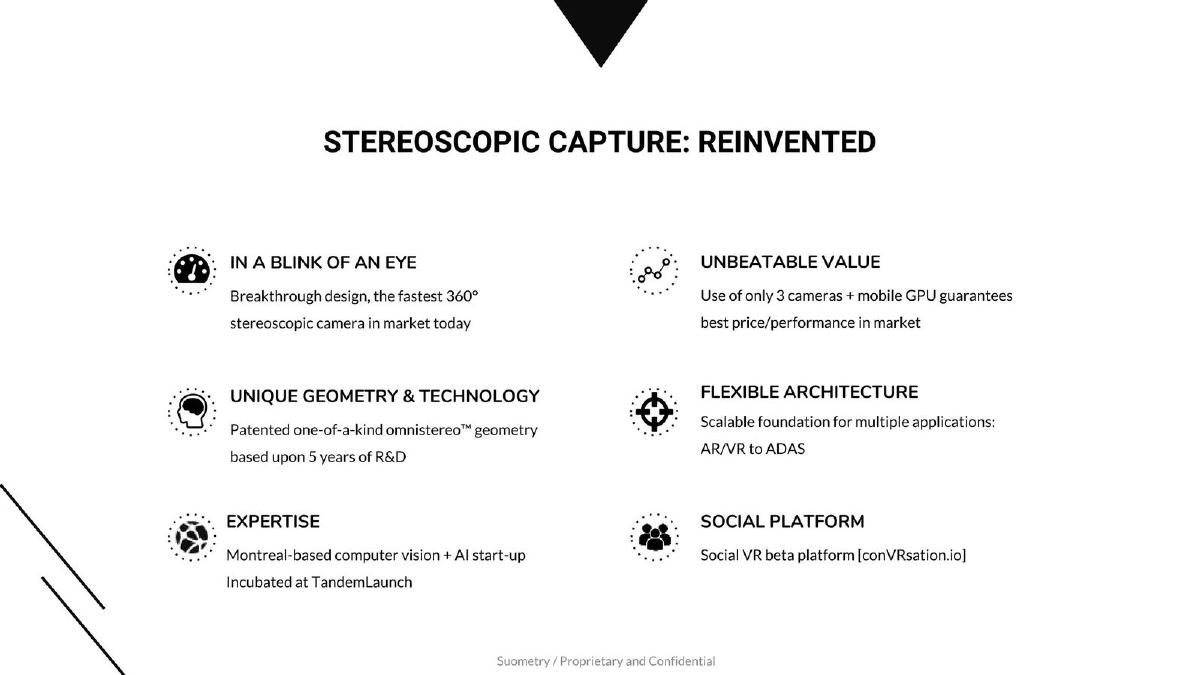
- The company claims to have the fastest stereoscopic panoramic camera currently in the market (Slide 2).
- Suometry utilizes a patented hardware/software solution to achieve real-time image capture (Slide 2).
- Technical specifications cite a real-time response of approximately 20ms per frame (Slide 4).
- The hardware design relies on a three-camera 'omnistereo' configuration using off-the-shelf lenses and sensors (Slide 4).
- Competitive benchmarking shows Suometry's pipeline duration at ~1s, compared to Insta360 at ~20 minutes and Yi+Jump at 8-24 hours (Slide 5).
- The technology is positioned as mission-critical for AR/VR, robotics, and ADAS systems (Slide 2).
- The deck mentions that camera evaluations have already commenced as of the 2018 pitch (Slide 2).
- The presentation lacks a team slide, financial projections, and a specific funding ask (Omitted).
Executive Summary: A Technical Showcase
The Suometry 2018 Startup Pitch deck is a highly technical document designed to support a live product demonstration. Presented at AWE USA, the deck focuses almost exclusively on the 'how' and 'what' of the technology, rather than the 'who' and 'how much' of the business. While it succeeds in creating a compelling technical gap between Suometry and its competitors, it leaves significant questions unanswered regarding the company's commercial viability and leadership.
Slide 1: Title Slide
The title slide is minimalist, featuring the Suometry logo—a geometric design incorporating a stylized 'O' that resembles a lens or a coordinate system. It clearly states '2018 STARTUP PITCH' and includes a 'Proprietary and Confidential' footer. This slide establishes the brand identity but provides no hint as to the specific industry or problem being solved.
Slide 2: Breakthrough Camera Design
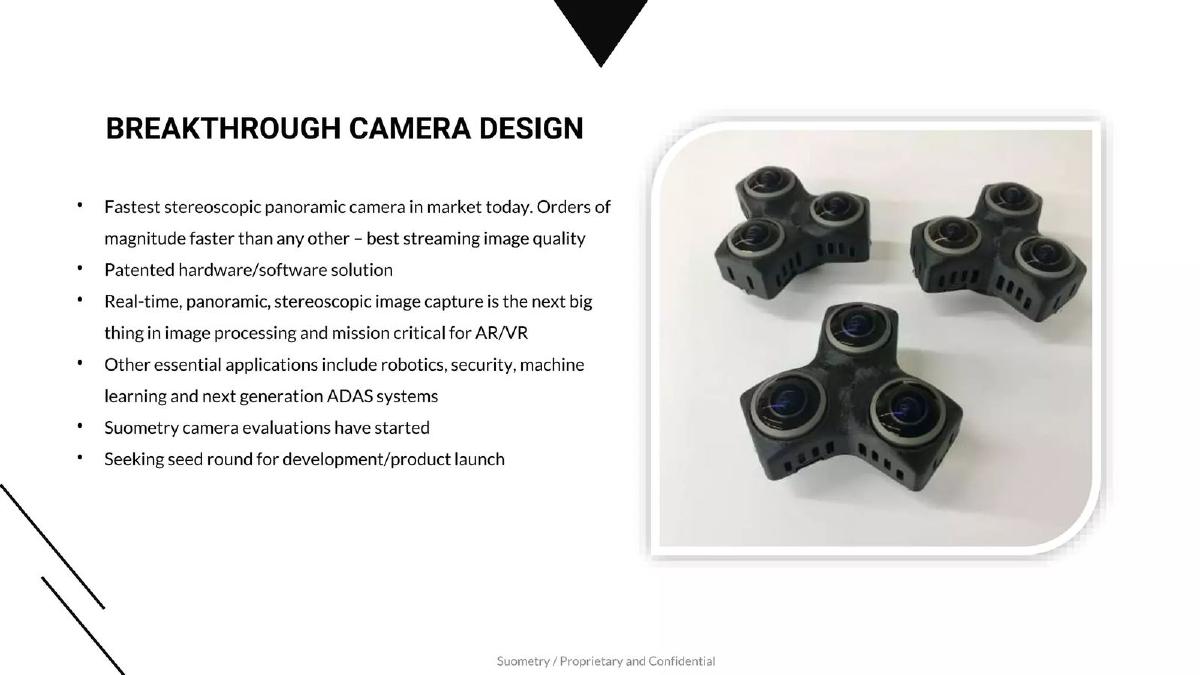
This slide serves as the high-level summary of the company's claims. It features a photo of three small, triangular camera modules, each equipped with three lenses. The text makes several bold claims:
It is the 'Fastest stereoscopic panoramic camera in market today.' · The solution is 'Orders of magnitude faster than any other.' · It utilizes a 'Patented hardware/software solution.'
Crucially, this slide identifies the target markets: AR/VR, robotics, security, machine learning, and ADAS. It also provides the only hint of a business milestone, stating that 'camera evaluations have started' and that the company is 'Seeking seed round for development/product launch.' No specific dollar amount for the seed round is mentioned on this slide or elsewhere in the provided materials.
Slide 3: Real-Time Stereo 360° is Next Big Thing
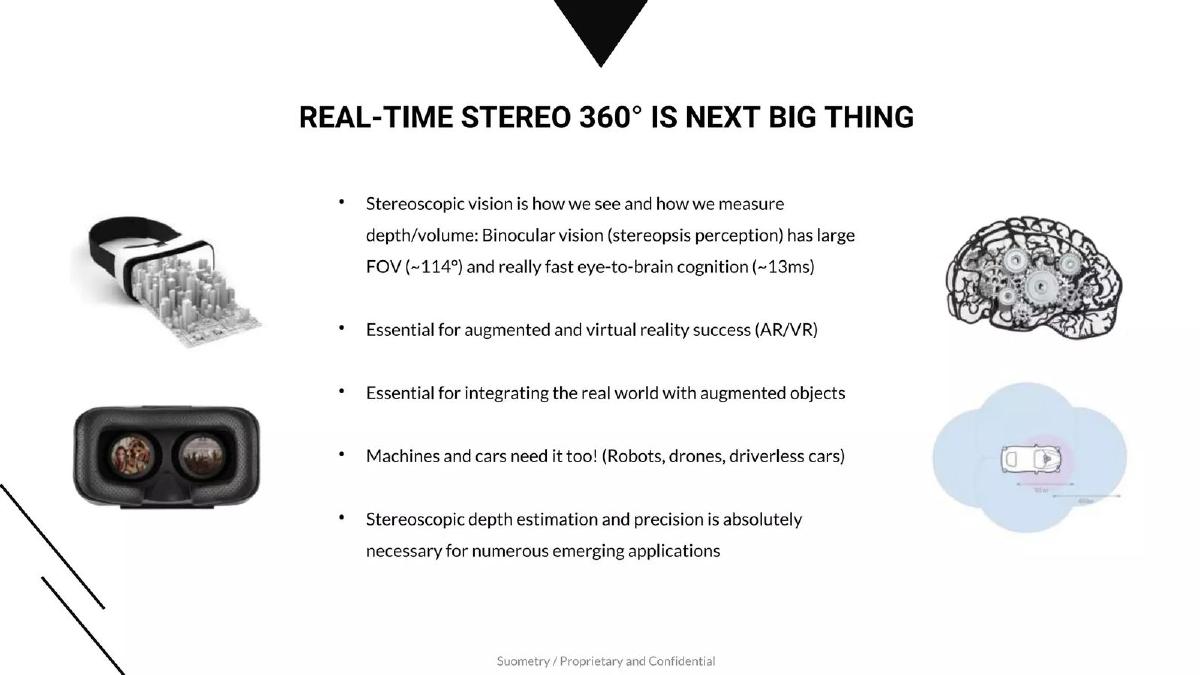
Slide 3 attempts to establish the 'Why Now?' and the necessity of the technology. It defines stereoscopic vision as having a large Field of View (~114°) and 'really fast eye-to-brain cognition (~13ms).' The slide argues that this level of depth estimation is essential for integrating real-world objects with augmented ones. The imagery includes a VR headset, a brain with gears, and a diagram of a car's sensor range, reinforcing the utility in both consumer electronics and industrial automation.
Slide 4: The Suometry Performance Edge (Technical Specs)
This slide moves into specific technical advantages. It introduces the 'patented omnistereo™ three-camera design.' Key performance metrics cited include:
Real-time response of '~20ms per frame.' · Deployable on 'low cost mobile GPU’s.' · Use of 'Off the shelf lenses and sensors.'
The mention of 'Good-to-great margins' and 'Very low supply chain risks' is the closest the deck gets to discussing unit economics, though it lacks the data to back up these qualitative statements. The central graphic is a triangle labeled with 'Real-Time,' 'Stereoscopic 3D,' and '360 Quality,' positioning the Suometry hardware at the center of these three competing priorities.
Slide 5: The Suometry Performance Edge (Competitive Benchmarking)
This is the most effective slide in the deck. It provides a horizontal timeline comparing the '3D 360 Pipeline Duration' of three entities: Yi+Jump, Insta360, and Suometry. The pipeline includes calibration, stitching, re-projection, cloud distribution, live streaming, and playback. The figures quoted are stark:
Yi+Jump: ~8-24 hours. · Insta360: ~20 minutes. · Suometry: ~1s.
Specifically, Suometry claims a stitching time of ' The final slide is a standard contact page. It features the tagline 'Seeing is Believing' and invites the audience to 'see our camera today in action!' This confirms that the deck was intended to be accompanied by a live demo. It provides the website 'www.suometry.com' and a 2018 copyright notice. There is no contact name, email, or phone number provided on this slide.
What Suometry Does Well
The deck excels at technical positioning. By focusing on a single metric—latency—Suometry makes a complex hardware/software product easy to understand. The competitive comparison on slide 5 is a masterclass in showing, not just telling, a competitive advantage. The use of 'off-the-shelf' components is also a smart inclusion, as it de-risks the hardware play by suggesting the company doesn't need to invent new silicon or specialized optics to succeed.
What is Missing from the Deck
As a fundraising tool, this deck is incomplete. The following elements are entirely absent from the six slides provided:
Team: There is no information about the founders (Isadore Katz) or their technical background. In deep-tech hardware, the pedigree of the engineering team is often the most important factor for seed investors. · Market Size: While they list industries like ADAS and Robotics, they do not provide a Total Addressable Market (TAM) figure. Investors need to know if this is a $100M opportunity or a $10B opportunity. · Business Model: It is unclear if Suometry intends to sell cameras as an OEM, license the 'omnistereo' software to other manufacturers, or operate a SaaS model for image processing. · Financials: There are no projections, historical burn rates, or unit cost breakdowns beyond the phrase 'good-to-great margins.' · The Ask: While they mention seeking a seed round, they do not state how much they are raising, the valuation they are seeking, or what specific milestones the funding will help them achieve.
Founder's Takeaway
Founders should study slide 5 for its clarity in competitive benchmarking. If your startup offers a 10x or 100x improvement in a specific technical metric, a visual timeline or bar chart is the most effective way to communicate that value. However, founders must also ensure that their deck can stand alone. If an investor views this deck without seeing the live demo or hearing the pitch, they would have no idea who is running the company or how the company plans to generate a return on investment. A technical breakthrough is a product; a team, a market, and a distribution strategy make it a business.
Frequently asked questions
- What is Suometry's primary value proposition?
- Suometry’s value proposition is centered on speed and latency reduction. According to slide 5, they have reduced the 3D 360 pipeline—from calibration to immersive playback—to approximately one second. This is significantly faster than the industry standards of 2018, which ranged from 20 minutes to a full day, making their tech viable for real-time applications like autonomous driving and live VR streaming.
- What markets is Suometry targeting?
- The deck identifies several high-growth sectors on slide 2 and slide 3. These include Augmented Reality and Virtual Reality (AR/VR), robotics, security, machine learning, and next-generation Advanced Driver Assistance Systems (ADAS). They argue that stereoscopic depth estimation is 'absolutely necessary' for these emerging applications to integrate the real world with augmented objects.
- How does the hardware differ from traditional 360 cameras?
- Slide 4 highlights a 'patented omnistereo three-camera design.' Unlike many 360 cameras that use two ultra-wide fisheye lenses or large arrays of many cameras, Suometry uses a specific three-camera configuration. Notably, they use 'off the shelf lenses and sensors,' which they claim results in very low supply chain risks and 'good-to-great' margins.
- Is there any evidence of market traction in the deck?
- Traction data is minimal. Slide 2 states that 'Suometry camera evaluations have started,' implying that prototypes are in the hands of potential partners or customers. However, the deck does not list names of companies conducting these evaluations, nor does it mention any letters of intent (LOIs), pilot results, or revenue figures.
- What are the most significant omissions in this pitch deck?
- The deck is missing almost all standard business metrics. There is no team slide to establish founder credibility, no market sizing (TAM) to show the scale of the opportunity, and no business model explaining how they will make money (e.g., licensing vs. hardware sales). Most importantly, while they mention seeking a 'seed round' on slide 2, they never specify the amount of capital required.