Hardware Product Slides: 8 Real Pitch Deck Examples
How hardware startups show their product: a priced product line, a photo of the working prototype, the device installed on site, three setup steps.
Hardware Product Slides: Real Pitch Deck Examples
Eight product slides from hardware decks (air purifiers, a panoramic camera, warehouse lighting, a wearable vest, point-of-sale terminals, laptops, power chips and smart-home devices), shown in full. With hardware, investors want to know whether the thing exists, what it costs and whether it can be built at a margin. The stronger slides show a photo of the real product with a price or a setting; the weaker ones list product names.
TL;DR
A hardware product slide should show a photo of the real device and say what it costs or where it is used. Aeris lines up four products with a price under each. AWE USA photographs three working camera units beside six bullets. Synergy Lighting shows its light being installed in a warehouse. Elektra explains its vest in three steps: put it on, download the app, feel the experience. iPoS Print photographs three terminals and lists pros and cons. Snags gives the retail price, production cost and profit per unit for two laptops. Cambridge GaN Devices compares its chip's circuit with a competitor's. Meta Innovations lists five product names with no pictures, the weaker example here.
Hardware product slides
Each example shows the exact stored slide above its analysis and links to the full teardown. Stronger examples first. Claims and figures are as shown on the slides; we have not verified them.
Aeris product slide — slide 5
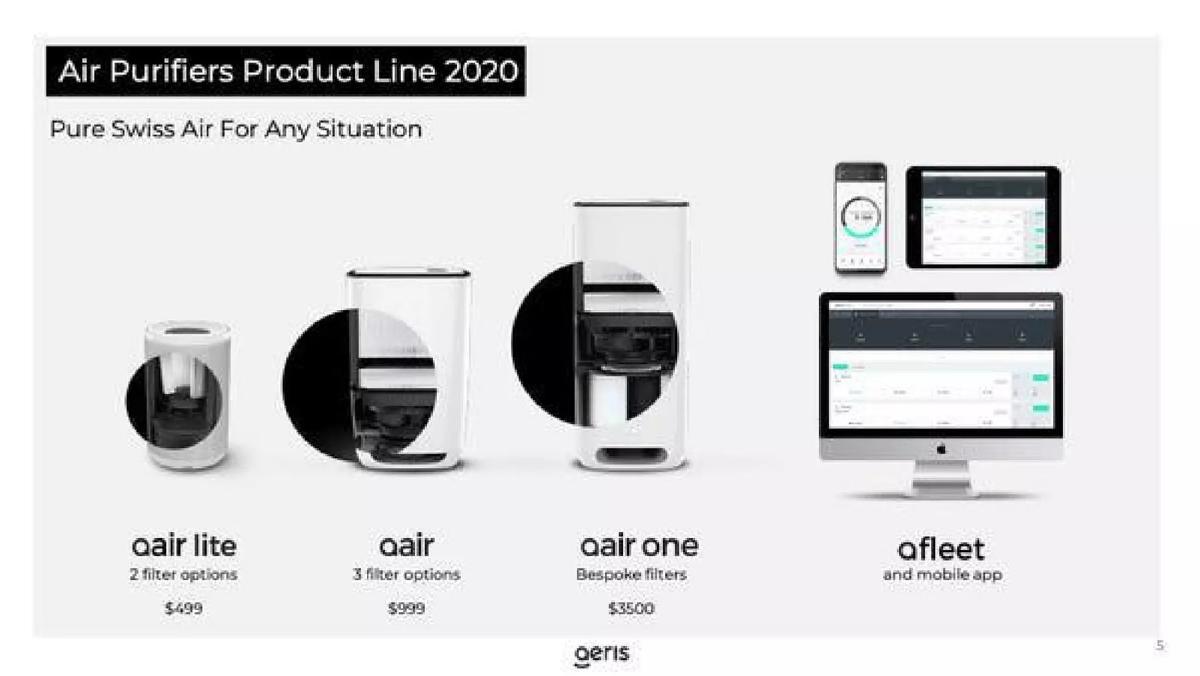
Series B (recorded). Air purifiers. A product line with prices.
Aeris deck, slide 5. Exact stored slide matched to this analysis.
Our analysis: The clearest example here: in one glance the investor sees the range, the price ladder and the software that ties the devices together.
Evidence and limitation: Four products pictured with prices; no sales figures on this slide.
What a founder can adapt: Line up your products left to right from cheapest to most expensive, with a photo and price under each.
Supporting analysis
What the deck claims: "Air Purifiers Product Line 2020." "Pure Swiss Air For Any Situation." "aair lite: 2 filter options, $499." "aair: 3 filter options, $999." "aair one: Bespoke filters, $3500." "afleet and mobile app" (shown on a phone, tablet and desktop screen).
Presentation choice: Prices from $499 to $3,500 show who each product is for without extra words.
When it does not fit: Say which product sells most; equal space for each hides where revenue comes from.
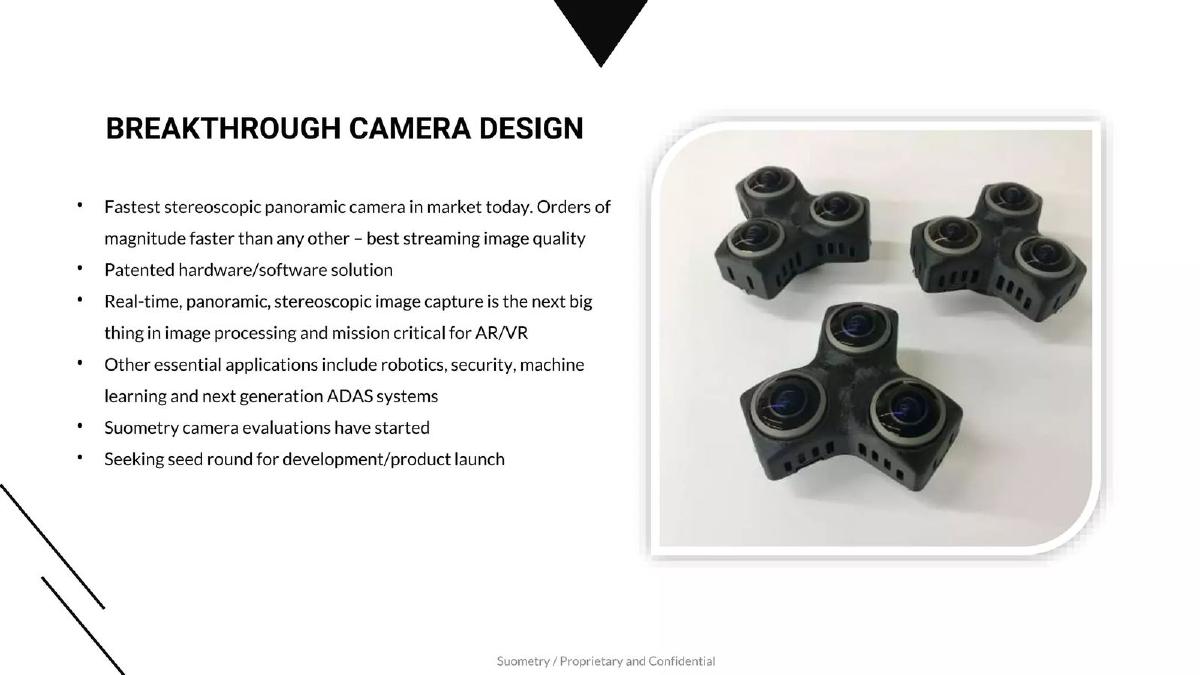
Seed stage (recorded). Stereoscopic panoramic camera. A photo of real units.
AWE USA deck, slide 3. Exact stored slide matched to this analysis.
Our analysis: The photo proves units exist, and the last two bullets say honestly where the product stands: evaluations started, launch not yet funded.
Evidence and limitation: A photo of physical units and a status line; speed claims have no figures.
What a founder can adapt: Photograph your working prototype and add one line on its status.
Supporting analysis
What the deck claims: "Breakthrough camera design." "Fastest stereoscopic panoramic camera in market today. Orders of magnitude faster than any other – best streaming image quality." "Patented hardware/software solution." "Real-time, panoramic, stereoscopic image capture is the next big thing in image processing and mission critical for AR/VR." "Other essential applications include robotics, security, machine learning and next generation ADAS systems." "Suometry camera evaluations have started." "Seeking seed round for development/product launch." A photo of three camera units.
Presentation choice: Stating the stage (evaluation, pre-launch) sets the right expectation for a seed investor.
When it does not fit: "Orders of magnitude faster" needs a number; give the frame rate or latency against the next-best camera.
Seed stage (recorded). Energy-efficient commercial lighting. The product being installed.
Synergy Lighting Group deck, slide 6. Exact stored slide matched to this analysis.
Our analysis: Showing the light going up on a real ceiling makes "installer friendly" believable and shows the buyer's setting.
Evidence and limitation: Real installation photos and a list of uses; no efficiency or price figures.
What a founder can adapt: Show your device where the customer uses it, ideally with a person using or installing it.
Supporting analysis
What the deck claims: "Interior Product: High Bay." "Synergy HB400 is compact, light, and installer friendly." "Typical uses: manufacturing, warehouses, distribution centers, basketball courts, gyms." Two photos of a worker on a lift fitting the light to a ceiling.
Presentation choice: A photo in the place of use answers "who buys this and where" without a separate slide.
When it does not fit: Add the one number the buyer cares about (energy saved, payback period) next to the photo.
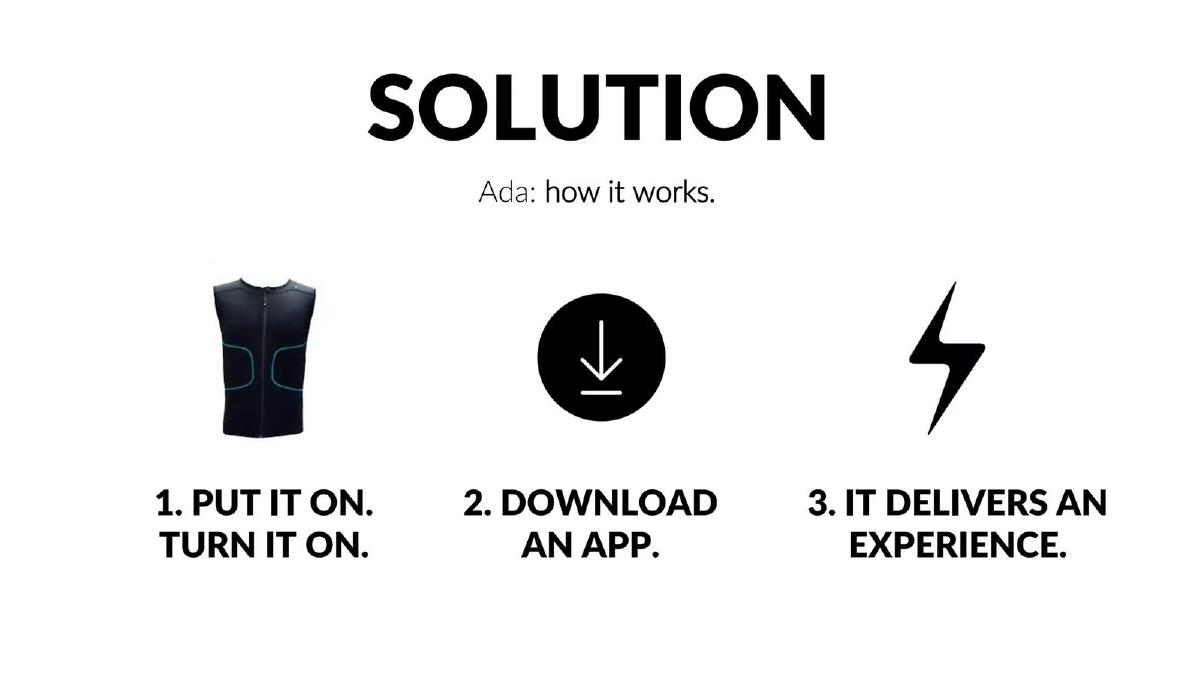
Seed stage (recorded). A wearable vest. Three setup steps.
Elektra deck, slide 5. Exact stored slide matched to this analysis.
Our analysis: Three steps make the product feel simple to use, which matters for a consumer wearable.
Evidence and limitation: A product picture and three steps; no figures.
What a founder can adapt: Show setup in three steps, each with a picture.
Supporting analysis
What the deck claims: "Solution." "Ada: how it works." "1. Put it on. Turn it on." "2. Download an app." "3. It delivers an experience." A picture of the vest, a download icon and a lightning bolt.
Presentation choice: Short numbered steps are easy to remember and show there is an app as well as a device.
When it does not fit: "It delivers an experience" is vague; say what the wearer feels or gets.
Stage not disclosed. Point-of-sale terminals. Product photos with pros and cons.
iPoS Print deck, slide 4. Exact stored slide matched to this analysis.
Our analysis: Listing cons is unusual and honest, but it is not clear whether the cons belong to these products or to the older category they replace.
Evidence and limitation: Real product photos and a short pros/cons list; no prices or sales figures.
What a founder can adapt: If you compare generations of a device, label which is yours and which is the old one.
Supporting analysis
What the deck claims: "Product Introduction." "The next iteration of advancement from the desktop based POS systems are these Micro and Mini POS systems." "Pros – Easy to use. All in one systems." "Cons – Monolithic design. Software capabilities limited. Maintenance expensive." Three photos of terminals.
Presentation choice: Clear photos show exactly what a retailer would put on the counter.
When it does not fit: Don't leave cons unattributed; an investor may read them as weaknesses of your product.
Series A (recorded). Laptops. Product range with unit economics.
Snags deck, slide 4. Exact stored slide matched to this analysis.
Our analysis: Puts unit economics on the product slide, which answers the hardware investor's first margin question.
Evidence and limitation: Price, cost and profit per unit for two products; figures are small and set in a hard-to-read colour.
What a founder can adapt: Add price, unit cost and margin under each product photo.
Supporting analysis
What the deck claims: "Product Range." "Zoombu X1": "RRP: $2,799. Production Cost: $1,338. Profit Per Unit: $1,018. % Sales Revenue: 53%. Brand Profit: $629,190." "Zoombu Pro": "RRP: $4,099. Production Cost: $1,595. Profit Per Unit: $2,185. % Sales Revenue: 47%. Brand Profit: $367,421." Bullets on each, including "New and improved replacement to Zoombu X1" and "Plans to improve product with R&D schedule to commence Q4".
Presentation choice: Price minus production cost per product shows the business can make money on each unit.
When it does not fit: The figures are hard to read; the two products' figures also don't obviously reconcile (price minus cost differs from profit per unit), so explain what else is deducted.
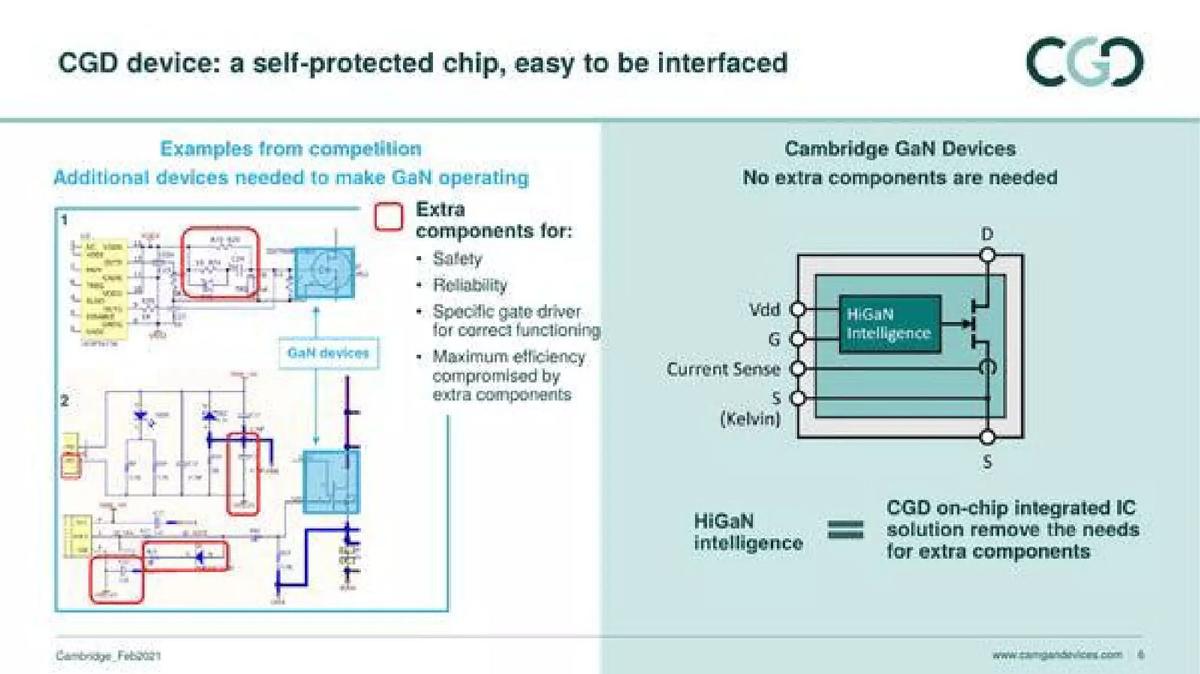
Series B (recorded). Power semiconductor chips. Its circuit compared with competitors'.
Cambridge GaN Devices deck, slide 6. Exact stored slide matched to this analysis.
Our analysis: For a chip no one can see, a busy circuit next to a simple one shows the benefit visually: fewer parts.
Evidence and limitation: Two circuit diagrams side by side; no cost or efficiency figures.
What a founder can adapt: For a component, compare the customer's design with and without it.
Supporting analysis
What the deck claims: "CGD device: a self-protected chip, easy to be interfaced." Left: "Examples from competition. Additional devices needed to make GaN operating. Extra components for: Safety, Reliability, Specific gate driver for correct functioning, Maximum efficiency compromised by extra components." Right: "Cambridge GaN Devices. No extra components are needed." "HiGaN intelligence = CGD on-chip integrated IC solution remove the needs for extra components."
Presentation choice: Side-by-side diagrams make a technical difference clear even to a non-engineer.
When it does not fit: Add what fewer parts saves (cost per board, space, failure rate).
Pre-seed (recorded). Smart-home devices. A list of product names (weaker example).
Meta Innovations deck, slide 4. Exact stored slide matched to this analysis.
Our analysis: The investor learns what the company plans to sell but cannot tell whether any device exists yet.
Evidence and limitation: Five product names; no pictures, prices or status.
What a founder can adapt: Photograph the one device that works today and mark the rest as planned.
Supporting analysis
What the deck claims: "Product portfolio." "Meta LED bulb." "Meta smart plug." "Meta motion detector." "Meta door sensor." "Meta App – smartphone based application."
Presentation choice: Included for contrast: a list of names is the least an investor needs and leaves the key question (does it exist?) open.
When it does not fit: Five products at pre-seed looks unfocused; lead with one.
How the product is presented, whether a real photo is shown, and whether a price or cost appears.
Example
Product
Presented as
Real photo
Price or cost
Aeris
Air purifiers
Product line
Yes
Price
AWE USA
Panoramic camera
Prototype photo + bullets
Yes
No
Synergy Lighting
Warehouse lighting
Installed on site
Yes
No
Elektra
Wearable vest
Three steps
Picture
No
iPoS Print
POS terminals
Photos + pros/cons
Yes
No
Snags
Laptops
Range + unit economics
Yes (small)
Price, cost, profit
Cambridge GaN Devices
Power chips
Circuit comparison
No (diagram)
No
Meta Innovations
Smart-home devices
Names only
No
No
Key Takeaways
Show a photo of the real device, not a render or stock image, if you have one.
Put the price next to each product.
Show the device in the place it is used.
Mark prototype vs shipping.
Build your hardware product slide
Start with a photo of the device, then add what an investor asks next.
Photo. The real device, or the prototype, on a plain background or in use.
Price. What a customer pays, per unit or per month.
Unit cost. What it costs you to build one, today and at volume.
Status. Prototype, pilot, or shipping, and how many units exist.
Copyable framework: [Photo of device in use] [Product]: [what it does]. Price: [price]. Unit cost: [cost now] → [cost at volume]. Status: [prototype/pilot/shipping], [units] built.
Illustrative example 1 — written by us
Before: Product portfolio: Meta LED bulb. Meta smart plug. Meta motion detector. Meta door sensor. Meta App – smartphone based application.
After: [Photo: smart plug and app screen] Meta smart plug: turns any socket into one you control from your phone. Price: [price]. Status: [units] working prototypes. Planned: bulb, motion detector, door sensor.
What improved: Our illustrative rewrite; not Meta Innovations' wording. Bracketed parts are placeholders to fill with real facts. It leads with one device that exists and marks the rest as planned.
What this guide adds
The library already has hardware market, business-model and go-to-market guides, a general product slide guide, product slides by stage, and sector product guides for SaaS, developer tools, consumer apps, cybersecurity and others. This page looks at how a physical product is shown to an investor.
Sector labels come from the sector recorded for each published teardown (high confidence for seven; medium for AWE USA). None of these eight slides appears in another guide. Other slides from the Aeris and Meta Innovations decks are used elsewhere in the library for different lessons.
Four ways hardware decks show the product
Product line with prices (Aeris, Snags): each product pictured with its price, and in Snags' case its unit cost and profit.
Real unit or real setting (AWE USA, Synergy Lighting, iPoS Print): photos of the working device or of it being installed.
Steps or diagram (Elektra, Cambridge GaN Devices): how a user sets it up, or how the design differs from a rival's.
Names only (Meta Innovations): a list of products. The investor sees no device.
Common mistakes
No photo. A list of names doesn't show the device exists.
No price. Investors need to know what a unit sells for.
Prototype shown as shipping. Say how far along the device is.
Unreadable figures. Unit economics in small, low-contrast text get missed.
Diagnostic checklist
A real photo of the device.
Price per unit.
Unit cost or margin.
Where it is used.
Prototype vs shipping marked.
Frequently asked questions
How we chose these examples
Corpus: published pitch deck teardowns on StartupFundraising.com. Founder-uploaded private decks are excluded.
Selection (2026-09-27): we took teardowns whose recorded sector is hardware with a stored slide image and readable text mentioning the product, device, prototype, features or how it works. We viewed eighteen candidate slides, left out slides already used in other guides, slides that were not about the product (Propel IP traction, Devanthro results, a Zoomzin market slide, Pinmypet cover), a second slide from the same deck (Dash AI's second product slide), and slides whose product is mainly a service (StairWear) or not clearly hardware (Ing Bags, AxCent's guitar tuning app slide), and kept eight that show different ways of presenting a physical product. Meta Innovations is included as a weaker example for contrast.
Sector is the category recorded for each teardown (high confidence for seven; medium for AWE USA). Stages as recorded: Meta Innovations, pre-seed; AWE USA, Elektra and Synergy Lighting, seed; Snags, Series A; Aeris and Cambridge GaN Devices, Series B; iPoS Print, not disclosed.
Review: stored slide images were checked on 2026-09-27 and matched to company, deck and slide number, and quoted text was read from the images (editorial model review). No person has yet completed an editorial review of this page.
Claims and figures are as shown on the slides; we have not verified them. We make no claim that any slide caused a fundraising outcome.