How hardware and robotics startups plan to sell physical devices: direct sales plus resellers and integrators, channel partners with status.
Hardware Go-to-Market Slide: How to Sell a Physical Device
Selling hardware means someone has to demo, install, support and sometimes finance the device. That is why hardware go-to-market slides usually mix direct sales with resellers, integrators, OEMs or retail partners, and why the strongest ones say what each partner does. This guide compares six real hardware go-to-market slides, from a robotics company's direct-plus-partner model to a slide that shows only where the product could be installed.
TL;DR
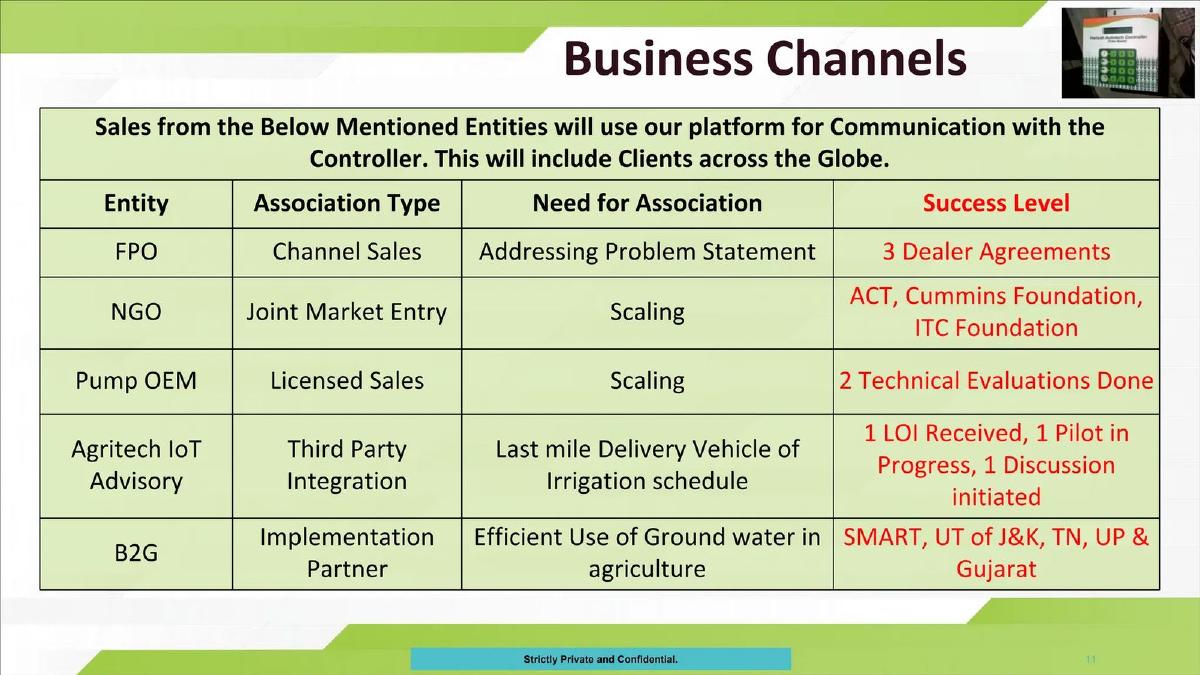
Say who sells, installs and supports the device, and what stage each channel is at. ANYbotics sells directly and names four partner types (local resellers, system integrators, industrial service providers, greenfield partners) with what each does. Intech Harness lists five channel types with a status for each, such as "3 Dealer Agreements" and "2 Technical Evaluations Done". A slide that only shows where the product could be used doesn't say how it gets sold.
Hardware go-to-market slides from real pitch decks
Each example shows the slide above its analysis and links to the full teardown. Slides that say who sells and supports the device come first. Claims are as shown on the slides; comments are ours.
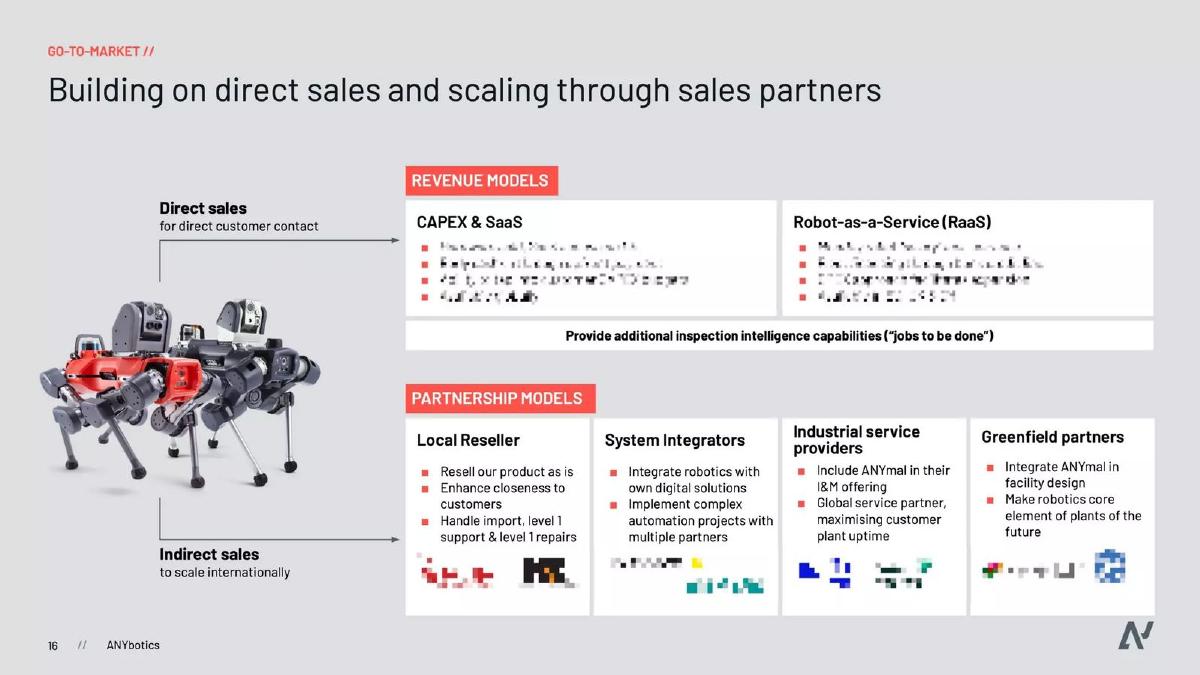
ANYbotics go to market slide — slide 16
Legged inspection robots for industrial plants.
ANYbotics deck, slide 16. Exact stored slide matched to this analysis.
Our analysis: Direct first, partners to scale, roles defined.
Evidence and limitation: It separates direct from indirect sales and says what each partner type does, including support and repairs. The revenue-model details and partner logos are blurred in the published deck, so we can't read them.
What a founder can adapt: "Direct: [N] accounts. Resellers ([region]): import, level-1 support. Integrators: [N] signed."
Supporting analysis
What the deck claims: "Go-to-Market. Building on direct sales and scaling through sales partners." "Direct sales for direct customer contact." "Indirect sales to scale internationally." Revenue models: "CAPEX & SaaS" and "Robot-as-a-Service (RaaS)". Partnership models: "Local Reseller: Resell our product as is, Enhance closeness to customers, Handle import, level 1 support & level 1 repairs." "System Integrators: Integrate robotics with own digital solutions." "Industrial service providers: Include ANYmal in their I&M offering." "Greenfield partners: Integrate ANYmal in facility design."
Presentation choice: Investors see who sells, integrates and services the robot.
When it does not fit: Partner types with no signed names.
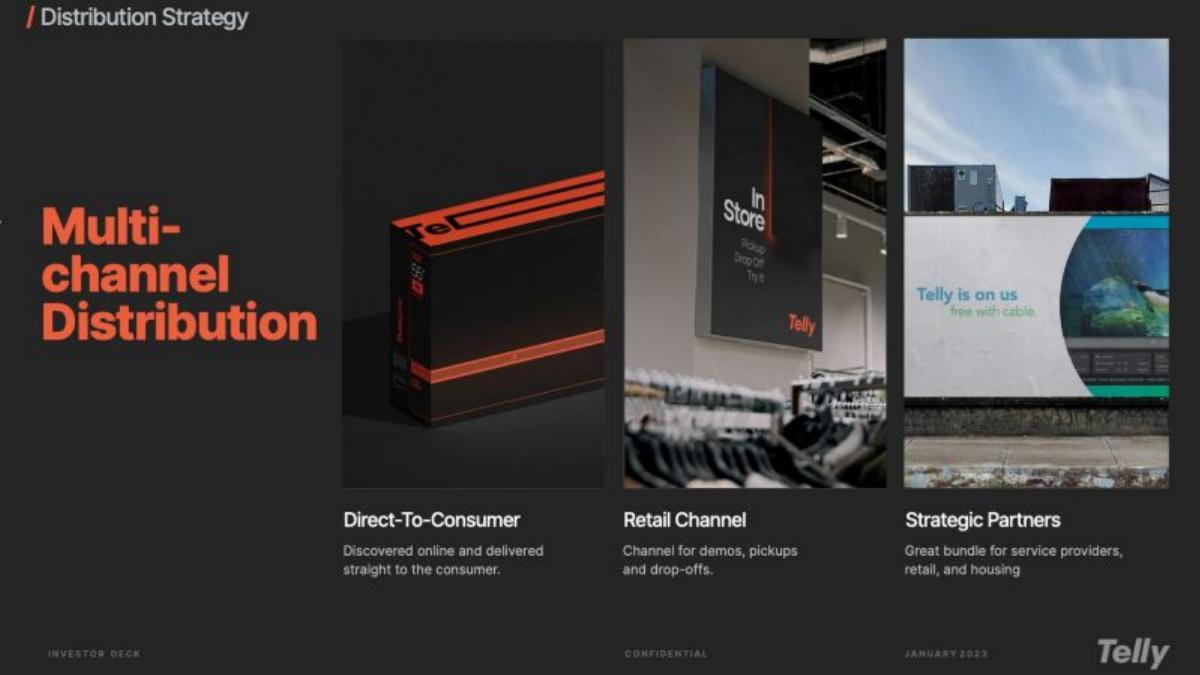
Dual-screen TV given free and funded by advertising, January 2023 deck.
Telly deck, slide 14. Exact stored slide matched to this analysis.
Our analysis: Three routes, each with a role.
Evidence and limitation: It names three routes and gives retail a clear job: demos and pickups. It doesn't name any partner or give volumes.
What a founder can adapt: "DTC: [N] units. Retail: demos in [N] stores. Partners: [named], [status]."
Supporting analysis
What the deck claims: "Distribution Strategy. Multi-channel Distribution." "Direct-To-Consumer: Discovered online and delivered straight to the consumer." "Retail Channel: Channel for demos, pickups and drop-offs." "Strategic Partners: Great bundle for service providers, retail, and housing."
Presentation choice: Retail as a demo channel fits a device people want to see first.
When it does not fit: Partner categories with no names.
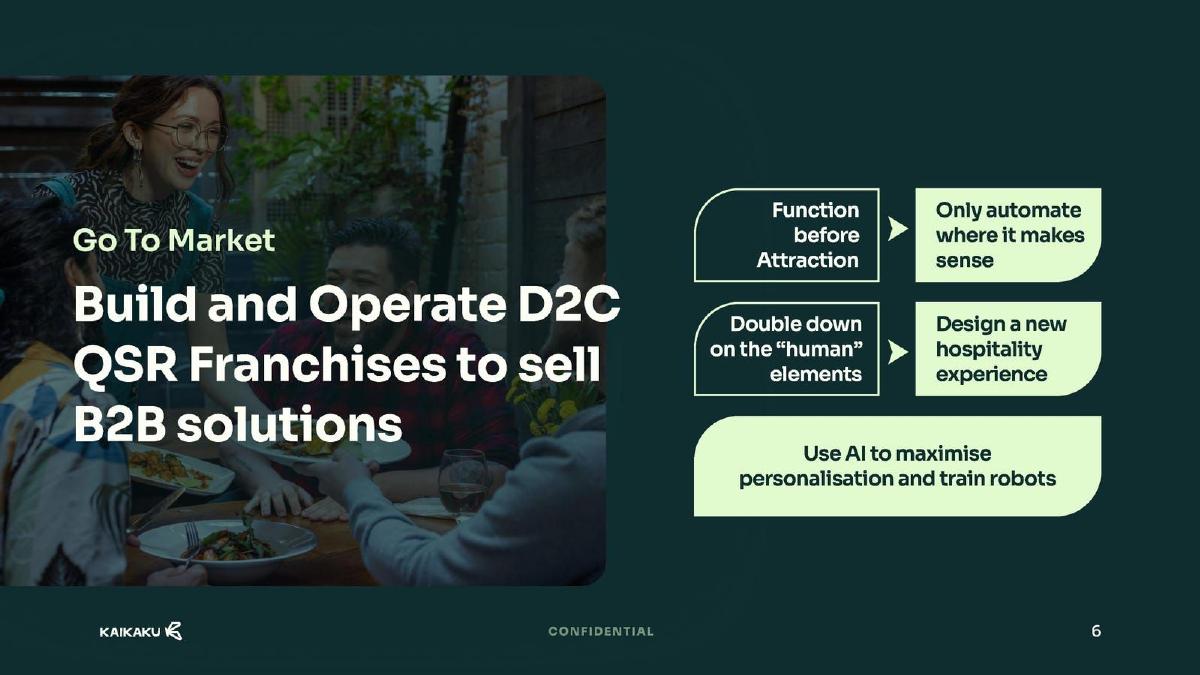
Food robotics and AI for quick-service restaurants.
Kaikaku deck, slide 7. Exact stored slide matched to this analysis.
Our analysis: Own sites first, then sell to others.
Evidence and limitation: It explains the sequence: run its own restaurants first, then sell the robots to other chains. The next page explains why it doesn't sell B2B directly yet. It doesn't say when B2B sales start or to whom.
What a founder can adapt: "Operate [N] sites by [date]; sell to [first chain type] from [date]."
Supporting analysis
What the deck claims: "Go To Market. Build and Operate D2C QSR Franchises to sell B2B solutions." "Function before Attraction → Only automate where it makes sense." "Double down on the 'human' elements → Design a new hospitality experience." "Use AI to maximise personalisation and train robots."
Presentation choice: Running the product yourself can prove it before asking chains to buy.
When it does not fit: Principles with no timeline to B2B sales.
Vertical hydroponic growing system for apartments in Chile.
Pino deck, slide 7. Exact stored slide matched to this analysis.
Our analysis: Direct sales and consumables, no channel.
Evidence and limitation: Weaker example. It names direct sales, presales and add-on consumables, but not where customers are found or who installs the system. The "$90000" price doesn't say whether it is in Chilean pesos or US dollars.
What a founder can adapt: "Presales via [channel]: [N] orders. Consumables: $[X]/month per unit."
Supporting analysis
What the deck claims: "How do we win?" "Direct sales to customers. Price $90000." "Presales at cost price." "Complementary product: Seeds, Nutrients."
Presentation choice: Presales and consumables are useful, but investors still need to know how buyers are reached.
When it does not fit: An unclear price and no channel.
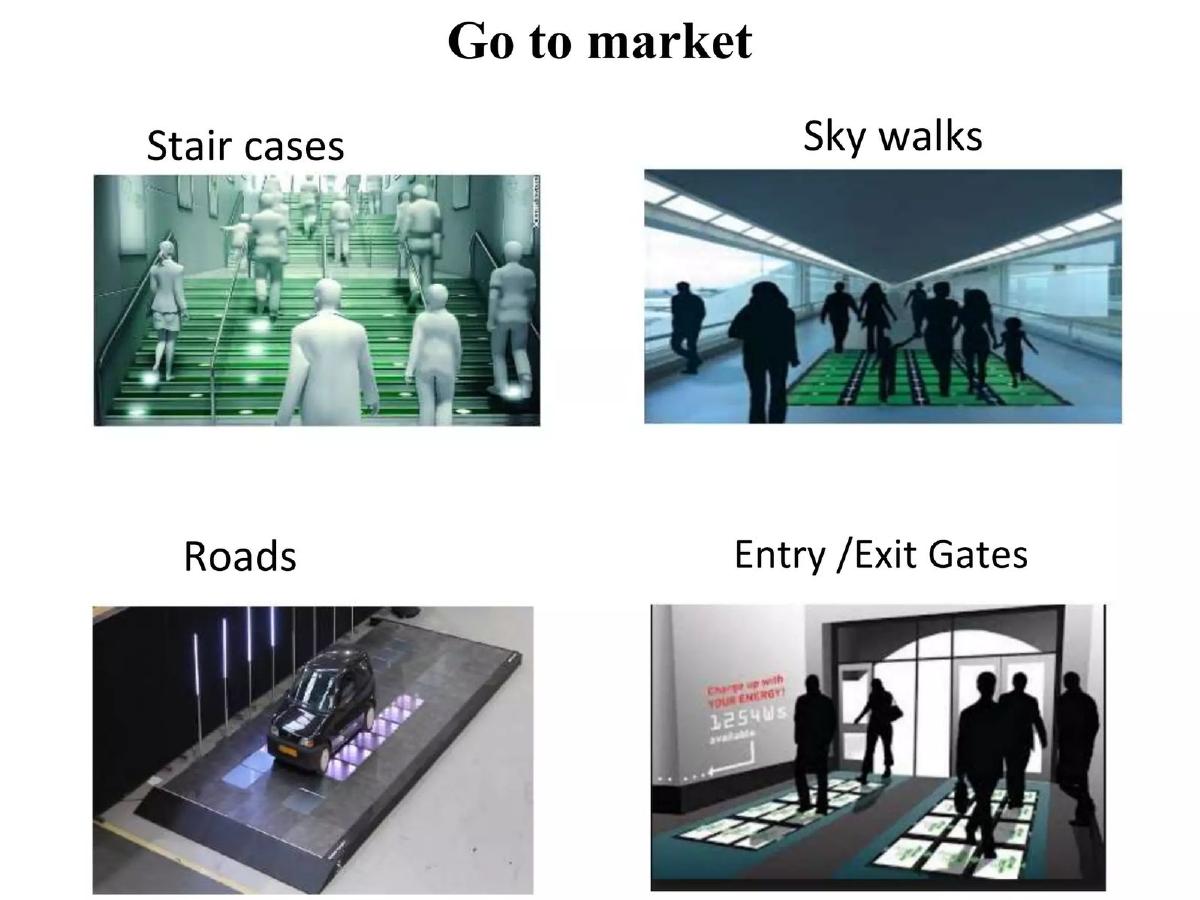
After: "First buyers: [metro operator]. Installed by [contractor]. [N] pilot sites, [M] in talks."
What improved: Our illustrative rewrite of Zero Point Energy's slide; bracketed text is a placeholder, not company fact.
What's different about hardware go-to-market
A device has to be shipped, installed and serviced, and expensive ones are often bought through a long sales process. Hardware companies usually sell the first units directly to learn, then add partners who already reach buyers and can install and support the product. Retail and direct-to-consumer work for cheaper consumer devices, often with demos. Some companies run their own sites to prove the product before selling it to others.
What investors check
Who sells the device and who installs and supports it. Whether partners are signed, evaluating or only targeted. Whether the channel fits the price. How long the sales cycle is. Whether any revenue models (purchase, subscription, leasing) change how it's sold.
How we read each slide
We quote the text on the slide images. We have not checked any partner, agreement or price. Page numbers are pages in the original deck file. All six pages were rendered from those files.
Common mistakes
Use cases instead of channels. Say who buys and who sells.
Partners with no role. Say who resells, integrates or services.
No status. Mark signed, pilot and target partners.
Ignoring support. Someone has to install and repair the device.
Diagnostic checklist
Buyer named.
Direct and partner sales separated.
Partner roles defined.
Status per channel.
Frequently asked questions
What should a hardware go-to-market slide show?
Who buys, who sells, and who installs and supports the device, with a status for each channel. ANYbotics defines four partner roles; Intech Harness gives each channel a stage.
Should hardware startups sell directly or through partners?
Many do both. ANYbotics uses direct sales for customer contact and partners to scale internationally.
How we chose these examples
Corpus: published pitch deck teardowns on StartupFundraising.com. Founder-uploaded private decks are excluded.
Selection (2026-09-26): we searched hardware, robotics and device teardowns for go-to-market, distribution, channel and sales strategy headings, scanned fourteen candidate decks around the matching pages, and kept six.
Excluded: Aeris (already featured in the main go-to-market guide), Tinker Bot and CeiR (not hardware), Ektio, ThermoNorth, Rypplzz and Oklo (matching pages were traction, text-heavy or not go-to-market plans), Plantee (deck file unavailable). Teardown text numbering differed from deck-file pages for Kaikaku, Pino and Zero Point Energy; pages were matched by eye.
Page numbers are pages in the original deck files. All six were rendered from the deck PDFs and stored with the existing slide-image workflow. All six decks were confirmed as published teardowns on 2026-09-26.
Partners, agreements and prices are quoted from the slides and not independently verified.
Review: slide images were checked on 2026-09-26 and matched to company, deck and page (editorial model review). No person has yet completed an editorial review of this page. We make no claim that any slide caused a fundraising outcome.