Telly’s 2023 pitch deck outlines a radical shift in the television industry, moving from hardware sales to a pure advertising and data play. Led by Pluto TV founder Ilya Pozin, the company proposes giving away 55-inch 4K HDR dual-screen TVs at no cost to the consumer. The primary innovation is a dedicated 'Smart Screen' below the main display that remains active even when the TV is off, serving as a hub for news, sports, and, most importantly, persistent advertising. With a team heavily recruited from Vizio, Pluto TV, and Google, Telly targets a massive U.S. market of 120 million households.…
Key takeaways
- The core product is a 55-inch 4K HDR 'Theater Display' paired with a secondary 'Smart Screen' for persistent ads and updates (Slide 7).
- Telly's business model relies on giving the hardware away 'completely free' to consumers to achieve rapid scale (Slide 5).
- The secondary screen features 'unobtrusive ads' and an 'always-on display' that functions as a smart hub even when the main TV is off (Slide 8).
- Founder and CEO Ilya Pozin brings significant credibility as the founder of Pluto TV, which was acquired by Paramount (Slide 15).
- The company identifies a 'perfect storm' in the industry: 5.8 hours of daily TV usage combined with $35+ CPMs for premium living room inventory (Slide 13).
- The hardware includes advanced sensors such as an HD camera for video calling, a motion sensor, and a microphone array for voice assistance (Slide 7).
- Telly targets a core audience of 107 million+ people, specifically focusing on high-usage demographics like ages 30-44 and 55-65 (Slide 17).
- The deck highlights that smart TV manufacturers currently make 'hardly any margin on hardware,' justifying the shift to a back-end monetization model (Slide 12).
Executive Summary: A High-Stakes Hardware Giveaway
Telly’s investor deck from January 2023 presents one of the most aggressive consumer electronics strategies in recent memory. The company, led by Pluto TV founder Ilya Pozin, aims to 'disrupt the living room' by removing the primary barrier to entry for high-end hardware: the price tag. By giving away a dual-screen 55-inch 4K TV for free, Telly intends to build a massive, captive audience for advertisers. The deck focuses heavily on the team’s pedigree and the inevitability of ad-supported models in a commodity hardware market.
Slides 1-5: The Hook and the Radical Value Proposition
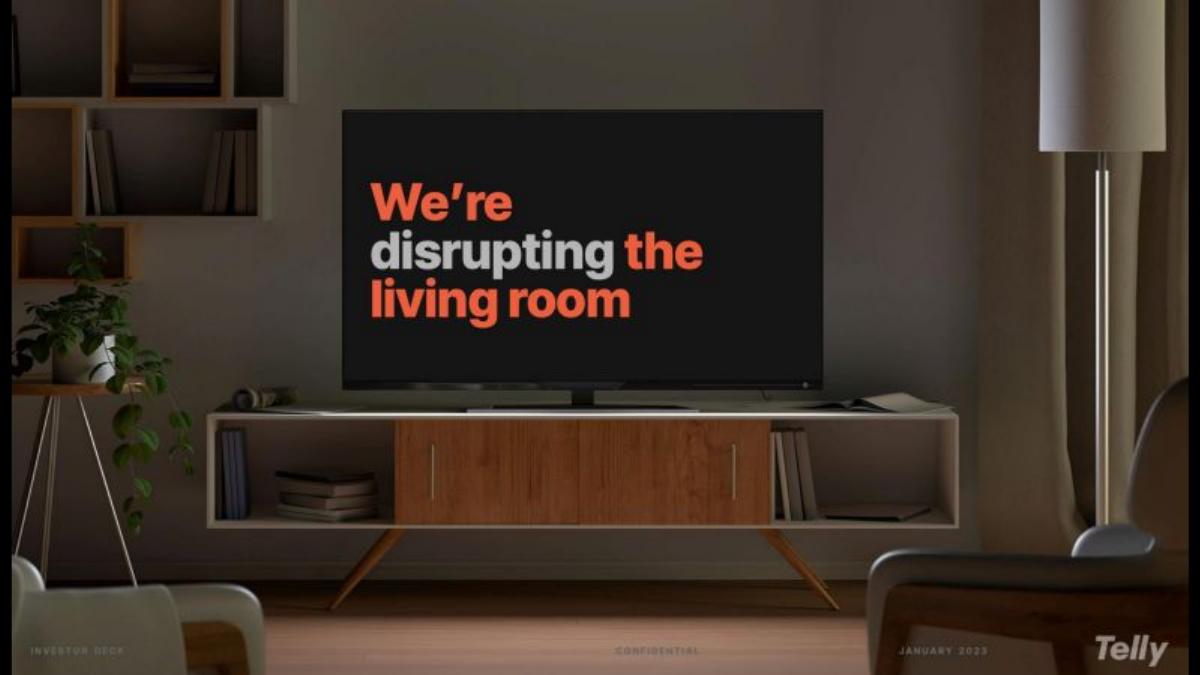
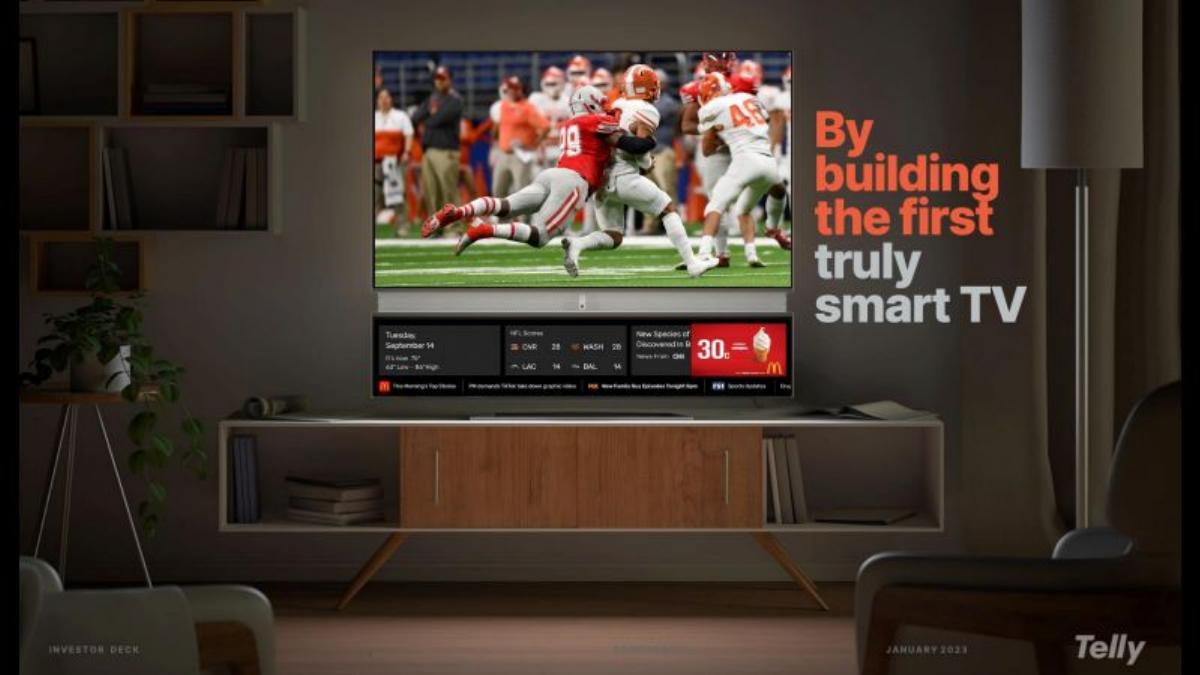
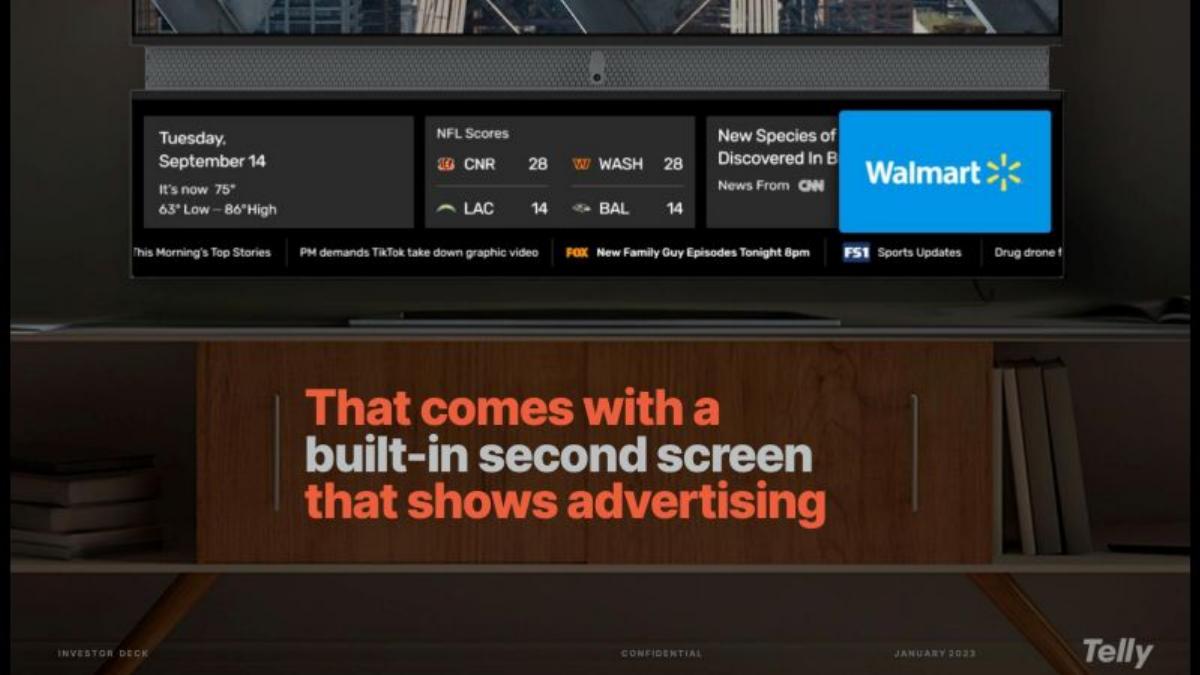
The deck opens with a minimalist cover (Slide 1) and immediately moves to its mission statement: 'We’re disrupting the living room' (Slide 2). Slide 3 introduces the physical product—the 'first truly smart TV'—which features a secondary display strip below a large main screen. Slide 4 is the pivot point for the business model, explicitly stating that the second screen 'shows advertising.' Slide 5 delivers the 'shocker' that defines the company: 'And we’re giving it away, completely free!' This sequence is designed to create immediate intrigue regarding the sustainability of such a model.
Slides 6-11: Product Capabilities and TellyOS
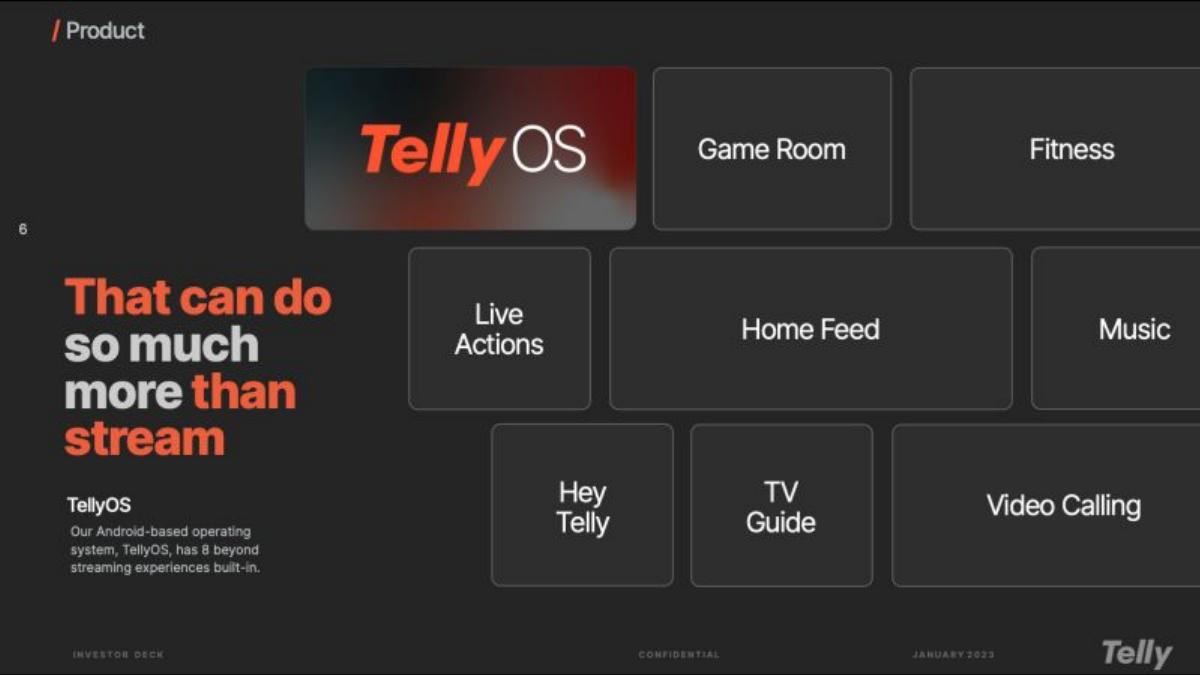
The product section (Slide 6) introduces 'TellyOS,' an Android-based operating system. It lists eight built-in experiences beyond streaming: Game Room, Fitness, Music, Video Calling, TV Guide, Hey Telly (voice), Home Feed, and Live Actions. Slide 7 provides a detailed hardware breakdown. The 'Theater Display' is a 55-inch 4K HDR screen. Below the soundbar sits the 'Smart Screen.' Key hardware features include a premium 5-driver integrated soundbar, an HD camera, a mic array, and a motion sensor for 'wake up and interactive gaming.' Slide 8 emphasizes that the Smart Display is 'always-on,' functioning as a smart hub even when the main TV is off. Slides 9, 10, and 11 demonstrate specific use cases: the 'Home Feed' (weather, stocks, sports), 'Fitness' (using the camera and sensors), and 'Video Calling' (integrated with Zoom).
Slides 12-13: The Industry Problem and the 'Perfect Storm'
Slide 12 addresses the 'Why Now?' by labeling TVs as a 'commodity.' It argues that consumers no longer care about hardware 'gimmicks' like curved screens or 8K, and that manufacturers make 'hardly any margin' on the hardware itself. Slide 13 presents the 'perfect storm' for Telly’s model: Americans spend 5.8 hours per day watching TV, and advertisers are willing to pay $35+ CPMs (Cost Per Mille) for premium living room inventory. The implication is that the value of the viewer's attention over the lifespan of the device far exceeds the cost of the hardware.
Slide 14: Distribution Strategy
Telly outlines a 'Multi-channel Distribution' plan. This includes Direct-To-Consumer (online discovery and delivery), a Retail Channel (for demos and pickups), and Strategic Partners. The 'Strategic Partners' category is particularly interesting, suggesting bundles for 'service providers, retail, and housing,' which could allow Telly to scale through B2B2C channels like apartment complexes or internet service providers.
Slide 15: The 'Proven Leaders' Team Slide
This is arguably the strongest slide in the deck. CEO Ilya Pozin’s track record with Pluto TV (acquired for $340M, now generating $1B+ in annual revenue) provides the necessary 'proof of concept' for ad-supported media. The 'Key Hires' list is a 'who's who' of the TV industry, featuring executives from Vizio (John Hwang, Eric Loes, Tarah Sinovic), Google (Sascha Prueter), CBS (Matt Katrosar), and Nielsen (Bob Ivins). The bottom of the slide lists 'Talent from more top companies' including Apple, Meta, and Roku, signaling that the company has successfully recruited from the biggest players in tech and media.
Slides 16-17: Market Size and Target Demographics
Slide 16 highlights the 'huge' advertising market, citing $326B in forecasted ad sales for 2022 and noting that less than 25% of respondents prioritize paying for ad-free plans. Slide 17 defines the 'Core Target' of 107M+ people within a Total Addressable Market (TAM) of 180M+. It specifically identifies two high-value segments: 65M+ people aged 30-44 with household incomes of $70k-$90k, and 42M+ 'TV dependent boomers' aged 55-65 with $75k incomes. Both groups are noted for high daily TV usage.
Slides 18-20: Closing and Contact
The deck concludes with a repeat of the 'Sneak Peek at the Future of Television' tagline and contact information for Ilya Pozin. There is no 'Ask' slide in this version of the deck, nor are there financial projections or a roadmap.
What Telly Does Well
Clear Value Proposition: The 'Free TV' hook is impossible to ignore and is presented early and clearly. · Team Credibility: By highlighting the Pluto TV exit and the Vizio pedigree of the engineering team, Telly mitigates the perceived risk of such a complex hardware/software undertaking. · Visualizing the 'Second Screen': The deck does a good job of showing how the ad-supported display isn't just a banner ad, but a functional utility (weather, sports, zoom) that happens to host ads. · Market Timing: The argument that hardware is a zero-margin commodity is well-supported by current industry trends.
What is Missing from the Telly Deck
Unit Economics: This is the most glaring omission. Investors need to know the 'Land Cost' of the TV versus the 'Average Revenue Per User' (ARPU). Without a projected payback period, the model looks like a bottomless pit for capital. · Data Privacy: A TV with an 'always-on' camera, microphone, and motion sensor that is given away for free in exchange for data will inevitably face privacy scrutiny. The deck does not address how they will handle consumer trust or regulatory compliance. · The 'Ask': There is no mention of how much money is being raised or how the funds will be allocated (e.g., 'X amount for first 100k units'). · Retention/Churn: There is no discussion of what happens if a user takes the free TV but never connects it to the internet, or uses a different device that obscures the second screen.
Founder's Guide: What to Copy from Telly
The 'Pedigree' Slide: If you have a team from top-tier competitors, use their logos and specific titles as Telly did on Slide 15. It builds instant authority. · The 'Perfect Storm' Slide: Combining two disparate but related stats (Usage Hours + CPMs) to create a 'Why Now' moment is a highly effective way to frame market opportunity. · Product-in-Context: Using high-quality renders of the TV in a real living room setting (Slides 2, 3, 5) helps investors visualize the product as a premium device rather than a 'cheap' giveaway. · Minimalist Messaging: Telly uses very few words per slide, letting the bold claims ('completely free!') and the product imagery do the heavy lifting.
Frequently asked questions
- How does Telly make money if the TV is free?
- Telly monetizes through a persistent secondary screen located below the main display. This 'Smart Screen' shows 'unobtrusive' ads while the user watches content and can remain on even when the main TV is powered down. By capturing 5.8 hours of daily viewing time and leveraging $35+ CPMs for living room inventory, Telly shifts the profit center from hardware margins to long-term advertising and data revenue.
- What are the technical specifications of the Telly TV?
- According to slide 7, the device features a 55-inch 4K HDR 'Theater Display.' It includes an integrated premium 5-driver soundbar, an HD camera for video calling and fitness, a microphone array for 'Hey Telly' voice control, and a motion sensor. It also comes with a 4K streaming stick and a tuner for over-the-air (OTA) channels.
- Who is behind the Telly leadership team?
- The team is led by Ilya Pozin, the founder of Pluto TV (acquired by Paramount). The executive bench is deep with industry veterans, including a Chief Product Officer from Google, and multiple 'Head of' roles filled by former Vizio, Pluto TV, CBS, and Nielsen employees. This concentration of hardware and ad-tech experience is a central pillar of the deck's credibility.
- What is the 'Smart Screen' used for besides advertising?
- The secondary screen serves as a 'Home Feed' for the household. Slide 9 and 10 show it displaying weather, sports scores, stock tickers, news headlines, and notifications. It also facilitates interactive features like video calling via Zoom and fitness tracking, where the camera and sensors turn the living room into a 'fitness studio' with data displayed on the lower screen.
- What is missing from the Telly pitch deck?
- The deck is notably silent on unit economics. It does not disclose the Bill of Materials (BOM) for the 55-inch dual-screen unit or the projected 'payback period'—how long a user must watch the TV before the ad revenue covers the cost of the hardware. It also lacks a specific 'Ask' slide detailing how much capital is being raised in this round.